Fixed Income Investment Options for NRIs in India



Non-resident Indians often look at India for rupee-denominated income, family-linked goals, property-sale proceeds, retirement planning, or portfolio diversification. Fixed income can be relevant in these situations, but the first question is not only "which product pays more?"
For NRIs, the better question is: which route is permitted, which account should be used, how will cash flows be taxed, and what happens if money has to be repatriated later?
This guide explains the main fixed income investment options for NRIs in India, including NRE and NRO fixed deposits, FCNR deposits, government securities, corporate bonds, NCDs, tax-free bonds, 54EC bonds, debt mutual funds and bond ETFs. It also explains the account, demat, tax, TDS and currency-risk checks that should come before any investment decision.
The article is written as an NRI fixed-income options guide, not as a recommendation list. The right fixed income investment option for an NRI depends on source of funds, future currency needs, tax residency, liquidity and risk tolerance.
For a broader resident-investor primer, see Equirize's guide to [fixed income investments in India](https://www.equirize.com/resources/blogs/fixed-income-investments-in-india).
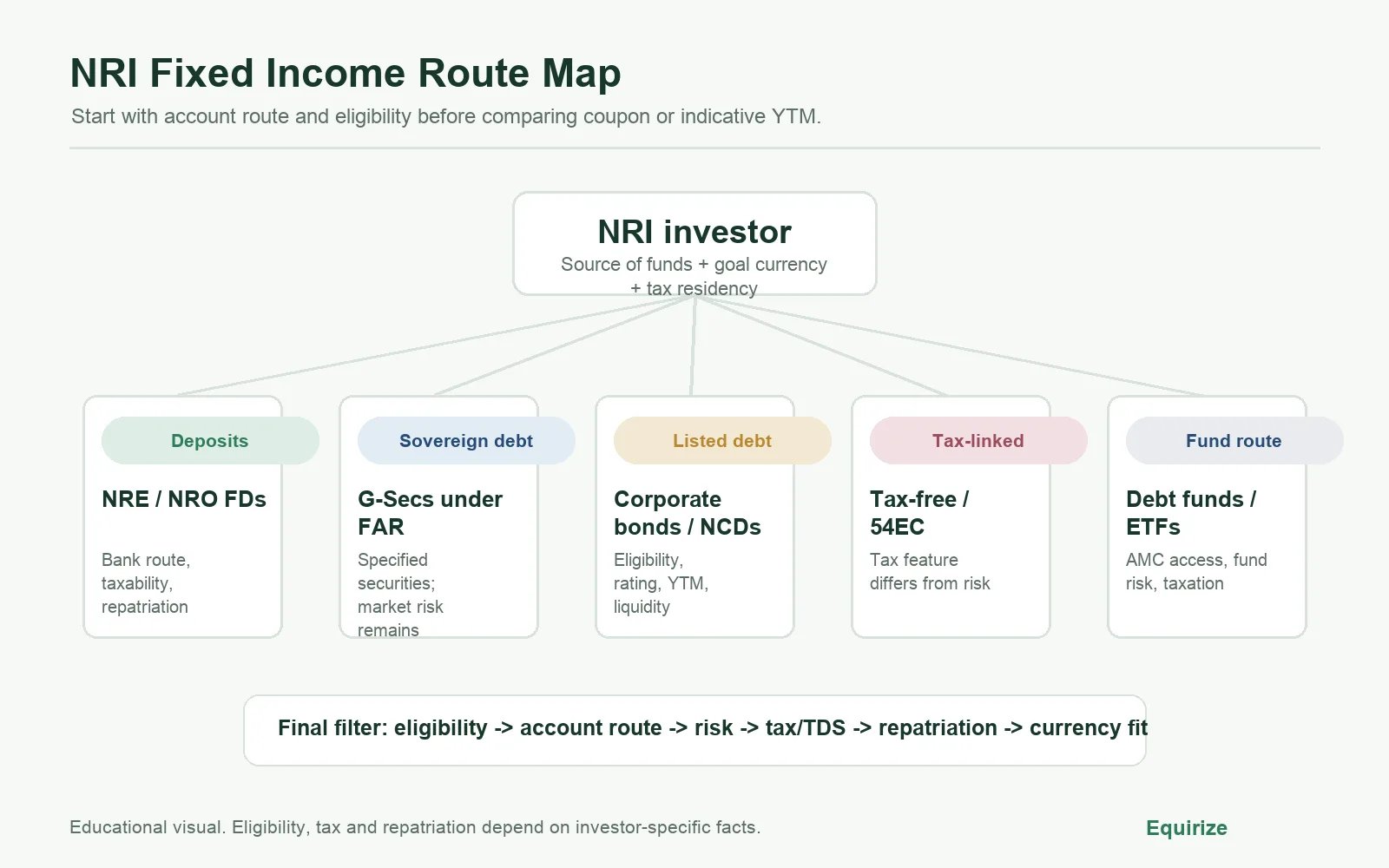
NRI Fixed Income Options: The Short Answer
NRIs may be able to access several fixed-income routes in India. The practical list includes bank deposits, eligible government securities, listed corporate bonds, non-convertible debentures, select tax-linked bonds, debt mutual funds and bond ETFs.
That is why NRI fixed income options should be compared as routes, not only as products. A product may look attractive on paper but still be unsuitable if the account, repatriation or tax treatment does not fit the investor.
But the answer is never universal. Eligibility can depend on the instrument, issuer terms, account type, KYC status, demat structure, platform support, FEMA rules and tax position.
That distinction matters because "NRI bonds" is often used loosely online. In practice, there is no single uniform product called an NRI bond. The phrase usually refers to bonds or debt instruments that an NRI may be allowed to buy under the relevant route.
Before comparing coupon rates or indicative pre-tax YTM, an NRI investor should usually check this order:
| Check | Why it matters |
| Residential status | Determines NRI-specific account, tax and reporting treatment |
| Source of funds | Foreign income and Indian income may need different account routes |
| Account type | NRE, NRO and FCNR(B) accounts have different tax and repatriation treatment |
| Instrument eligibility | Not every bond, fund or deposit is open to all NRIs |
| Demat and KYC | Listed securities generally require clean demat and KYC mapping |
| Repatriation | Cash flows may or may not be freely repatriable |
| Tax and TDS | Coupon, interest, capital gains and withholding can differ by product |
| Currency exposure | Rupee returns can change when measured in the investor's home currency |
For a practical bond-buying route map, see Equirize's guide on [how to invest in bonds in India](https://www.equirize.com/resources/blogs/investing-in-bonds-india-10000).
NRE, NRO and FCNR Deposits for NRIs
Fixed deposits remain the most familiar fixed income option for many NRIs. They are usually easier to understand than listed bonds because the deposit is issued by a bank and the payout structure is stated upfront.
Among fixed income options for NRIs, deposits are often the starting point because they force the investor to clarify source of funds first.
Even here, the account route matters.
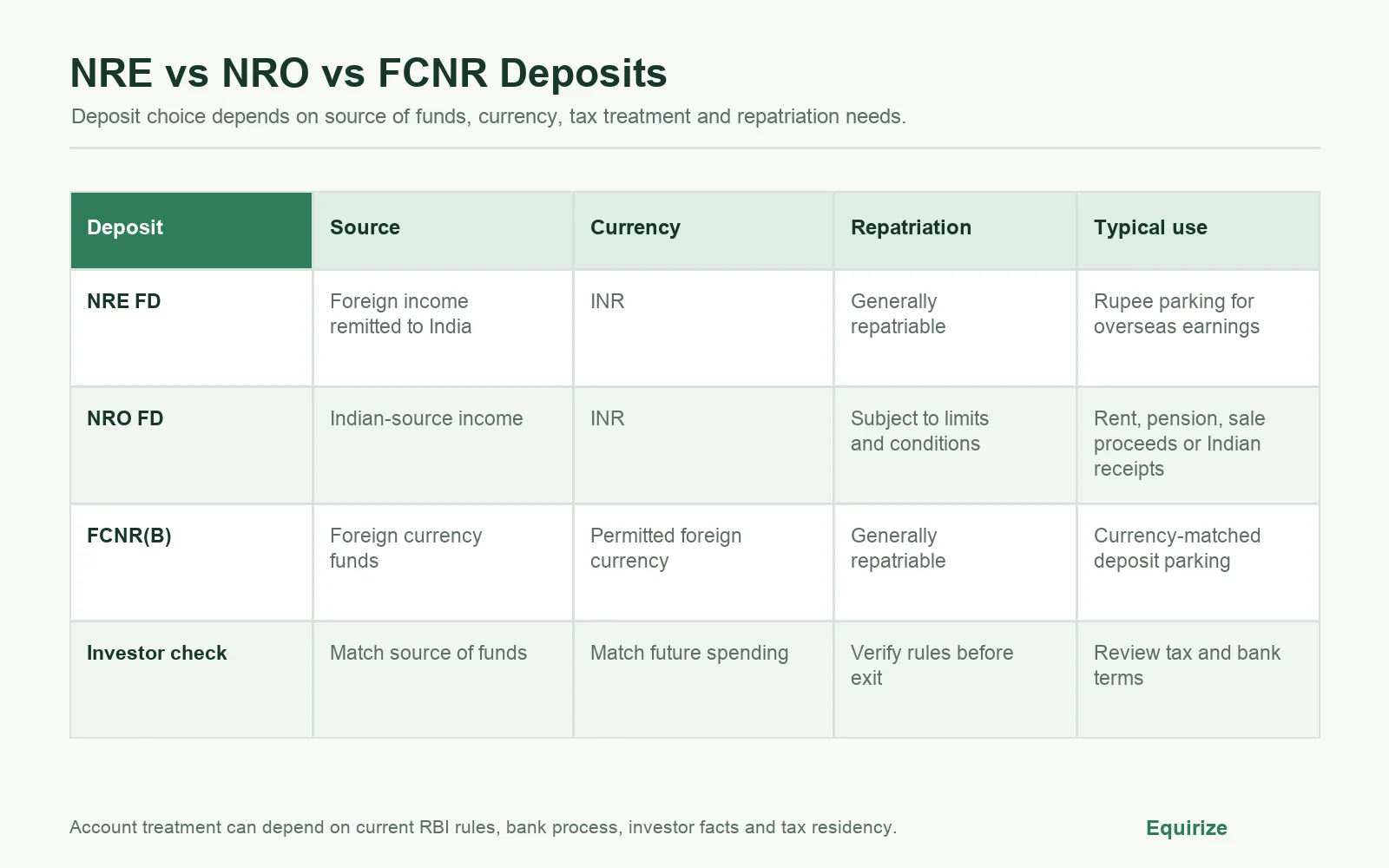
NRE Fixed Deposit for Foreign Income
An NRE fixed deposit is generally used for foreign income remitted into India. It is rupee-denominated, so the investor takes INR currency exposure. RBI's non-resident account FAQ states that NRE account income is exempt from Indian income tax, while balances are repatriable.
That does not remove currency risk. If the investor eventually spends in dollars, pounds, dirhams or another currency, the INR movement between deposit and repatriation can affect the final home-currency outcome.
NRO Fixed Deposit for Indian Income
An NRO fixed deposit is generally used for income earned in India, such as rent, pension, dividend, sale proceeds or other domestic receipts. RBI's account FAQ notes that income in NRO accounts is taxable, and NRO balances are not freely repatriable except within permitted limits and conditions.
RBI's FAQ states that balances in an NRO account of NRIs/PIOs are remittable up to USD 1 million per financial year, subject to conditions. This is one reason NRIs should not treat NRO and NRE accounts as interchangeable.
FCNR Deposit for Currency-Matched Parking
An FCNR(B) deposit is maintained in permitted foreign currency rather than INR. It can be useful when the investor wants fixed-deposit-like exposure without converting funds into rupees.
This can reduce INR currency mismatch, but it is not the same as investing in Indian rupee debt securities. The decision depends on the investor's future spending currency, time horizon, tax residency and banking relationship.
For a broader risk comparison between deposits and bonds, read Equirize's guide to bonds vs fixed deposits.
Government Bonds for NRI Investors Under FAR
Government securities, or G-Secs, are debt instruments issued by the Government of India. NRIs and other eligible non-resident investors may access specified Government of India securities through the Fully Accessible Route, or FAR.
For many NRI fixed-income portfolios, this is the government-securities route to understand before moving into issuer-specific corporate debt.
The RBI introduced FAR for non-resident investment in specified Government of India dated securities with effect from April 1, 2020. RBI states that eligible investors can invest in specified Government securities under FAR without investment ceilings.
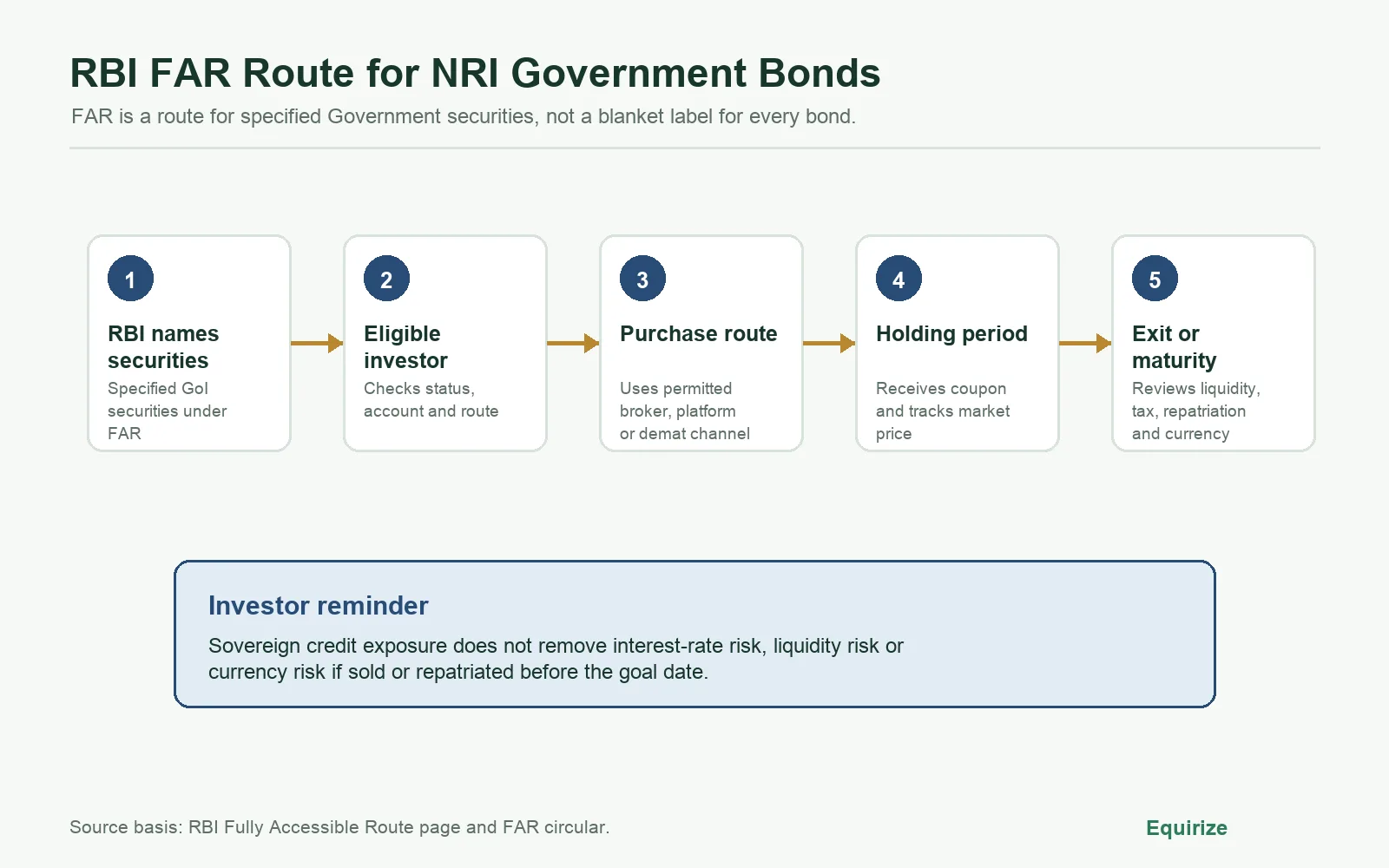
RBI Fully Accessible Route for Non-Resident Investment
FAR is a route, not a product label. It does not mean every government-related instrument is automatically available to every NRI. It applies to specified securities notified under the route.
This distinction is important because investors often group G-Secs, SDLs, PSU bonds, sovereign green bonds and RBI bonds together. Their eligibility, issuer, tax treatment and market liquidity may differ.
The official source to verify the route is RBI's Fully Accessible Route page for specified securities.
G-Secs, SDLs and Sovereign Green Bonds for NRIs
G-Secs carry sovereign credit exposure, but they still have market risk if sold before maturity. Bond prices can move with yields, liquidity and time to maturity. A long-tenure government bond may be credit-strong, but it can still show price volatility before maturity.
State Development Loans and sovereign green bonds should be checked separately for eligibility and route. Sovereign green bonds may be designated under the FAR route where notified. For more on green bond structures, see Equirize's guide to green bonds in India.
Corporate Bonds and NCD Investment for NRIs
Corporate bonds and non-convertible debentures are debt securities issued by companies, NBFCs, financial institutions and other eligible issuers. They can offer scheduled coupon payments and maturity proceeds, subject to issuer performance and instrument terms.
Within the wider set of fixed income investment options for NRIs, listed corporate bonds and NCDs require the most careful issuer-level due diligence.
NRIs may be able to invest in eligible listed corporate bonds and NCDs, but availability is not automatic. The investor must check whether the security permits NRI participation, whether the account route is supported, whether KYC and demat records are aligned, and whether the platform or broker supports that NRI transaction flow.
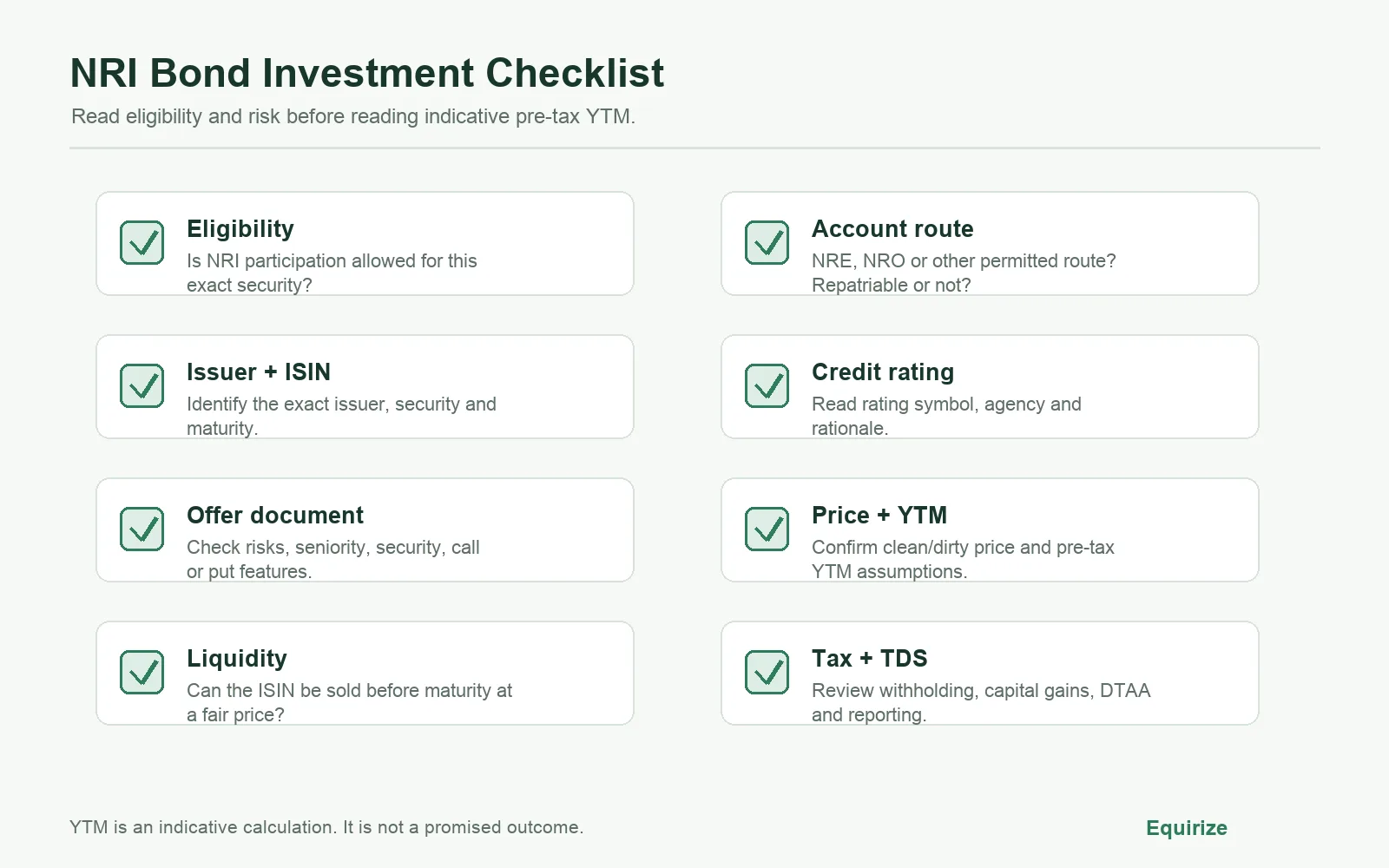
Listed Corporate Bonds for NRIs Through Demat Routes
Listed bonds are held in demat form. This means an NRI investor should first confirm that the demat account, bank account, PAN, KYC details, residential status and tax information are correctly recorded.
For listed corporate bonds, the offer document and platform details should identify the issuer, ISIN, coupon, maturity, credit rating, rating agency, security cover if any, seniority, call or put features, payment frequency and risk factors.
Equirize is a SEBI-registered Online Bond Platform Provider and stock broker in the debt segment of BSE and NSE. For platform-selection checks, read Equirize's guide on how to choose an online bond platform provider.
NRI Bond Investment Checks Before Reading YTM
Yield to maturity, or YTM, is useful, but it should not be the first filter. For an NRI investor, the sequence should be:
- Is the bond eligible for NRI participation?
- Is the investment repatriable or non-repatriable?
- Which bank and demat account route is required?
- Who is the issuer and what is the credit rating?
- What does the offer document say about risks and investor eligibility?
- Is the quoted YTM pre-tax or post-tax?
- Is the market price clean price or dirty price?
- How liquid is the ISIN if the bond must be sold before maturity?
- What TDS, tax filing, DTAA or overseas reporting applies?
YTM assumes the investor holds the bond until maturity and the issuer makes scheduled payments. It is an indicative calculation, not a promised outcome. For the mechanics, see Equirize's guide to yield to maturity.
If your account route, KYC and tax position allow bond access, Equirize can help you review listed bond information, issuer details, credit ratings, maturity dates, coupon schedules and offer documents through a SEBI-registered OBPP framework.
Tax-Free Bonds and 54EC Bonds for NRIs
Tax-linked fixed-income products are often misunderstood because the word "tax" can refer to different benefits.
They can be useful fixed income options for NRIs only when the tax feature, eligibility route and holding period all fit the investor's facts.
Tax-free bonds and 54EC bonds are not the same. Tax-free bonds are generally known for tax-exempt interest on qualifying notified bonds. 54EC bonds are used in specific capital-gains situations, generally linked to eligible long-term capital gains from land or building, subject to statutory conditions.
Tax-Free Bonds for NRI Coupon Income
Tax-free bonds may be available in the secondary market, subject to availability, investor eligibility, price, liquidity and documentation. The tax-exempt feature usually relates to qualifying interest income. If the bond is sold before maturity at a profit, capital gains may still need separate review.
NRIs should also remember that an Indian tax label may not settle the tax treatment in the country where they are tax resident. Overseas reporting can still matter.
For a deeper treatment, see Equirize's guide to tax-free bonds in India.
54EC Bonds for NRIs After Indian Property Sale
54EC bonds come up frequently when an NRI sells property in India. The online answers around NRI eligibility are not always consistent, so this should not be treated casually.
An NRI should check issuer terms, FEMA position, account route, sale consideration trail, TDS on property sale, six-month investment timing, the ₹50 lakh statutory cap where applicable, lock-in rules, and Indian return-filing requirements with a qualified tax advisor.
Equirize's dedicated guide on 54EC bonds after property sale goes deeper into that instrument.
Debt Mutual Funds and Bond ETFs for NRIs
Debt mutual funds and bond ETFs are indirect fixed-income routes. Instead of buying a specific bond, the investor holds units of a fund that invests across debt securities according to its mandate.
These NRI fixed income options shift the evaluation from a single issuer to a fund structure, which changes both convenience and risk.
For NRIs, access can depend on the asset management company's policies, the investor's country of residence, FATCA/CRS declarations, KYC status and bank account route. Some AMCs may impose restrictions for investors from certain jurisdictions.
The risk profile is also different from holding a direct bond. A direct bond has issuer-specific credit risk and a stated maturity. A debt fund or bond ETF has portfolio risk, expense ratio, mark-to-market movement, fund-manager decisions, taxation and redemption rules.
For the direct-versus-fund comparison, read Equirize's guide to debt mutual funds vs direct bonds.
NRI Demat Account, Repatriation and KYC Checklist
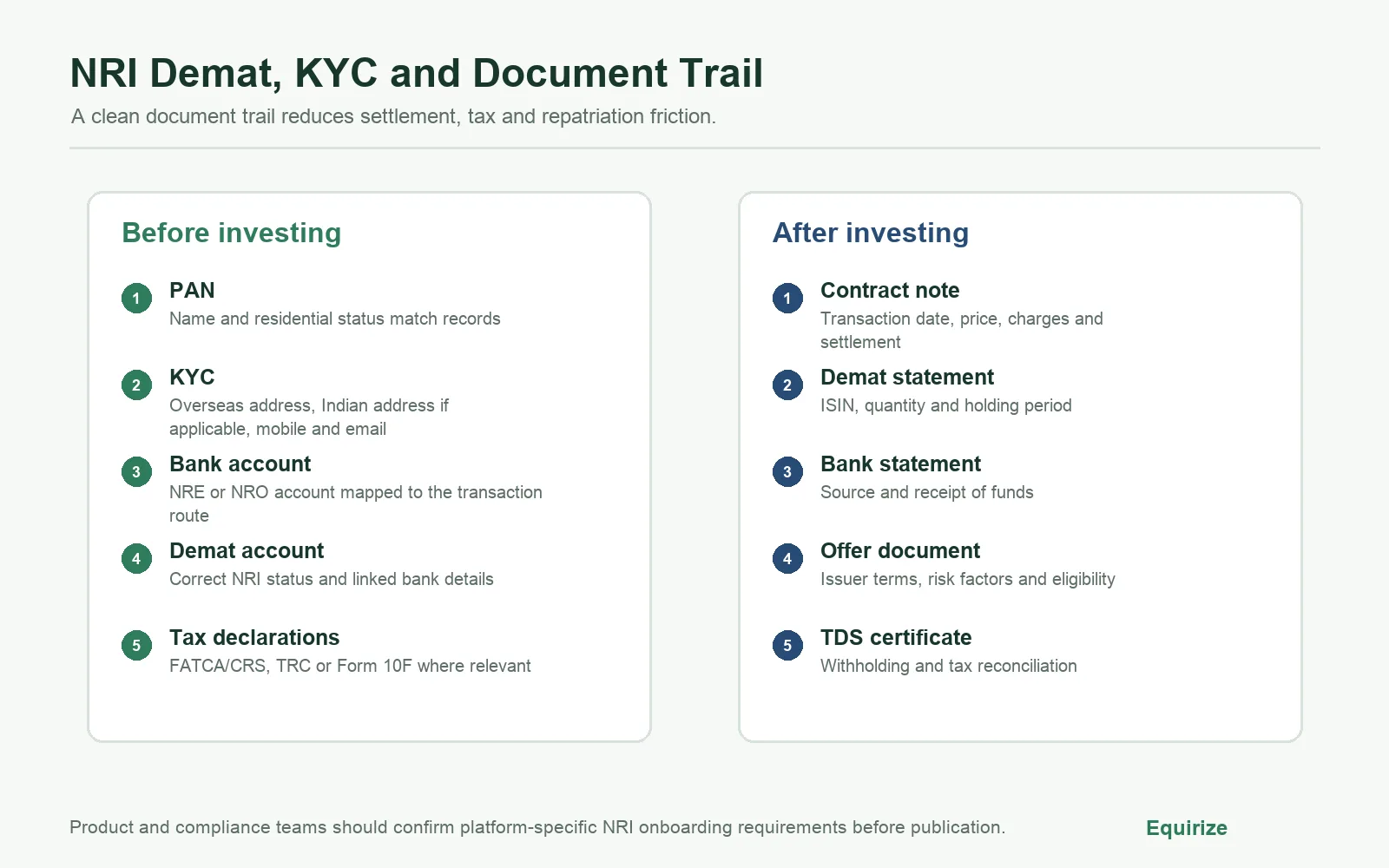
The operational layer can decide whether a fixed-income investment is even possible. NRIs should complete this before comparing instruments too closely.
For fixed income investments for NRIs in India, paperwork is not a side issue. It decides whether coupon credits, redemption proceeds, tax certificates and repatriation records remain easy to trace.
NRE vs NRO Account for Investment Routing
NRE and NRO accounts serve different purposes. NRE accounts generally receive foreign income remitted to India. NRO accounts generally handle Indian-source income. RBI's account FAQ also distinguishes repatriability and taxability across non-resident accounts.
This affects more than paperwork. It can affect whether proceeds are repatriable, what tax is withheld, how bank statements map to demat transactions, and whether the investor can move funds overseas later.
PAN, KYC and Demat Account for NRI Bond Access
For listed securities, NRIs should generally ensure that PAN, KYC, residential status, overseas address, bank account, demat account, nominee details and tax declarations are updated.
They should also keep a clean document trail:
| Record | Why to preserve it |
| Contract note | Shows transaction date, price and charges |
| Demat statement | Confirms holding and ISIN |
| Bank statement | Shows source and receipt of funds |
| Offer document | Records issuer terms and risk factors |
| Tax deduction certificate | Supports TDS reconciliation |
| Sale/redemption statement | Helps compute capital gains or income |
RBI's Accounts in India by Non-residents FAQ is a useful primary reference for account treatment.
Tax, TDS and DTAA on NRI Fixed Income
Tax should be evaluated before investing, not after the first coupon or redemption.
Post-tax comparison is especially important when reviewing fixed income options for NRIs because Indian withholding and overseas reporting may both apply.
NRI fixed-income taxation can involve multiple layers:
| Tax point | What to check |
| Interest income | Whether it is taxable in India and at what rate |
| TDS | Whether withholding applies and whether treaty relief is available |
| Capital gains | Treatment on sale before maturity or fund redemption |
| DTAA | Whether the investor can claim treaty benefit, subject to documentation |
| Foreign reporting | Whether the income or asset must be reported in the country of tax residence |
| Forms and certificates | Whether TRC, Form 10F, TDS certificates or other documents are required |
Resident tax-saving forms should not be assumed to apply to NRIs. For example, Equirize's Form 121 and bond interest TDS guide specifically notes that NRIs should not assume they can use resident-investor forms for bond interest.
Tax treatment depends on individual circumstances and may change. Please consult a qualified tax advisor.
Currency Risk in NRI Fixed Income Portfolios
A rupee fixed-income instrument produces rupee cash flows. That can work well if the investor has future rupee liabilities, such as family support, Indian expenses, property maintenance or eventual spending in India.
The same fixed income investment option for an NRI may look different when measured in INR and in the investor's home currency.
The same investment can look different if the investor measures outcomes in another currency. A coupon and maturity value that appear steady in INR can translate into a different home-currency result if the rupee moves during the holding period.
Currency risk is not only a market-view question. It is a matching question:
| Future use of money | Currency-fit question |
| Spending in India | Does rupee income match rupee expenses? |
| Sending money abroad | What are the repatriation and FX conversion costs? |
| Long-term overseas goal | Is INR exposure appropriate for that goal? |
| Mixed India/overseas goals | Should the fixed-income allocation be split across currencies? |
For the bond-yield side of currency movement, see Equirize's guide to rupee movement and bond yields in India.
How to Compare Fixed Income Options for NRIs
A useful comparison starts with the job of the money.
That is the most practical way to compare fixed income investment options for NRIs in India without turning the decision into a rate-shopping exercise.
| Option | What it may be used for | Main checks |
| NRE FD | Foreign income parked in INR | Currency risk, bank terms, Indian tax returns |
| NRO FD | Indian income parked domestically | Taxability, TDS, repatriation limit |
| FCNR(B) deposit | Foreign-currecy parking | Bank terms, currency, tenure |
| G-Secs under FAR | Sovereign rupee debt exposure | Specified security, duration, market price |
| Listed corporate bonds/NCDs | Issuer-specific coupon and maturity exposure | Eligibility, issuer risk, rating, liquidity, YTM, tax |
| Tax-free bonds | Coupon income with specific tax feature | Price, YTM, liquidity, sale-gain tax, eligibility |
| 54EC bonds | Eligible property-sale capital-gains planning | Issuer terms, timing, sale-gain tax, eligibility |
| Debt funds/bond ETFs | Diversified debt exposure through funds | AMC access, expense ratio, fund risk, taxattion |
The cleanest comparison is not "which option has the highest rate?" It is:
- Is the instrument open to my residential status and account route?
- Does it match the goal duration?
- Is the risk issuer-level, market-level, fund-level or bank-level?
- Can I exit if plans change?
- What happens after tax, TDS and currency movement?
- Can I repatriate the money when needed?
That framework also reduces common errors. For a broader list, see Equirize's guide to bond investing mistakes in India.
SEBI-Registered OBPP Route for NRI Bond Access
An Online Bond Platform Provider, or OBPP, facilitates access to eligible listed debt securities through an online platform. SEBI formalised the registration and regulatory framework for OBPPs through its November 14, 2022 circular.
SEBI registration improves the regulatory perimeter around online bond access. It does not mean SEBI approves, endorses or guarantees any specific security listed on a platform. The underlying bond can still carry credit risk, interest-rate risk, liquidity risk and reinvestment risk.
Equirize is a SEBI-registered Online Bond Platform Provider and stock broker in the debt segment of BSE and NSE. EquiRize Securities Private Limited carries SEBI Registration Number (Stock Broker): INZ000323730.
Investors can verify the OBPP framework through SEBI's registration and regulatory framework for Online Bond Platform Providers and SEBI's list of registered OBPPs.
For investor protection context, read Equirize's guide to SEBI rules for bond investors in India.