SEBI Rules for Bond Investors in India: Protections, Safeguards and Limits


SEBI rules for bond investors in India are designed to make listed bond access more transparent, supervised and process-driven. They help investors understand what they are buying, where the transaction is routed, how settlement takes place, and where complaints can be escalated.
They do not, however, make a bond risk-free.
This distinction matters. A SEBI-registered Online Bond Platform Provider, or OBPP, works within a defined regulatory perimeter. It must follow rules on registration, disclosures, order routing, settlement, transaction records, advertisements and grievance redressal. But the bond itself still carries issuer credit risk, interest-rate risk, liquidity risk, tax risk and the possibility of delay or default in payment.
This guide explains the main safeguards under SEBI's OBPP framework, what investors should verify before placing a bond order, and where the limits of regulatory protection begin.
For readers searching for SEBI bond investor rules, the useful frame is simple: the rules improve the market process around listed bonds. They do not replace credit analysis, tax review or personal suitability.
Why SEBI Bond Investor Rules Matter on Online Bond Platforms
For many years, Indian bond investing was easier for institutions than for individuals. Retail investors often faced fragmented information, higher minimum ticket sizes, offline execution, and limited visibility into pricing and documentation.
Online bond platforms changed access. Investors could browse listed corporate bonds, NCDs and other fixed-income instruments from a screen. That convenience created a new problem: if a platform looks polished, investors may assume the whole transaction is equally supervised.
SEBI's OBPP framework was introduced to bring online bond distribution into a clearer market structure. The rules aim to ensure that platforms operate through recognised stock-market infrastructure, show standardised information, route eligible orders through exchange mechanisms, and maintain defined grievance processes.
For investors comparing SEBI-registered online bond platforms, the real question is not only "Is this platform convenient?" It is also: what SEBI protections for bond investors sit behind the interface?
What the SEBI OBPP Framework Covers for Listed Bonds
An OBPP is an Online Bond Platform Provider. In simple terms, it is a platform that facilitates access to listed debt securities and certain permitted fixed-income products through an online interface.
Under SEBI's framework, an entity operating as an OBPP must be registered as a stock broker in the debt segment of recognised stock exchange or exchanges. It must also comply with operating requirements covering technology, KYC, disclosures, order routing, receipts, risk management, advertising and grievance redressal. These are the core rules for bond investors to understand before relying on any digital bond journey.
For investors, this creates a defined perimeter. You are not simply dealing with an unverified website claiming to sell bonds. You are expected to transact through an entity that is visible in the recognised regulatory and exchange ecosystem.
Equirize is a SEBI-registered Online Bond Platform Provider (OBPP) and stock broker in the debt segment of BSE and NSE. EquiRize Securities Private Limited carries SEBI Registration Number (Stock Broker): INZ000323730.
Registration with SEBI as an Online Bond Platform Provider does not constitute SEBI's approval, endorsement, or guarantee of any specific security listed on the platform. Investments are subject to market risks. Please read the offer document and risk factors carefully before subscribing.
SEBI-Registered Bond Platforms and Debt-Segment Stockbroker Status
A key safeguard is registration. SEBI's OBPP framework requires an online bond platform provider to operate as a registered stock broker in the debt segment. This matters because the platform is then subject to stockbroker-related conduct, reporting, supervision and grievance norms. In practical terms, SEBI bond investor safeguards start with knowing who the regulated entity is.
Investors should verify the platform's legal entity name, SEBI registration number, and exchange membership details. Brand names can be easier to remember, but the legal entity and registration number are what you should match against official records.
Listed Debt Securities, Public Issues and Permitted Product Boundaries
SEBI's rules also define what can be offered on an online bond platform. The framework originally focused on listed debt securities and debt securities proposed to be listed through public issues. Later circulars expanded and clarified the permitted product perimeter, including listed municipal debt securities, listed securitised debt instruments, Government Securities, State Development Loans, Treasury Bills, listed Sovereign Gold Bonds, and other products or services regulated by financial-sector regulators. This product boundary is one of the least discussed SEBI protections for bond investors.
The principle is important: an OBPP should not blur regulated listed bonds with unregulated lookalike products. If a platform shows different tabs or linked products regulated by another financial-sector regulator, the investor should see clear regulator-specific framing.
OBPP Investor Protection: The Safeguards Built Into the Bond Journey
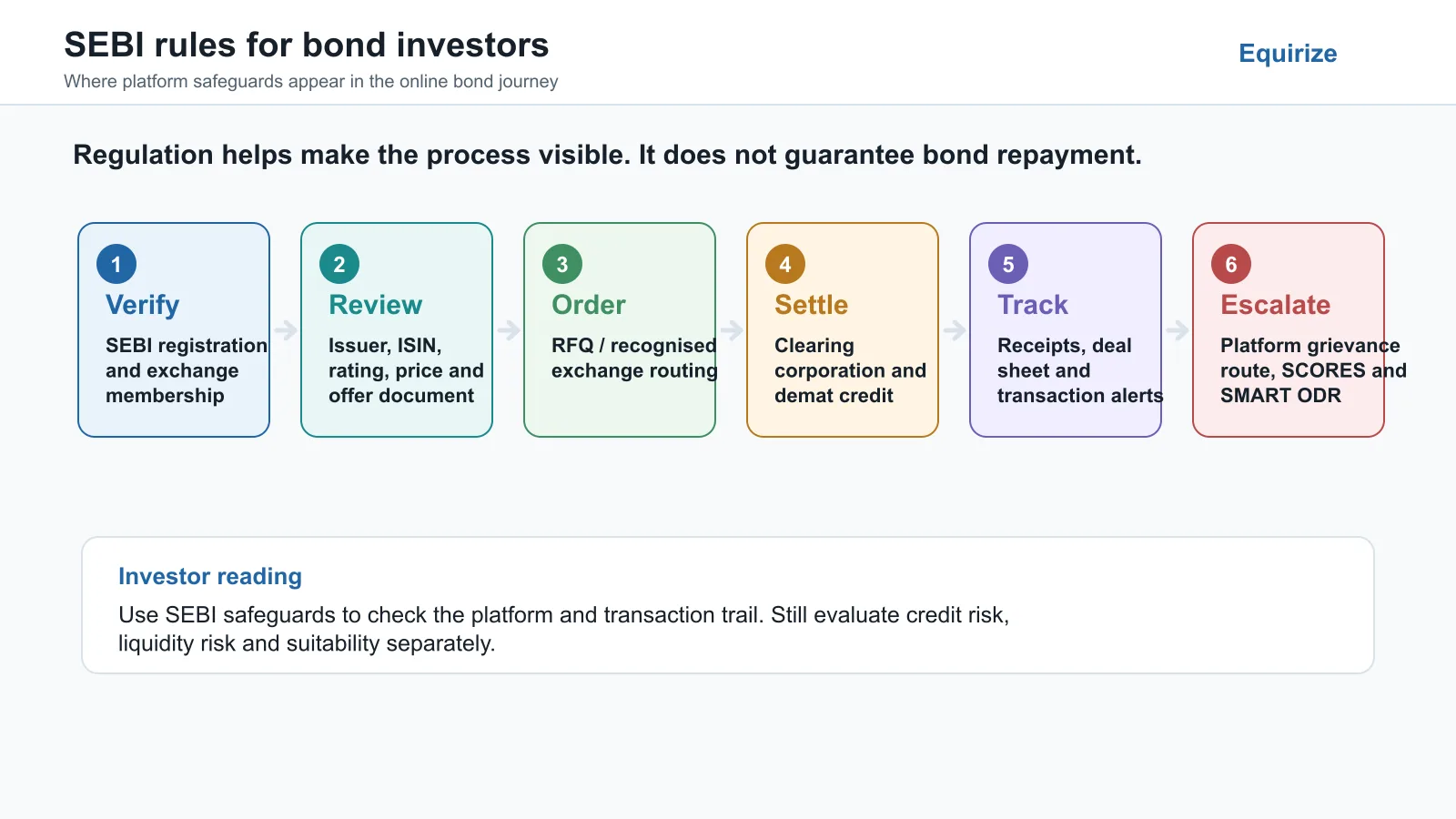
OBPP investor protection is best understood as a journey, not one single rule. The safeguard starts before the order and continues through settlement and post-transaction records.
| Stage | SEBI-linked safeguard | Investor takeaway |
| Platform selection | OBPP registration and debt-segment stockbroker status | Check the legal entity and registration number |
| Bond discovery | Minimum disclosure requirements | Compare ISIN, issuer, rating, price, coupon, maturity and documents |
| Order placement | Exchange/RFQ routing for listed debt securities | The order should move through recognised market infrastructure |
| Execution | Order receipt and deal sheet | Save transaction evidence and settlement details |
| Settlement | Clearing-corporation and demat-linked process | Verify final bond credit in your demat account |
| Post-investment | Alerts and grievance redressal | Track updates and escalate through the defined route if needed |
The point is not that every investment outcome becomes predictable. The point is that the process becomes more visible and auditable.
RFQ Platform for Bonds and Exchange-Routed Orders
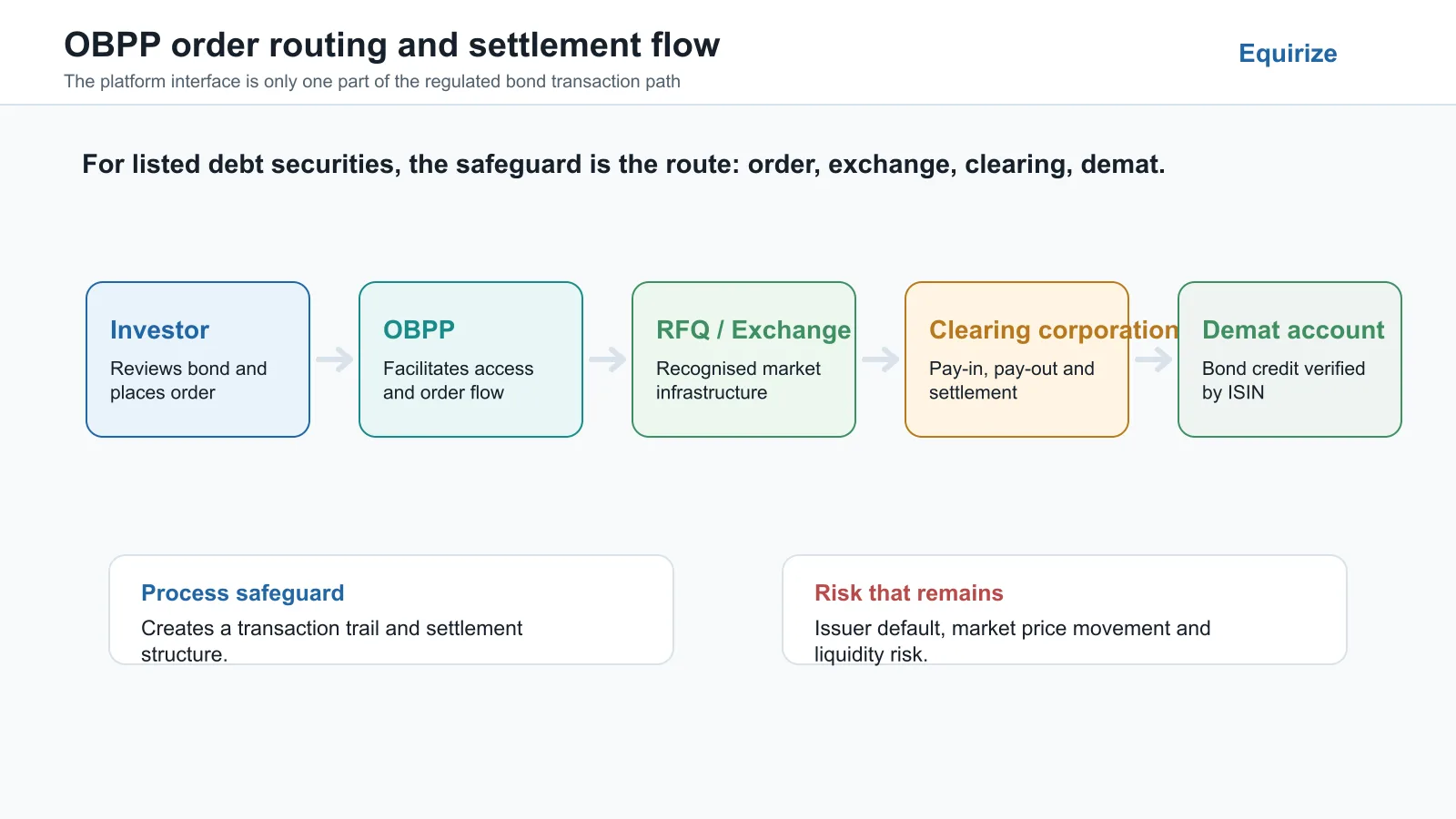
For listed debt securities placed on an OBPP, SEBI's framework requires orders to be routed through the Request for Quote, or RFQ, platform of recognised stock exchanges and settled through the respective clearing corporations.
This is one of the most meaningful bond platform safeguards. It reduces dependence on opaque bilateral execution and brings the transaction closer to recognised market infrastructure.
If you are new to the execution sequence, Equirize's guide on the bond settlement process from order to demat credit explains the post-order journey in more detail.
Clearing Corporation Settlement and Demat Credit
Settlement is the point at which money and securities move. In regulated bond-market infrastructure, clearing corporations and depositories help create a more structured process than informal transfer arrangements.
For investors, the practical endpoint is demat credit. A platform order screen is useful, but the investor should still verify the holding in the demat account or depository statement using the ISIN, quantity and security name.
This is especially important because an OBPP is a facilitator, not the custodian of the bond in the economic sense. Your demat account record is the stronger ownership check.
Bond Deal Sheet, Order Receipt and Transaction Alerts
SEBI's OBPP framework requires investor-facing transaction records. On order placement, the investor should receive an electronic order receipt. After execution, the investor should receive a deal sheet containing relevant transaction information such as order timing, settlement timing, quantity, amount and counterparty details where applicable.
Do not treat these as routine emails to ignore. Save them.
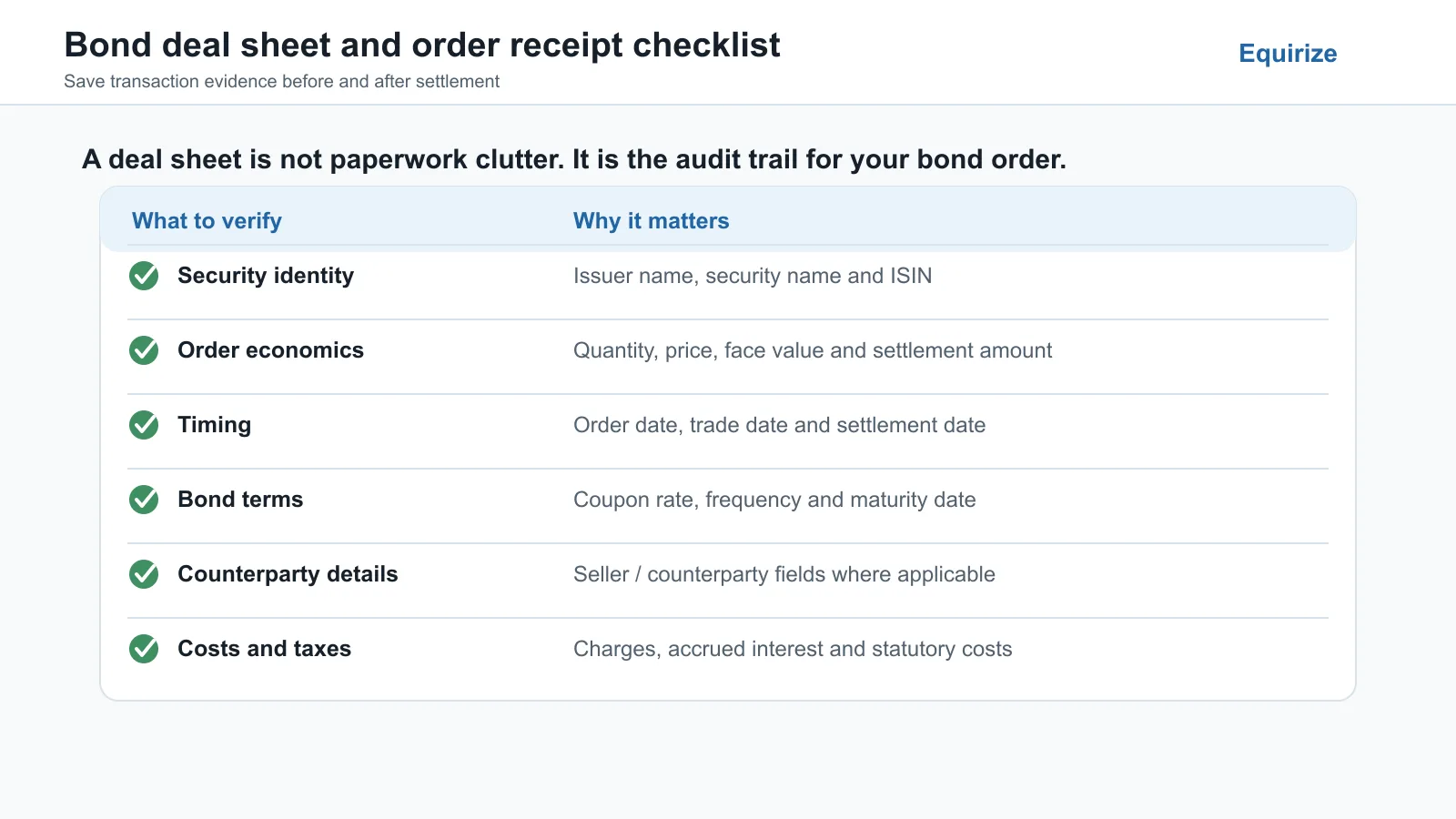
At minimum, compare:
- Security name and ISIN
- Quantity and face value
- Clean price, dirty price and settlement amount
- Trade date and settlement date
- Coupon rate and maturity date
- Counterparty or seller details where shown
- Charges, taxes or other cost fields where applicable
If any detail looks inconsistent with the order you intended to place, raise it promptly with the platform.
Bond Disclosure Checklist Required Under SEBI Rules
SEBI's minimum disclosure requirements are one of the most useful parts of the framework for investors. They turn a bond listing from a marketing surface into a due-diligence document.
A regulated platform should show enough information for an investor to identify the exact security, understand its core terms, and access the formal documents.
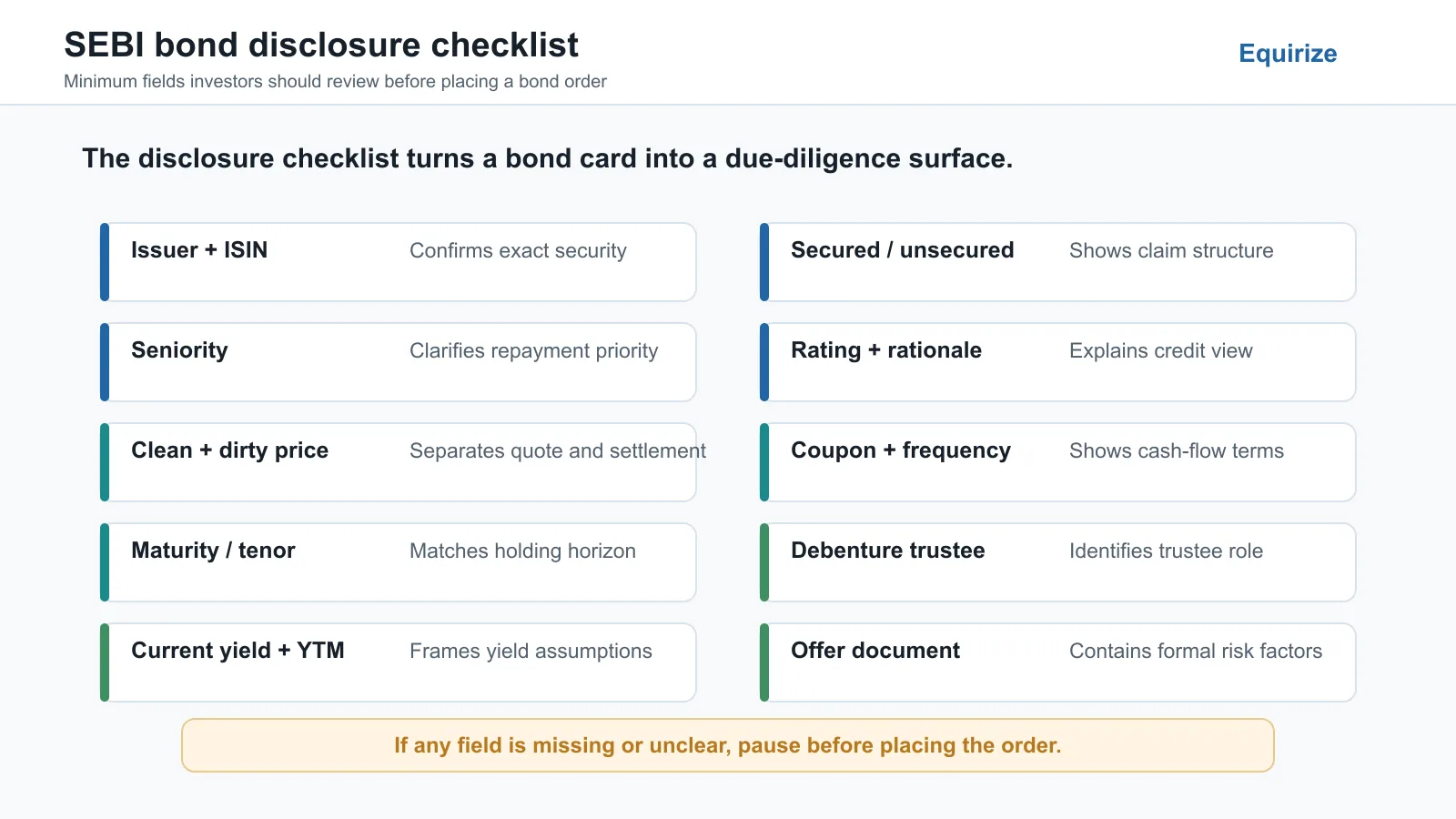
ISIN, Issuer Name, Rating and Offer Document Checks
Start with identity.
The issuer name, security name and ISIN help confirm the exact bond being reviewed. This matters because the same issuer may have multiple bonds with different coupons, maturities, seniority, security cover or payment structures.
Next, review the rating. Do not stop at the rating symbol. Check the rating agency, date of rating, and latest rating rationale where available. Rating rationales often explain leverage, business risk, liquidity position, sector exposure and recent rating actions.
Then read the offer document or prospectus. The offer document is where the formal terms and risk factors sit. It may not be light reading, but for a direct bond investor it is part of the instrument, not a footnote.
Clean Price, Dirty Price, Coupon and Yield to Maturity Checks
Bond pricing has its own vocabulary. SEBI's disclosure list includes clean price, dirty price, coupon and yield fields because investors need more than a headline return number.
Clean price generally excludes accrued interest. Dirty price includes accrued interest and is closer to what the buyer actually pays in settlement. Coupon tells you the stated interest rate on face value. Yield to maturity, or YTM, is an indicative annualised measure based on price, coupon, redemption value and time to maturity.
YTM is not a guaranteed return. It generally assumes the bond is held until maturity and that scheduled payments happen as expected. If the bond is sold before maturity, or if the issuer delays or defaults on payment, the actual return can differ.
For a deeper cost-aware reading, use Equirize's guide to bond platform fees, spreads and yield checks. For risk compensation, also see the explainer on credit spread in bonds.
Bond Platform Safeguards vs Bond Investment Risks
The most common investor misunderstanding is to treat platform regulation as investment protection. They are related, but not the same.
SEBI rules can improve the quality of the marketplace. They can require disclosures, regulate platform conduct, route transactions through exchange-linked mechanisms, and provide a grievance path. They cannot make an issuer financially stronger. They cannot make an illiquid bond easy to sell. They cannot guarantee that market rates will move in your favour. This is the central limit of bond investor rules under SEBI.
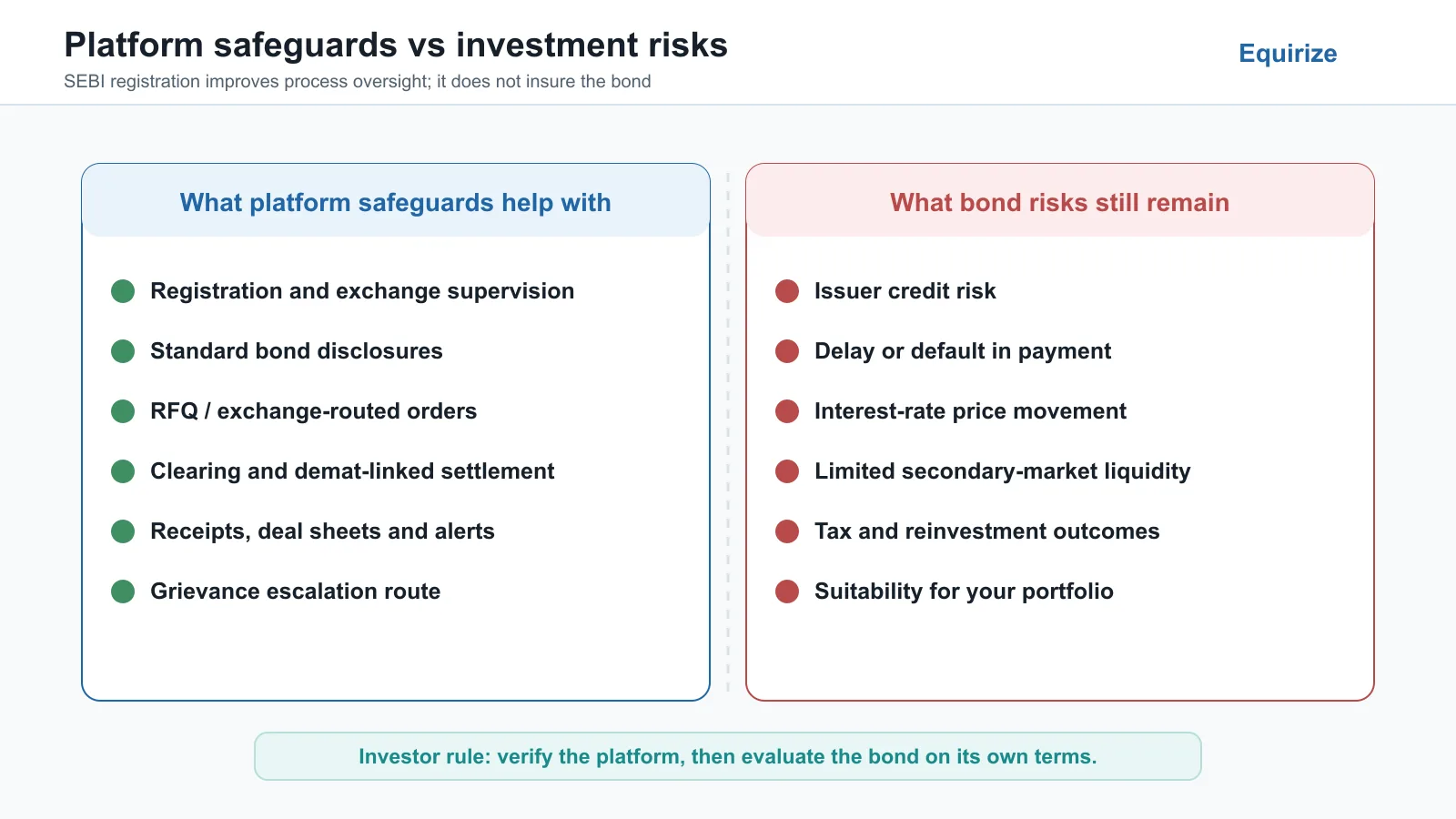
| Safeguard area | What it helps with | What it does not solve |
| OBPP registration | Platform accountability and supervision | Issuer repayment ability |
| Standard disclosures | Better pre-order information | Whether the bond is suitable for you |
| RFQ/exchange routing | More structured execution | Future price movement |
| Clearing/demat process | Settlement visibility and ownership record | Coupon delay or default |
| Grievance route | Complaint escalation | Guaranteed recovery or compensation |
| Advertising code | Less misleading communication | Market and credit risk |
Credit Risk, Interest-Rate Risk and Liquidity Risk Still Remain
Credit risk is the risk that the issuer is unable to meet coupon or principal obligations on time. A credit rating can help you assess this risk, but it is not a guarantee.
Interest-rate risk is the risk that bond prices fall when market yields rise. This matters most if you may sell before maturity. A bond held to maturity may still face issuer risk, but interim price movement becomes more relevant when liquidity is needed early.
Liquidity risk is the risk that you may not find a buyer at the price or time you prefer. Listed does not always mean actively traded. Before assuming you can exit easily, check secondary-market depth, historical trading activity and your own ability to hold until maturity. Equirize's guide on how to sell bonds before maturity in India covers this risk in detail.
What SEBI Registration Does Not Mean for Bond Investors
SEBI registration does not mean:
- SEBI has approved a specific bond.
- SEBI guarantees coupon or principal payment.
- The bond is insured.
- The platform is providing personalised investment advice.
- The displayed YTM is assured.
- Liquidity will always be available.
- A complaint will necessarily result in recovery.
The safer reading is this: a SEBI-registered OBPP must operate within a supervised framework, but the investor still has to evaluate the bond.
How to Verify a SEBI-Registered OBPP Before Investing
Before using an online bond platform, take a few minutes to verify its status. Many SEBI bond investor safeguards only become useful if you first confirm that the platform is actually within the registered OBPP perimeter.
- Check the platform's legal entity name and SEBI registration number in its footer, disclosures or regulatory page.
- Visit SEBI's page for the list of OBPPs registered with NSE and BSE.
- Open the relevant NSE or BSE list and match the platform's legal entity name.
- Confirm the INZ registration number and exchange membership details where available.
- Be cautious if a platform uses a similar-sounding brand name but does not show a clear legal entity, registration number or exchange linkage.
For Equirize, the relevant legal entity is EquiRize Securities Private Limited, and the SEBI Registration Number (Stock Broker) is INZ000323730.
This verification step is especially important because SEBI has publicly cautioned investors against dealing with unregistered online bond platforms. The check is simple, but it can prevent a large category of avoidable process risk.
Bond Investor Grievance Redressal: Platform, SCORES and SMART ODR
If something goes wrong in the transaction journey, start with the intermediary or platform. Keep the order receipt, deal sheet, emails, screenshots, bank reference numbers and demat statement ready. A complaint without transaction evidence is harder to resolve.
If the response is not satisfactory, investors can use the regulatory grievance and dispute-resolution routes available for securities-market participants, including SCORES and SMART ODR where applicable.
The basic escalation discipline is:
- Raise the issue with the platform or intermediary.
- Preserve all transaction evidence and responses.
- Escalate through SEBI's complaint or dispute-resolution mechanism if the issue remains unresolved.
- Track timelines and keep communication factual.
SMART ODR for Bond Investors After Intermediary Escalation
SMART ODR is SEBI's online dispute-resolution route for securities-market disputes. SEBI's investor materials note that investors should first take up the complaint with the intermediary before using SMART ODR.
ODR is useful because it creates a digital process for conciliation and, where required, arbitration. But it should not be treated as a guarantee of a particular outcome. It is a structured route for dispute resolution, not insurance against investment losses.
Pre-Investment Safety Checklist Under SEBI Bond Investor Rules
Before placing a bond order, use this checklist:
- Is the platform a SEBI-registered OBPP or operating through authorised debt-segment infrastructure?
- Does the legal entity name match the SEBI/NSE/BSE record?
- Is the bond a listed debt security or otherwise within the permitted product perimeter?
- Can you see the issuer name, security name and ISIN?
- Is the rating shown with rating agency, date and rationale?
- Have you read the offer document and risk factors?
- Do you understand whether the bond is secured or unsecured, senior or non-senior?
- Have you checked coupon frequency, maturity date, clean price, dirty price and settlement amount?
- Is YTM clearly understood as indicative and not guaranteed?
- Can you hold until maturity if secondary-market liquidity is limited?
- Have you checked issuer concentration across your portfolio?
- Do you know the grievance route if the transaction record, settlement or demat credit has an issue?
After execution, save the order receipt and deal sheet. After settlement, verify the demat credit. During the holding period, track issuer updates, rating actions, coupon dates and tax records. That habit turns SEBI bond investor rules into a working checklist rather than a regulatory footnote.
Equirize facilitates access to listed bonds and helps investors compare key terms such as issuer, ISIN, rating, maturity, coupon and indicative yield. Investors can explore listed bonds on Equirize after reviewing the relevant documents and risk factors.
The better question is not "Does SEBI make this bond safe?" It is: "Does the regulatory framework give me enough transparency to make a more informed decision, and have I still evaluated the bond risk on its own terms?"