Bond Platform Fees: Spread, Yield and Price Explained


Bond Platform Fees: The Quick Investor View
Bond platform fees are not always visible as one neat line item. Depending on the platform, bond, and transaction route, cost may show up as an explicit platform charge, brokerage, statutory charge, depository participant charge, or as a spread embedded in the price at which the bond is offered.
That is why serious bond investors should read three numbers together:
- The all-in purchase price
- The indicative pre-tax yield to maturity (YTM)
- The final settlement amount
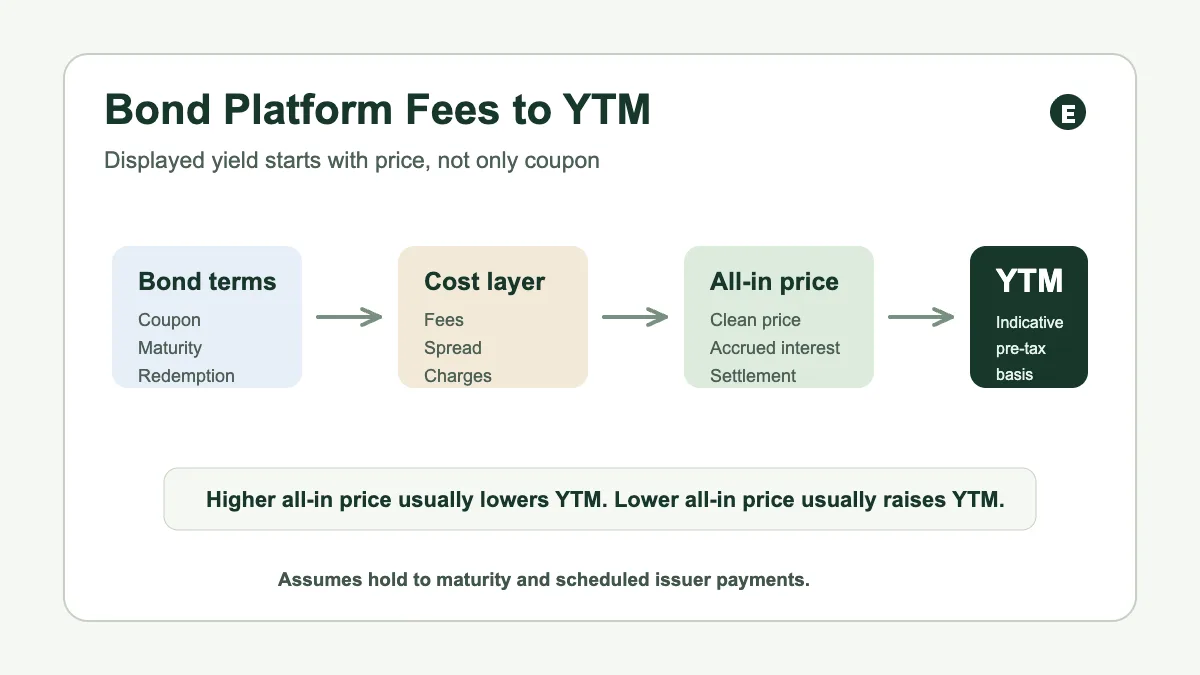
Coupon alone is not enough. A bond's coupon rate is fixed by the issuer, but the yield available to an investor depends on the price paid, time to maturity, coupon schedule, redemption terms, and whether the issuer makes payments as scheduled.
Equirize is a SEBI-registered Online Bond Platform Provider (OBPP) that facilitates access to listed bond opportunities. It does not provide investment advice. The investor's job is still to compare price, yield, risks, documents, liquidity, and costs before subscribing.
How Bond Platform Fees Show Up in Price and Yield
Bond investing costs can appear in different places. Some may be charged separately. Some may be included in the transaction price. Some may not be platform revenue at all, but statutory or account-level charges.
The practical question is not only, "Is there a fee?"
The better question is: "What is my all-in cost, and how does that cost affect the indicative YTM shown to me?"
Explicit bond platform charges vs embedded spread
An explicit charge is a separate line item. For example, a platform, broker, exchange, or depository-related charge may appear in the order confirmation, contract note, or account statement.
An embedded spread works differently. The platform may offer the bond at a price that includes its transaction spread or markup. In that case, the investor may not see a separate "platform fee" line, but the purchase price still matters because price affects YTM.
This does not make one structure automatically better or worse. It means investors should compare the final economics, not the label.
Statutory, exchange, demat and tax-related costs
Not every charge in a bond transaction is a platform fee. Some charges may be regulatory, exchange-related, clearing-related, depository-related, or tax-related. Your depository participant may also have its own schedule of charges.
Before placing an order, check:
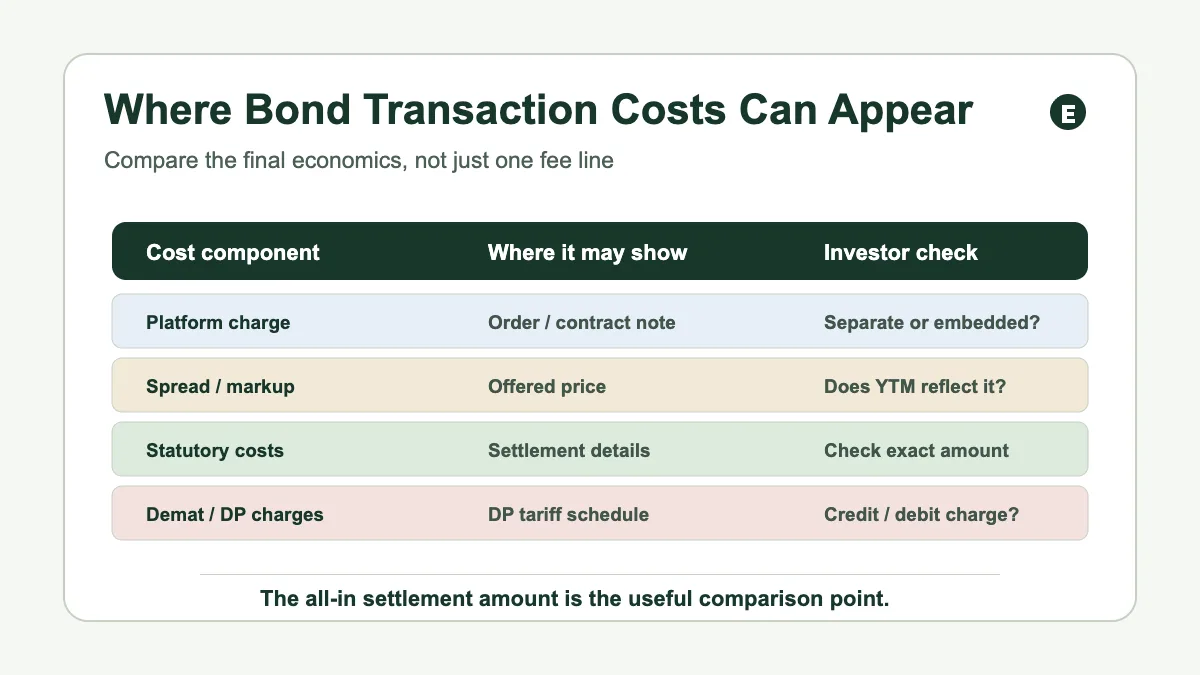
| Cost component | Where it may appear | What to verify |
| Platform or brokerage charge | Order page, pricing disclosure, contract note | Whether it is separate or built into price |
| Spread or markup | Offered price and displayed YTM | Whether the displayed YTM is based on all-in price |
| Statutory charges | Contract note or settlement details | Exact amount and basis |
| DP / demat charges | Depository participant schedule | Whether credit/debit charges apply |
| Tax impact | Your tax computation | Pre-tax vs post-tax outcome |
Tax treatment depends on individual circumstances and may change. Please consult a qualified tax advisor.
Why all-in bond price matters more than one fee line
A "zero brokerage" or "no separate fee" message does not, by itself, tell you the full cost. Similarly, a visible charge does not, by itself, mean the transaction is expensive.
The investor should check the final purchase price, accrued interest if applicable, statutory charges, and displayed YTM assumptions together. If two platforms show the same ISIN at different prices, the YTM can differ even when the coupon, issuer, maturity date, and face value are identical.
In bonds, price is not a cosmetic detail. Price is one of the inputs that decides yield.
Platform Spread, Credit Spread and Bid-Ask Spread: Not the Same Thing
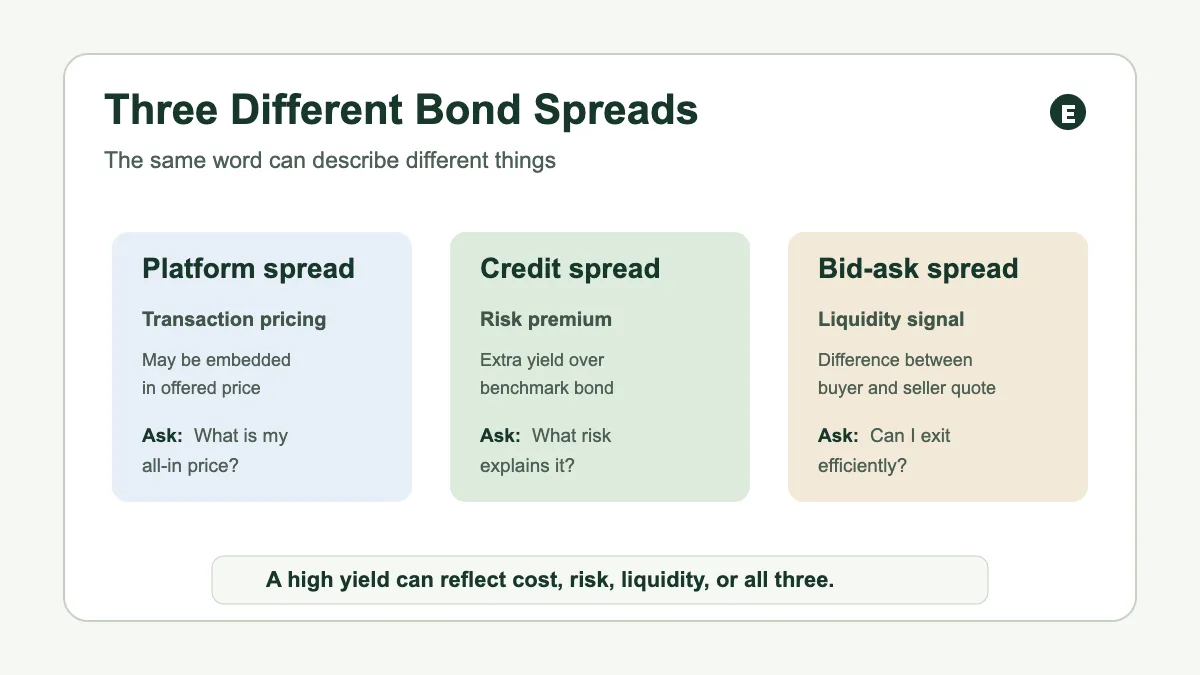
The word "spread" creates confusion because it is used in multiple ways in bond markets. A platform spread is not the same as a credit spread. A bid-ask spread is different again.
Getting this distinction right protects investors from drawing the wrong conclusion from one number.
What is platform spread in bonds?
A platform spread is a transaction-pricing concept. It may refer to the difference between the price at which a platform sources or accesses a bond and the price at which it is offered to an investor.
If this spread is embedded in the quoted price, the investor may see an all-in price and an indicative YTM rather than a separate fee line. The key question is whether the displayed yield already reflects the purchase price being shown.
Investors should avoid assuming that a spread is always unfair or always small. They should ask where the spread appears, whether it is disclosed clearly, and how it affects the final YTM.
What is credit spread or yield spread in bonds?
A credit spread or yield spread is a market-risk concept. It usually refers to the extra yield a corporate bond offers over a comparable government security or benchmark with similar maturity.
For example, if a comparable government security yields 7.00% and a corporate bond yields 8.50%, the spread is 1.50 percentage points, or 150 basis points. That extra yield may compensate investors for issuer credit risk, liquidity risk, structure, tenure, or market demand.
What is bid-ask spread in listed bonds?
Bid-ask spread is a liquidity concept. The bid is the price a buyer is willing to pay. The ask is the price a seller is willing to accept. The difference between them is the bid-ask spread.
In listed bonds, a wider bid-ask spread can mean that exiting the bond before maturity may be more expensive or less certain. It can also indicate lower trading activity for that ISIN.
This matters most when the investor may need to sell before maturity. A bond can be listed and still have limited secondary-market liquidity.
Why confusing spreads leads to wrong conclusions
A higher YTM may come from a lower purchase price, weaker liquidity, longer maturity, lower credit rating, wider credit spread, or different platform pricing. It is not automatically proof that one platform is cheaper.
Equally, a lower displayed YTM may reflect a higher purchase price, stronger credit profile, shorter maturity, better liquidity, or a different all-in pricing method.
The right comparison starts with the same ISIN, same quantity, same settlement date, and same yield basis.
Bond Price and Yield Relationship: Why Fees Affect YTM
Bond price and yield move in opposite directions. When the purchase price rises, the yield available to a new investor generally falls. When the purchase price falls, the yield generally rises.
This relationship is central to understanding bond platform fees. If a cost is embedded in the price, it can reduce the indicative YTM even if there is no separate fee line.
Coupon rate is fixed, YTM moves with price
The coupon rate is the interest rate stated on the bond's face value. It is fixed by the issuer unless the bond terms specify a step-up, reset, floating-rate, or other special structure.
Yield to maturity is different. YTM estimates the annualised return an investor may earn if the bond is bought at the current price, held until maturity, and all scheduled payments are made on time.
That is why yield to maturity is often more useful than coupon when comparing listed bonds online.
How a higher purchase price can reduce displayed YTM
Consider a simplified, illustrative example.
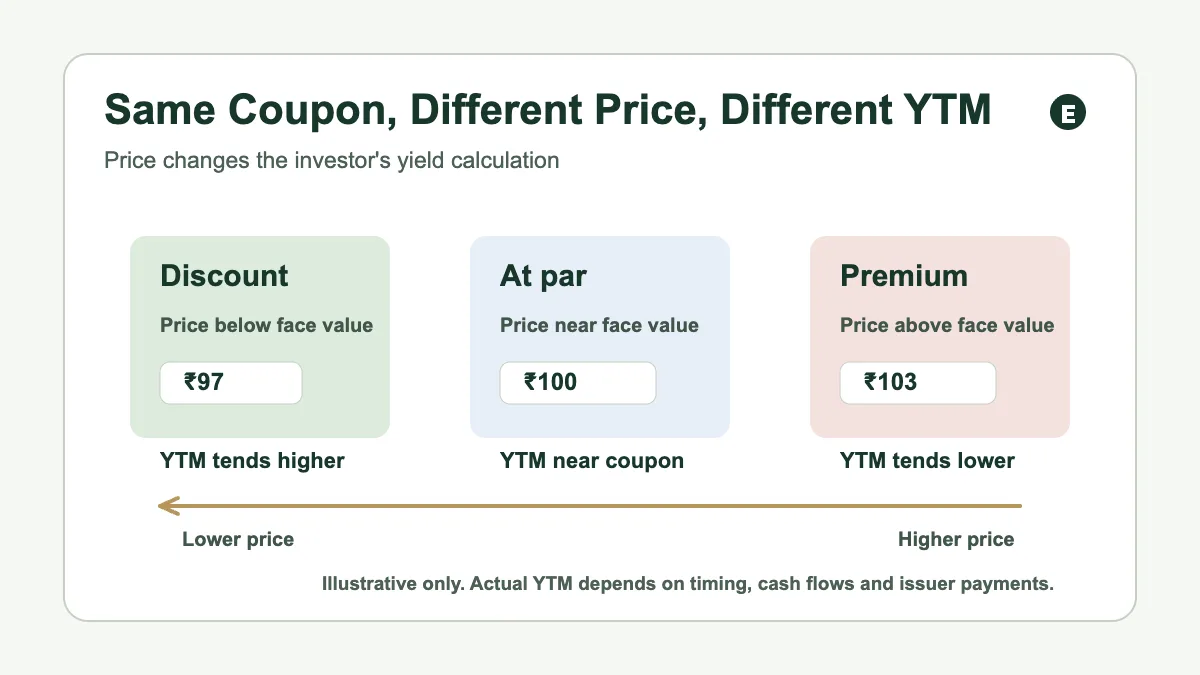
Assume a bond has a face value of ₹1,00,000 and pays a 9% annual coupon. If an investor buys it at ₹1,00,000 and holds it to maturity, the indicative yield may be close to the coupon, subject to timing and calculation method.
If the same bond is bought at ₹1,03,000, the investor pays a premium. The coupon cash flow is still based on the face value, not on the higher purchase price. So the indicative YTM is likely to be lower than the coupon.
If the same bond is bought at ₹97,000, the investor pays a discount. The coupon remains the same, and the maturity value may be higher than the purchase price if the issuer repays as scheduled. The indicative YTM is likely to be higher than the coupon.
These numbers are illustrative only. They are not live market quotes.
Why clean price, dirty price and accrued interest matter
Bond settlement can include accrued interest. This is the coupon interest that has accumulated since the previous coupon date.
The clean price usually excludes accrued interest. The dirty price, or full price, includes accrued interest. The final settlement amount may therefore differ from the clean price that an investor first notices.
This is why investors should check the order confirmation or contract note carefully. A clean-looking price comparison can be incomplete if one quote includes accrued interest and another quote does not.
How to Compare Bond Platform Fees Before You Invest
Comparing bond platform fees requires a disciplined checklist. It is not enough to compare the highest displayed YTM or the lowest visible charge.
A useful comparison asks: "For the same bond, same quantity, and same settlement date, what am I paying, what yield is being shown, and what assumptions does that yield make?"
Compare the same ISIN, maturity and quantity
Every listed bond has an ISIN. Use that as the starting point. Two bonds from the same issuer can have different coupon rates, maturities, seniority, security cover, call features, and liquidity.
If you compare only issuer name or rating, you may be comparing different instruments.
For an apples-to-apples comparison, match:
- ISIN
- Face value
- Quantity
- Settlement date
- Maturity date
- Coupon frequency
- Call or put features
- Tax treatment, if relevant
Check displayed YTM assumptions
When a platform shows YTM, ask what it includes.
Is it pre-tax or post-tax? Is it based on the all-in purchase price? Does it assume holding until maturity? Does it assume all coupon and principal payments happen on schedule? Does it include accrued interest? Does it reflect any platform charges or statutory charges?
YTM is useful, but it is not a promise. It is an assumption-based comparison metric.
Read the contract note and order confirmation
The contract note and order confirmation should help you understand the transaction economics. Review the price, quantity, settlement amount, taxes or charges shown, and other transaction details.
If a charge is unclear, ask before subscribing. If the displayed YTM does not clearly state whether it is pre-tax or post-tax, treat it as something to verify, not assume.
Transparency is not only about whether a platform uses a separate fee line. It is about whether the investor can understand the final price and yield basis.
Do not compare cost without comparing risk
A lower all-in price may show a higher YTM, but that does not automatically make the bond more suitable. Also check:
| Question to ask | Why it matters | Where to verify |
| What is the credit rating and agency? | Rating indicates credit opinion, not repayment certainty | Rating rationale, platform page, offer document |
| What is the maturity date? | Longer maturity can increase interest-rate and liquidity risk | Term sheet, offer document |
| Is there a call or put option? | Early redemption features can change realised yield | Offer document |
| How liquid is the ISIN? | Exit before maturity may depend on buyer demand | Market depth, trade history, bid-ask spread |
| Is the yield pre-tax? | Post-tax outcome can differ by investor | Tax advisor, platform disclosure |
| What is the security structure? | Secured and unsecured bonds have different risk profiles | Debenture trustee documents, offer document |
Worked Example: How Price, Spread and YTM Interact
The example below is simplified and illustrative. It is meant to show the mechanism, not to represent a live bond or a recommendation.
Assume:
- Face value: ₹1,00,000
- Coupon: 9% annually
- Time to maturity: 3 years
- Scheduled repayment: ₹1,00,000 at maturity, subject to issuer performance
Same coupon, different purchase price
| Scenario | Illustrative purchase price | Coupon cash flow | YTM direction |
| Bought at discount | ₹97,000 | Same coupon on face value | Higher than coupon |
| Bought at par | ₹1,00,000 | Same coupon on face value | Near coupon |
| Bought at premium | ₹1,03,000 | Same coupon on face value | Lower than coupon |
The coupon does not change because the purchase price changed. The investor's entry price changes the return calculation.
If a platform spread or transaction cost increases the all-in price, the indicative YTM can reduce. If the all-in price is lower, the indicative YTM can rise. But price is only one part of the decision.
What the example does not prove
This example does not prove that a lower price is always better. A lower price may reflect weaker demand, lower liquidity, issuer-specific concerns, longer duration, or a wider credit spread.
It also does not prove that a platform charging separately is more expensive than a platform using embedded pricing. The final comparison depends on the all-in price, YTM basis, charges, documents, liquidity, and risk.
The investor takeaway
Read price, yield and spread together.
Before subscribing to a listed bond, ask:
- What is the final settlement amount?
- What is the indicative pre-tax YTM?
- Is that YTM calculated after the shown price?
- What charges are separate?
- What risks explain the yield?
- Can I sell before maturity, and at what likely spread?
That is a stronger approach than comparing headline yield alone.
What EquiRize Readers Should Check on Any Bond Platform
An online bond platform can make bond discovery simpler, but it cannot remove investor due diligence. Equirize's role as a SEBI-registered OBPP is to facilitate access to listed debt securities within the applicable framework. It is not the issuer and does not provide investment advice.
Use this checklist before you compare bond platform fees or yields.
Price and Charges
Check the bond's offered price, final settlement amount, accrued interest, platform charges if any, statutory charges, and demat-related charges. Do not rely only on one phrase such as "zero fee" or "low brokerage".
Yield and Assumptions
Check whether the displayed yield is indicative, pre-tax, and based on holding until maturity. Confirm whether it assumes all coupon and principal payments happen on schedule.
Risk and Documents
Review the issuer, rating agency, rating rationale, offer document, security cover, maturity, coupon frequency, and call or put features. Registration with SEBI as an OBPP does not mean SEBI approves or guarantees a specific bond.
Liquidity and Exit Route
If you may need money before maturity, check secondary-market liquidity. A listed bond may be eligible for sale before maturity, but execution, timing, and sale price depend on buyer demand, market conditions, and the bond's liquidity.
For a broader view of rate movement and price risk, see Equirize's guide to RBI repo rate and bond yields.
Bond Platform Fees: Final Take
Bond platform fees are only one part of the fixed-income decision. Spread, price, YTM, liquidity, credit rating, tenure, tax, and documentation all shape the investor's real experience.
If a platform shows a separate fee, read it. If a platform uses all-in pricing, understand how that price affects indicative YTM. If two platforms show different yields for the same bond, check whether the ISIN, price, settlement date, accrued interest, and yield basis are the same.
The cleanest habit is simple: compare the full transaction, not the headline number.
Investors can explore listed bonds on Equirize and review issuer details, ratings, maturities, coupon schedules, indicative yields, and offer documents before making an investment decision.