How to Exit or Sell Bonds Before Maturity in India


How to Exit or Sell Bonds Before Maturity in India
If you invest in a bond, do you have to wait until maturity to get your money back?
Not always. Many listed bonds can be sold before maturity in the secondary market. But the important word is "can", not "will". A listed bond may be eligible for sale, but actual exit depends on whether there is a buyer, what price the market is offering, and how liquid that specific bond is at the time.
This is the part investors should understand before investing, not only when they suddenly need cash.
When you sell a bond before maturity, you are usually not asking the issuer to repay you early. You are selling the bond to another buyer in the market. The issuer typically redeems the bond at maturity, unless the offer document includes a specific put option, call option, buyback, or early-redemption feature.
So the short answer is:
Yes, many listed bonds can be sold before maturity in India. But sale execution, timing, and price are not guaranteed.
If you are comparing listed bond opportunities, the better question is not only "what is the yield?" It is also: "If I need to exit before maturity, how realistic is that exit, and at what price?"
Bond Exit Options in India: Sale, Maturity, Put Option and Call Option
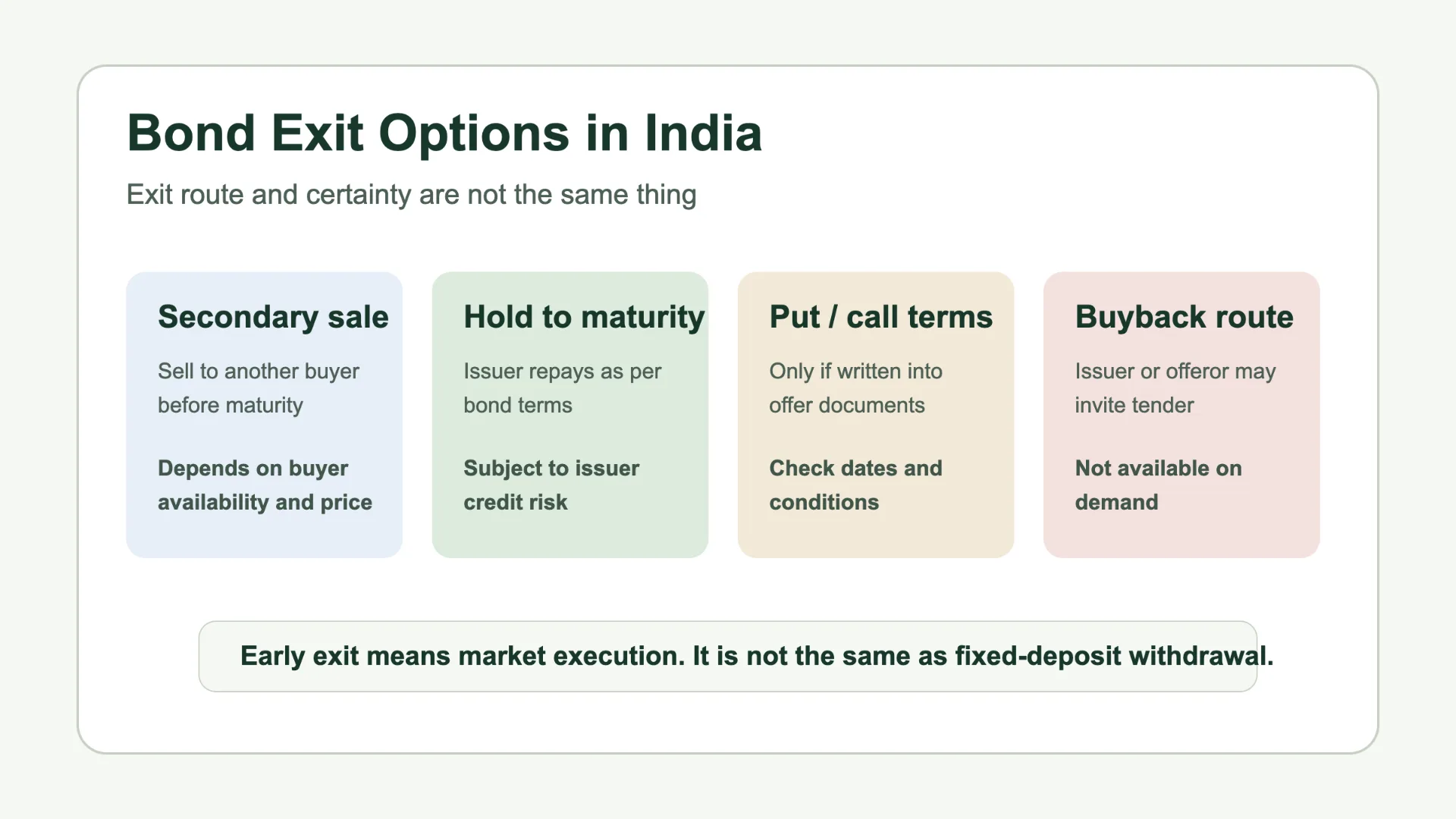
Bond exits can happen in different ways. Each route has a different meaning, and mixing them up can lead to poor expectations.
| Exit Route | What it means | Who pays you? | Is it available for every bond? | Main risk |
| Secondary-market sale | You sell the bond to another buyer before maturity | Buyer in the market | Only if the bond is listed/tradable and a buyer is available | Price and liquidity risk |
| Hold until maturity | You keep the bond until scheduled redemption | Issuer | Depends on issuer meeting obligations | Credit/default risk |
| Put option | Investor has a right to ask for early redemption on specified terms | Issuer | Only if written into the bond terms | Terms and issuer-payment risk |
| Call option | Issuer has a right to redeem early on specified terms | Issuer | Only if written into the bond terms | Reinvestment risk for investor |
| Buyback/tender | Issuer or another party offers to buy back bonds | Issuer/offeror | Only if announced and applicable | Only if announced and applicable |
Secondary-Market Sale Before Maturity
For listed corporate bonds and non-convertible debentures (NCDs), the most common early-exit route is a secondary-market sale. The bond is already issued and held in your demat account. You sell it through an exchange, broker, or platform workflow to another market participant.
This is not the same as withdrawing money from a fixed deposit. Bonds trade at market prices. The price can be above or below your purchase price, and it can differ from the face value.
Holding Bonds Until Maturity
If you hold a bond until maturity, the issuer is expected to repay the maturity amount according to the offer document, subject to issuer credit risk. This is the assumption behind yield to maturity (YTM): the investor holds the bond until maturity and all scheduled cash flows are received as expected.
If you sell early, your realised return may be different from the YTM shown at the time of investment.
Put Option, Call Option or Buyback Terms
Some bonds include put or call features. A put option may give investors the right to seek redemption on a specified date or under specified conditions. A call option may give the issuer the right to redeem before final maturity.
These are not universal features. They must be checked in the offer document, term sheet, and exchange disclosures. Do not assume a bond has an early-redemption route only because another bond from a similar issuer does.
Products With Lock-In or Special Rules
Some debt products have additional conditions. For example, 54EC capital-gains bonds are designed around a lock-in period for tax purposes. Sovereign Gold Bonds (SGBs) have their own RBI-specified maturity and premature-redemption rules. Government securities can be traded, but the route and price discovery may differ from listed corporate bonds.
How to Sell Bonds Before Maturity in the Secondary Market
If you hold a listed bond in demat form, the sale process usually follows a market workflow. The exact screens and steps depend on your broker, OBPP, or platform, but the underlying logic is similar.
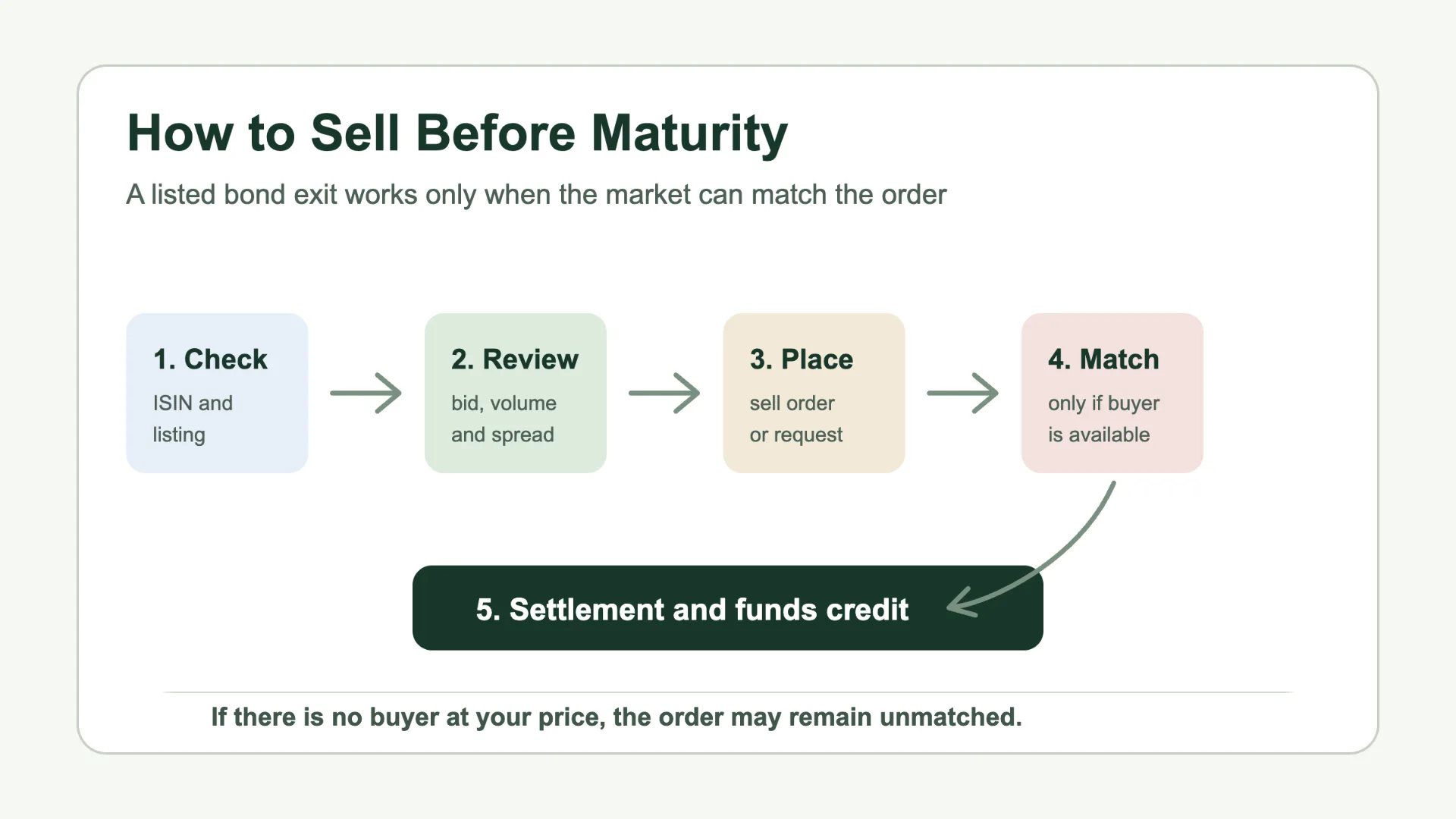
Step 1: Check Whether the Bond Is Listed and Tradable
Start with the ISIN, exchange listing, and offer document. A bond being in your demat account does not automatically mean it has active liquidity. You need to confirm whether the bond is listed, where it is traded, and whether there are recent trades or active bids.
For a corporate bond or NCD, look for:
- ISIN
- issuer name
- exchange listing
- face value
- coupon rate
- maturity date
- credit rating and agency
- secured/unsecured status
- recent traded price or available bid
- offer document and risk factors
Step 2: Check Demat and Trading Account Readiness
Listed bonds are held in demat form. To sell, you generally need a demat account and a trading route through a broker, exchange-linked platform, or SEBI-registered Online Bond Platform Provider (OBPP).
SEBI's OBPP framework brought online bond platforms into a defined regulatory perimeter for listed debt securities. Equirize is a SEBI-registered OBPP and facilitates access to listed corporate bonds and other listed debt securities. Equirize does not provide investment advice.
Step 3: Review Available Price, Quantity and Recent Trades
Before placing a sell order, check what the market is actually showing.
Useful signals include:
- best available bid price
- quantity available at that bid
- last traded price
- last traded yield
- recent volume
- bid-ask spread
- time since last trade
If there is no visible buyer, the bond may still be listed but difficult to exit quickly. If the bid-ask spread is wide, your sale price may be meaningfully lower than the price you expected.
Step 4: Place a Sell Order or Request Platform Assistance
Depending on the route, you may place a sell order yourself or request assistance through the platform. A limit-price mindset is useful: decide the minimum price at which selling still makes sense for you after considering tax, accrued interest, and opportunity cost.
This is not a recommendation to trade bonds actively. It is a reminder that early exit is a transaction. The price matters.
Step 5: Settlement and Funds Credit
Once a trade is matched and confirmed, settlement follows the applicable exchange and clearing timelines. NSE Clearing states that it follows a T+1 rolling settlement cycle for capital-market trades, while debt-segment settlement can depend on the product, platform, and exchange mechanism used.
For an investor, the practical check is this: confirm the settlement timeline on the platform before placing the sale order, especially if you need funds by a specific date. For a deeper explainer, see Equirize's guide to bond settlement and demat credit.
What Price Will You Get if You Exit a Bond Early?
This is where bond investing becomes more nuanced.
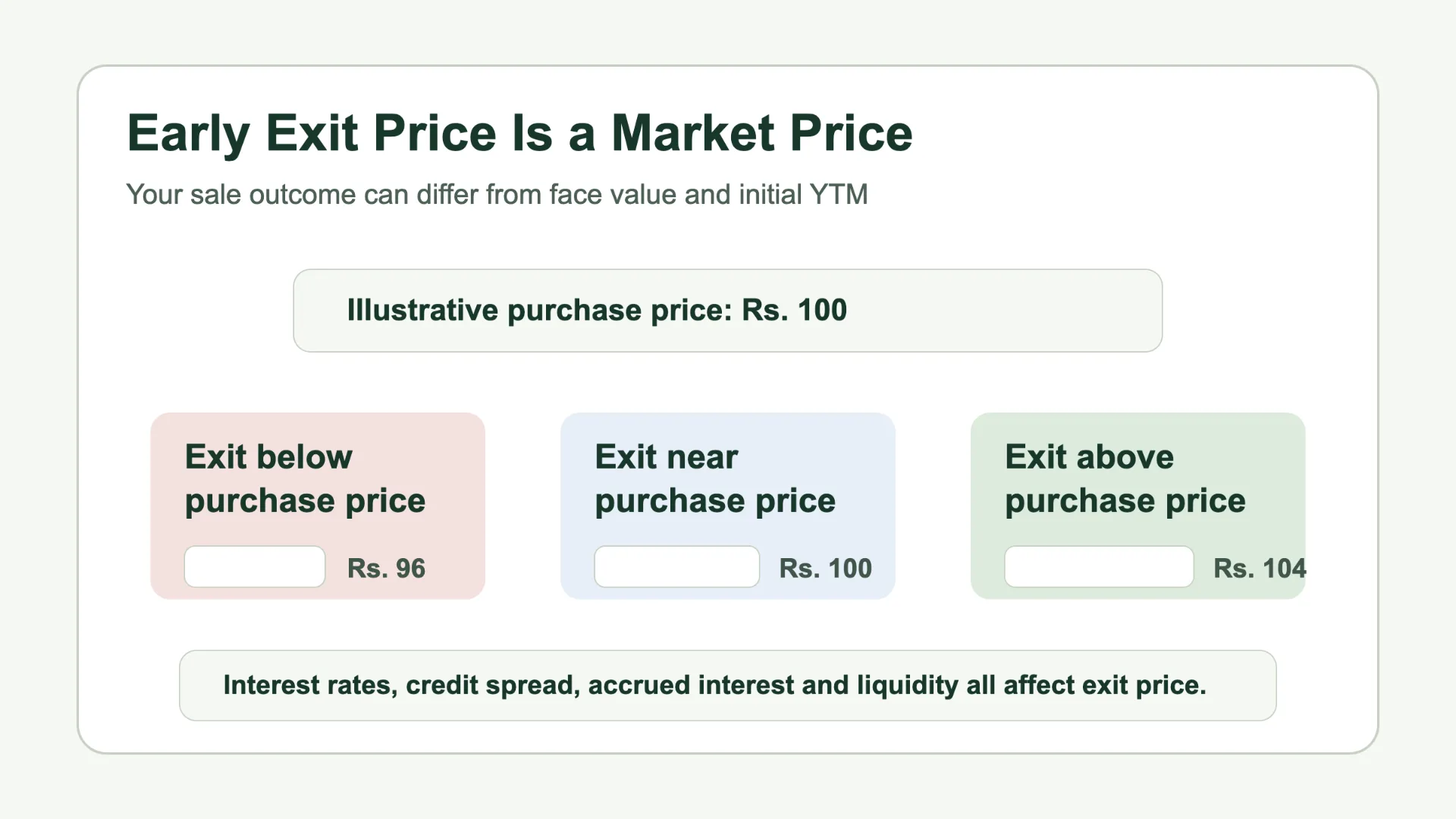
If you sell a bond before maturity, you do not automatically receive the face value. You receive the market price available for that bond, if a buyer is available. That price can be higher than, lower than, or close to your purchase price.
Market Interest Rates and Bond Price Movement
Bond prices and market yields generally move in opposite directions. If market yields rise after you bought a fixed-rate bond, the price of your bond may fall because new buyers can potentially find similar bonds at higher yields. If market yields fall, an existing fixed-rate bond may become more attractive, and its price may rise.
This is not a prediction about interest rates. It is the basic mechanism behind interest-rate risk.
Credit Rating, Credit Spread and Issuer News
A bond's price also reflects the market's view of issuer credit risk. If the issuer's financial position weakens, if rating outlook changes, or if the market demands a higher credit spread for that issuer or rating category, buyers may ask for a lower price.
Credit ratings help investors understand credit quality, but they are not guarantees. The rating rationale, outlook, financials, security cover, covenants, and recent issuer updates all matter.
For more on this, read Equirize's explainer on credit spreads in bonds.
Clean Price, Dirty Price and Accrued Interest
Bond pricing can also include accrued interest.
The clean price excludes accrued interest. The dirty price includes accrued interest payable to the seller for the coupon period already earned. Depending on the market and product, the displayed price and settlement amount may not be the same.
Example:
| Item | Illustrative amount |
| Face value | ₹1,00,000 |
| Clean price quoted | ₹99,200 |
| Accrued interest | ₹1,100 |
| Settlement amount before charges/taxes | ₹1,00,300 |
This example is only illustrative. It does not represent a live bond, price, yield, or recommendation. The actual settlement value depends on the bond's terms, accrued-interest calculation, trade date, settlement date, and platform/exchange workflow.
Liquidity, Lot Size and Buyer Availability
Liquidity risk is the risk that you may not be able to sell quickly, in the quantity you want, or at the price you expect.
Two bonds can have the same rating and similar maturity, but very different liquidity. A frequently traded bond with narrower bid-ask spreads may be easier to exit than a bond with limited traded volume. Larger face values, smaller investor base, lower awareness, or issuer-specific concerns can reduce buyer demand.
This is why "listed" should not be read as "liquid at all times."
Indicative YTM vs Actual Exit Outcome
YTM is useful, but it assumes the bond is held until maturity and scheduled payments occur as expected. If you sell before maturity, your outcome depends on sale price, accrued interest, coupon received, taxes, charges, and timing.
Your realised return can therefore differ from the indicative YTM seen when you invested.
Sell or Hold Till Maturity: How to Think About the Decision
There is no universal answer to whether you should sell a bond before maturity. The decision depends on your cash need, the bond's current market price, issuer risk, tax impact, and the alternatives available to you.
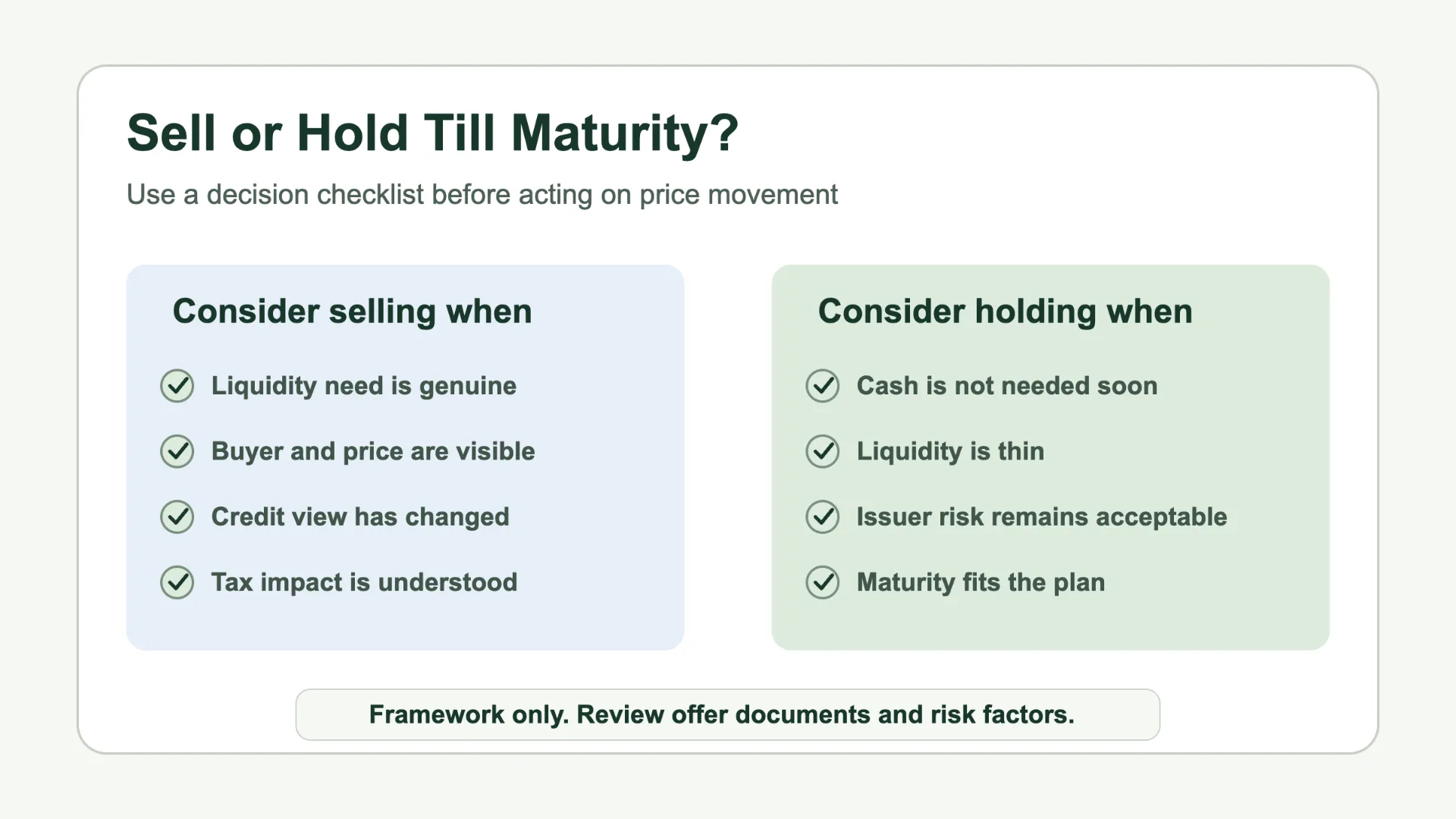
This section is not investment advice. It is a decision framework.
Reasons Investors Consider Selling Early
Investors may consider selling bonds before maturity for several reasons:
- they need liquidity earlier than expected
- their investment horizon has changed
- they want to reduce exposure to a specific issuer or sector
- they are rebalancing across maturities
- the issuer's credit profile has changed
- the market price offers a favourable exit
- they need to manage tax or cash-flow timing
Not all reasons are equal. Selling because your financial plan changed is different from selling because a price moved temporarily.
Questions to Ask Before Selling
Before selling, ask:
1. What price is available today?
2. Is there an actual buyer or only an indicative quote?
3. How does the sale price compare with my purchase price and accrued interest?
4. What coupon income have I already received?
5. What tax treatment may apply to the gain or loss?
6. Has the issuer's credit profile changed?
7. Do I need immediate liquidity, or can I wait for a better bid?
8. What happens if the order is not matched?
These questions help separate emotional exit from informed exit.
When Holding May Be Simpler
Holding until maturity may be simpler when the issuer's credit profile remains acceptable to you, the bond continues to meet your cash-flow plan, and secondary-market liquidity is thin.
But holding is not risk-free either. You still carry issuer credit risk, interest-rate risk if you mark your portfolio to market, reinvestment risk on coupons, and concentration risk if too much of your money sits in one issuer or maturity bucket.
Tax on Selling Bonds Before Maturity in India
Tax should be checked before selling, not after the money is credited.
The tax treatment of selling bonds before maturity can depend on the instrument type, holding period, listing status, investor category, purchase route, and whether the security is a regular coupon bond, government security, market-linked debenture, or another structure.
Tax treatment depends on individual circumstances and may change. Please consult a qualified tax advisor.
Interest Income, Accrued Interest and Sale Proceeds
Bond coupons are generally taxed as income according to the investor's applicable tax position. A sale before maturity may also create a capital gain or loss based on the difference between the sale consideration and the cost of acquisition, subject to the applicable tax rules.
Accrued interest can complicate the calculation because part of the settlement value may represent interest earned for the current coupon period rather than capital appreciation.
Capital Gains Can Depend on Holding Period and Instrument Type
The Income Tax Department's capital-gains guidance classifies gains as short-term or long-term depending on the asset and holding period, with short-term gains generally taxed according to the assessee's applicable status and long-term gains subject to the applicable rate under current law.
Market-linked debentures need separate care. Section 50AA of the Income-tax Act contains a special provision for computation of capital gains in the case of market-linked debentures and specified funds. Investors should not assume that all debenture or bond structures receive the same capital-gains treatment.
Records to Keep After Selling a Bond
Maintain a clean transaction trail:
- purchase contract note
- sale contract note
- demat statement
- coupon credit records
- TDS certificates, if applicable
- Form 26AS / AIS entries
- accrued-interest calculation, where available
- offer document and term sheet
- platform statements
These records matter because the final tax answer may depend on purchase date, sale date, holding period, instrument type, and income already reported.
For related documentation, see Equirize's guide to bond tax documentation such as Form 121.
What to Check Before Buying a Bond if You May Need Early Exit
The best time to think about exit is before you invest.
If you know there is a chance you may need money before maturity, do not evaluate a bond only by coupon or indicative YTM. Add a liquidity screen.
Listing Status and Exchange Tradability
Check whether the bond is listed and where it is traded. A listed bond has a possible secondary-market route. An unlisted or restricted instrument may have a much more limited exit path.
Recent Trading Volume and Bid-Ask Spread
Look beyond the label. Ask whether the bond has traded recently, in what quantity, and at what yield. Thin trading volume does not automatically make a bond unsuitable, but it does mean early exit could be uncertain.
A wide bid-ask spread can reduce your realised return if you need to sell quickly.
Remaining Maturity and Coupon Structure
Longer-maturity bonds are generally more sensitive to interest-rate changes. Low-coupon or zero-coupon bonds may also show sharper price movement when market yields change because more of the return is concentrated in the future.
If your time horizon is short, a long-maturity bond with limited liquidity may not be a natural fit.
Credit Rating and Rating Rationale
Credit rating is a useful starting point, not the full answer. Read the rating rationale, outlook, financial trends, security cover, and key risks. A rating change or outlook revision can affect secondary-market demand and pricing.
Also check whether the bond is secured or unsecured, senior or subordinated, and whether there are covenants that matter for repayment priority.
Offer Document Terms: Put, Call, Lock-In and Redemption
The offer document should answer questions such as:
- Is there a put option?
- Is there a call option?
- Are there lock-in restrictions?
- What is the redemption date?
- Are there step-up or step-down coupon terms?
- What happens on rating downgrade or covenant breach?
- What is the minimum trading lot?
- Who is the debenture trustee?
This is not paperwork for later. It is the map for your investment.
Selling Bonds Before Maturity Through an OBPP
An OBPP (Online Bond Platform Provider) is a SEBI-regulated route for facilitating access to listed debt securities online. SEBI introduced the OBPP regulatory framework in November 2022 to bring online bond platforms within a formal regulatory structure for listed debt securities.
Through an OBPP or broker-linked route, investors may be able to explore listed bonds, review offer documents, complete KYC, and transact through exchange-linked mechanisms. The bond itself is held in the investor's demat account.
What an OBPP should not be expected to do is eliminate market risk.
An OBPP can facilitate access and information. It cannot guarantee that a buyer will be available whenever you want to exit. It cannot guarantee that the exit price will match face value, purchase price, or the indicative yield shown when you invested.
That distinction is central to responsible bond investing.
On Equirize, investors can compare listed bonds by issuer details, rating, maturity, coupon structure, offer documents, and risk factors. Use those details to match the bond with your investment horizon before subscribing.
Key Takeaways on Exiting Bonds Before Maturity
Selling bonds before maturity is possible for many listed bonds in India, but it should not be treated as a guaranteed withdrawal feature.
Keep these points in view:
- Listed bonds may be sold in the secondary market, subject to buyer availability and liquidity.
- Early exit happens at market price, not automatically at face value.
- Bond prices can move because of interest rates, credit spreads, issuer news, time to maturity, and liquidity.
- YTM assumes hold-to-maturity and scheduled payments; realised return can differ if you sell early.
- Tax treatment can vary by instrument, holding period, and investor category.
- The offer document is the primary reference for maturity, put/call terms, redemption, security, and risk factors.
The most practical approach is to plan the exit before you invest. Match the bond's maturity, liquidity profile, and credit risk with the time horizon of the money you are putting in.