54EC Capital Gain Bonds: Save Tax on Property Sale



Selling a property often creates one immediate tax question: how much of the long-term capital gain can be reduced through a permitted reinvestment route?
For many property sellers, 54EC bonds are the first answer they hear from a CA or wealth advisor. The phrase remains widely used in searches and investor conversations. In current tax-law language, the same mechanism now sits under Section 85 of the Income-tax Act, 2025, for tax years beginning April 1, 2026 onward. The older Section 54EC terminology still matters because earlier years, existing guidance, issuer forms, and common search behaviour continue to use it.
The short version: 54EC capital gain bonds can help an eligible taxpayer reduce long-term capital gains tax on sale of land, building, or both, if the capital gain is invested in specified bonds within the permitted deadline and limit. The core rule set is narrow: eligible property gain, six-month investment window, ₹50 lakh cap, five-year lock-in, and taxable annual interest.
Tax treatment depends on individual circumstances and may change. Please consult a qualified tax advisor.
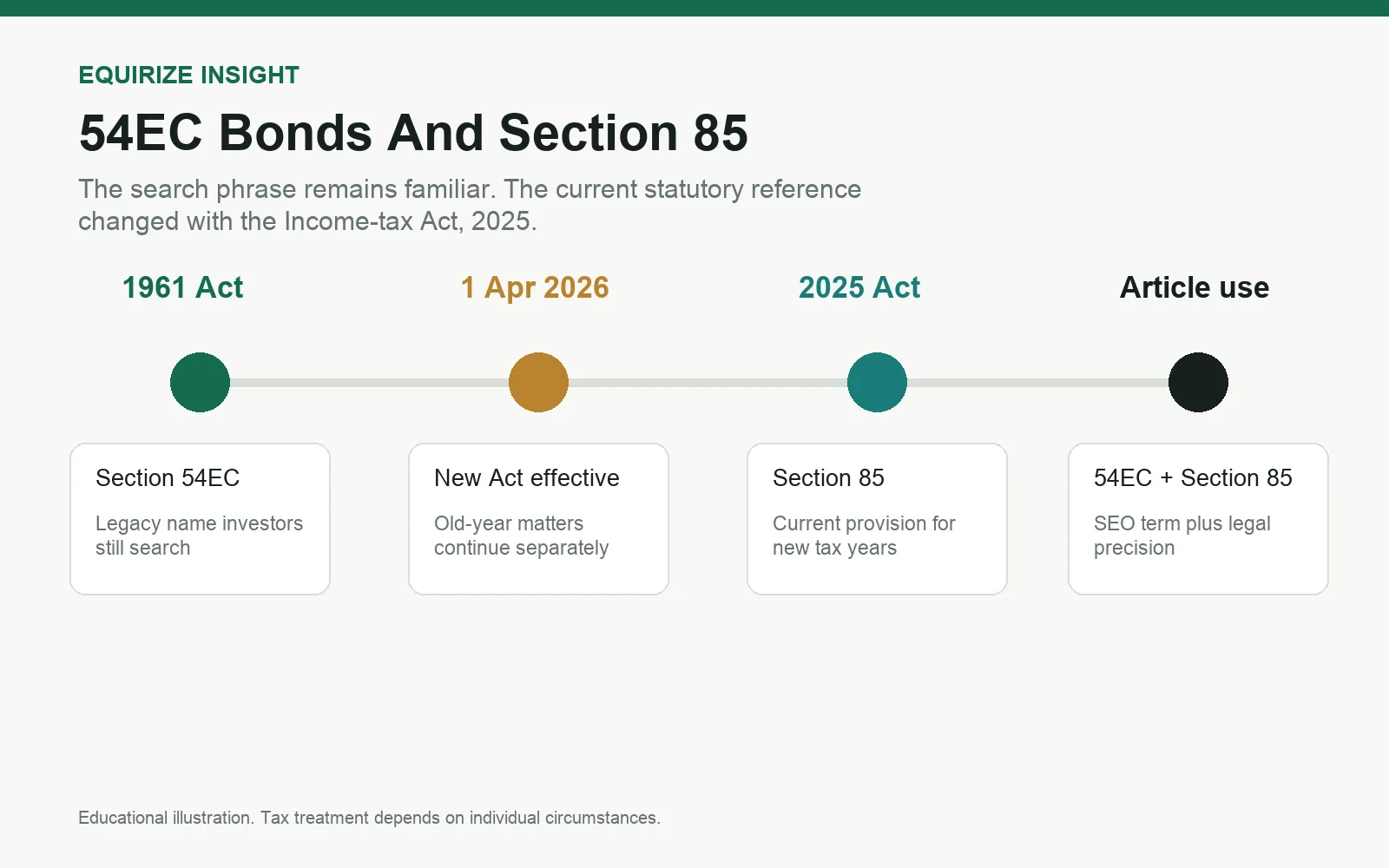
54EC Bonds And Section 85: What Changed In 2026
The market still calls them 54EC bonds. The current statute, however, uses a new section number.
The Income-tax Act, 2025 came into force from April 1, 2026. For tax years starting on or after that date, the provision for capital gains not being charged on investment in certain bonds is covered under Section 85. For earlier tax years and pending matters, the older Income-tax Act, 1961 framework continues to matter.
This is not just a naming detail. A property seller searching today may see old issuer forms, CA notes, bank pages, and bond-platform pages using "54EC". At the same time, official current-law references may say "Section 85". A useful article should bridge both, without pretending the legal numbering has not changed.
Section 54EC Exemption Under The 1961 Act: Why The Name Still Matters
Section 54EC became the shorthand for capital gain bonds because it was the relevant provision under the Income-tax Act, 1961. Most investor-facing pages, application journeys, and older tax explainers still use the phrase "54EC bonds".
Section 85 Bonds Under The 2025 Act: Current Tax-Year Framing
Section 85 applies where an assessee has long-term capital gains from transfer of land or building, or both, and invests the whole or part of those capital gains in a long-term specified asset within six months after the date of transfer.
In simpler terms, the mechanism is still recognisable: sell eligible property, compute the long-term capital gain, invest the eligible gain in specified bonds within time, and claim exemption to the extent permitted.
Capital Gain Bonds After Property Sale: The Quick Rule Table
For most readers, the useful starting point is not theory. It is the rule table.
| Rule | What to check before investing |
| Eligible asset | Long-term capital gains should arise from transfer of land, building, or both. |
| Investment window | Invest within six months after the date of transfer. |
| Maximum investment for exemption | ₹50 lakh limit applies as per the provision. |
| Lock-in period | The specified bond must be redeemable after five years. |
| Early transfer or conversion | Transfer or conversion into money within five years can cause the exempt gain to become taxable. |
| Loan or advance against bond | A loan or advance on the security of the bond is treated as conversion into money. |
| Interest taxation | Interest on 54EC bonds is generally taxable in the investor's hands. |
| Issuer verification | Check current issuer term sheet, application form, coupon, allotment process and eligibility before applying. |
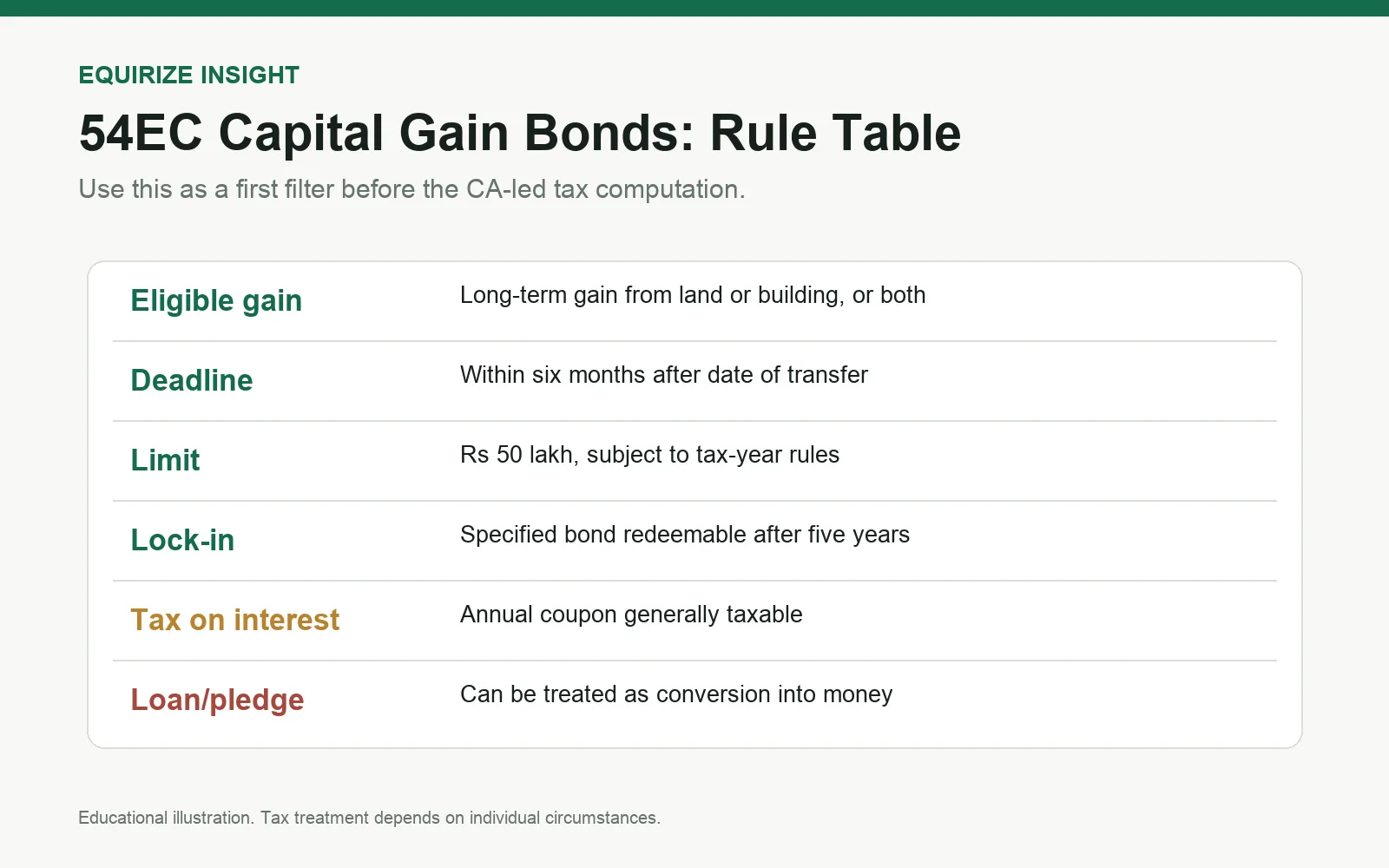
This table should be read with a CA, not as a substitute for tax advice. Property transactions can involve joint ownership, inherited cost, development agreements, NRI tax withholding, indexation questions for earlier-year matters, and documentation issues.
Long-Term Capital Gains From Land Or Building: Eligible Asset Test
The provision is specific to long-term capital gains arising from land or building, or both. It is not a general route for every capital gain.
That distinction matters. A gain from a listed share, mutual fund, gold, business asset, or unlisted instrument may have its own tax treatment, but it should not automatically be assumed to qualify for 54EC or Section 85 bond exemption.
Six-Month 54EC Bond Deadline From Date Of Transfer
The six-month clock starts from the date of transfer. In a straightforward sale, taxpayers often use the registered sale deed date as the planning anchor, subject to their CA's review.
Waiting until the last few weeks is avoidable risk. KYC mismatches, payment failures, NRI documentation, bank-account issues, demat details, or issuer processing delays can make a clean tax plan messy.
54EC Bond Limit Of ₹50 Lakh Across The Tax Year
The ₹50 lakh limit is central. If the eligible capital gain is ₹35 lakh and the taxpayer invests ₹35 lakh, the exemption may cover the gain, subject to conditions. If the gain is ₹90 lakh, investing ₹50 lakh does not shelter the remaining ₹40 lakh.
The current provision also frames the limit across the relevant tax year and the year of transfer plus subsequent tax year. This is exactly the kind of detail to confirm before trying to split investments across dates.
How 54EC Bonds Save Capital Gains Tax On Property Sale
The most common misunderstanding is this: 54EC bonds are linked to the capital gain, not necessarily the full property sale value.
Suppose a flat is sold for ₹1.80 crore. After considering cost, permitted expenses and the applicable tax computation, the long-term capital gain works out to ₹42 lakh. The 54EC decision is built around that ₹42 lakh gain, not the full ₹1.80 crore sale consideration.
If the taxpayer invests the eligible ₹42 lakh within the required period in specified bonds, the gain may be exempt to that extent. If only ₹30 lakh is invested, only that portion is considered for exemption. If the gain is higher than ₹50 lakh, the cap becomes the practical ceiling.
54EC Exemption Calculation: Gain Invested Versus Sale Value
The calculation flow is:
| Step | Illustration |
| Property sale consideration | ₹1.80 crore |
| Less: cost and eligible expenses, as computed | ₹1.38 crore |
| Long-term capital gain | ₹42 lakh |
| Amount invested in eligible 54EC / Section 85 bonds | ₹42 lakh |
| Gain potentially eligible for exemption | Up to ₹42 lakh |
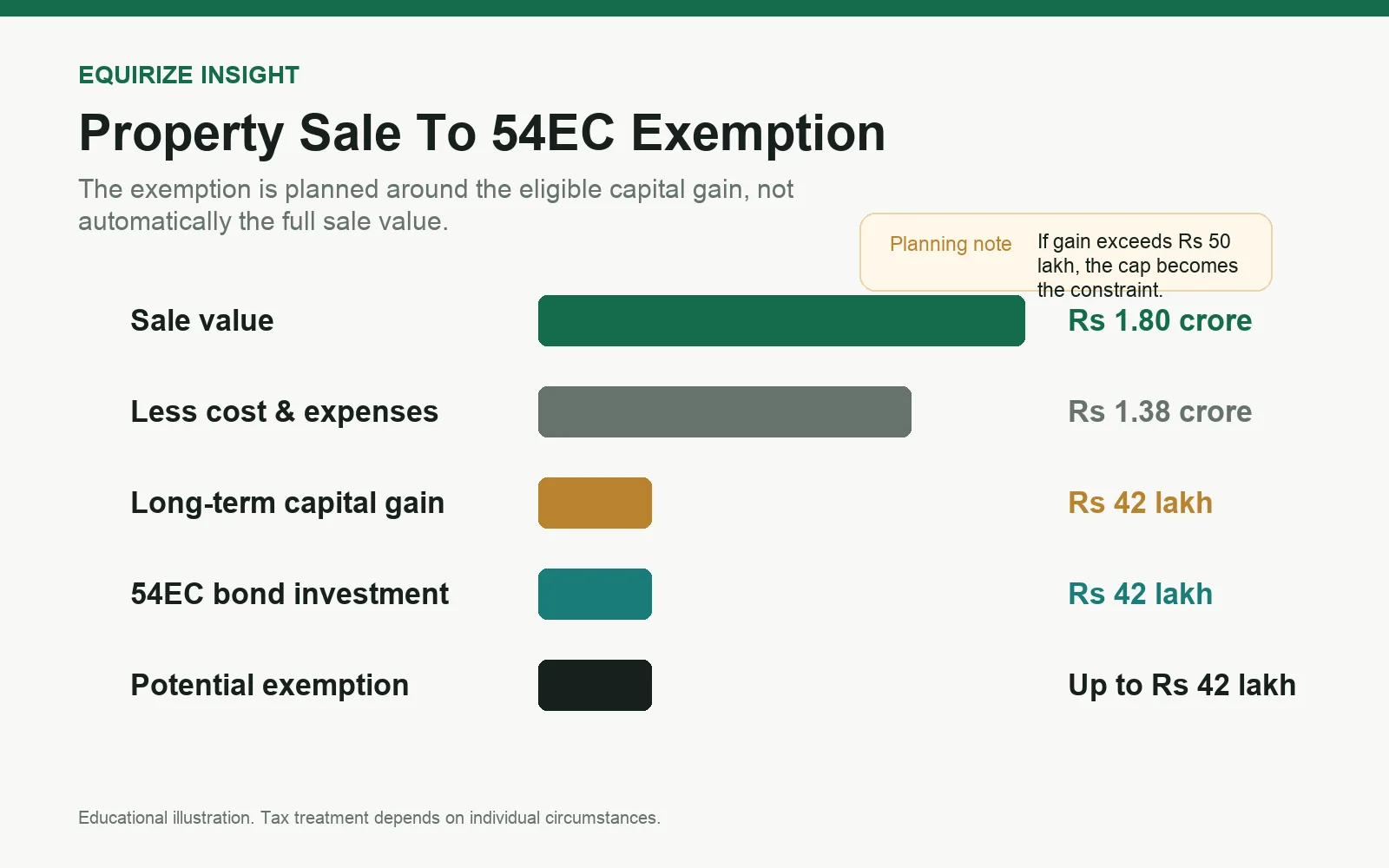
This does not mean every property seller with a ₹42 lakh gain should automatically use the route. It means the route can be evaluated once the gain, deadline, lock-in, liquidity and alternative reinvestment plans are clear.
54EC Bonds Example For A ₹42 Lakh Property Gain
Take Ananya, a salaried professional who sells an old investment apartment. Her CA calculates a long-term capital gain of ₹42 lakh. She already owns the home she lives in and does not want to buy another residential property only to manage tax.
For her, 54EC bonds may be a clean route if she can accept a five-year lock-in and does not need this ₹42 lakh for near-term obligations. The remaining sale proceeds can then be planned separately across liquid reserves, fixed deposits, listed bonds, or other investments based on risk and liquidity.
The important point is that the 54EC allocation should be treated as the tax-linked sleeve of the post-sale plan, not the entire investment plan.
54EC Bonds Interest Rate, Taxability And Post-Tax Income
Most current 54EC bond pages show a coupon around 5.25% p.a., payable annually, but the exact rate, issue terms and eligibility should always be checked against the current issuer document or application portal before applying.
The interest rate is not the main reason investors use these bonds. The primary reason is the capital gains exemption on an eligible property gain. The coupon is the income received during the lock-in period, and it needs a separate tax view.
For broader fixed-income tax context, Equirize's guide to bond interest taxation in India explains why coupon income and capital gains should be read separately. If you are comparing 54EC coupons with other listed bonds, the Yield to Maturity guide is also useful because coupon rate and YTM are not the same thing.
| Item | How to read it |
| Coupon | Annual interest rate stated in the issuer terms. |
| Payment frequency | Usually annual, but confirm issuer-specific dates. |
| Taxability | Interest is generally taxable at the investor's applicable slab rate. |
| TDS | Some issuer/application pages state no TDS for resident investors, but no TDS does not mean tax-free income. |
| Post-tax income | Depends on the investor's marginal tax rate and reporting. |
54EC Bonds Taxable Interest: What the Exemption Does not Cover
The exemption is on eligible long-term capital gains invested in the specified bonds. It does not usually make the annual interest tax-free.
For example, if a bond pays 5.25% p.a. and the investor is in a higher tax slab, the post-tax coupon income will be lower than 5.25%. That does not make the route ineffective. It simply means the tax benefit and the coupon income should be evaluated separately.
This is also why comparing a 54EC bond coupon with a bank FD rate can be misleading. An FD does not create a 54EC or Section 85 exemption. The real comparison is between the tax saved, the taxable coupon, the five-year lock-in, and the alternative plan for the money if tax is paid instead.
No TDS On 54EC Bond Interest: What Investors Still Need To Report
Some issuer and distributor pages state that tax is not deducted at source on 54EC bond interest for resident investors. That should not be interpreted as "no tax". For a related recordkeeping lens on bond interest, see Equirize's explainer on Form 121 for bond investors, while confirming the exact reporting route for 54EC interest with your CA.
The interest may still need to be reported in the income-tax return. Keep the allotment advice, bank statement, interest credit details, and issuer communication. A clean document trail is useful if the exemption or interest reporting is reviewed later.
54EC Bond Lock-In Period And Early Exit Consequences
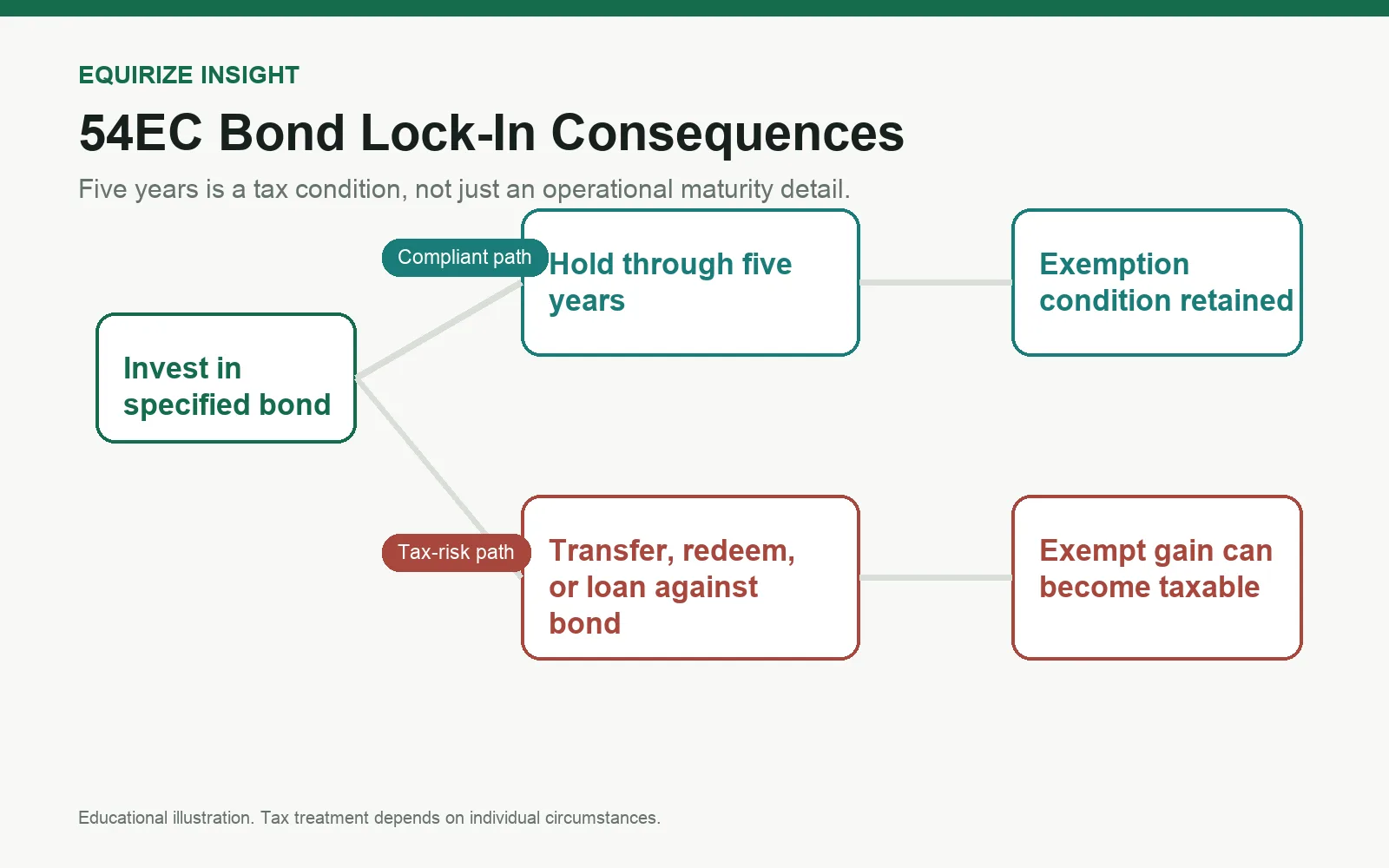
The five-year lock-in is not a small operational detail. It is part of the tax condition.
If the specified bond is transferred or converted into money within five years, the capital gain that was earlier not charged may be deemed taxable in the tax year of transfer or conversion. In practical terms, this means 54EC bonds should not be treated like flexible short-term parking.
Loan Against 54EC Bonds: Why Pledging Can Reverse The Exemption
The rule also covers a loan or advance taken on the security of the specified asset. Such a loan or advance is treated as conversion into money on the date it is taken.
This is easy to miss. An investor may think, "I am not selling the bond; I am only borrowing against it." The tax rule can still treat that as a conversion event. Avoid pledging 54EC bonds unless a tax professional has reviewed the consequence.
Redeeming 54EC Bonds Before 5 Years: Tax Consequence
Premature redemption or transfer is generally not the design of these bonds. They are meant to be held through the lock-in period. This is different from ordinary secondary-market bond liquidity, which is covered separately in Equirize's guide to selling bonds before maturity in India.
If liquidity is likely to be needed within five years, consider whether the taxpayer should use the entire eligible gain for 54EC bonds or keep part of the proceeds outside the structure and pay tax on the balance gain. The right answer is personal and should be planned before investing.
Eligible 54EC Bond Issuers And Official Documents To Verify
54EC and Section 85 bonds are not any bond that happens to be issued by a known institution. They must be specified or notified bonds that qualify under the relevant provision.
Common issuer names seen in the market include REC, PFC, IRFC, NHAI and HUDCO, subject to current notifications and issue availability. The safer way to approach this is not to memorise a list. It is to verify the current issuer document before applying.
| Issuer/document check | Why it matters |
| Current application form or portal | Confirms whether the series is open and accepting applications. |
| Term sheet | Shows coupon, tenure, redemption, mode of holding and key conditions. |
| Minimum and maximum application size | Prevents under- or over-application. |
| PAN, KYC and bank details | Reduces processing delay. |
| Demat or physical holding option | Helps match the investor's documentation preference. |
| Allotment proof | Needed for records and tax filing. |
REC, PFC, IRFC, NHAI and HUDCO 54EC Bonds: Issuer Checklist
Do not rely only on a blog post or a screenshot for issuer details. Check the official issuer page, registrar portal or current application document.
For each issuer, verify: whether the bond is eligible under the current provision, coupon rate, annual interest date, lock-in, face value, minimum subscription, maximum subscription, permitted investor categories, mode of holding, nomination, application process and contact details.
If the investor is an NRI, a trust, a firm, a company or a joint seller, issuer eligibility and tax reporting should be checked with extra care.
How To Invest In 54EC Bonds Online Or Offline
A practical process looks like this:
- Ask your CA to compute the long-term capital gain from the property sale.
- Decide the eligible investment amount after considering the ₹50 lakh cap.
- Confirm the six-month deadline from the date of transfer.
- Choose a currently eligible issuer and review the term sheet.
- Complete PAN, KYC, bank and holding details.
- Make payment through the permitted route.
- Store application, payment proof, allotment advice, certificate or demat statement, and interest records.
54EC Bonds Vs Section 54, Section 54F And Fixed Deposits
Property sellers rarely evaluate 54EC bonds in isolation. The actual choice is often between buying another property, using capital gain bonds, paying tax and investing freely, or temporarily parking money in fixed deposits.
| Route | What it generally does | When it may be relevant |
| 54EC / Section 85 bonds | Invest eligible long-term capital gain in specified bonds, subject to limit and lock-in. | You want tax relief without buying another property. |
| Section 54 | Reinvest eligible gain from sale of a residential house into another residential house, subject to conditions. | You genuinely need or want another residential property. |
| Section 54F | Reinvest net consideration from certain non-house asset sales into a residential house, subject to conditions. | The asset sold is not a residential house and conditions are met. |
| Fixed deposit | Park money for interest and liquidity, depending on terms. | You need operational simplicity, but it does not create 54EC exemption. |
| Pay tax and invest elsewhere | Keep flexibility after tax payment. | You value liquidity or return flexibility more than the tax deferral/exemption route. |
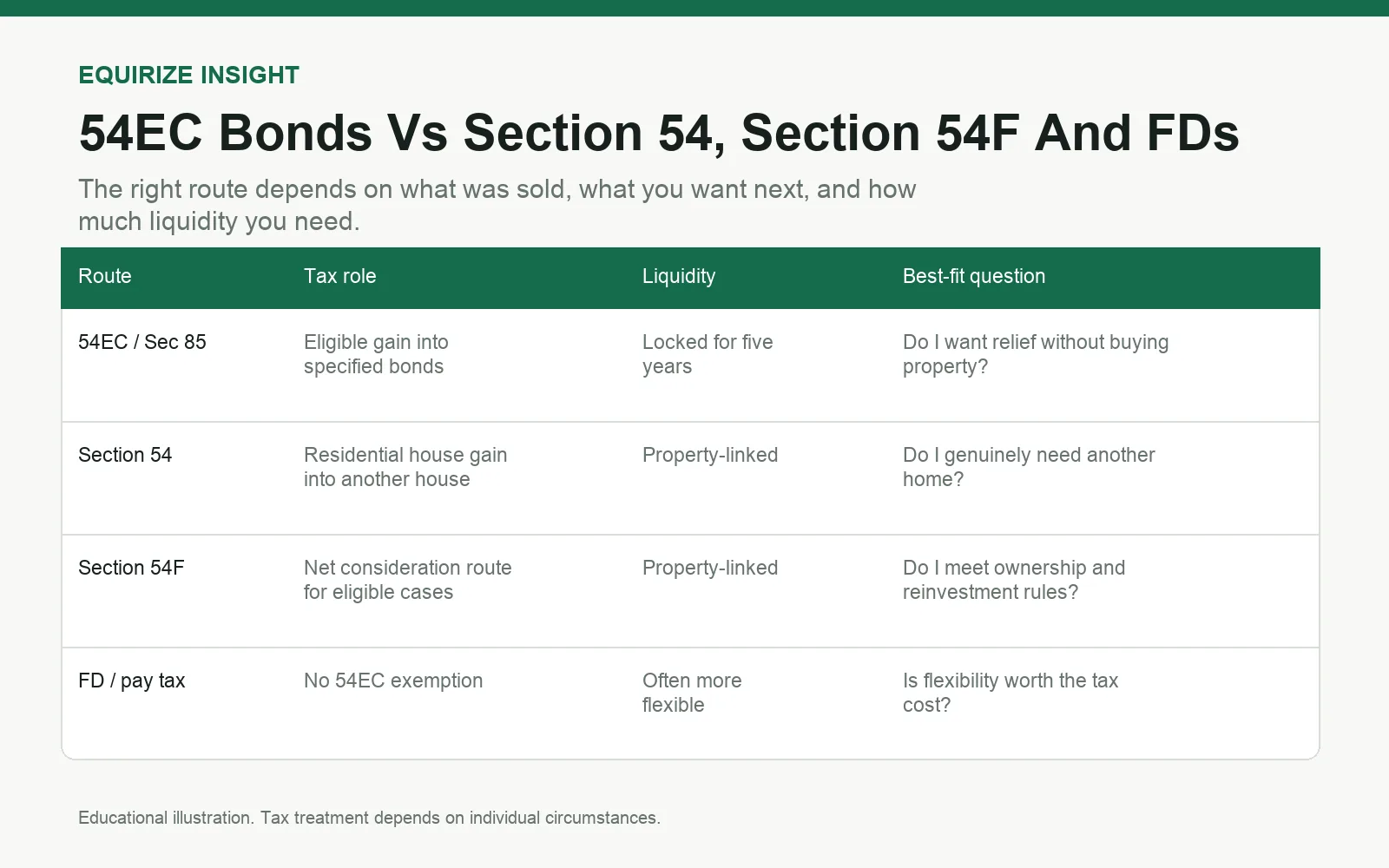
Section 54 vs 54EC Bonds for Residential Property Sellers
Section 54 is usually relevant where a residential house is sold and the taxpayer reinvests in another residential house, subject to conditions. 54EC or Section 85 bonds do not require buying another house, but they have the ₹50 lakh limit and five-year lock-in.
For someone who genuinely wants another home, Section 54 may be central. For someone exiting real estate exposure, capital gain bonds may be cleaner.
Section 54F Vs 54EC Bonds For Non-House Asset Sales
Section 54F has a different structure and applies to certain non-house capital assets where net consideration is invested in a residential house, subject to eligibility conditions.
The comparison should be done carefully because the base amount differs. 54EC focuses on eligible capital gain, while Section 54F has its own reinvestment logic around net consideration.
Fixed Deposits Vs 54EC Bonds After Property Sale
Fixed deposits may be useful for parking sale proceeds, managing liquidity, or creating predictable bank interest. But an FD does not produce a 54EC or Section 85 exemption. For a broader category comparison, see Equirize's guide to bonds vs fixed deposits in India.
The question is not "Which pays more interest?" The better question is: "How much tax is saved, how much liquidity is lost, how is the coupon taxed, and what would the post-tax alternative look like?"
Who Should Consider 54EC Capital Gain Bonds
54EC capital gain bonds may fit taxpayers who have eligible long-term gains from land or building, do not want to buy another property, can accept the five-year lock-in, and have enough liquidity outside the bond allocation. For the non-54EC part of the proceeds, Equirize's note on bond allocation in portfolio can help frame concentration, liquidity and tenure questions.
They may not fit taxpayers who need the money within five years, have gains beyond the limit and no plan for the balance, have unresolved ownership or documentation issues, or are comparing only coupon rates without considering tax and liquidity.
NRI Investment In 54EC Bonds: Check Issuer Terms First
NRI eligibility is often discussed online, but it should not be answered casually. Some sources permit it subject to terms; others qualify it by account type, issuer condition or regulatory permission.
An NRI selling Indian property should confirm TDS on property sale, residential status, repatriation, bank account type, issuer eligibility and return filing with a CA before applying.
Joint Property Sellers And 54EC Bonds: Ownership Caveats
Joint property sales need careful allocation. The capital gain may need to be computed taxpayer by taxpayer. The investment, PAN, ownership records and exemption claim should align with the legal and tax facts.
This is not a paperwork afterthought. If the property is inherited, jointly held, gifted, or sold through a family arrangement, documentation should be reviewed before the bond application is made.
54EC Bonds Checklist Before Filing Your Tax Return
Before filing, build one clean folder for the tax year.
| Document / check | Why it matters |
| Registered sale deed / transfer document | Establishes transfer date and sale consideration. |
| Capital gains computation | Shows eligible long-term capital gain. |
| CA note on applicable section | Helps distinguish Section 54EC / Section 85 / other route. |
| Bond application form | Shows amount, issuer, applicant and date. |
| Payment proof | Supports investment within the deadline. |
| Allotment advice or bond certificate / demat statement | Proves the specified asset was allotted. |
| Interest credit statement | Supports income reporting. |
| ITR working papers | Ties exemption claim to return filing. |
Documents Needed For 54EC Bond Exemption Claim
The basic record set includes sale deed, purchase/cost documents, improvement and transfer-expense evidence if relevant, capital-gains computation, bond application, payment proof, allotment proof and interest records.
For NRIs, inherited assets, joint property or development agreements, additional documents may be required.
Questions To Ask Your CA Before Buying 54EC Bonds
Ask these before the application, not after:
1. Is the gain long-term and from land, building, or both?
2. Which tax year and section wording applies: 54EC, Section 85, or another provision?
3. What is the exact capital gain after considering cost and eligible expenses?
4. How much should be invested after applying the ₹50 lakh limit?
5. What is the last eligible investment date?
6. Does any Section 54 or Section 54F route fit better?
7. Is there any NRI, joint-owner or documentation issue?
8. How should annual interest be reported?
54EC Bonds For Property Tax Planning: Final Take
54EC bonds are useful because they solve a specific problem: eligible long-term capital gains from sale of land or building. They are not a general yield-maximisation product, and they are not a substitute for tax advice.
Use them when the rule set fits: eligible property gain, six-month deadline, ₹50 lakh cap, five-year lock-in, current eligible issuer, clean documentation and enough liquidity outside the locked amount.
Equirize is a SEBI-registered Online Bond Platform Provider (OBPP) and stock broker in the debt segment of BSE and NSE. Investors can use Equirize to review listed bond opportunities, issuer details, credit ratings, maturity dates, coupon schedules and offer documents before making an investment decision. Equirize does not provide investment advice.