How Much Should You Allocate to Bonds in Your Portfolio?


There is no single correct bond allocation in portfolio for every investor. A 30-year-old founder with irregular income, a 45-year-old salaried professional with school fees ahead, and a 68-year-old retiree drawing monthly cash flow may all need bonds. But they do not need the same percentage, the same maturity, or the same credit-risk profile.
A better question is: what job should bonds do in your portfolio?
Bonds can add fixed-income stability, create visible coupon and maturity dates, reduce dependence on equity markets for near-term goals, and help investors plan cash flows. They can also introduce risks that are easy to underestimate: issuer credit risk, interest-rate risk, liquidity risk, concentration risk, reinvestment risk, and tax impact.
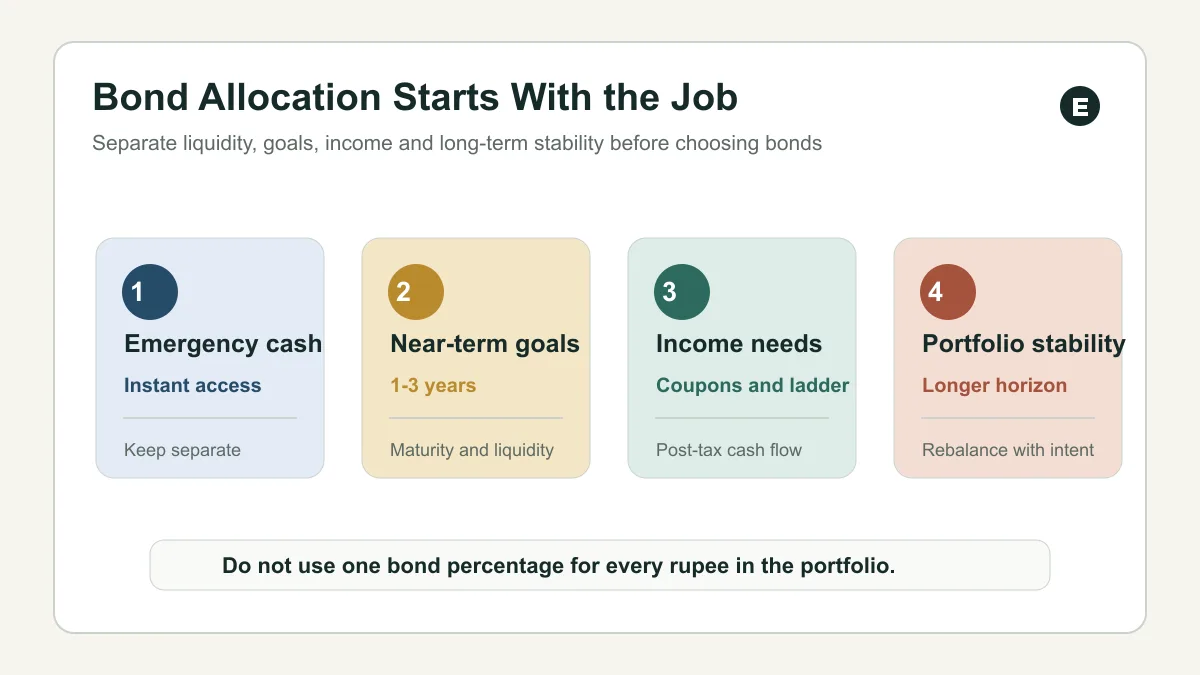
So before asking how much to invest in bonds, separate the money by purpose. Emergency money, a goal due in two years, retirement income, and long-term portfolio stabilisation are different jobs. They should not be forced into one allocation rule.
This guide gives a practical, India-specific framework for deciding how much of your portfolio may belong in bonds, how to choose between government and corporate bonds, and how to implement the allocation without treating yield as the only input.
Bond Allocation in Portfolio: The Short Answer
The short answer is that your bond allocation should reflect goal timing, income stability, risk tolerance, tax position, and liquidity needs. It should not be copied from an age rule or a model portfolio without context.
For many investors, bonds sit inside the broader debt or fixed-income allocation. That allocation may include government securities, listed corporate bonds, debt mutual funds, fixed deposits, cash, and other fixed-income instruments. The role of bonds inside that mix depends on what you want them to do.
| Investor need | Possible role for bonds | What to check first |
| Goal due in 1-3 years | Limited role; liquidity and capital access matter more | Can you hold to maturity? What if you need early exit? |
| Goal due in 3-7 years | Maturity matching and cash-flow visibility | Maturity date, credit rating, liquidity, tax |
| Long-term portfolio stability | Debt allocation and diversification | Government vs corporate mix, duration, concentration |
| Retirement or income planning | Coupon and maturity calendar | Issuer quality, payout frequency, post-tax income |
| Rebalancing after equity rally | Shift back toward target allocation | Tax cost, instrument choice, fresh contribution route |
This is not investment advice and not a model allocation. It is a structure for thinking. A personal allocation should be decided after considering your full financial situation, preferably with a SEBI-registered investment advisor.
The common mistake is to treat bonds as one bucket. A long-duration government security, a short-tenure listed corporate bond, a debt mutual fund, and an RBI Floating Rate Savings Bond do not behave the same way. They differ by route, liquidity, taxation, issuer risk, price sensitivity, and holding structure.
How Much to Invest in Bonds Depends on the Job of the Money
The question how much to invest in bonds becomes easier when you divide your money into jobs. A portfolio is not one pool with one risk profile. It is a set of future claims on your money.
Start with four buckets.
The first bucket is emergency money. This is the money you may need without warning: job loss, medical expense, business disruption, family support, or sudden travel. Bonds are usually not the first home for this bucket because even listed bonds may not provide instant exit at the price you expect.
The second bucket is near-term goals. If you need money in the next one to three years, the main concern is capital access and low complexity. Some short-tenure fixed-income instruments may fit, but only if liquidity and maturity match the goal.
The third bucket is planned income or medium-term goals. This is where bonds can become more useful. Coupon dates and maturity dates can be mapped to known expenses, subject to issuer performance and tax.
The fourth bucket is long-term portfolio stability. Here, bonds can reduce dependence on equity outcomes and give the portfolio a fixed-income counterweight. The exact allocation depends on how much volatility you can tolerate and how much return uncertainty your plan can absorb.
For income-oriented investors, Equirize's guide to [monthly income from bonds](https://www.equirize.com/resources/blogs/monthly-income-from-bonds-cash-flow-plan) explains how coupon schedules and maturity calendars can be used for cash-flow planning.
Bonds for Emergency Money vs Bonds for Long-Term Portfolio Stability
Bonds can look stable when held to maturity and when the issuer pays on schedule. But emergency money has a different requirement: immediate access.
If you buy a listed bond and need to sell before maturity, the exit price depends on market yields, buyer availability, credit perception, accrued interest, and liquidity. The bond may be listed, but the market may not be deep at the exact moment you need cash.
That is why emergency money should usually sit in simpler, more liquid instruments. Bonds are better considered after the liquidity buffer is already in place. For planned exits, read Equirize's guide on selling bonds before maturity in India.
Bond Allocation by Age Is Only a Starting Point
Rules such as 100 minus age or 110 minus age are often used to estimate equity allocation, with the balance going to bonds or fixed income. For example, a 40-year-old using a 110-minus-age rule might start with 70% equity and 30% bonds or fixed income.
The problem is that bond allocation by age ignores too much. It does not know whether your income is stable or variable. It does not know whether your parents depend on you. It does not know whether your child needs higher-education funding in four years. It does not know whether you can stay invested through a 30% equity drawdown.
Use age rules as rough prompts, not instructions. A younger investor with near-term liabilities may need more fixed income than age suggests. An older investor with pension income and long horizons for part of the corpus may need a different mix.
Stock Bond Allocation in India: Practical Ranges, Not Prescriptions
The phrase stock bond allocation in India can be misleading if it suggests one universal answer. A useful article should offer ranges and decision variables, not prescriptions.
The table below is illustrative. It is not a recommendation and does not account for your income, liabilities, tax slab, existing assets, insurance, family situation, or investment horizon.
| Investor situation | Illustrative bond / fixed-income allocation range | Why bonds may be used | Watchouts |
| Long-horizon growth investor | 10-25% | Portfolio stabiliser and goal-specific debt | Do not ignore near-term goals just because age is low |
| Balanced wealth-builder | 25-45% | Mix of stability, rebalancing, and medium-term goals | Avoid over-concentration in one issuer or rating band |
| Conservative investor | 45-70% | Lower equity volatility and more predictable cash-flow planning | Inflation, tax, and reinvestment risk still matter |
| Retiree / income-seeker | 50-80% fixed income, not necessarily all bonds | Income visibility and maturity matching | Liquidity, credit quality, health expenses, and tax |
| Business owner with variable income | Case-specific | Buffer against income volatility | Keep emergency cash separate from bond allocation |
The important word is fixed-income, not only bonds. A fixed-income allocation may include bank fixed deposits, government securities, listed corporate bonds, debt mutual funds, cash-like instruments, and other approved instruments. The mix should follow the job.
What Percentage of Portfolio Should Be in Bonds for Growth Investors?
For a growth investor with a long horizon, the answer to what percentage of portfolio should be in bonds may be lower than for a retiree. But lower does not mean zero.
Bonds can still serve three useful roles: they can fund near-term goals, provide a rebalancing pool during equity volatility, and reduce the emotional pressure to sell equities in a downturn.
The key is to separate the long-term growth corpus from money needed soon. A 30-year-old may hold a high equity allocation for retirement, while still using fixed income for a home down payment planned in three years.
How Much Should Conservative Investors Allocate to Bonds?
Conservative investors may prefer a higher fixed-income allocation, but the question how much should I allocate to bonds still needs nuance.
Higher bond allocation can reduce equity volatility, but it does not remove all risk. Corporate bonds carry issuer credit risk. Government bonds carry interest-rate risk if sold before maturity. Long-tenure bonds can fluctuate meaningfully when yields move. Interest income can also be taxed at the investor's slab rate.
The conservative version of bond investing is not "choose the highest coupon". It is matching maturity, credit quality, liquidity, and post-tax outcome to the investor's actual need.
Fixed-Income Allocation for Retirees and Income-Seekers
For retirees and income-seekers, fixed-income allocation is usually less about beating a benchmark and more about cash-flow reliability, tax awareness, and capital access.
Listed bonds can be useful when coupon frequency and maturity dates are visible. A retiree may combine monthly coupon bonds, quarterly coupon bonds, fixed deposits, government securities, and cash buffers. The objective is to avoid depending on one issuer, one maturity date, or one payout schedule.
For this audience, liquidity matters as much as income. Medical expenses and family needs do not always arrive according to coupon dates. Equirize's guide on bonds for senior citizens covers the income-risk-liquidity trade-off in more detail.
Government Bonds vs Corporate Bonds in a Portfolio
The choice between government and corporate bonds is not only about yield. Government bonds vs corporate bonds portfolio decisions should start with risk type.
Government securities issued by the Central Government have sovereign credit backing. State Development Loans carry state-government credit exposure. These instruments are often used for lower credit-risk exposure, but their market prices can still move when interest rates change.
Corporate bonds are issued by companies, banks, NBFCs, housing finance companies, public sector undertakings, and other eligible issuers. They may offer higher indicative yields than comparable government securities, but they introduce issuer credit risk. The issuer's ability to pay matters.
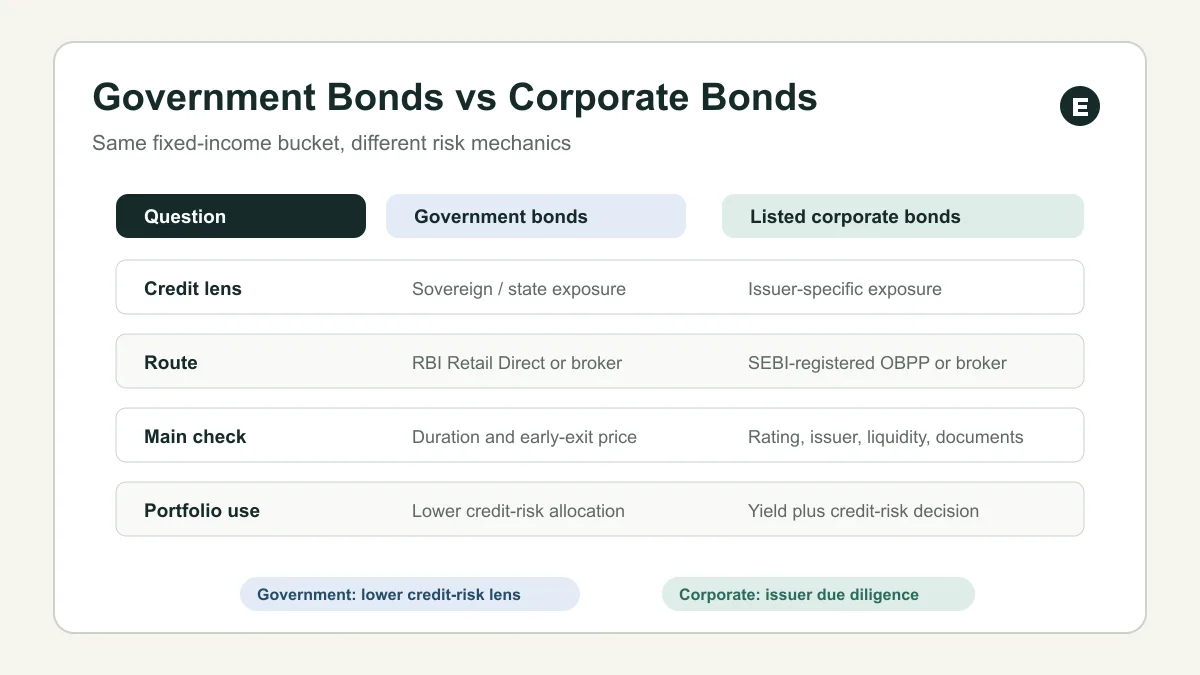
| Portfolio role | Government bonds / G-Secs | Listed corporate bonds |
| Credit-risk lens | Sovereign or state-government exposure | Issuer-specific corporate exposure |
| Yield lens | Usually lower than comparable riskier corporate bonds | May offer higher indicative yield for higher risk |
| Route | RBI Retail Direct, broker/exchange routes | SEBI-registered OBPP, broker, exchange routes |
| Holding | Retail Direct Gilt account or demat-linked route | Demat account |
| Main risk to understand | Interest-rate risk and liquidity if sold early | Credit, liquidity, interest-rate, concentration risk |
How to Invest in Government Bonds for Lower Credit Risk Exposure
Investors researching how to invest in government bonds can start with RBI Retail Direct. RBI activated the Retail Direct Scheme in 2021 to let retail individual investors open a Retail Direct Gilt account and access government securities through primary issuance and secondary-market routes.
Government bonds can reduce issuer credit risk compared with corporate debt, but they are not a shortcut around duration risk. If you buy a long-tenure G-Sec and sell before maturity, the market price may be higher or lower than your purchase price.
How to Invest in Corporate Bonds Without Over-Concentrating Risk
Investors researching how to invest in corporate bonds should focus on issuer quality and concentration before yield.
Check the issuer legal name, credit rating, rating agency, rating rationale, maturity date, coupon frequency, indicative pre-tax YTM, security cover, seniority, call or put features, liquidity, and offer document. A high displayed yield may reflect a lower rating, longer tenure, lower liquidity, sector risk, or market pricing.
Equirize's guide to yield to maturity in bonds explains why YTM should be treated as a comparison metric, not a complete investment decision.
Equirize is a SEBI-registered Online Bond Platform Provider (OBPP). Investors can use Equirize to explore listed bonds, compare key terms, and review available documents. Equirize does not provide investment advice.
Direct Bonds vs Bond Funds: Which Fits Your Bond Allocation?
The direct bonds vs bond funds decision is really a delivery-system decision. Both can sit inside a fixed-income allocation, but they behave differently.
Direct bonds give visibility into the issuer, coupon, maturity date, and cash-flow schedule. If held to maturity and the issuer pays as scheduled, the investor can plan around defined dates. The trade-off is that the investor must evaluate issuer risk, liquidity, concentration, and reinvestment.
Bond funds or debt mutual funds provide pooled exposure managed by a fund manager. They can offer diversification and easier access for smaller amounts, but the investor owns fund units rather than a specific bond maturity. The NAV can move with interest rates, credit events, flows, and portfolio changes.
| Factor | Direct listed bonds | Bond funds / debt mutual funds |
| What you own | A specific listed debt security in demat | Units of a fund scheme |
| Cash-flow visibility | Coupon and maturity dates are security-specific | Depends on scheme type and NAV movement |
| Diversification | Must be built by the investor | Built into the fund portfolio, subject to scheme mandate |
| Control | Investor chooses issuer and maturity | Fund manager chooses portfolio |
| Liquidity | Secondary-market sale, subject to buyers and price | Redemption through fund route, subject to scheme terms |
| Main diligence | Issuer, rating, price, YTM, maturity, liquidity | Duration, credit quality, expense ratio, portfolio, taxation |
If the allocation is small and diversification is difficult, a fund route may be easier to manage. If the investor wants defined maturity visibility and is comfortable reviewing individual securities, direct bonds may play a role. Many portfolios can use both.
How to Invest in Bonds After Deciding Your Allocation
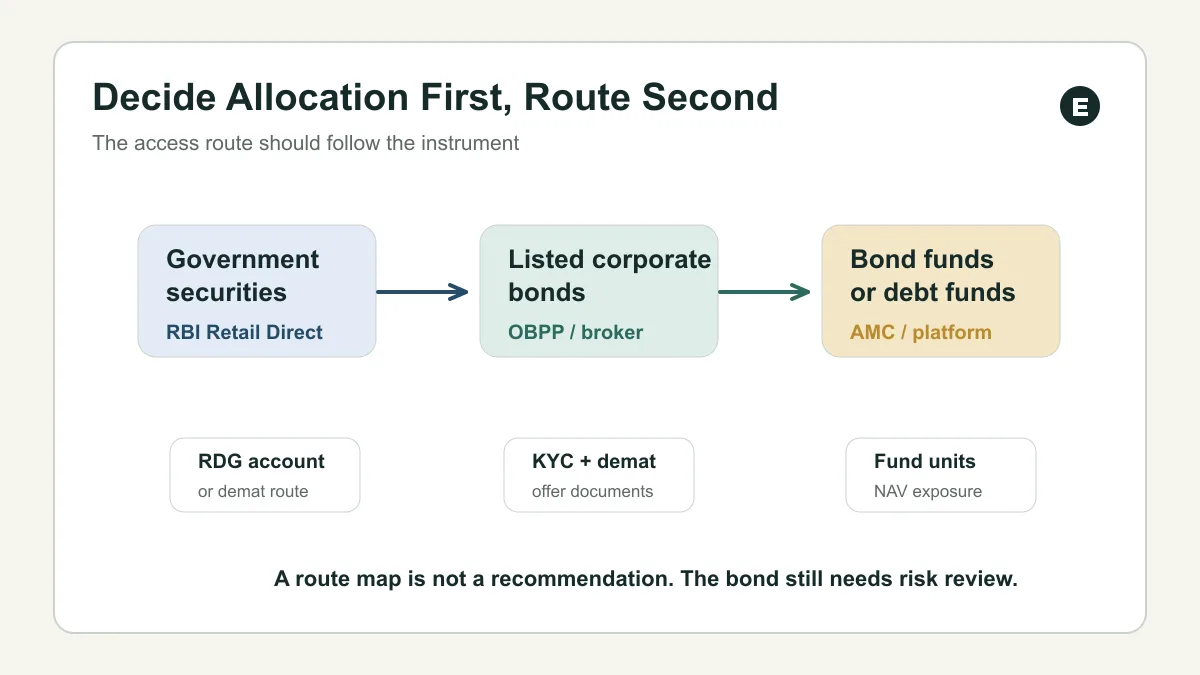
Only after deciding the allocation should you ask **how to invest in bonds**. The route depends on the instrument.
If the allocation is meant for sovereign debt, the route may be RBI Retail Direct or a broker/exchange route for government securities. If the allocation is meant for listed corporate bonds, the route may be a SEBI-registered OBPP, stock broker, or exchange mechanism. If the allocation is meant for diversified debt exposure, the route may be a mutual fund platform or broker.
How to Buy Indian Government Bonds Through RBI Retail Direct
For investors asking how to buy Indian government bonds, RBI Retail Direct is the official route to understand first. It lets eligible retail individual investors open a Retail Direct Gilt account and access government securities. Investors can participate in primary issuance and access the secondary market through the scheme's permitted routes.
Before investing, review tenure, coupon, yield, auction process, tax treatment, and whether you can hold until maturity. Lower credit risk does not mean no price movement before maturity.
How to Buy Bonds Online Through a SEBI-Registered OBPP
For investors asking **how to buy bonds online**, a SEBI-registered OBPP can help with listed corporate bond discovery and transaction flow.
A typical process includes onboarding, KYC, PAN and bank verification, demat verification, reviewing issuer and issue details, placing an order, settlement, and demat credit. The bond is not a deposit with the platform. It is a listed debt security issued by the underlying issuer and held in the investor's demat account.
SEBI issued the regulatory framework for Online Bond Platform Providers through its November 14, 2022 circular. The framework creates a regulated perimeter for online bond platforms; it does not remove the risk of the underlying security.
Bond Laddering for Portfolio Liquidity and Cash Flow
Bond laddering for portfolio planning means spreading money across different maturity dates instead of putting the full amount into one bond.
For example, an investor may divide a fixed-income allocation across bonds maturing in one, two, three, four, and five years. When one rung matures, the proceeds can be used for a planned expense or reinvested, depending on the investor's plan.
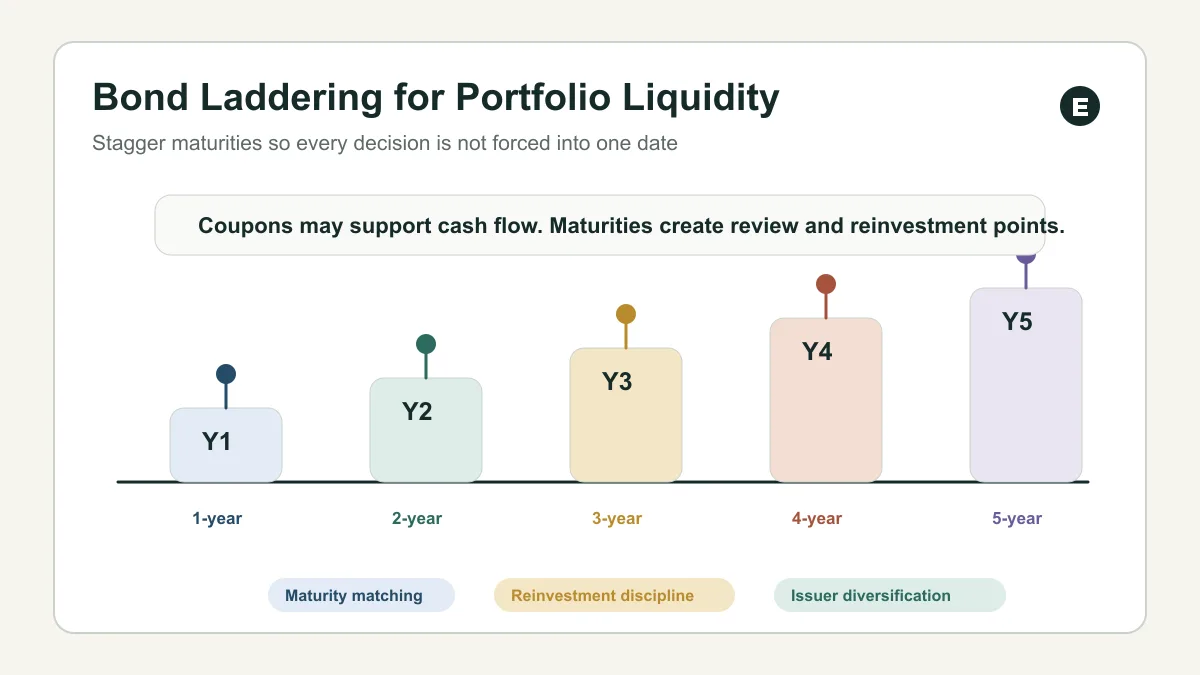
Laddering can help with three things:
- maturity matching, because some money comes due earlier;
- reinvestment discipline, because not all capital matures on one date;
- cash-flow visibility, because coupon and maturity dates can be mapped.
It does not eliminate credit risk, interest-rate risk, or liquidity risk. A ladder with five bonds from the same issuer group is not well diversified simply because it has five line items. Review issuer, group, sector, rating band, maturity, and liquidity together.
Bond Portfolio Rebalancing: When to Review Your Allocation
Bond portfolio rebalancing should happen because your portfolio has drifted from your plan or because your life has changed. It should not happen only because markets feel noisy.
Review your bond allocation when:
- equity markets have moved enough to change your intended asset mix;
- a goal has moved from long-term to medium-term;
- income stability has changed;
- a major expense is now visible;
- retirement is approaching;
- a bond is nearing maturity;
- an issuer rating or outlook has changed;
- tax rules or personal tax position have changed.
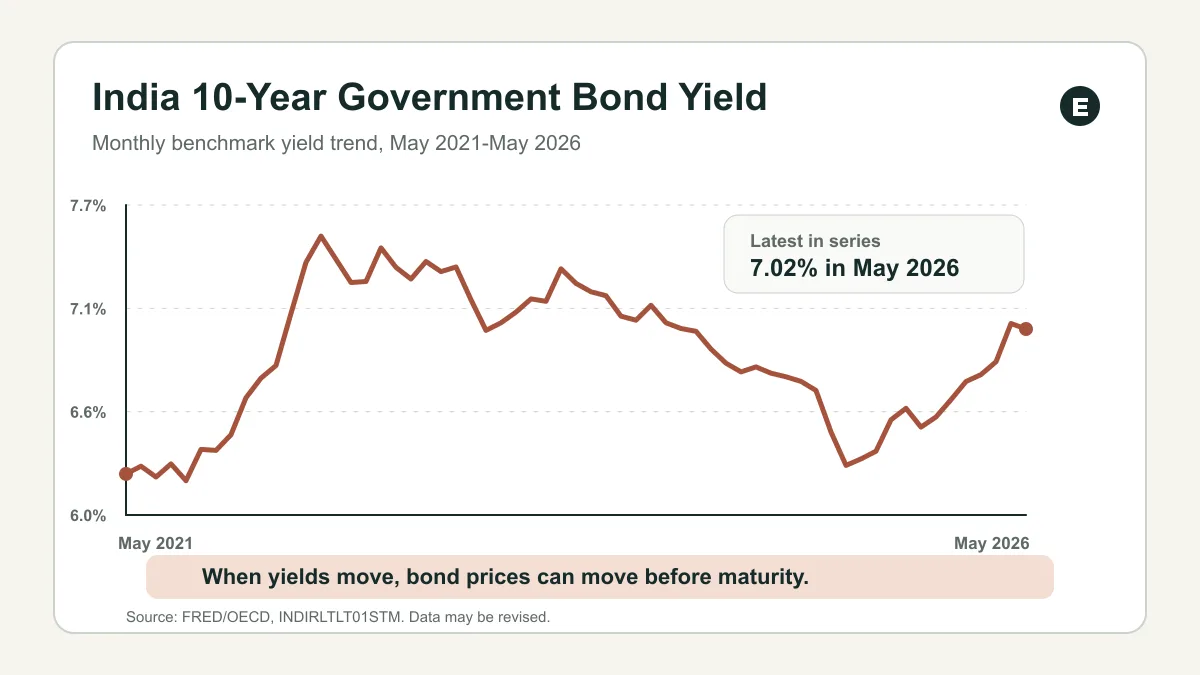
The chart above uses monthly FRED/OECD data for India's 10-year benchmark government bond yield through May 2026. It is included to show a mechanism, not to forecast rates: yields move, and bond prices can move before maturity. This is why maturity matching matters.
If you hold a bond until maturity and the issuer pays on schedule, interim price movement may matter less. If you need to sell early, it can matter a great deal.
Bond Allocation Checklist Before You Buy
Before turning an allocation into an order, use a checklist. This is especially important for direct bonds because the investor is selecting issuer-level exposure.
| Check | Question to ask | Why it matters |
| Goal | What job is this bond doing? | Prevents yield-first decisions |
| Tenure | Does maturity match the goal date? | Reduces forced early-sale risk |
| Issuer | Who is borrowing? | Credit risk sits with the issuer |
| Rating | What is the rating and agency? | Rating is a starting point for credit review |
| Documents | Have I read the offer document and risk factors? | Terms sit in the document, not in the headline |
| Liquidity | Can I exit before maturity, and at what uncertainty? | Listed does not always mean liquid |
| Tax | What is the post-tax outcome? | Coupon income may be taxed at slab rate |
| Concentration | How much exposure do I have to one issuer/group/sector? | Avoids one event dominating the portfolio |
| Route | Is the route regulated and appropriate for the instrument? | RBI Retail Direct, OBPP, broker, bank, or fund route differ |
Equirize facilitates access to listed corporate bonds through a SEBI-registered OBPP framework. Investors can compare listed bonds on Equirize, review available issue information, and evaluate whether a bond fits their portfolio role.
The mature bond-allocation question is not "What is the highest yield I can find?" It is "What fixed-income role am I trying to fill, and what risk am I accepting to fill it?"
Final Take on Bond Allocation in Portfolio
A thoughtful bond allocation starts with purpose. Emergency money needs liquidity. Near-term goals need capital access and low complexity. Income planning needs coupon and maturity visibility. Long-term portfolios need an allocation that helps the investor stay disciplined through market cycles.
The percentage will differ by investor. A growth investor may use bonds mainly for stability and rebalancing. A conservative investor may hold a larger fixed-income allocation. A retiree may focus on income visibility and liquidity buffers. None of these choices should be made only from a generic age formula.
Once the allocation is clear, choose the route: RBI Retail Direct or exchange routes for government securities, a SEBI-registered OBPP or broker for listed corporate bonds, and fund platforms for bond funds. Then run the bond-level checks: issuer, rating, maturity, liquidity, tax, concentration, offer document, and ability to hold to maturity.