Bond Laddering in India: How to Build a Bond Ladder for Regular Income


For many Indian investors, the fixed-income question is not only, "Which bond should I buy?" It is also, "When will cash come back, and will that timing match my expenses?"
That is where bond laddering in India becomes useful. A bond ladder is a way to hold bonds with different maturity dates, so that the portfolio does not depend on one issuer, one maturity date, or one reinvestment moment. It can help investors plan coupon cash flows and maturity proceeds with more visibility, subject to credit risk, market risk, liquidity risk, taxation, and issuer performance.
If your objective is regular income, a ladder is not a promise of income. It is a structure for thinking clearly about cash flow. For a deeper cash-flow view, see Equirize's guide to monthly income from bonds.
What is Bond Laddering in India?
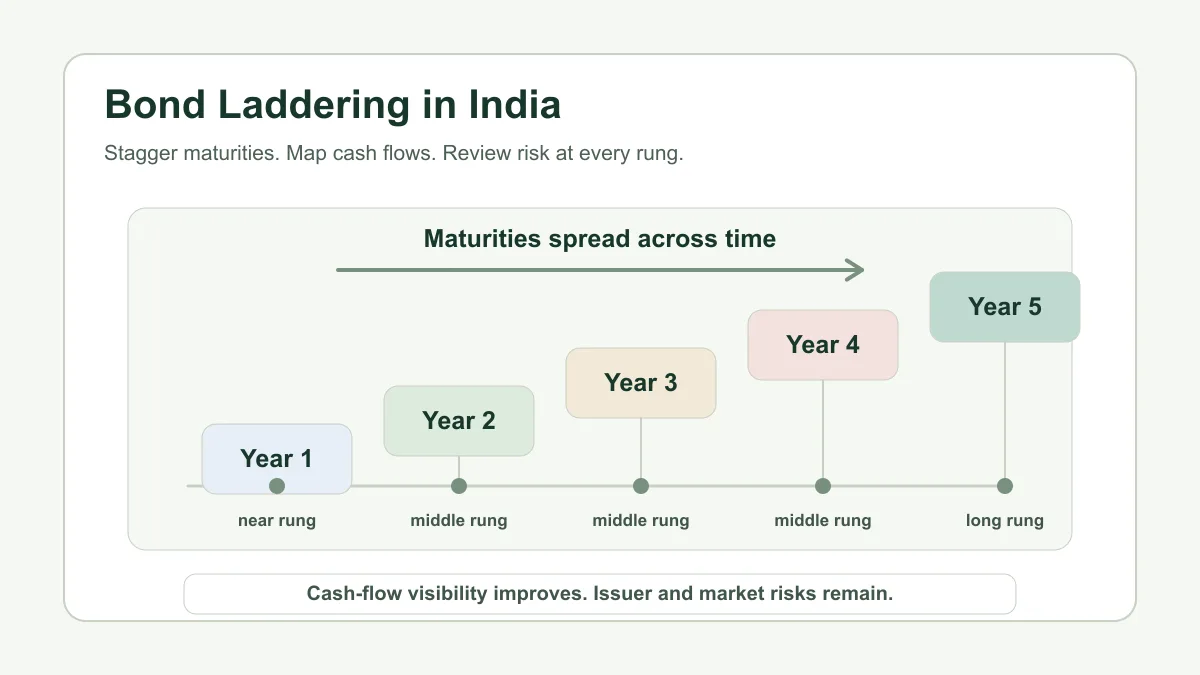
Bond laddering is a fixed-income strategy where an investor divides capital across multiple bonds with different maturity dates. Each maturity date becomes a "rung" of the ladder.
For example, instead of putting the full amount into one five-year bond, an investor may divide the amount across bonds maturing in one, two, three, four, and five years. When the first bond matures, the investor can use the proceeds for expenses or reinvest them into a new longer-tenure bond, depending on the plan.
In India, a bond ladder may include listed corporate bonds, government securities, PSU bonds, SDLs, or other listed debt securities, depending on availability, eligibility, risk profile, minimum investment, liquidity, and tax treatment. This article focuses on listed bonds and the practical checks an investor should run before using them for regular income planning.
The important point is this: a ladder organizes maturity timing. It does not remove the risks of the underlying bonds.
Bond Ladder vs One Bond: The Basic Difference
A single bond gives exposure to one issuer, one maturity date, one coupon structure, and one reinvestment point. If the maturity date does not match the investor's cash-flow need, the investor may have to sell early or keep idle cash.
A bond ladder spreads those dates. One rung may mature sooner, while other rungs continue paying coupons or remain invested. This can reduce the pressure to make one large reinvestment decision at a single point in the rate cycle.
The trade-off is that a ladder needs more monitoring. Investors must track multiple issuers, coupon dates, maturity dates, credit ratings, tax impact, and reinvestment choices.
How a Bond Ladder Can Support Regular Income Planning
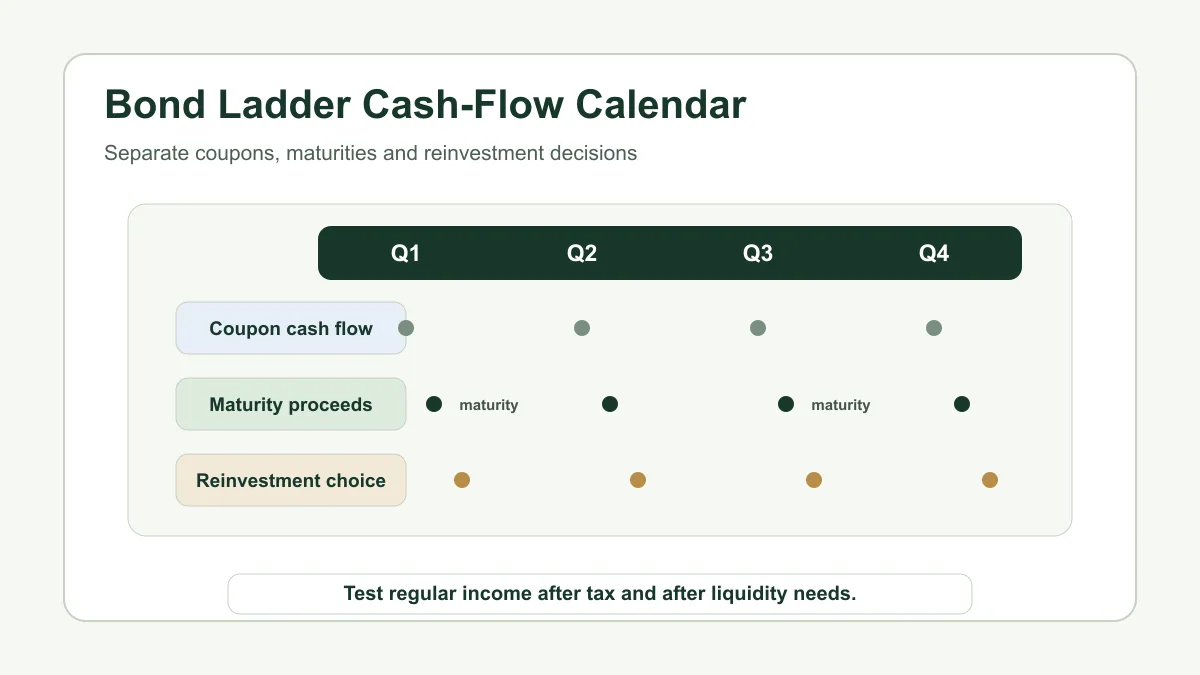
Regular income from bonds usually comes from three places:
| Cash-flow source | What it means | Risk to check |
| Coupon payments | Periodic interest payments as per bond terms | Depends on issuer's ability to pay on schedule |
| Maturity proceeds | Principal repayment at maturity | Depends on issuer's ability to repay |
| Reinvestment proceeds | Money reinvested when a rung matures | Future yields may be higher or lower |
An investor seeking monthly cash flow may look for bonds with monthly payouts. Another investor may prefer quarterly coupons and hold a separate cash buffer for monthly expenses. A third investor may focus on annual maturities, using principal repayments for planned expenses.
There is no universal design. The right structure depends on the investor's expense pattern, tax bracket, ability to hold to maturity, and comfort with credit risk.
For senior citizens and retirees, the income question should be paired with liquidity and risk. A bond may show an attractive coupon schedule, but if the investor cannot hold it through maturity or if the issuer's credit profile weakens, the ladder may not behave as expected. Equirize's guide on bonds for senior citizens covers this income-risk-liquidity trade-off in more detail.
Coupon Cash Flows are Not the Same as Certain Income
Bond coupon dates are scheduled in the offer document, but scheduled does not mean certain. Coupon payments depend on the issuer meeting its obligations.
This distinction matters in any regular-income article. A corporate bond ladder can help investors map expected cash flows, but it cannot guarantee that every coupon or maturity payment will arrive as planned. Credit risk, issuer-specific stress, interest-rate movements, liquidity constraints, and taxation can all affect actual outcomes.
The safer way to think about a bond ladder is: it improves visibility of planned cash-flow dates. It does not eliminate investment risk.
How to Build a Bond Ladder: 7-Step Framework
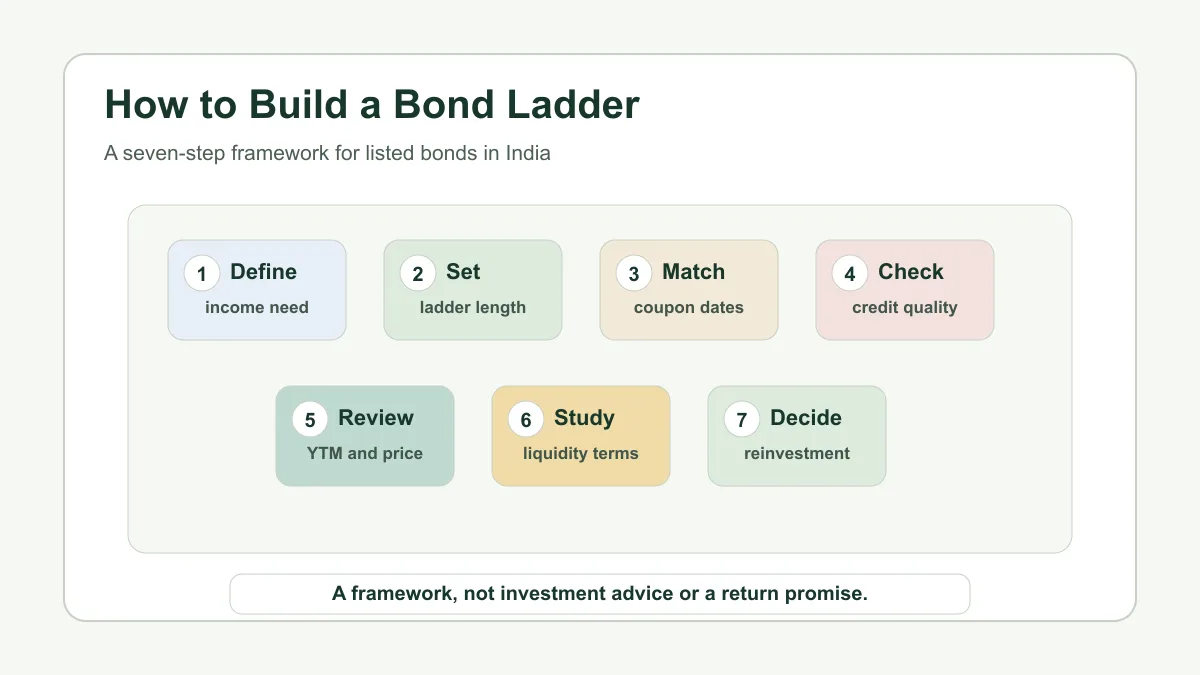
Step 1: Define the Income Need and Time Horizon
Start with the expense, not the product.
List the amount needed each month or quarter, the number of years for which the cash flow is required, and the expenses that cannot be delayed. Keep an emergency buffer outside the bond ladder. Bonds may be listed, but secondary-market liquidity is not the same as instant withdrawal.
Step 2: Decide the Ladder Length and Rung Spacing
A ladder can be short, medium, or long. A simple structure may use annual maturities across one to five years. A more detailed structure may use quarterly maturities, but that requires more instruments and more monitoring.
For many investors, annual rungs are easier to manage. Coupon frequency can then be used to smooth cash flow between maturity dates.
Step 3: Choose Coupon Frequencies that Match Cash-Flow Needs
Listed bonds may have monthly, quarterly, semi-annual, annual, cumulative, or maturity-linked payout structures. The coupon frequency should match the investor's cash-flow need as closely as possible, but it should not be the only selection filter.
A monthly-paying bond with weaker credit quality may not suit a conservative income plan. A quarterly-paying bond from an issuer the investor understands may be easier to monitor. The coupon schedule is one input, not the full decision.
Step 4: Check Credit Rating, Issuer, Sector and Security Cover
Credit rating is a useful starting point, not a complete credit decision. Investors should also review the issuer's business model, leverage, profitability, repayment history, sector exposure, security cover, and rating outlook where available.
Avoid making the ladder too dependent on one issuer, one group, or one sector. Diversification can reduce concentration risk, but it does not remove credit risk.
Step 5: Review YTM, Price and Hold-to-Maturity Assumptions
Yield to Maturity, or YTM, estimates the return an investor may earn if the bond is purchased at a given price and held until maturity, assuming payments occur as scheduled. It is usually a pre-tax measure unless stated otherwise.
This matters because two bonds with similar coupons can have different YTMs depending on price, maturity, and cash-flow structure. Equirize's fixed-income guide explains Yield to Maturity in the broader context of fixed-income investments.
If an investor sells before maturity, the realized return may differ from the YTM shown at purchase.
Step 6: Check Liquidity, Call/Put Features and Exit Options
Before adding a bond to a ladder, check whether it is listed, whether it trades regularly, and whether there is a visible market for exit. A listed bond can still have limited buyers at the price the investor expects.
Also review call and put features. A callable bond may be repaid early by the issuer if the bond terms allow it. That can disrupt the ladder, especially if reinvestment happens at a lower yield.
Step 7: Reinvest or Use Maturity Proceeds Deliberately
When a rung matures, the investor has three choices:
- Use the proceeds for planned expenses.
- Reinvest into a new rung at the longer end of the ladder.
- Keep the money liquid if the need is near-term.
This reinvestment decision is where discipline matters. A ladder works only if the investor keeps matching maturities to the original cash-flow objective, instead of chasing the most eye-catching yield on the screen.
Bond Ladder Example for Regular Income in India
The example below is illustrative only. It is not a recommendation, not a model portfolio, and not based on live bond availability.
Assume an investor wants to allocate Rs. 10 lakh to a five-rung ladder. The investor wants annual maturity visibility, some coupon cash flow, and no dependence on one maturity date.
| Rung | Illustrative allocation | Maturity role | Coupon frequency to review | Main risk check |
| 1 | Rs. 2,00,000 | Near-term maturity | Monthly or quarterly | Liquidity and issuer quality |
| 2 | Rs. 2,00,000 | Year 2 maturity | Quarterly or semi-annual | Credit rating and sector exposure |
| 3 | Rs. 2,00,000 | Year 3 maturity | Quarterly or annual | Price/YTM and tax impact |
| 4 | Rs. 2,00,000 | Year 4 maturity | Semi-annual or annual | Call features and reinvestment risk |
| 5 | Rs. 2,00,000 | Year 5 maturity | As suitable | Ability to hold to maturity |
In this structure, each rung has a different job. The first rung gives the investor an earlier maturity. The middle rungs create staggered reinvestment points. The last rung extends the ladder, but also increases the need to evaluate interest-rate risk and credit risk over a longer period.
The investor may choose monthly coupon bonds for some rungs, but the ladder should not be forced into monthly payouts at the cost of credit quality or liquidity. In practice, many income plans work better when coupon cash flows are combined with a separate cash buffer.
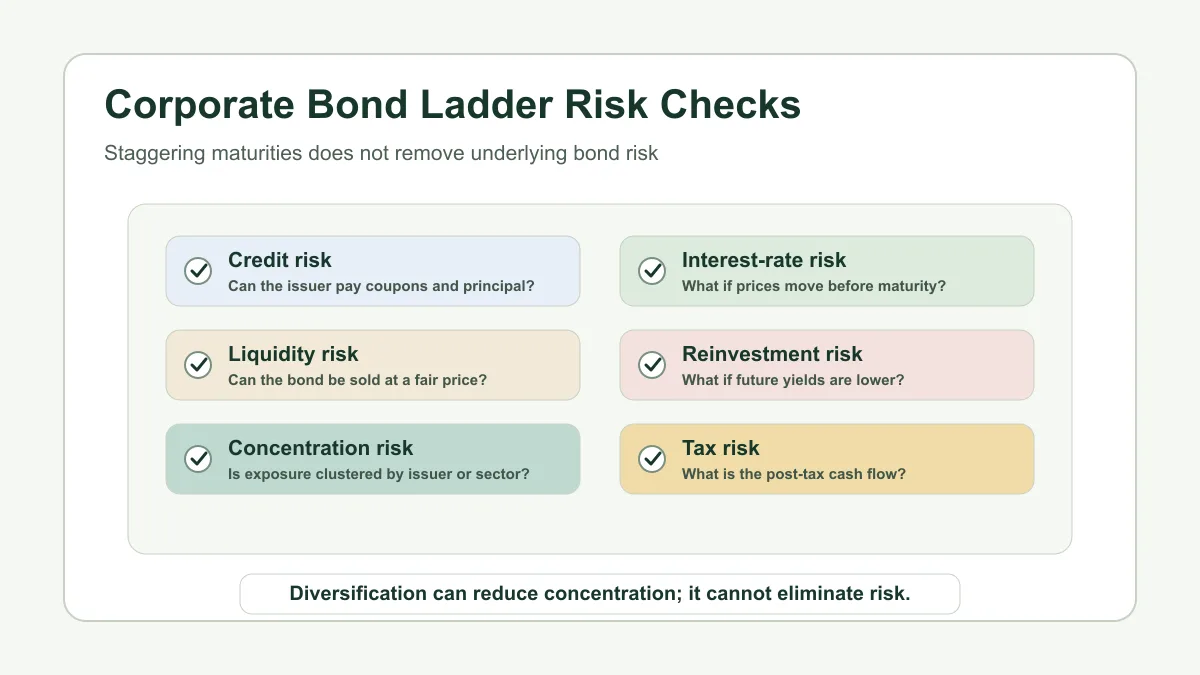
Risks to Check Before Building a Corporate Bond Ladder
A corporate bond ladder reduces the risk of depending on one maturity date. It does not remove the risks of owning corporate debt.
Credit risk is the risk that the issuer delays or defaults on interest or principal payments. This is the most important risk in a regular-income plan because the investor is depending on payments arriving on schedule.
Interest-rate risk affects bond prices. If rates rise, existing bond prices may fall. This may not matter if the investor holds to maturity and the issuer pays as scheduled, but it matters if the investor needs to sell early.
Reinvestment risk appears when a bond matures and the available reinvestment yields are lower than expected. A ladder spreads reinvestment dates, but it does not control future rates.
Liquidity risk matters if the investor may need to exit before maturity. A bond can be listed and still trade infrequently.
Tax risk matters because coupon income and capital gains may be taxed differently based on the investor's circumstances and applicable law. Tax treatment may change, so investors should consult a qualified tax advisor.
SEBI's regulatory framework for Online Bond Platform Providers was introduced through its circular dated November 14, 2022, to regulate online bond platforms and bring listed debt-securities access into a clearer framework: SEBI OBPP circular.
Why Diversification Does Not Remove Risk
Diversification can reduce dependence on one issuer or maturity, but it cannot remove risk. If the entire ladder is concentrated in one sector, one credit-quality band, or one economic cycle, the portfolio can still face correlated stress.
A better ladder design reviews issuer, sector, rating, security cover, payout frequency, maturity, liquidity, and tax together.
What Can Break the Ladder?
A bond ladder can become less effective if:
- an issuer delays or misses payment;
- a callable bond is redeemed earlier than expected;
- the investor sells before maturity at an unfavourable price;
- a rung matures when reinvestment yields are lower;
- too much capital is concentrated in one issuer or sector;
- tax impact reduces post-tax cash flow more than expected.
These are not reasons to avoid laddering. They are reasons to build the ladder with the right questions upfront.
Bond Ladder vs Bond Fund vs Fixed Deposit Ladder
Investors often compare bond ladders with debt mutual funds and fixed deposit ladders. The right fit depends on the job the fixed-income allocation is meant to do.
| Factor | Bond ladder | Debt mutual fund | Fixed deposit ladder |
| Ownership | Specific bonds in demat | Units of a pooled scheme | Individual deposits |
| Cash-flow path | Coupons and maturity proceeds, subject to issuer performance | NAV movement and scheme distributions, if any | Interest and maturity as per deposit terms |
| Control | Investor chooses issuer and maturity | Fund manager decides portfolio | Depositor chooses bank/NBFC and tenure |
| Liquidity | Secondary-market sale, subject to buyers and price | Redemption through fund route, subject to scheme terms | Premature withdrawal rules vary |
| Main risks | Credit, interest-rate, liquidity, concentration, reinvestment | Credit, duration, liquidity, expense, NAV risk | Bank/NBFC credit risk, premature withdrawal terms, tax |
| Better suited for | Defined maturity and cash-flow planning | Managed exposure and diversification | Simpler deposit-based planning |
This is not a ranking. It is a structure comparison. For a fuller comparison between direct bonds and debt mutual funds, read Equirize's guide on debt mutual fund vs direct bonds.
Using an OBPP to Review Listed Bonds for a Ladder
A SEBI-registered Online Bond Platform Provider helps investors review listed bond opportunities in one place. Investors can compare issuer names, credit ratings, maturity dates, coupon frequencies, indicative YTM, offer documents, and risk factors before deciding.
Equirize is a SEBI-registered Online Bond Platform Provider (OBPP). Equirize facilitates access to listed corporate bonds. Equirize does not provide investment advice.
For a bond ladder, the useful platform question is not only, "What is the yield?" It is:
- When does the bond mature?
- What is the coupon frequency?
- Who is the issuer?
- What is the credit rating and rating agency?
- Is the bond secured or unsecured?
- What does the offer document say?
- Is there secondary-market liquidity?
- Can I hold this bond until maturity?
Investors can explore listed bonds on Equirize and compare live fixed-income opportunities. For investors starting with smaller ticket sizes, Equirize also has a guide to investing in bonds in India with Rs. 10,000.
Who Should Consider a Bond Ladder, and Who Should Pause?
A bond ladder may suit investors who have defined future expenses, want better visibility on coupon and maturity dates, can hold bonds until maturity, and are comfortable reviewing credit risk and offer documents.
It may also suit investors who do not want all fixed-income capital maturing on one date. By spreading maturities, they can review reinvestment decisions gradually.
An investor should pause before building a ladder if the money may be needed at short notice, if the investment amount is too small to diversify, if the investor is uncomfortable with issuer-level credit risk, or if the objective is certainty of income and principal.
The last point is important. A bond ladder is a planning framework. It is not a substitute for emergency cash, insurance, or personal financial advice.
Bond Laddering in India: Final Checklist Before You Invest
Before building a bond ladder, answer these questions:
- What expense or income need is this ladder meant to support?
- What amount should remain outside bonds for emergency liquidity?
- How many rungs are practical to monitor?
- Are maturities staggered across time?
- Are coupon dates mapped to actual expenses?
- Is exposure diversified across issuers and sectors?
- Have credit rating, rating outlook, security cover, and offer documents been reviewed?
- Is YTM being treated as pre-tax and hold-to-maturity unless stated otherwise?
- What happens if the bond must be sold before maturity?
- What will be done when each rung matures?
The more clearly these answers are written down, the less likely the ladder is to become a collection of unrelated bonds.
Review listed bond details, cash-flow schedules and offer documents on Equirize.