Fixed Income Investments in India: Types, Returns & Guide (2026)



Fixed income investments are financial instruments that pay a predetermined or relatively predictable return over a specified period. When you invest in a bond, government security, or similar instrument, you are essentially lending money to an issuer in exchange for regular interest payments and the return of your principal at maturity.
Unlike equities, where returns depend largely on market performance, fixed income securities are designed to provide greater visibility into potential earnings. That predictability makes them a popular choice for investors seeking stability alongside growth-oriented assets.
In India, the fixed income landscape has expanded significantly beyond traditional fixed deposits. Today, investors can access a wide range of opportunities, including corporate bonds, government bonds, debt mutual funds, and other debt investments India offers through regulated platforms.
Fixed Income Market in India: 2026 Outlook
India's fixed income market has entered a phase of steady expansion. Strong economic growth, rising corporate borrowing, and increasing investor participation have pushed bonds further into the mainstream investment conversation.
Large corporates, financial institutions, and infrastructure companies continue to raise capital through the bond market, creating a broader investment universe for retail investors. As access improves through digital platforms, fixed income investments in India are no longer limited to institutions and high-net-worth individuals.
Rising Retail Participation
Retail investors are becoming more comfortable moving beyond traditional fixed deposits. A growing awareness of yield, diversification, and risk-adjusted returns has increased interest in corporate bonds India and other fixed income products.
Technology has played a major role in this shift. Investors can now compare opportunities, review issuer information, and invest online with far greater transparency than was possible a few years ago. The result is a more informed investor base that is actively exploring alternatives within debt investments India offers.
Interest Rate Environment and Its Impact
Interest rates remain one of the biggest drivers of fixed income performance. After a period of elevated rates aimed at controlling inflation, investors in 2026 are closely watching the Reserve Bank of India's policy direction.
Higher interest rates generally create opportunities to lock in attractive yields on newly issued bonds. At the same time, any future rate cuts could support bond prices, potentially benefiting investors who position themselves early. This dynamic makes active evaluation more important than simply chasing the highest available yield.
Why Fixed Income Investments are Becoming More Relevant
Market volatility has reminded investors that returns and risk are inseparable. While equities remain an important wealth-creation tool, many investors now want greater balance within their portfolios.
A well-constructed fixed income portfolio can provide stability, predictable cash flows, and diversification during uncertain market conditions. That combination is especially appealing for investors approaching major financial goals, planning retirement, or seeking regular income. As a result, fixed income investments in India are increasingly moving from a defensive allocation to a strategic one.
Types of Fixed Income Investments in India
India's fixed income market offers far more choice than most investors realise. From government-backed securities to corporate debt and tax-saving instruments, each option serves a different purpose depending on your risk tolerance, income requirements, and investment horizon.
The table below provides a quick comparison of some of the most popular fixed income investments in India:
| Instrument | Risk Level | Return Potential | Liquidity | Ideal Horizon |
|---|---|---|---|---|
| Corporate Bonds | Moderate | Moderate to High | Moderate to High | 1-10 years |
| Government Securities (G-Secs) | Low | Moderate | High | 5-40 years |
| Treasury Bills | Very Low | Low to Moderate | High | Up to 1 year |
| State Development Loans (SDLs) | Low | Moderate | Moderate | 5-15 years |
| Fixed Deposits | Low | Moderate | Moderate | 1-10 years |
| PPF | Very Low | Moderate | Low | 15 years |
| NSC | Very Low | Moderate | Low | 5 years |
| RBI Floating Rate Bonds | Very Low | Moderate | Low | 7 years |
| Debt Mutual Funds | Low to Moderate | Moderate | High | Flexible |
| Target Maturity Funds | Low to Moderate | Moderate | High | Goal-based |
| Tax-Free Bonds | Low | Moderate | Moderate | Long-term |
Corporate Bonds
Corporate bonds are debt instruments issued by companies to raise capital. In return, investors receive regular interest payments and repayment of principal at maturity.
The biggest attraction of corporate bonds India investors consider is the potential for higher yields compared to traditional fixed deposits. Bonds issued by established companies such as banks, NBFCs, and large corporates often provide attractive risk-adjusted returns while offering predictable income.
Government Securities (G-Secs)
Government Securities are issued by the Government of India to fund public expenditure and borrowing requirements. Since they carry sovereign backing, they are widely regarded as one of the safest investment options available.
G-Secs appeal to investors seeking stability and long-term income. They are available through the RBI Retail Direct platform, making access easier for individual investors.
Treasury Bills (T-Bills)
Treasury Bills are short-term government securities issued with maturities of 91 days, 182 days, and 364 days. Unlike traditional bonds, they do not pay periodic interest.
You purchase T-Bills at a discount and receive the face value at maturity. Their short duration and sovereign backing make them suitable for parking surplus funds with minimal risk.
State Development Loans (SDLs)
State Development Loans are bonds issued by Indian state governments to finance development projects and budgetary requirements.
SDLs generally offer slightly higher yields than comparable government securities. While they carry low credit risk, they may be less liquid than central government bonds in the secondary market.
Fixed Deposits (FDs)
Fixed Deposits remain one of India's most popular fixed income products. Banks and financial institutions offer a fixed interest rate for a specified tenure, providing certainty around returns.
Many investors choose FDs for their simplicity and familiarity. While returns may not always outpace inflation, they continue to play a role in conservative portfolios.
Public Provident Fund (PPF)
The Public Provident Fund is a government-backed long-term savings scheme designed to encourage disciplined wealth creation.
PPF combines capital safety, tax benefits, and compounding growth. Its 15-year tenure makes it particularly useful for long-term goals such as retirement planning or children's education.
National Savings Certificate (NSC)
National Savings Certificates are fixed income instruments offered through India Post. They provide a fixed rate of return over a five-year period and qualify for tax deductions under Section 80C.
NSCs are often used by investors seeking a secure, government-backed investment with predictable returns and minimal complexity.
RBI Floating Rate Savings Bonds
These bonds are issued directly by the Reserve Bank of India and offer interest rates linked to prevailing government savings schemes.
Unlike traditional fixed-rate bonds, the coupon rate adjusts periodically. This feature can help investors navigate changing interest rate environments more effectively.
Debt Mutual Funds
Debt mutual funds invest in a diversified portfolio of bonds, money market instruments, and other fixed income securities. Professional fund managers actively manage these portfolios based on market conditions.
For investors seeking liquidity and diversification, debt funds can provide access to a broad range of debt investments India offers without requiring direct security selection.
Target Maturity Funds
Target Maturity Funds are passive debt funds that hold bonds maturing around a predetermined date. Investors can align these funds with specific financial goals and time horizons.
Their structure provides greater visibility into expected outcomes compared to many actively managed debt funds, making them increasingly popular among goal-based investors.
Tax Free Bonds
Tax-free bonds are long-term debt instruments typically issued by government-backed entities such as infrastructure and public sector organisations.
The interest earned from these bonds is exempt from income tax, which can significantly improve post-tax returns for investors in higher tax brackets. Although fresh issuances remain limited, existing bonds continue to trade in the secondary market.
Alternative Fixed Income Investments
Beyond traditional instruments, investors can also explore alternative fixed income opportunities such as market-linked debentures, securitised debt products, and structured debt offerings.
These products often target investors seeking higher fixed income returns, but they may involve additional complexity and risk. Careful evaluation becomes particularly important before allocating capital to alternative fixed income opportunities.
Key Risks in Fixed Income Investing You Must Understand
Many investors associate fixed income with safety. While these instruments generally carry lower volatility than equities, they are not risk-free. Understanding the key risks can help you make better decisions and avoid unpleasant surprises.
Credit Risk
Credit risk refers to the possibility that an issuer may fail to make interest payments or repay the principal amount on time.
Not all bonds carry the same level of creditworthiness. A bond issued by a financially strong company typically carries lower risk than one issued by a company with weaker financials. This is why credit ratings matter. Higher yields often signal higher risk, and chasing returns without assessing the issuer's ability to repay can be costly.
Interest Rate Risk
Bond prices and interest rates move in opposite directions. When interest rates rise, the value of existing bonds tends to fall. When rates decline, existing bonds often become more valuable.
Suppose you purchase a bond yielding 7%. If newly issued bonds start offering 9%, investors may find your bond less attractive, which can reduce its market value. This risk becomes more pronounced in long-term bonds.
Liquidity Risk
Liquidity risk arises when you want to sell an investment before maturity but struggle to find a buyer at a fair price.
Some government bonds India investors purchase trade actively in the market, making them relatively liquid. Certain corporate bonds, however, may have limited trading activity. During periods of market stress, liquidity can become even harder to access.
Inflation Risk
Inflation gradually reduces the purchasing power of your money. Even if your investment generates a fixed return, rising prices can erode your real wealth.
For example, if a bond earns 7% annually but inflation averages 6%, your actual gain after accounting for inflation remains relatively modest. Investors focused only on nominal returns often underestimate this risk.
Reinvestment Risk
Interest payments received from bonds or other fixed income instruments need to be reinvested if you want to maximise long-term returns.
The challenge arises when interest rates fall. Future reinvestment opportunities may offer lower yields than the original investment, reducing your overall fixed income returns over time.
Default Risk
Default risk represents the most severe form of credit risk. It occurs when an issuer fails to meet its debt obligations entirely.
While defaults remain relatively rare among high-quality issuers, they can occur. Investors should never assume that every bond offers the same level of safety simply because it belongs to the fixed income category.
How to Manage These Risks
The most effective way to manage fixed income risks is through careful selection and diversification. Consider the following principles:
- Diversify across issuers and instrument types.
- Focus on credit quality rather than headline yields.
- Align investment maturity with your financial goals.
- Maintain a mix of short-, medium-, and long-term holdings.
- Review your fixed income portfolio periodically as market conditions change.
The strongest investors do not avoid risk entirely. They understand it, price it correctly, and build portfolios that can withstand different market environments. That approach remains just as important for fixed income investments in India as it does for any other asset class.
How to Evaluate a Fixed Income Investment Before You Invest
A fixed income investment may offer an attractive yield on paper, but yield alone tells only part of the story. The real question is whether the investment aligns with your risk tolerance, income needs, and financial goals. Smart investors look beyond returns and evaluate multiple factors before committing capital.
Check the Credit Rating
Credit ratings provide an independent assessment of an issuer's ability to meet its debt obligations. In India, agencies such as CRISIL, ICRA, CARE Ratings, and India Ratings evaluate bonds and assign ratings based on credit quality.
Higher-rated instruments generally carry lower default risk, while lower-rated bonds often compensate investors with higher yields. If two bonds offer similar returns, choosing the issuer with stronger credit quality is usually the more prudent decision.
Understand Yield vs Coupon Rate
Many investors confuse coupon rate with yield. The coupon rate represents the fixed interest paid on the bond's face value, while yield reflects the actual return based on the price you pay for the bond.
Consider a bond with a face value of ₹1,000 and a coupon rate of 8%. If you purchase it in the secondary market for ₹950, your effective yield will be higher than 8%. Understanding this distinction helps you compare opportunities more accurately and avoid misleading return assumptions.
Assess the Issuer's Financial Health
A credit rating offers a useful starting point, but it should not be your only source of information.
Review the issuer's business performance, debt levels, profitability, and cash flow position whenever possible. Companies with strong balance sheets and stable earnings generally have a greater capacity to service debt during economic downturns. This becomes especially important when evaluating corporate bonds India investors often consider for higher yields.
Review Maturity and Direction
The maturity period determines how long your money remains invested. Some instruments mature within a few months, while others can extend for decades.
Your investment horizon should guide your choice. If you need funds within three years, a 15-year bond may not be appropriate regardless of its yield. Longer-duration investments also tend to react more sharply to changes in interest rates.
Evaluate Liquidity
Liquidity determines how easily you can exit an investment before maturity.
Certain government bonds India investors purchase enjoy active trading volumes and relatively easy exit options. Other bonds may have limited market participation, making it difficult to sell quickly without accepting a lower price. Liquidity becomes particularly important if you anticipate needing access to your capital unexpectedly.
Understand Tax Implications
Taxes can significantly affect your actual earnings. Two investments offering identical pre-tax returns may produce very different post-tax outcomes.
Before investing, calculate the net return after considering interest taxation, capital gains treatment, and any available tax benefits. Focusing solely on headline yields can lead to disappointing results once taxes are factored in.
Match Investments With Your Financial Goals
The best fixed income investment is not necessarily the one offering the highest return. It is the one that serves a specific purpose within your broader financial plan.
A retiree seeking regular income may prioritise predictable cash flows. A professional saving for a house purchase in five years may focus on capital preservation and liquidity. Your goals should drive your investment decisions, not market trends. A simple evaluation framework can help:
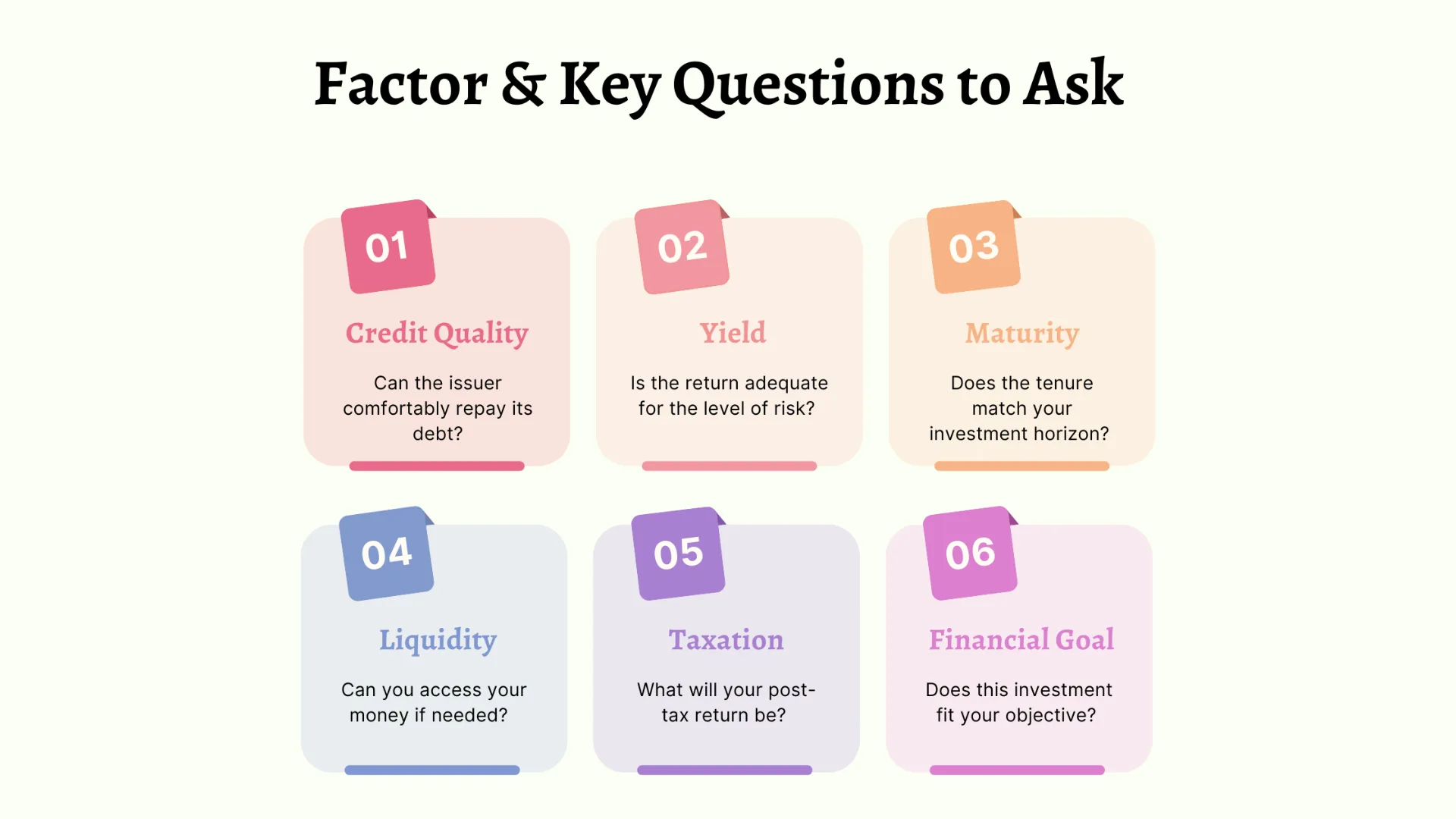
The most successful investors approach fixed income investments in India with the same discipline they apply to equities. They analyse risk, assess quality, and invest with a clear purpose rather than chasing the highest available yield.
Fixed Income Taxation in India: A Complete 2026 Guide
Taxes play a major role in determining the actual return you earn from any investment. Two instruments may offer similar yields, but the one with better tax efficiency can leave more money in your pocket. That makes taxation an essential factor when evaluating fixed income investments in India.
Taxation of Corporate Bonds
Interest earned from corporate bonds is taxable according to your income tax slab. The interest gets added to your total income and taxed at the applicable rate.
For example, if you earn ₹50,000 in annual bond interest and fall under the 30% tax bracket, your tax liability on that income could significantly reduce your effective return. Investors should always evaluate post-tax yields rather than relying solely on advertised coupon rates.
When you sell listed corporate bonds before maturity, any capital gain is subject to capital gains taxation depending on the holding period and prevailing tax rules.
Taxation of Government Securities
Interest income from government bonds India investors hold generally follows the same principle as corporate bonds. The interest is added to your taxable income and taxed according to your slab rate.
Capital gains may arise if you sell the securities before maturity at a profit. The applicable tax treatment depends on factors such as holding period and the latest income tax regulations in force at the time of sale.
Although government securities offer high credit quality, they do not automatically provide tax-free income unless specifically structured to do so.
Taxation of Fixed Deposits
Interest earned from fixed deposits is fully taxable under the head "Income from Other Sources."
Banks may also deduct Tax Deducted at Source (TDS) once interest income exceeds the prescribed threshold limits. Even if TDS is deducted, you remain responsible for reporting the full interest income in your tax return.
Many investors overlook taxation while comparing FDs with bonds. As a result, the investment that appears attractive on a pre-tax basis may deliver lower net returns after taxes.
Taxation of Debt Mutual Funds
Debt mutual funds have undergone significant tax changes in recent years, making them less tax-advantaged than they once were.
For many debt mutual fund investments purchased under the revised taxation framework, gains are taxed according to the investor's applicable income tax slab rather than receiving traditional long-term capital gains benefits. Investors should carefully review the tax treatment applicable to their specific investment before making allocation decisions.
Capital Gains Tax on Fixed Income Investments
Capital gains arise when you sell an investment for more than its purchase price.
The tax treatment depends on several factors, including the type of instrument, whether it is listed or unlisted, and the duration for which you hold it. Since tax laws evolve periodically, investors should verify the latest provisions before making investment decisions based on anticipated tax outcomes.
A simple way to think about taxation is to separate income from gains:
| Source of Return | Typical Tax Treatment |
|---|---|
| Interest Income | Taxed as per income tax slab |
| Capital Gains | Tax treatment depends on holding period and applicable rules |
Strategies to Improve Post-tax Returns
Improving post-tax returns often has a greater impact on wealth creation than chasing marginally higher yields.
Consider these practical approaches:
- Compare investments based on post-tax returns rather than headline yields.
- Use tax-efficient instruments where suitable for your financial goals.
- Diversify across multiple fixed income products instead of concentrating in a single instrument.
- Align investment choices with your income tax bracket.
- Factor taxation into your overall fixed income portfolio strategy.
A bond yielding 8.5% may not necessarily outperform one yielding 8% if taxation significantly alters the final outcome. Successful investors focus on what they keep, not just what they earn. Understanding the tax implications of debt investments India offers can help you make more informed decisions and maximise long-term fixed income returns.
Fixed Income vs Other Investments: Which is Right for You?
No single investment works for every investor or every financial goal. The right choice depends on your risk tolerance, return expectations, investment horizon, and need for liquidity. Rather than viewing asset classes as competitors, it often makes more sense to understand the role each one plays in a portfolio.
Fixed Income vs Equity
Equities offer ownership in a company and the potential for significant long-term capital appreciation. Fixed income investments, on the other hand, focus more on capital preservation and predictable income.
If you invest ₹10 lakh in equities, your portfolio value may fluctuate sharply during market cycles. A similar allocation to high-quality fixed income investments in India is likely to experience lower volatility, though it may generate more moderate returns over time.
Fixed Income vs Mutual Funds
Mutual funds cover a broad spectrum of investments, including both equity and debt-oriented products. The comparison therefore depends on the type of fund you choose.
Equity mutual funds generally aim for higher growth but carry greater market risk. Debt mutual funds invest in bonds and other fixed income securities, making them more closely aligned with traditional fixed income strategies.
For investors who prefer professional management and diversification without selecting individual securities, mutual funds can be an effective option.
Fixed Income vs Gold
Gold has historically served as a hedge against economic uncertainty and inflation. Unlike bonds or other income-generating instruments, however, gold does not provide regular cash flow.
Its value depends largely on market demand and price movements. Fixed income investments offer greater predictability, while gold can provide diversification during periods of market stress.
Many investors use both asset classes rather than choosing one exclusively.
Fixed Income vs Real Estate
Real estate offers the potential for rental income and long-term capital appreciation. It also requires significantly higher capital commitments and often comes with lower liquidity.
Selling a property can take weeks or months. By comparison, many bonds and other debt investments India offers can be bought and sold far more efficiently. Real estate also involves maintenance costs, taxes, and transaction expenses that investors should factor into their calculations.
Fixed Income vs Fixed Deposits
Fixed Deposits remain one of the most familiar investment products for Indian households. They offer simplicity, capital stability, and predictable returns.
The key difference lies in flexibility and return potential. Certain corporate bonds India investors consider may offer higher yields than comparable FDs, though they can involve varying levels of credit and market risk. Fixed deposits may suit investors who prioritise simplicity, while bonds provide access to a broader range of opportunities.
How Much of Your Portfolio Should Be in Fixed Income?
There is no universal percentage that works for every investor. The ideal allocation depends on your age, financial goals, income needs, risk tolerance, and investment horizon. A 30-year-old building long-term wealth will likely need a different mix than someone approaching retirement.
The real purpose of fixed income is not to maximise returns. It is to provide stability, preserve capital, and create a reliable source of income when markets become unpredictable.
For Conservative Investors
Conservative investors typically prioritise capital preservation over aggressive growth. They are often retirees, near-retirees, or individuals with short- to medium-term financial goals.
A fixed income allocation of 70% to 90% may be appropriate in such cases. Government securities, high-quality corporate bonds, and other relatively stable instruments can help reduce volatility while generating predictable cash flows.
For Moderate Investors
Moderate investors seek a balance between growth and stability. They want exposure to equities but also recognise the importance of managing risk.
An allocation of 40% to 60% in fixed income investments in India can provide that balance. This approach allows you to participate in equity market growth while maintaining a cushion against market downturns. Many long-term investors fall into this category.
For Aggressive Investors
Aggressive investors typically have longer investment horizons and a higher tolerance for short-term market fluctuations.
Even in growth-focused portfolios, fixed income still plays an important role. A 10% to 30% allocation can provide diversification and liquidity without significantly reducing growth potential. Ignoring fixed income entirely often increases portfolio risk more than investors realise.
Age-Based Asset Allocation Approach
A commonly used guideline suggests increasing your fixed income allocation as you get older. The closer you are to retirement, the less time you have to recover from significant market declines. For example:
| Age Group | Suggested Fixed Income Allocation |
|---|---|
| 25 - 35 Years | 10% - 20% |
| 36 - 45 Years | 20% - 40% |
| 46 - 55 Years | 30% - 60% |
| 56+ Years | 50% - 80% |
Goal-Based Allocation Approach
Your financial goals often matter more than your age.
If you are saving for a house down payment within three years, a larger allocation to fixed income may make sense regardless of your age. On the other hand, a 50-year-old investor building a retirement corpus for the next 15 years may still maintain meaningful equity exposure.
The strongest portfolios are designed around goals, not market headlines. A well-diversified fixed income portfolio can provide stability, reduce overall risk, and support long-term wealth creation alongside growth-oriented investments. That balance is often more valuable than chasing the highest possible returns.
Fixed Income Investment Strategies for Different Types of Investors
The best fixed income strategy depends on what you need your money to do. An investor focused on retirement income will have very different priorities from someone building wealth over the next two decades. Matching your strategy to your financial goals often matters more than selecting the highest-yielding investment.
Strategy for Retirees
Retirees typically prioritise regular income and capital preservation. Protecting accumulated wealth often becomes more important than pursuing aggressive growth.
A portfolio focused on high-quality corporate bonds, government bonds India investors trust, and other relatively stable income-generating instruments can help create predictable cash flows. Many retirees also prefer staggering maturities so that portions of their investments become available at different intervals, reducing reinvestment risk.
Strategy for Salaried Professionals
Salaried professionals often juggle multiple goals, including home ownership, children's education, retirement planning, and emergency savings.
For this group, fixed income works best as a stabilising component within a broader investment portfolio. A mix of short- and medium-term debt investments India offers can help balance liquidity needs while providing steady returns. Investors approaching a major financial goal may gradually increase their fixed income allocation to protect accumulated capital.
Strategy for High-Net-Worth Individuals (HNIs)
HNIs often use fixed income not only for income generation but also for capital preservation and portfolio diversification.
A diversified allocation across different issuers, maturities, and credit profiles can help manage risk while optimising returns. Some investors combine high-quality corporate bonds with select higher-yield opportunities to enhance overall portfolio efficiency. The focus shifts from simply earning interest to building a sophisticated fixed income portfolio that complements other asset classes.
Strategy for Young Investors
Many younger investors focus heavily on equities, which makes sense given their longer investment horizons. Even so, ignoring fixed income entirely can create unnecessary portfolio imbalance.
A modest allocation to fixed income investments in India can provide stability and liquidity without significantly reducing growth potential. Young professionals saving for a future down payment, higher education, or entrepreneurial venture may benefit from maintaining a dedicated fixed income allocation alongside equity investments.
Strategy for Business Owners
Business owners often face irregular cash flows and unique liquidity requirements. Their investment strategy needs to balance return generation with easy access to capital.
Short- to medium-duration fixed income instruments can help preserve surplus business funds while earning better returns than idle cash. Liquidity becomes particularly important because investment decisions may need to adapt quickly to business opportunities or unexpected expenses.
One common mistake investors make is copying someone else's strategy. A retiree's approach, a young professional's plan, and a business owner's allocation can all be correct at the same time because each serves a different objective. The strongest fixed income strategies are built around personal goals, cash flow needs, and risk tolerance rather than market trends.
How to Build a Fixed Income Portfolio in India in 2026
Step 1: Define Your Investment Objective
Are you looking for regular income, capital preservation, retirement planning, or a place to park surplus funds? Your objective will influence every decision that follows. A portfolio designed for monthly income will look very different from one created to fund a child's education ten years from now.
Step 2: Determine Your Time Horizon
Short-term goals generally require investments with lower volatility and greater liquidity. Longer-term goals allow you to consider a wider range of fixed income opportunities. A mismatch between investment tenure and financial goals can create unnecessary risk, even when the underlying investment is high quality.
Step 3: Assess Your Risk Tolerance
Not all fixed income investments carry the same level of risk. Some investors are comfortable accepting moderate credit risk in exchange for higher returns, while others prioritise maximum capital protection.
You can also check out - Building an Investment Portfolio with Equirize: A Step-by-Step Guide
Understanding your comfort level with potential fluctuations and credit exposure helps create a more sustainable investment strategy. The goal is to build a portfolio you can stay invested in through different market conditions.
Step 4: Diversify Across Fixed Income Instruments
Rather than concentrating your entire allocation in a single instrument, consider spreading investments across multiple categories such as government securities, corporate bonds India investors commonly use, and other fixed income products. Different instruments respond differently to market conditions, which can improve overall portfolio stability.
Step 5: Focus on Credit Quality
A bond offering 11% may not necessarily be a better investment than one offering 8% if the issuer carries significantly higher risk. Strong portfolios balance return potential with issuer strength. Investors who consistently prioritise quality often avoid the most costly mistakes.
Step 6: Monitor Interest Rate Trends
You do not need to predict every move by the Reserve Bank of India. However, understanding the broader interest rate environment can help you make informed decisions about investment tenure, reinvestment opportunities, and portfolio positioning.
Step 7: Review and Rebalance Periodically
Review your investments at regular intervals. Replace underperforming holdings when necessary, reassess credit quality, and ensure your allocation remains aligned with your objectives. A portfolio built five years ago may no longer be suitable for your current financial situation.
Common Mistakes Investors Make in Fixed Income - And How to Avoid Them
Fixed income investing may appear straightforward, but many investors make decisions that reduce returns or expose them to unnecessary risk. The good news is that most mistakes are avoidable with a disciplined approach and a basic understanding of how fixed income investments work.
Chasing High Yields Without Assessing Risk
A bond offering a 12% yield may look more attractive than one offering 8%, but higher returns often come with higher risk.
Many investors focus on yield without evaluating the issuer's financial strength. Instead of asking, "How much can I earn?", ask, "Why is this investment offering such a high return?" A strong fixed income portfolio balances return potential with credit quality.
Ignoring Credit Ratings
Credit ratings are one of the first indicators of an issuer's ability to meet its debt obligations. Ignoring them can lead to avoidable losses.
Before investing in corporate bonds India offers, review the credit rating and understand what it indicates about the issuer's financial health. A slightly lower return from a stronger issuer can often be a better long-term decision than pursuing a higher yield from a weaker one.
Failing to Diversify
Concentrating a large portion of your money in a single issuer or instrument increases risk unnecessarily.
Diversification helps spread risk across different issuers, maturities, and asset types. Even within fixed income investments in India, diversification remains one of the simplest and most effective risk management tools available to investors.
Overlooking Tax Implications
Many investors compare investments based on pre-tax returns and ignore what they will actually earn after taxes.
An investment yielding 8.5% may not outperform one yielding 8% if the tax treatment differs significantly. Always evaluate opportunities based on post-tax returns rather than headline numbers.
Investing Without Understanding Maturity
Investment tenure should align with your financial goals.
Locking money into a long-term instrument when you may need liquidity in the near future can create unnecessary challenges. Before investing, consider when you are likely to need access to your capital and select maturities accordingly.
Ignoring Inflation
A positive return does not automatically translate into an increase in real wealth.
If inflation remains close to your investment return, your purchasing power may not improve meaningfully over time. Investors should focus on real returns rather than looking only at nominal income.
Not Reviewing Investments Periodically
Fixed income investments often require less attention than equities, but they should not be forgotten entirely.
Credit profiles change, interest rates move, and financial goals evolve. Reviewing your debt investments India allocation periodically helps ensure your portfolio remains aligned with your objectives and risk tolerance.
The biggest mistake investors make is assuming fixed income is completely risk-free. The most successful investors understand the risks, stay diversified, focus on quality, and make decisions based on long-term goals rather than short-term yield opportunities.
Why Corporate Bonds are Gaining Attention Among Indian Investors
For years, many Indian investors relied heavily on fixed deposits for stable returns and equities for growth. Corporate bonds are increasingly filling the space between those two extremes. They offer the potential for predictable income while often delivering higher yields than traditional savings instruments.
1. Higher return potential compared to traditional deposits
Corporate bonds from well-rated issuers can offer yields 1.5–3% higher than comparable bank fixed deposits, making them attractive for investors seeking better income without significantly higher risk.
2. Predictable income streams
Unlike equities, corporate bonds pay interest at pre-defined intervals — typically semi-annually — giving investors visibility into their cash flows well in advance.
3. Portfolio diversification benefits
Adding corporate bonds to a portfolio dominated by equity and FDs reduces overall correlation risk. Bond prices often behave differently from equity markets, cushioning portfolios during downturns.
4. Growing access through digital investment platforms
Platforms like Equirize have made it possible for retail investors to discover, compare, and invest in SEBI-regulated bonds online — something that was once restricted to institutional players and HNIs.
5. The role of corporate bonds in modern portfolios
As Indian investors become more financially literate, corporate bonds are moving from an "alternative" allocation to a core portfolio component alongside equities, delivering stability without sacrificing all growth potential.
Conclusion: Building Wealth and Fixed Income in India
Fixed income investments play an important role in creating a balanced and resilient portfolio. Whether your goal is generating regular income, preserving capital, or reducing overall portfolio volatility, the right mix of fixed income assets can help you stay on track through changing market conditions.
The key is to look beyond headline yields and focus on factors such as credit quality, diversification, taxation, and investment horizon. From government securities and fixed deposits to corporate bonds, investors today have more choices than ever before.
As India's bond market continues to evolve, fixed income investments in India are becoming increasingly accessible to retail investors. A well-constructed fixed income portfolio can complement growth-oriented investments and support long-term wealth creation with greater stability and predictability.