How Rupee Movement Affects Bond Yields in India


Rupee Movement and Bond Yields: The Short Answer
Rupee movement and bond yields are connected, but not mechanically. A weaker rupee can put upward pressure on Indian bond yields if markets start pricing higher imported inflation, weaker foreign investor demand, or tighter liquidity conditions. A stronger rupee can have the opposite effect, but only when other factors are supportive.
For bond investors, the useful question is not: "Will the rupee make yields rise or fall?"
The better question is: "Which part of the yield move is coming from currency, and which part is coming from inflation, RBI policy expectations, government borrowing, credit spread, liquidity or issuer-specific risk?"
That distinction matters because listed bonds are priced through more than one lens. Government securities respond quickly to macro signals. Corporate bond yields also include credit risk, maturity, structure and liquidity. If you are comparing listed bond opportunities on Equirize, rupee movement should be treated as one signal in the yield puzzle, not as a standalone investment decision.
How Rupee Movement Affects Bond Yields in India
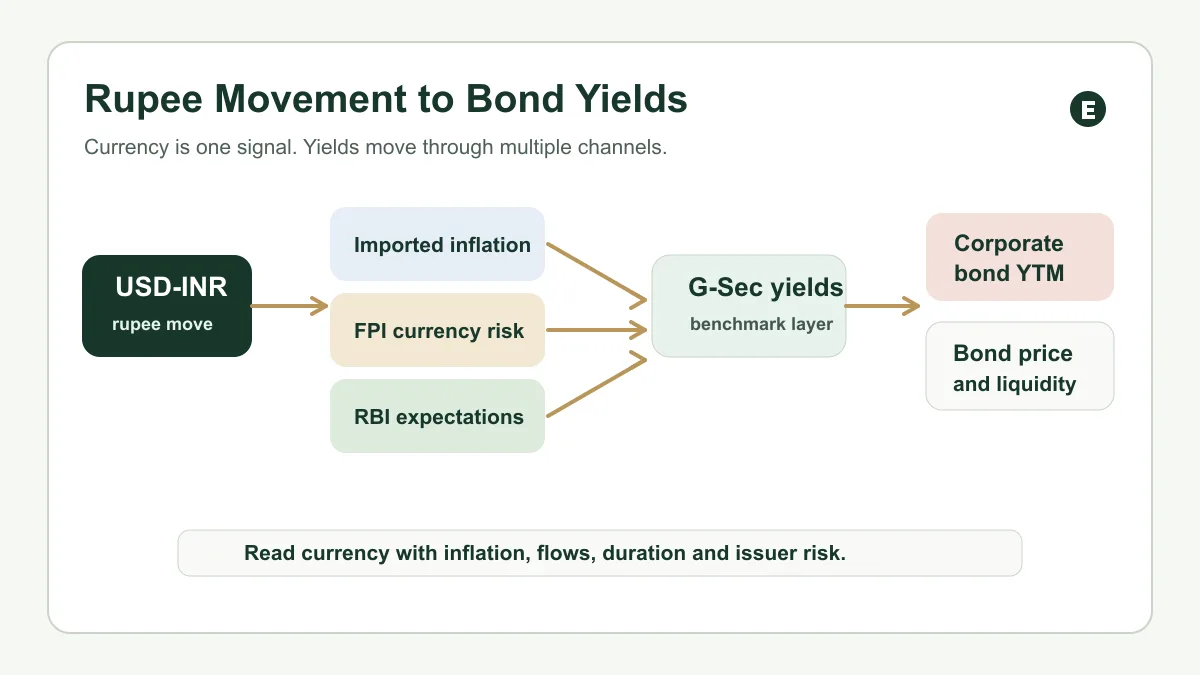
The Indian rupee affects bond yields through several channels. Some are direct market signals. Others work through expectations.
The Reserve Bank of India's government securities primer explains the basic bond-market rule: bond prices and market yields move in opposite directions, and duration measures a bond price's sensitivity to yield movements. Source: RBI Government Securities Market in India - A Primer.
The imported inflation channel
India imports a meaningful share of its crude oil and several other inputs. When the rupee weakens against the US dollar, the rupee cost of dollar-priced imports can rise. If that pressure is sustained, markets may start worrying about higher inflation.
Bond yields are sensitive to inflation expectations. Investors generally ask for higher yields when they expect inflation to erode the purchasing power of future coupon and principal payments. This is why a sharp rupee depreciation, especially when combined with rising crude oil prices, can lead to higher G-Sec yields.
The word "can" matters. If global commodity prices fall at the same time, or if domestic liquidity remains comfortable, the impact may be smaller.
The RBI policy expectation channel
Currency pressure can also influence how the bond market reads monetary policy. If the rupee is under stress and imported inflation risk rises, investors may expect the RBI to keep liquidity tighter or delay rate easing. That expectation can lift yields, even before any formal policy action.
The RBI does not set long-term bond yields directly. It sets policy rates and manages liquidity. The market then prices expectations across the yield curve.
This is why bond yields may move even when the policy repo rate is unchanged.
The FPI and currency-risk channel
Foreign portfolio investors look at Indian bonds in rupee terms and in their own currency terms. A 7% rupee yield does not mean the same thing to an unhedged dollar investor if the rupee depreciates by 3% during the holding period.
When the rupee is stable or strengthening, Indian bonds may look more attractive to foreign investors, all else equal. When the rupee is weakening, foreign investors may demand a larger yield cushion or reduce exposure.
This flow channel can affect demand for Indian government securities, especially in periods when global rates, US Treasury yields, crude oil prices and currency volatility are all moving together.
Rupee Depreciation Impact on Bond Yields
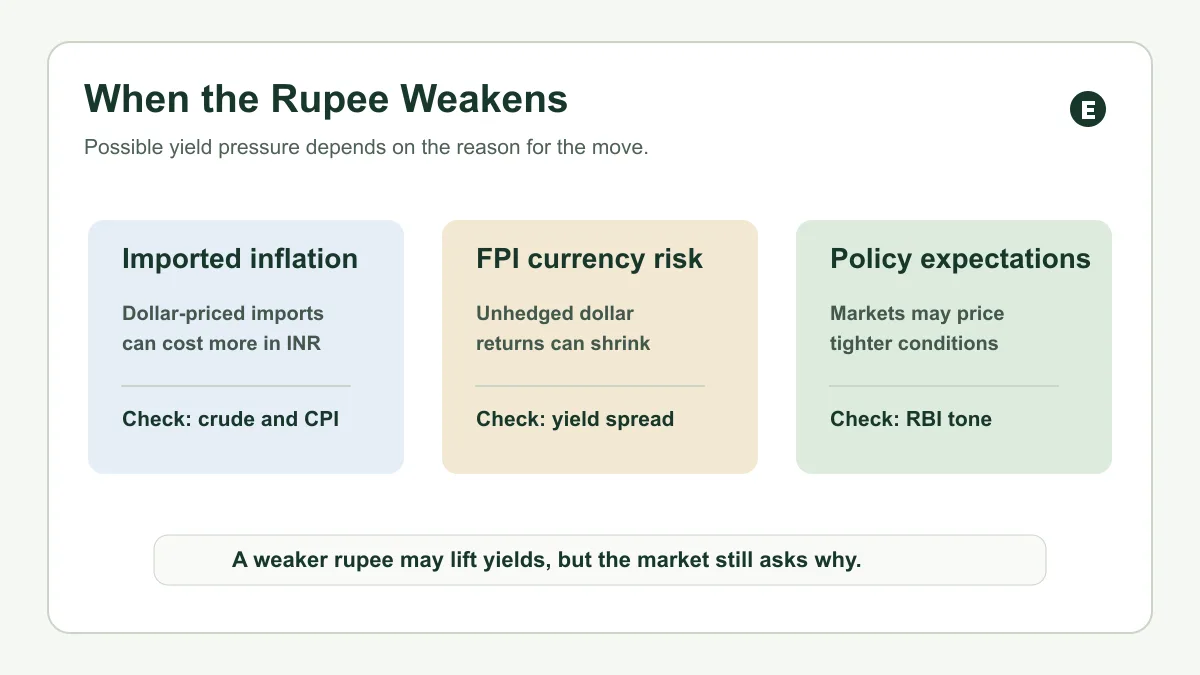
Rupee depreciation may push bond yields higher through three broad effects:
| Channel | Possible bond-market effect | Investor question |
| Imported inflation | Markets may demand higher yields to offset inflation risk | Is the rupee move linked to crude or broad dollar strength? |
| FPI currency risk | Foreign demand for rupee bonds may soften | Is the yield spread enough after currency and hedging costs? |
| Policy expectations | Markets may expect tighter liquidity or delayed easing | What did the latest RBI policy and liquidity commentary signal? | |
This does not mean every rupee decline causes a bond sell-off. Markets care about why the rupee is moving. A short, orderly move may have little impact. A sharp move driven by crude oil, widening external deficits or global risk aversion can matter more.
Why bond prices can fall when yields rise
For a fixed-rate bond, price and yield move in opposite directions. If market yields rise after you buy a bond, your existing bond may need to trade at a lower price so that its effective yield becomes competitive with newer market levels.
This price movement matters most if you plan to sell before maturity. If you hold until scheduled redemption, interim price changes may matter less, but credit risk and payment risk remain.
Why longer-duration bonds usually react more
Duration is a measure of interest-rate sensitivity. A longer-duration bond generally moves more when yields change because its fixed cash flows extend further into the future.
For example, a long-maturity government security may react more sharply to currency-led inflation concerns than a short-maturity bond. Corporate bonds can react differently because issuer credit spread and secondary-market liquidity also affect price.
Rupee Appreciation and Bond Yields
Rupee appreciation can support bond prices when it reduces imported inflation pressure and improves foreign investor comfort. If the market believes currency stability will keep inflation contained, investors may accept lower yields on government securities.
That can help existing bond prices because lower yields generally mean higher prices.
Rupee appreciation can also improve unhedged foreign investor returns. If FPIs expect the rupee to remain stable, they may find Indian bond yields more attractive relative to US Treasury yields, after considering currency and hedging costs.
Why a stronger rupee does not always mean lower yields
A stronger rupee is not a guarantee of lower yields.
Yields may still rise if government borrowing supply is heavy, global yields move higher, domestic liquidity tightens, inflation surprises on the upside, or credit spreads widen. RBI intervention can also smooth currency volatility without changing the broader bond-market direction.
The Reserve Bank has previously described India's exchange rate as largely market-determined, with intervention used to maintain orderly conditions and curb excessive volatility. Source: BIS paper on RBI's foreign exchange intervention approach.
So, investors should read currency movement with other macro signals, not in isolation.
USD-INR, FPI Flows and Indian G-Sec Yields
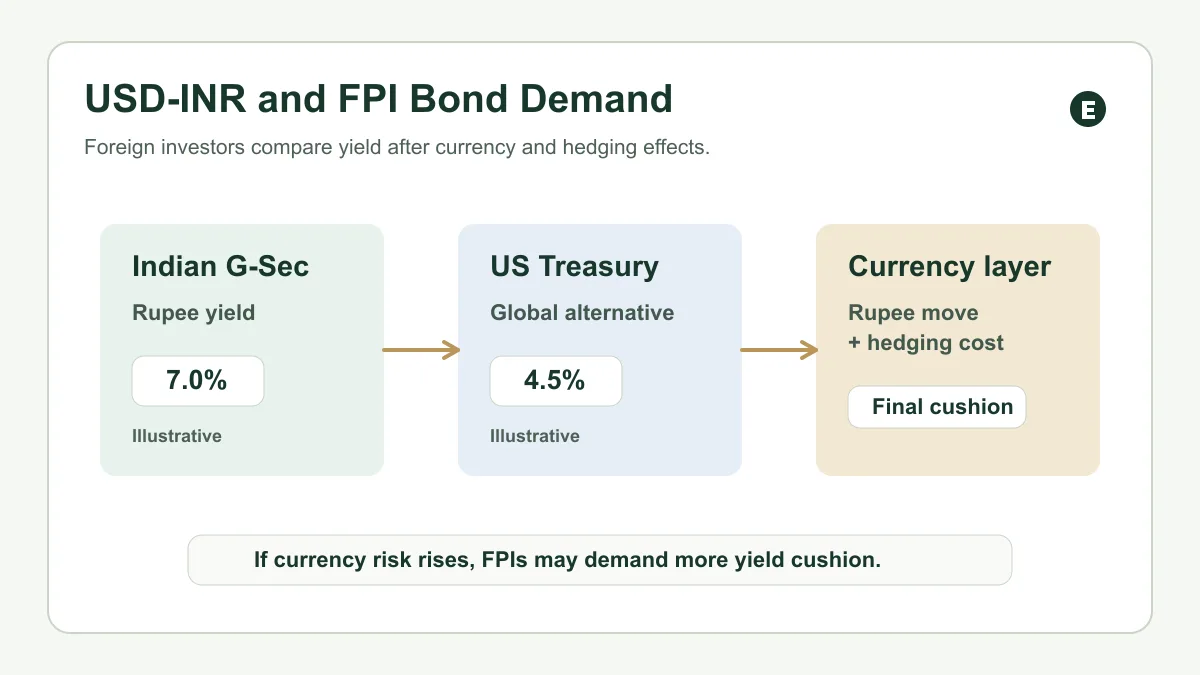
The USD-INR exchange rate matters because foreign investors compare Indian bond yields with global alternatives.
An FPI looking at Indian G-Secs may consider:
- Indian government bond yield
- US Treasury yield
- Expected rupee movement
- Hedging cost
- Liquidity and index inclusion
- Tax and settlement rules
- Global risk appetite
India has also opened specified government securities to non-resident participation through the Fully Accessible Route framework. That makes the foreign-flow channel more visible in the government bond market, especially around global index inclusion and yield-spread discussions.
Yield spread versus currency risk
Here is a simplified illustration.
Assume an overseas investor can buy an Indian government security at a 7.0% rupee yield, while a comparable US Treasury yields 4.5%. The headline yield spread is 2.5 percentage points.
But if the rupee depreciates by 2.0% over the holding period, the unhedged currency-adjusted cushion is much smaller. If hedging costs are high, the investor's effective return can be lower still. This is why rupee movement can influence demand for Indian bonds even when domestic investors are focused on coupon and YTM. For Indian retail investors, the FPI channel matters indirectly. It can affect G-Sec yields, which then influence the benchmark layer used to price corporate bonds.
What Rupee Movement Means for Corporate Bond Yields in India
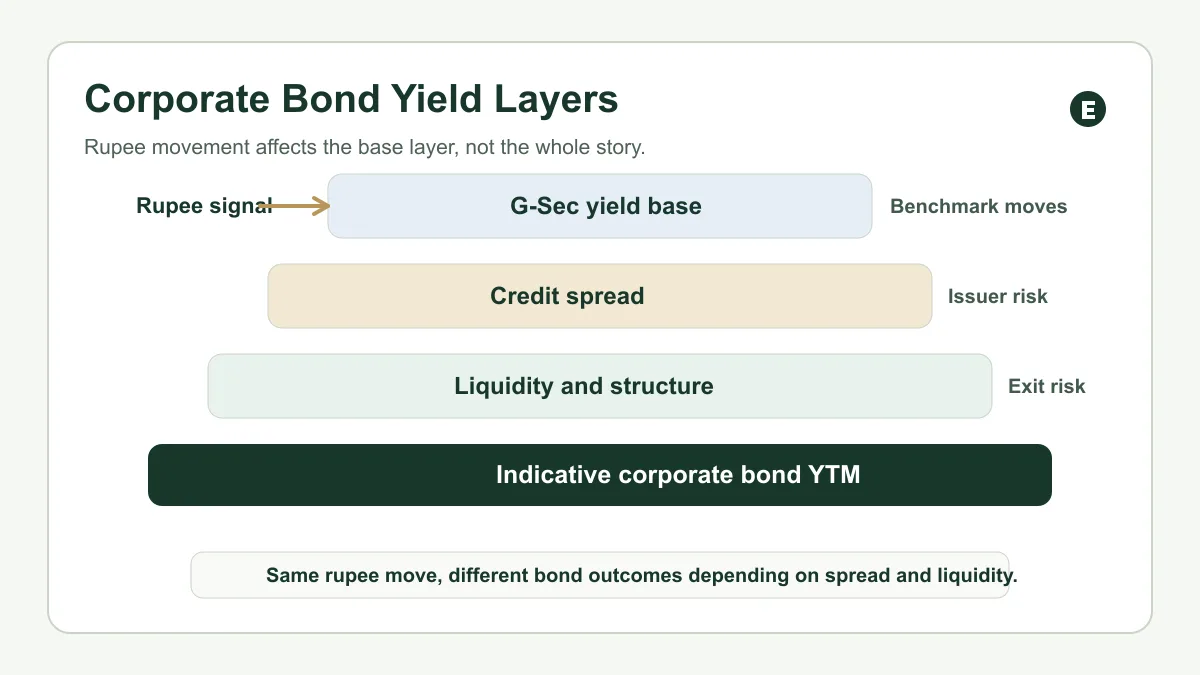
Corporate bond yields in India are not only a currency story. They are usually built from two layers:
- The benchmark yield environment, often linked to G-Sec yields of similar maturity.
- The issuer-specific spread, which reflects credit risk, liquidity, structure, demand and market perception.
This is why a rupee move may affect corporate bond yields, but not uniformly.
G-Sec yield is the base layer
If rupee weakness pushes G-Sec yields higher, corporate bonds may also need to offer higher yields to remain attractive. This can affect newly issued bonds and the secondary-market prices of existing bonds.
The effect is usually clearer for higher-rated corporate bonds, where benchmark-yield movement is a larger part of pricing.
Credit spread can move differently from the rupee
Credit spread is the extra yield a corporate bond offers over a comparable government security. It can widen or narrow for reasons unrelated to currency.
For example, a corporate bond's yield may rise even when the rupee is stable if the issuer's sector faces stress or if liquidity is weak. Conversely, a rupee depreciation may not move a specific bond much if its maturity is short, demand is strong, or the spread has already adjusted.
Investor Checklist: Reading Bond Yields When the Rupee Moves
When the rupee moves sharply, do not look only at the headline bond yield. Use a checklist.
| Check | Why it matters |
| What changed? | Rupee, crude oil, US yields, RBI tone and inflation can point in different directions |
| Which yield are you seeing? | Coupon, current yield and YTM are not the same |
| Is YTM pre-tax or post-tax? | Tax treatment changes the investor's final outcome |
| What is the maturity and duration? | Longer duration usually means more price sensitivity |
| Is the bond liquid? | Exit price matters if you may sell before maturity |
| What is the rating and agency? | Credit risk remains even when macro yields are attractive | |
| What does the offer document say? | Security cover, covenants and payment terms matter |
| Is the yield move broad or issuer-specific? | A currency-led move is different from a credit-spread move |
Equirize can help investors review listed bond details such as issuer name, rating, maturity, coupon schedule, indicative pre-tax YTM and offer documents where available. Equirize is a SEBI-registered OBPP and does not provide investment advice.
Rupee Movement, Bond Yields and Investor Action
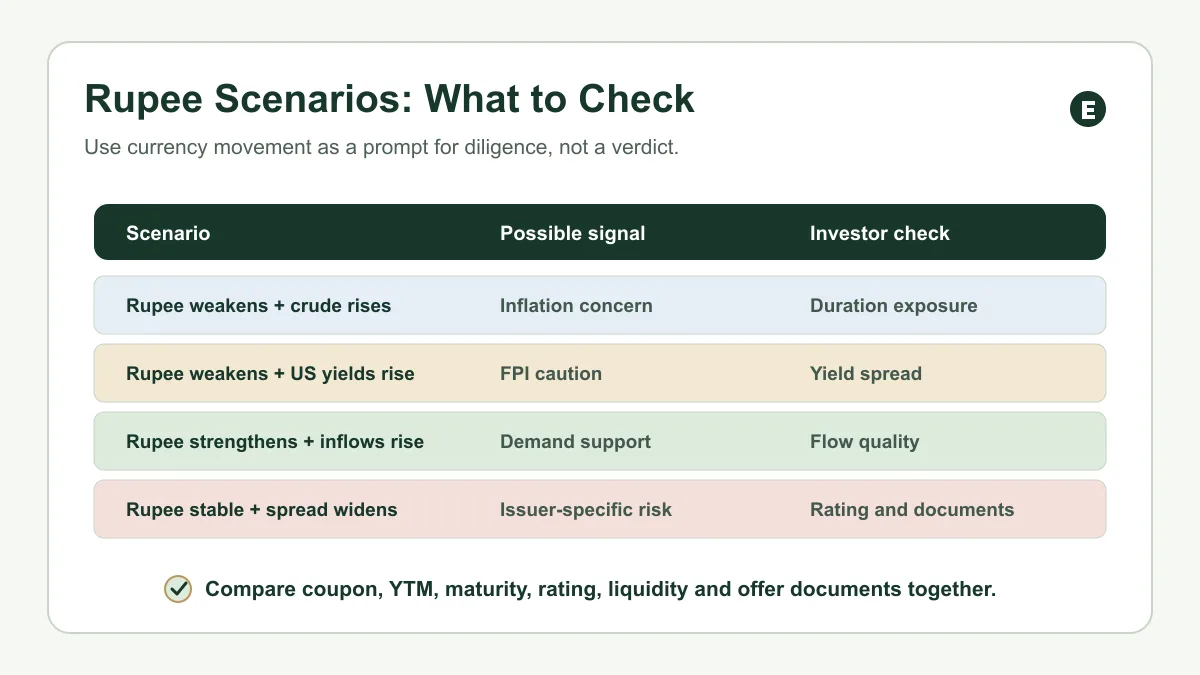
| Scenario | Likely market signal | What to check before acting |
| Rupee weakens and crude rises | Imported inflation concern may push yields higher | Inflation data, RBI commentary, duration exposure |
| Rupee weakens and US yields rise | FPI demand may become more cautious | India-US yield spread, hedging cost, foreign-flow data |
| Rupee strengthens with better inflows | G-Sec demand may improve | Whether the move is flow-led or intervention-led |
| Rupee stable but borrowing concerns rise | Yields may still rise due to supply | Government borrowing calendar and fiscal signals |
| Rupee stable but credit spread widens | Corporate bond yields may rise issuer-wise | Rating actions, sector stress, liquidity and covenants |
Common Mistakes to Avoid
The first mistake is assuming that rupee direction alone predicts bond yields. It does not. Currency is one input among inflation, liquidity, fiscal supply, global yields and credit spreads.
The second mistake is comparing only coupon rates. Coupon tells you what the bond pays on face value. YTM reflects the price you pay, time to maturity, redemption value and cash-flow assumptions.
The third mistake is ignoring duration. A longer-duration bond may show sharper interim price movement when yields change.
The fourth mistake is treating higher yield as automatically better. A higher yield may reflect credit risk, low liquidity, structural complexity, or weak demand.
The fifth mistake is assuming regulatory registration removes investment risk. SEBI registration of an OBPP regulates the platform framework. It does not mean SEBI approves, endorses or guarantees a listed security.
Final Take: Use Rupee Movement as a Signal, Not a Verdict
Rupee movement can affect Indian bond yields through imported inflation, FPI flows, RBI policy expectations and benchmark G-Sec yields. But it does not act alone.
For listed corporate bonds, investors also need to evaluate credit rating, issuer fundamentals, maturity, duration, liquidity, security structure, tax treatment and offer-document risk factors.
A weaker rupee may put upward pressure on yields. A stronger rupee may support bond prices. But both statements are conditional.
The disciplined approach is to use currency movement as a signal, then ask better questions about the bond in front of you.
Registration with SEBI as an Online Bond Platform Provider does not constitute SEBI's approval, endorsement, or guarantee of any specific security listed on the platform. Investments are subject to market risks. Please read the offer document and risk factors carefully before subscribing.