How to Choose an Online Bond Platform Provider (OBPP) in India


Choosing a bond platform is not the same as choosing a bond.
That distinction matters because an online bond platform can make discovery, documentation and transaction flow easier. It can help you see issuer details, ratings, maturity, coupon schedule, indicative yield to maturity (YTM), offer documents and order information in one place. But it cannot make every listed bond suitable, liquid or free from credit risk.
If you are trying to understand how to choose an online bond platform in India, start with three questions.
First, is the platform operating inside the SEBI Online Bond Platform Provider framework? Second, is the transaction route clear enough for you to verify payment, order and demat credit? Third, does the platform give you enough bond-level information to evaluate risk instead of reacting only to a headline yield?
This guide gives you a practical OBPP comparison framework. It does not rank platforms. It shows what to verify before you transact.
Online Bond Platform Provider India: Start With the OBPP Role
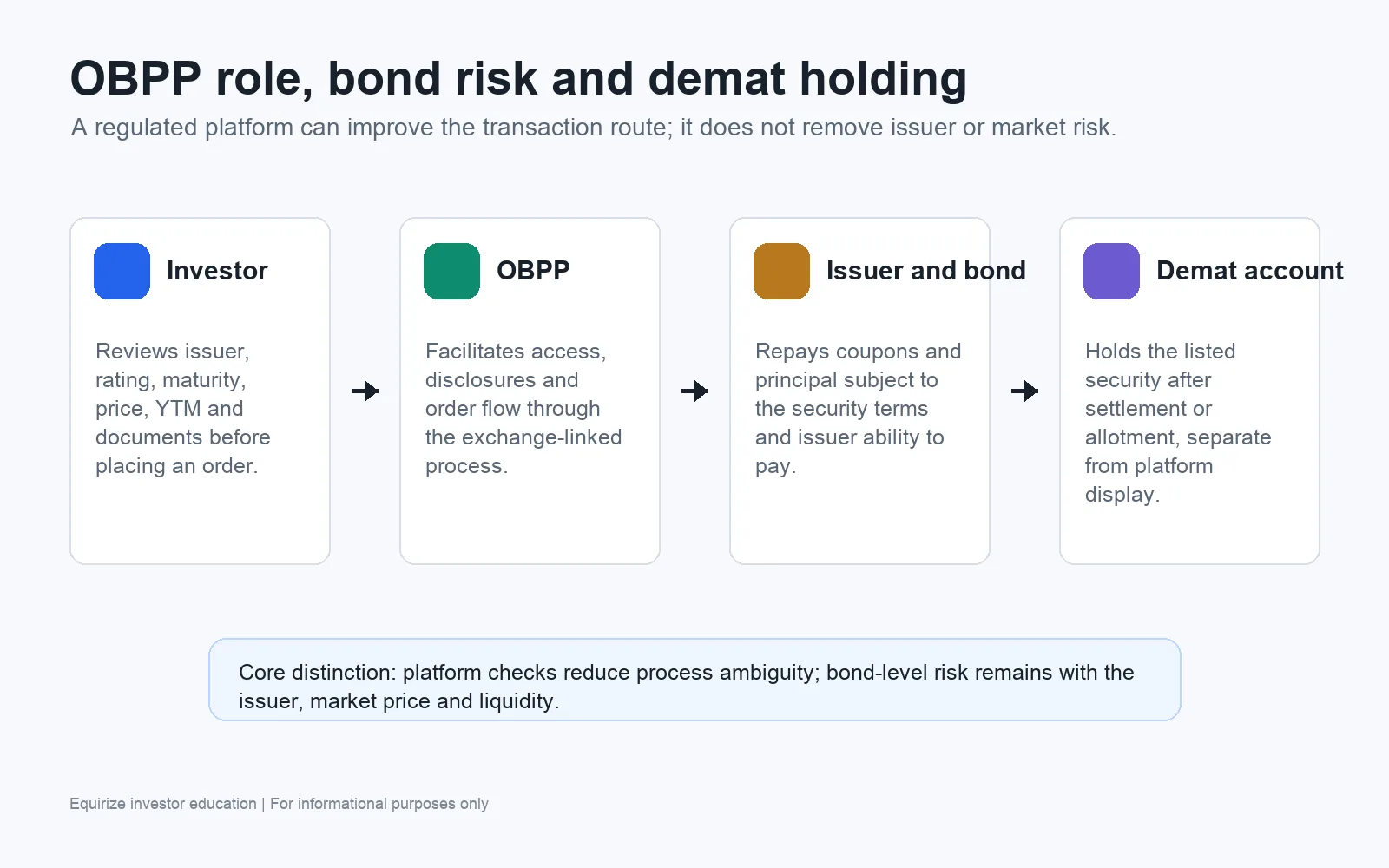
An Online Bond Platform Provider, or OBPP, is an entity that facilitates access to eligible listed debt securities through an online platform. SEBI formalised the registration and regulatory framework for OBPPs through its circular dated November 14, 2022. The framework brought online bond distribution into a more defined perimeter, with exchange registration, platform conduct rules and disclosure expectations. [Source: SEBI OBPP framework]
For an investor, the important point is simple: an online bond platform provider India investor uses should be understood as a facilitator. It is not the issuer of the bond. It is not the guarantor of the issuer's payments. Unless separately registered for that activity, it is not your investment advisor.
Equirize is a SEBI-registered Online Bond Platform Provider (OBPP) and stock broker in the debt segment of BSE and NSE. EquiRize Securities Private Limited carries SEBI Registration Number (Stock Broker): `INZ000323730`.
You can use Equirize to explore listed bonds, compare key terms and review available documents. The decision still needs to be made with issuer risk, liquidity, maturity, tax and portfolio fit in view.
SEBI-Registered OBPP Meaning: Platform Access, Not SEBI Approval
The phrase SEBI-registered OBPP is useful, but it can be misunderstood.
Registration means the platform is visible in the regulatory and exchange ecosystem. It does not mean SEBI has approved a specific bond, endorsed a platform's commercial claims or guaranteed the outcome of a transaction. That is why any serious platform-selection process should separate regulatory status from investment merit.
Registration with SEBI as an Online Bond Platform Provider does not constitute SEBI's approval, endorsement, or guarantee of any specific security listed on the platform. Investments are subject to market risks. Please read the offer document and risk factors carefully before subscribing.
Listed Corporate Bonds Online: What an OBPP Can and Cannot Offer
An OBPP may help investors discover listed corporate bonds online, review bond terms, place orders and track transaction information. A useful platform should surface the issuer name, ISIN, coupon, maturity, rating, rating agency, payment schedule, price, indicative pre-tax YTM and offer document where applicable.
What it should not do is imply certainty.
A fixed coupon is not the same as a guaranteed return. A displayed YTM is not the amount you will receive in every scenario. A listed bond may still have low secondary-market liquidity. The issuer may be downgraded. The price may fall if rates rise or credit spreads widen. A platform that explains these limits is usually giving you more useful information than one that only highlights yield.
How to Verify OBPP Registration Before You Transact
Do not rely only on a homepage badge. If you want to know how to verify OBPP registration, use official sources and match details carefully.
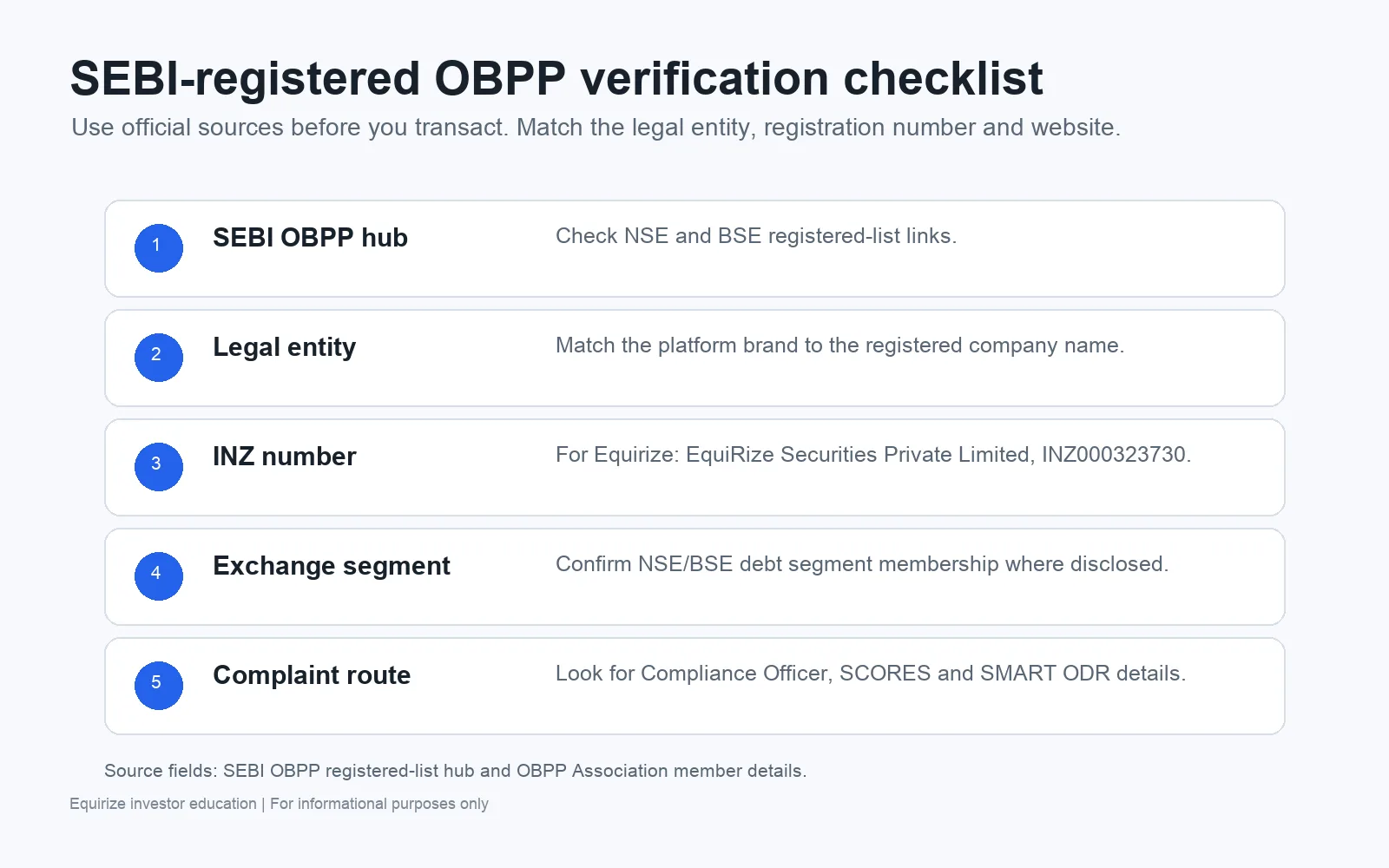
SEBI maintains a page that links to the registered OBPP lists of NSE and BSE. The OBPP Association also publishes member details, including legal entity names, SEBI registration numbers and websites. The OBPP Association member list includes EquiRize Securities Private Limited with registration number `INZ000323730` and website `www.equirize.com`. [Source: SEBI OBPP registered-list hub] [Source: OBPP Association member details]
SEBI OBPP List Check: Match the Legal Entity and INZ Number
The SEBI OBPP list check should include four fields.
Match the platform's brand name to the legal entity. Match the website to the registered entity. Match the registration number, usually an `INZ` number for a stock broker registration. Then check whether the same identity appears consistently in the platform's footer, terms, risk disclosures and grievance page.
This matters because many investors remember brand names, while regulatory records may use legal names. For Equirize, the legal entity is EquiRize Securities Private Limited and the SEBI registration number is `INZ000323730`.
If a platform's regulatory identity is hard to find, incomplete or inconsistent across pages, pause before transacting.
Also check the small mismatches. A platform may use a consumer-facing brand name in ads and a legal entity name in regulatory records. That is normal. What you want is a clear bridge between the two: the same website, the same registered intermediary details, and the same grievance channel. If the bridge is missing, the investor has to do more work before trusting the transaction route.
NSE and BSE Debt Segment Membership: Why Exchange Registration Matters
NSE BSE debt segment membership matters because OBPP transactions are not meant to be informal transfers hidden behind a website interface. The investor should be able to understand the market route, settlement process and records generated after the order.
This does not remove bond risk. It does make the process more traceable.
SEBI's June 16, 2023 circular also addressed product offerings by OBPPs under Regulation 51A of the SEBI NCS Regulations. For investors, the practical lesson is to check whether the platform is clearly distinguishing eligible listed debt securities from products outside the OBPP perimeter. [Source: SEBI 2023 OBPP product-offering circular]
This is especially important when the same financial-services group offers more than one product category. Listed bonds, fixed deposits, P2P lending, securitised debt instruments and unlisted opportunities do not sit in the same regulatory box. A clean platform experience should make the product category visible before the investor commits money.
OBPP Comparison Framework: Eight Checks Before Choosing a Platform
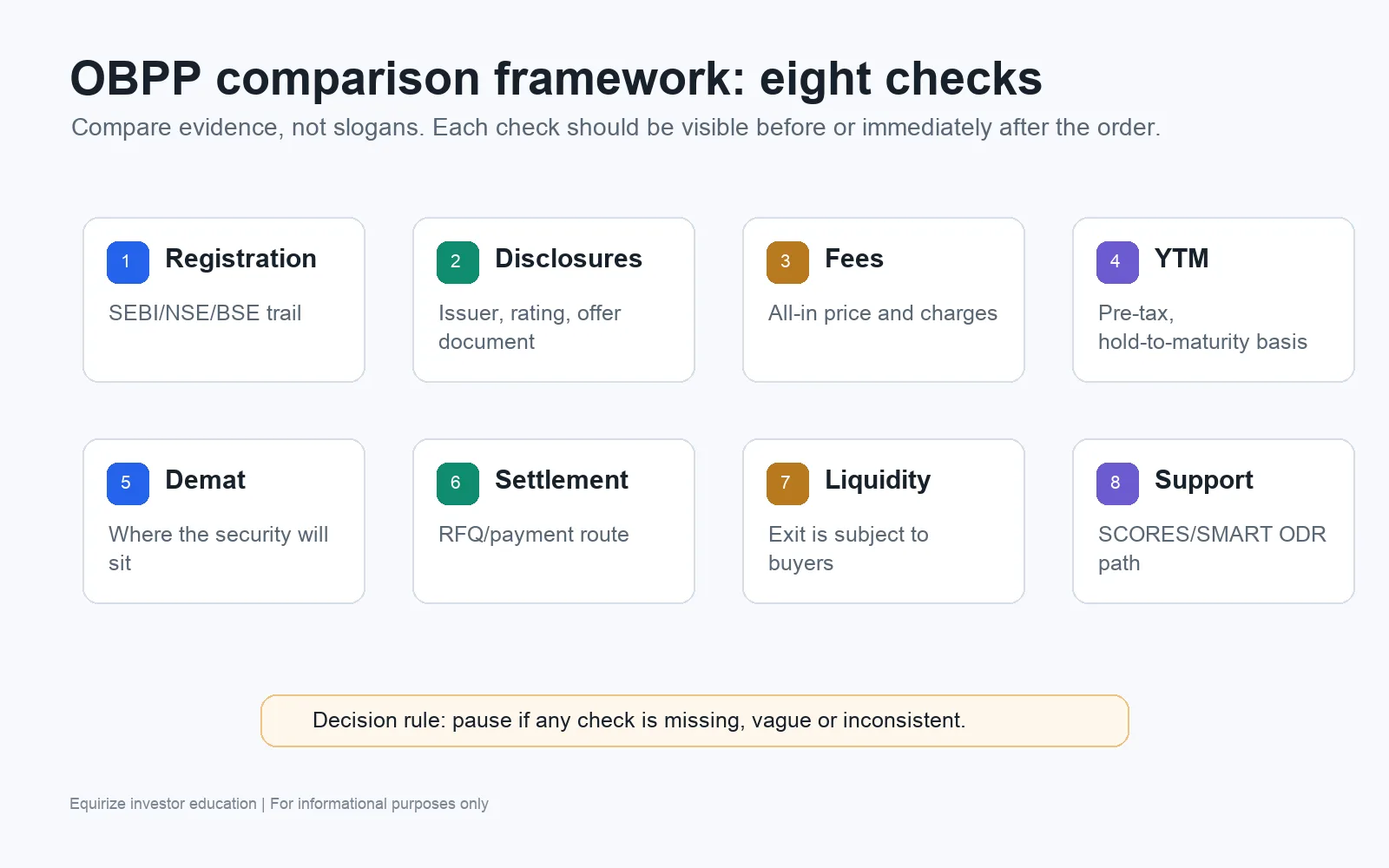
A good OBPP comparison framework should not begin with "Which platform shows the highest yield?" It should begin with evidence. Use the eight checks below before you choose a platform and before you place an order.
Bond Platform Safety India: Separate Process Risk From Issuer Risk
Searches around bond platform safety India often compress two different risks into one question.
The first is process risk: whether the platform is registered, whether the order route is clear, whether the payment flow is traceable, whether the complaint mechanism exists, and whether securities are credited to demat as expected.
The second is issuer and market risk: whether the issuer can pay, whether the bond price can move, whether you can exit before maturity, and whether the displayed YTM still applies if you sell early.
A SEBI-registered OBPP may reduce ambiguity around the process. It does not insure the bond or remove issuer credit risk.
This is why the safety question should be rewritten as two checks: "Is the platform route regulated and traceable?" and "Is this bond suitable for the risk I am taking?" A yes to the first question does not automatically answer the second. The second still requires credit review, liquidity review and concentration review.
Bond Platform Fees: Compare All-In Price, Not Just Yield
Bond platform fees are not always visible as a separate line item. Sometimes the investor sees an all-in price, a yield after spread, exchange-related charges, taxes, payment charges or other transaction components.
The comparison should be made on the same ISIN, same settlement date and same quantity wherever possible. Ask:
| Check | Why it matters |
| Clean price | Shows price excluding accrued interest. |
| Dirty price | Shows price including accrued interest and is closer to settlement amount. |
| Accrued interest | Affects what you pay when buying between coupon dates. |
| Explicit charges | Brokerage, platform fee, taxes or exchange-related charges may apply. |
| Indicative YTM | Changes with price, settlement date, maturity and cash-flow assumptions. |
For a deeper breakdown, see Equirize's guide to bond platform fees, spread, price and indicative YTM.
Yield to Maturity on Bond Platforms: Check the Assumptions
Yield to maturity on bond platforms should be read as a calculation, not a promise.
YTM generally assumes the bond is bought at the quoted price, coupons and principal are paid as scheduled, and the investor holds the bond until maturity. It is usually pre-tax unless stated otherwise. It can change if the price changes, if the settlement date changes, if the investor exits early, or if the issuer delays or defaults on payment.
NSE and BSE have issued investor advisories asking investors to understand bond risks and the factors affecting yield before dealing through OBPPs. Factors include interest rates, time to maturity, liquidity and issuer creditworthiness. [Source: NSE/BSE advisory on OBPPs and bond yield]
Demat Account for Bonds Online: Confirm Where the Security Will Sit
A demat account for bonds online is central to the investor's evidence trail.
After settlement or allotment, eligible listed bonds should be held in dematerialised form. The platform may show your holding inside its interface, but the real custody question is where the security sits in the demat ecosystem and whether you can verify it through your holding statement.
If you are new to the process, read Equirize's guide on how to invest in bonds in India before placing your first order.
RFQ Platform Bond Settlement: Check the Order and Payment Route
RFQ platform bond settlement refers to the request-for-quote route used for debt securities on exchange infrastructure. Investors do not need to master every operational detail, but they should understand the evidence trail.
Before placing an order, check how the quote is accepted, where funds are transferred, how the order is confirmed, when settlement is expected, and what record you receive afterwards. The basic question is: can you reconcile the order from platform screen to payment confirmation to contract note or deal record to demat credit?
If the answer is unclear, slow down.
For a first order, it helps to keep a simple reconciliation log. Note the platform, legal entity, ISIN, order date, settlement amount, payment reference and expected demat credit date. After settlement, match these against the records you receive. This may feel administrative, but it is useful if there is a mismatch in quantity, price, credit date or tax records later.
Bond Platform Grievance Redressal: Support, SCORES and SMART ODR
Bond platform grievance redressal should be visible before you need it.
Look for a Compliance Officer, contact details, registered office, escalation path, SCORES reference and SMART ODR reference. Support quality is not only about fast chat responses. It is about whether the platform tells you how formal complaints move if a transaction, record or service issue is not resolved.
This is especially important for first-time investors, NRIs and investors placing larger orders.
Online Bond Platform Red Flags: What to Pause and Check
Red flags are not accusations. They are signals to pause, verify and ask better questions.
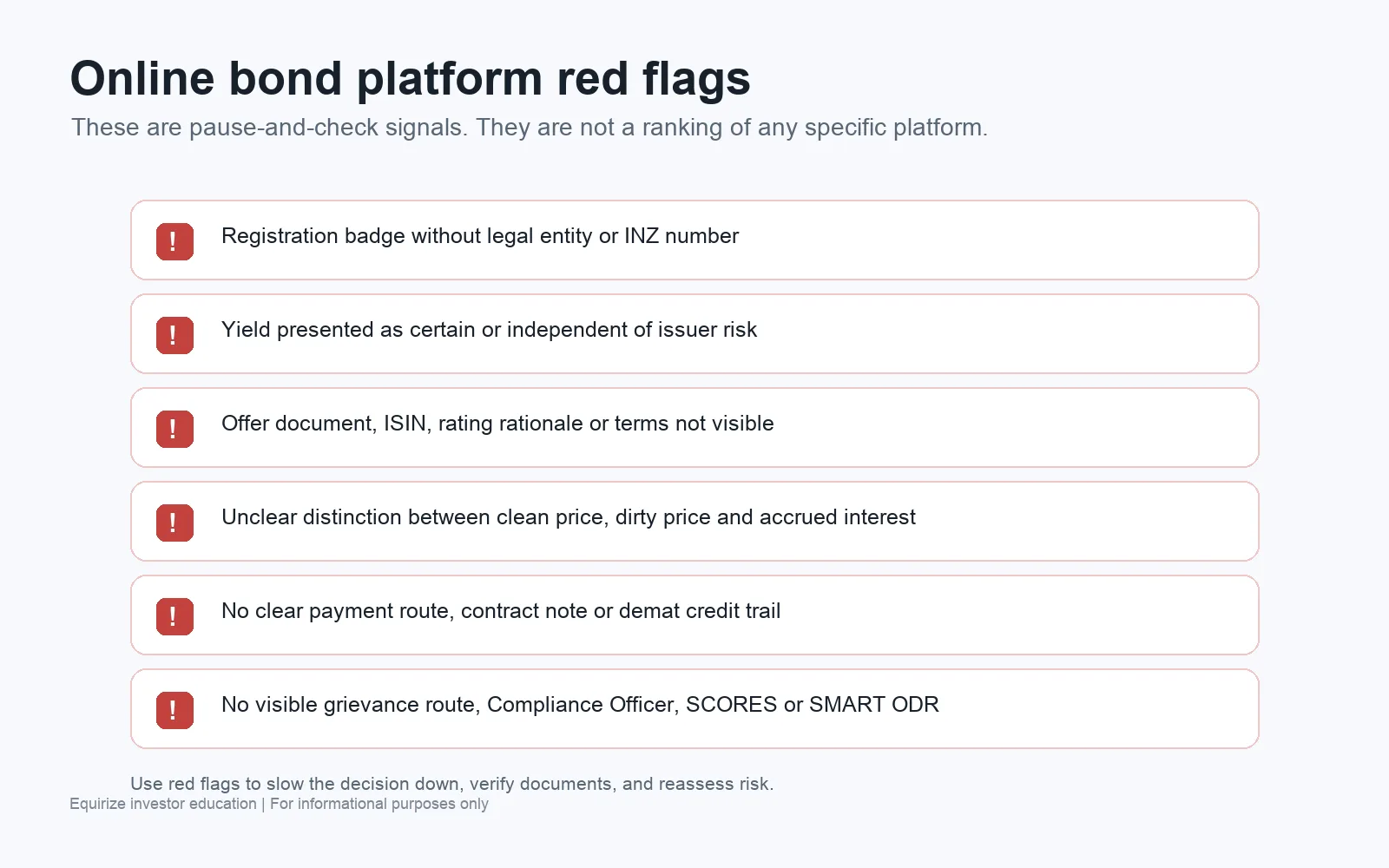
An online bond platform red flags checklist should include missing registration details, unclear legal entity, no offer document, no ISIN, vague pricing, no rating rationale, no demat clarity, no complaint route, and yield language that sounds certain.
SEBI issued a public caution on November 19, 2025 regarding unregistered Online Bond Platform Providers and urged investors to verify registration before transacting. That caution is directly relevant to platform selection. [Source: SEBI caution on unregistered OBPPs]
High-Yield Bond Platform Claims: Read Rating, Liquidity and Offer Documents Together
High-yield bond platform claims need context.
A higher displayed YTM may reflect lower credit quality, longer maturity, lower liquidity, security structure, market conditions, accrued interest mechanics or a combination of these. It is not enough to ask whether the yield is attractive. Ask why the market is pricing the bond that way.
Read the rating symbol with the rating rationale. Read the maturity with the liquidity position. Read the coupon with the price. Read the offer document before subscribing.
The same logic applies to monthly coupon bonds and shorter-tenure bonds. A frequent payout schedule does not make the issuer stronger. A shorter maturity does not automatically mean easy exit. A secured structure still needs the investor to understand security cover, trustee role, enforcement limits and the issuer's operating cash flow. Platform selection should therefore include a check on whether the page explains the instrument, not only whether it displays a number.
Best Bond Platform India Searches: Why Rankings Need Evidence
Many investors search for best bond platform India. The phrase is understandable, but it is not the best way to make a financial decision.
Rankings often hide the criteria. A platform may look better on yield but weaker on explanation. Another may have a cleaner interface but fewer disclosure prompts. A third may be useful for discovery but not for every investor's risk profile.
Use criteria instead of rankings: registration, transparency, bond-level information, fee clarity, settlement route, demat evidence, liquidity explanation and grievance handling.
How to Choose an OBPP in India: A Practical Investor Checklist
The practical answer to how to choose an OBPP in India is to split your checks into three moments: before signup, before order and after order.
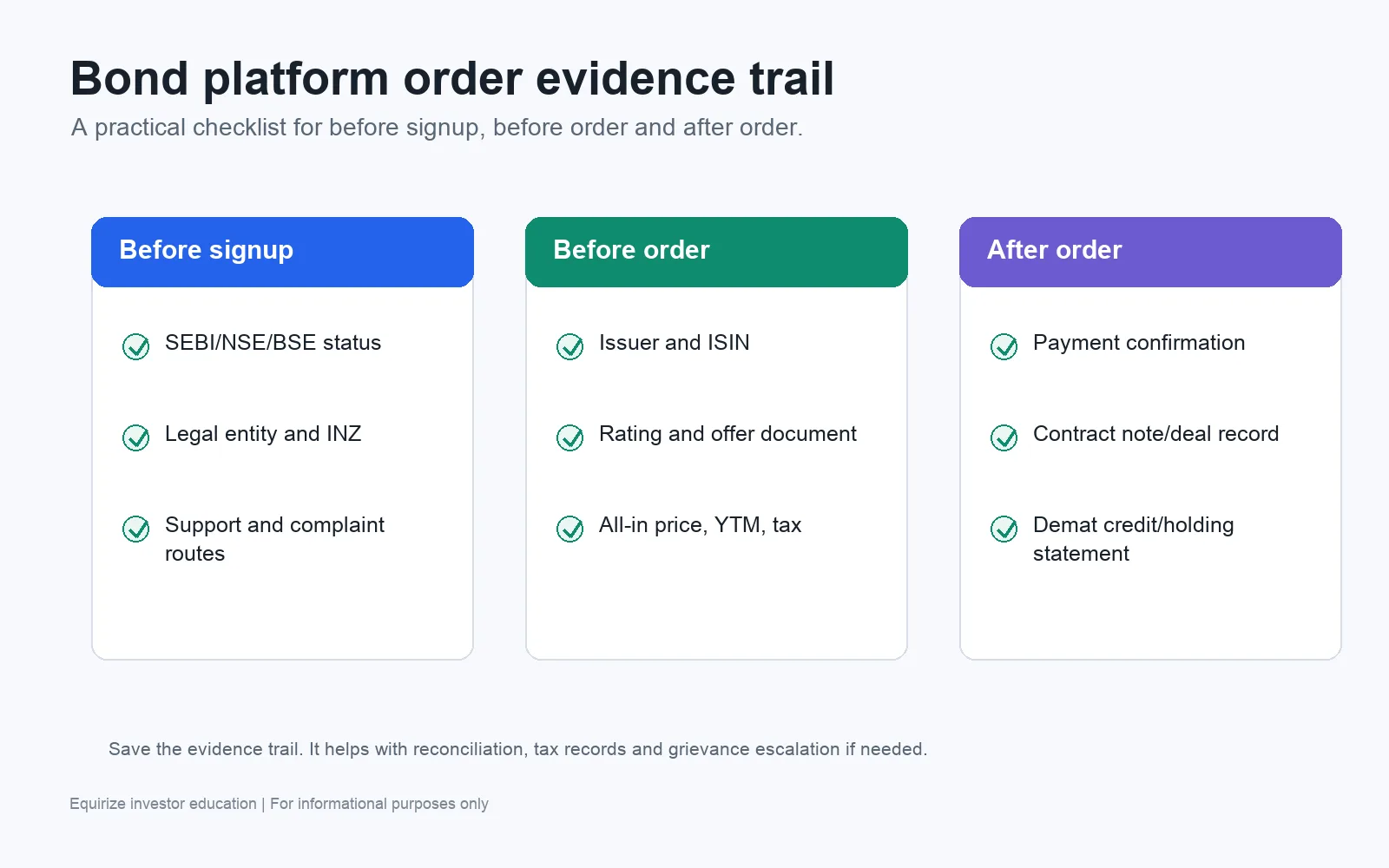
Before signup, verify the platform's legal entity, SEBI registration number, exchange/debt segment status, complaint route and product perimeter.
Before order, verify the issuer, ISIN, rating, rating agency, rating rationale, coupon, maturity, security structure, offer document, price, accrued interest, settlement amount, indicative pre-tax YTM and liquidity assumptions.
After order, save the payment confirmation, order confirmation, contract note or deal confirmation, allotment or settlement record, and demat holding statement. These records help with reconciliation, tax reporting and grievance escalation.
Bond Platform Checklist for Beginners: Five Documents to Save
A bond platform checklist for beginners should include five records:
| Document or record | What it helps you verify |
| Offer document or information memorandum | Security terms, risk factors, issuer obligations and repayment structure. |
| Rating rationale | Why the rating agency assigned the rating and what could change it. |
| Order confirmation or contract note | Order details, price, quantity, date and transaction trail. |
| Payment confirmation | Amount paid, route used and timing. |
| Demat holding statement | Whether the security appears in your demat account after settlement or allotment. |
Do not treat these as paperwork. In bonds, documentation is part of the risk review.
Compare Listed Corporate Bonds on Equirize With Risk Context
Equirize helps investors compare listed corporate bonds with issuer details, rating, maturity, coupon schedule, indicative pre-tax YTM, documents and other relevant terms where available. The platform is designed to make bond information easier to review, not to replace investor judgement.
If you are ready to review opportunities, you can compare listed bonds on Equirize with the same discipline used in this guide: verify the platform, understand the transaction route, then evaluate the bond on issuer risk, liquidity, price, tax and maturity fit.
For investors focused on payout timing, the guide to monthly income from bonds may also help frame cash flow without treating coupon schedules as certainty.
The article's central rule is intentionally conservative: choose the route first, then the bond. A transparent platform should help you slow the decision down in the right places. It should make documents easier to find, pricing easier to compare, and risk easier to discuss. That is more useful than a platform experience that pushes the investor quickly from yield display to order placement.
Tax treatment depends on individual circumstances and may change. Please consult a qualified tax advisor.