How to Invest in Bonds in India: A Beginner's Guide



If you are trying to understand how to invest in bonds in India, the first thing to know is that "bonds" is not one route, one risk, or one account type.
A Government of India security, a Treasury Bill, a State Development Loan, an RBI Floating Rate Savings Bond, a listed corporate bond, and a tax-saving 54EC bond all sit in the fixed-income universe. But they are bought through different channels, held in different account structures, and carry different risks.
For a beginner, the practical question is not only "which bond should I buy?" It is:
- What type of bond am I trying to access?
- Which route is meant for that bond?
- Do I need a demat account, an RBI Retail Direct Gilt account, or a bank route?
- What risk am I taking: sovereign, issuer, interest-rate, liquidity, or tax?
- What should I read before placing the first order?
This guide answers those questions in the order a first-time investor should ask them. It is a practical guide to **how to invest in bonds in India** without treating every bond as the same product.
Bond Investment in India: What a Beginner is Actually Buying
A bond is a debt security. When you buy a bond, you are lending money to an issuer for a defined period. The issuer may be the Central Government, a state government, a public sector undertaking, a bank, an NBFC, a housing finance company, a municipality, or another eligible institution.
In return, the issuer agrees to make payments as per the bond's terms. Some bonds pay periodic coupons. Some are issued at a discount and redeemed at face value. Some carry floating coupons linked to a reference rate. Some have tax-specific rules. The common thread is that a bond is a contract, not an ownership stake.
That distinction matters. A shareholder owns part of a company and participates in business upside and downside. A bondholder is a lender to the issuer and evaluates whether the issuer can meet scheduled obligations.
For beginners, the three roles should stay separate:
| Role | What it means |
| Issuer | The government, company, bank, NBFC, or institution borrowing money through the bond |
| Investor | The person buying or subscribing to the bond and taking the relevant risk |
| Platform/broker/bank | The access route that helps the investor discover, apply for, buy, or hold the bond |
Equirize is a SEBI-registered Online Bond Platform Provider (OBPP). It facilitates access to listed corporate bonds and other eligible listed debt securities. It is not the issuer of those bonds and does not provide investment advice.
Coupon Rate vs Yield to Maturity in Bonds
Two terms create avoidable confusion for first-time bond investors: coupon and yield to maturity.
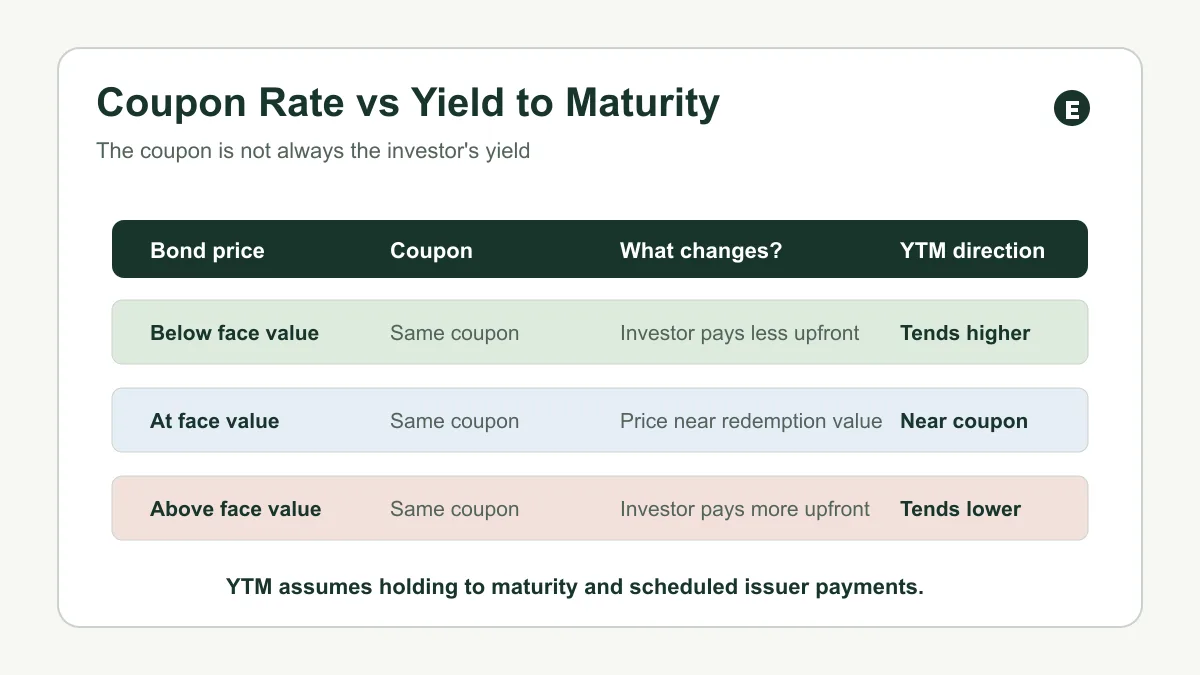
The coupon rate is the stated rate at which the bond pays interest on face value. If a bond has a face value of ₹1,000 and a 9% annual coupon, the scheduled annual coupon is ₹90, subject to the issuer meeting its obligations and the terms of the issue.
The yield to maturity, or YTM, is different. It is an indicative annualised return if the investor buys the bond at the current price, receives scheduled payments, and holds it until maturity. YTM depends on price, coupon, maturity date, redemption value, accrued interest, and timing of cash flows.
This is why a bond with a 9% coupon may not give a 9% YTM. If you buy it above face value, the YTM can be lower than the coupon. If you buy it below face value, the YTM can be higher. The actual outcome also depends on the issuer making scheduled payments.
Government Bonds, Corporate Bonds and RBI Bonds in India
Beginners often use one phrase, "bond investment", for several different instruments. A useful starting map looks like this:
| Bond type | Common issuer | Typical route | Holding structure |
| G-Secs | Central government | RBI Retail Direct, exchange routes, brokers | Retail Direct Gilt account or demat-linked route |
| Treasury bills | Central government | RBI Retail Direct, exchange routes | Retail Direct Gilt account or demat-linked route |
| State Development Loans | State government | RBI Retail Direct, exchange routes | Retail Direct Gilt account or demat-linked route |
| Listed corporate bonds / NCDs | Companies, banks, NBFCs, PSUs | SEBI-registered OBPP, broker, exchange route | Demat account |
| RBI Floating Rate Savings Bonds | Government of India through designated banks | Bank route | Bond Ledger Account |
| 54EC capital gains bonds | REC, PFC, IRFC and other notified issuers, as applicable | Issuer / broker route | Demat or physical, depending on terms |
The route should follow the instrument. Do not choose the platform first and then force every bond into the same mental model.
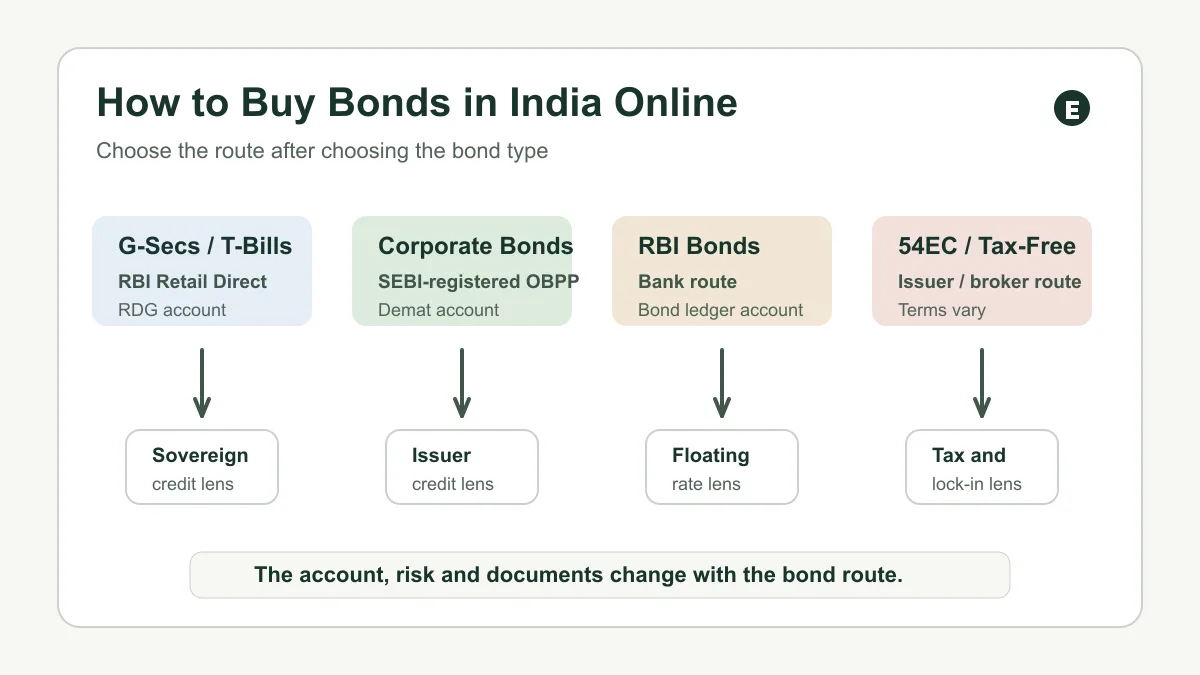
How to Buy Bonds in India Online: Main Routes
There are four broad ways to buy bonds in India online or through assisted digital routes.
The first is RBI Retail Direct, which gives individual investors access to eligible government securities through a Retail Direct Gilt account. This is relevant for Government of India securities, Treasury Bills, State Development Loans and Sovereign Gold Bonds when available under the scheme.
The second is a SEBI-registered Online Bond Platform Provider. This route is commonly used for listed corporate bonds and NCDs. The bond is held in the investor's own demat account after settlement or allotment, subject to the process and terms.
The third is a broker or exchange route. Investors may access eligible bonds through existing stockbrokers, exchange mechanisms, public issues of NCDs, or secondary-market routes.
The fourth is the bank or issuer route. Some instruments, such as RBI Floating Rate Savings Bonds, are accessed through designated banks and held in a Bond Ledger Account. 54EC bonds may be accessed through issuer or distributor routes, depending on the issuer's process.
No route is universally better. The right route depends on the bond type, account structure, minimum amount, documents, liquidity, and your own reason for buying. That is why any serious guide on how to buy bonds in India online should begin with route selection, not a product list.
How to Buy Government Bonds in India through RBI Retail Direct
If you want to understand how to buy government bonds in India, start with RBI Retail Direct. For many beginners researching **how to invest in government bonds in India**, this is the cleanest official route to understand first.
RBI Retail Direct allows individual investors to open a Retail Direct Gilt account and access eligible government securities. The route covers primary issuance and secondary-market access for eligible securities under the scheme. Government securities can include Treasury Bills, dated G-Secs, State Development Loans, and Sovereign Gold Bonds where applicable.
The attraction is direct access to sovereign debt. But sovereign backing does not mean the market price cannot move. If you sell a government bond before maturity, the price can be higher or lower than your purchase price, depending on interest rates and market conditions.
For beginners, shorter-duration government securities can be easier to understand than long-duration bonds. A 30-year G-Sec may carry very low credit risk, but it can still show meaningful price movement if yields change.
How to Buy Corporate Bonds in India through a SEBI-Registered OBPP
If you are trying to understand how to buy corporate bonds in India, the important difference is issuer credit risk. The same point applies to anyone searching for how to invest in corporate bonds in India through a regulated online route.
A corporate bond or listed NCD is issued by a company or eligible institution. The issuer may be a bank, NBFC, housing finance company, PSU, infrastructure company, or private corporate. The investor is exposed to the issuer's ability to meet coupon and principal obligations.
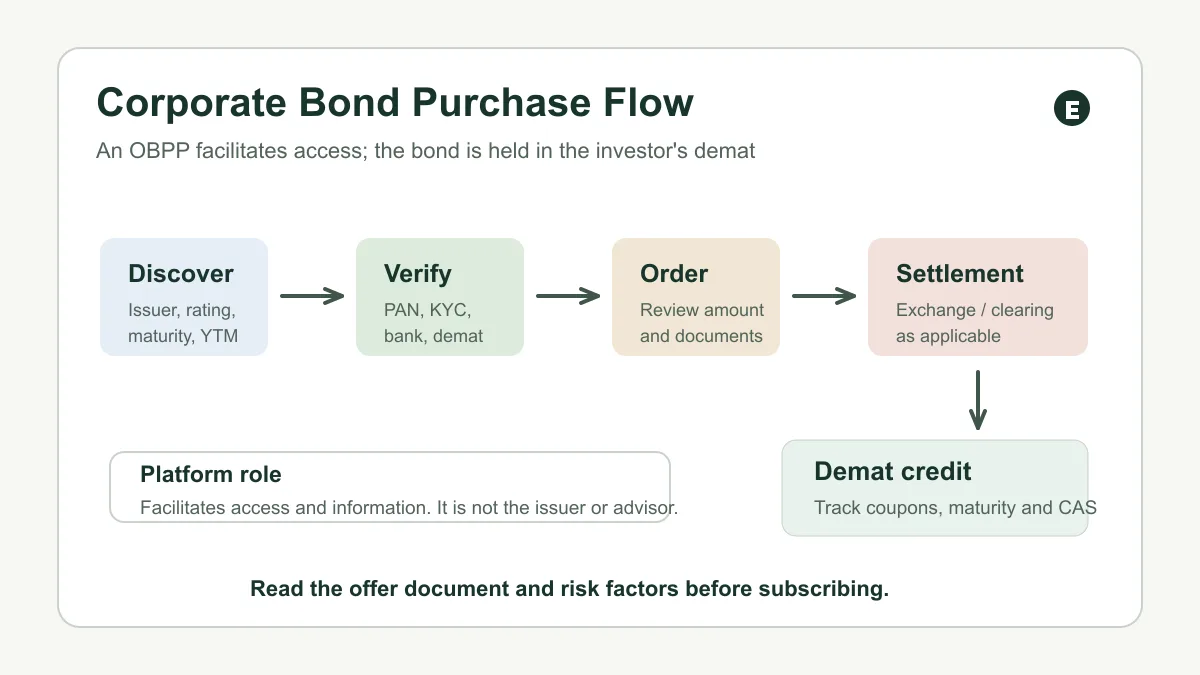
A SEBI-registered OBPP can help investors discover listed bond opportunities, review issuer details, check credit rating and agency, access offer documents, complete onboarding, verify demat details, and subscribe or buy through the platform flow.
The bond is not an Equirize deposit. It is not backed by the platform. It is a debt security issued by the underlying issuer and held in the investor's demat account. That is why issuer review is central.
Before buying a corporate bond, check:
- issuer legal name;
- credit rating and rating agency;
- rating outlook or watch, if any;
- coupon rate, YTM, maturity date and payout frequency;
- security cover and seniority, where applicable;
- liquidity and exit route;
- offer document and risk factors.
How to Buy RBI Bonds in India through Banks
Searches for how to buy RBI bonds in India often refer to RBI Floating Rate Savings Bonds.
These are not the same as listed corporate bonds. They are generally accessed through designated banks and held in a Bond Ledger Account. The interest rate is floating and linked to the scheme terms. The lock-in, eligibility, interest payment, taxation and premature withdrawal rules should be checked from the issuing bank or official scheme documentation before applying.
This distinction matters because a demat account is not the central holding route for every bond-like instrument. A beginner who wants RBI Floating Rate Savings Bonds should not assume the process is identical to buying a listed NCD through an OBPP.
What You Need Before Investing in Bonds in India
Before investing in bonds in India, identify the account route and documentation needed for the specific instrument. This is the operational foundation of how to invest in bonds in India with fewer surprises during onboarding.
For listed bonds and NCDs, you generally need:
- PAN;
- completed KYC;
- bank account;
- demat account;
- mobile number and email for verification;
- access to the offer document and transaction confirmation.
For RBI Retail Direct, you need to follow the Retail Direct Gilt account process. For RBI Floating Rate Savings Bonds, you follow the designated bank route. For 54EC bonds, check the issuer or distributor process.
The practical point is simple: the documentation is not decorative friction. In regulated finance, the platform, bank or broker must verify identity, bank details, eligibility and holding structure.
Demat Account to Buy Bonds in India: When It Is Needed
A demat account is needed when you buy or hold listed securities in dematerialised form. Listed corporate bonds and listed NCDs are generally held in demat.
If you already invest in equities or mutual funds through a broker, you may already have a demat account with NSDL or CDSL. That account can often be used for listed bond holdings, subject to the platform or broker's process.
But not every bond route depends on demat. RBI Retail Direct uses a Retail Direct Gilt account. RBI Floating Rate Savings Bonds may be held in a Bond Ledger Account. 54EC bonds may have demat or physical options depending on the issuer and terms.
This is a useful beginner filter: ask where the bond will be held before you ask what the yield is.
KYC, PAN and Bank Account for Bond Investing
PAN and KYC help verify identity and tax records. Bank verification helps confirm the payment and payout route. Demat verification confirms where listed securities will be credited.
If a platform asks for PAN, CKYC, DigiLocker, demat details, bank verification or digital signatures, the investor should understand why those steps exist. The process may feel more involved than opening a simple savings product, but listed securities require a clean record of identity, ownership and settlement.
Good onboarding should explain these steps. It should not make the investor guess.
Step-by-Step Process to Buy Bonds in India
The cleanest way to approach how to buy bonds in India is to slow the decision down into six steps. The same sequence works whether the investor is learning how to buy bonds India through an OBPP, broker, bank, or RBI route.
1. Decide the job of the money.
2. Choose the bond category.
3. Choose the correct access route.
4. Read the bond terms and risk factors.
5. Place the order or application.
6. Track holding, coupon payments, tax records and maturity.
A first bond purchase should not be rushed because the ticket size looks manageable. A ₹10,000 purchase can still teach the wrong habit if the investor looks only at headline yield.
Define the Goal Before You Buy Bonds in India
Start with the holding period.
Is this money needed in six months, two years, five years, or after retirement? A mismatch between bond maturity and personal liquidity need is one of the most common beginner mistakes.
If you may need the money before maturity, check liquidity first. Listed does not mean there will always be a buyer at the price you want. Secondary-market liquidity can vary sharply by ISIN, issuer, rating, remaining maturity and market conditions.
If the goal is regular income, coupon frequency and maturity staggering matter. If the goal is capital preservation, issuer type and duration matter. If the goal is yield enhancement, credit risk and concentration become more important.
Compare Bond YTM, Coupon and Maturity Before Buying
Compare bonds on the same basis. A two-year AA rated NCD should not be compared casually with a 10-year G-Sec or a lower-rated five-year bond only because the displayed yield is higher.
Check:
- coupon rate;
- indicative pre-tax YTM;
- clean price and dirty price, where shown;
- accrued interest;
- maturity date;
- call or put features, if any;
- payout frequency;
- tax treatment;
- liquidity.
YTM is useful, but it is not a guarantee. It assumes the bond is held until maturity and the issuer makes scheduled payments. If you sell before maturity, your outcome depends on market price and available buyers.
Check Credit Rating and Offer Document Before Investing in Bonds
For corporate bonds, the credit rating is a starting point, not the end of the review.
Read the rating agency name. Check whether the rating is AAA, AA, A or below, and whether the outlook is stable, positive, negative or under watch. A higher rating generally indicates lower assessed credit risk, but ratings can change.
Then read the offer document or issue document. Look for the issuer's business, purpose of borrowing, security cover, repayment terms, covenants, risk factors, related-party exposure and financial information.
A familiar brand name does not replace document review. A high coupon does not replace credit review. A platform listing does not replace suitability assessment.
Place the Bond Order and Track Settlement in Demat
Once the investor is comfortable with the bond terms, the order flow depends on the route.
For listed corporate bonds through an OBPP or broker, the investor reviews the order, confirms the amount, completes payment, and then tracks settlement or allotment. Once the process is complete, the bond should reflect in the investor's demat account, subject to the applicable settlement cycle and process.
For government securities through RBI Retail Direct, the investor follows the RDG account process. For RBI Floating Rate Savings Bonds, the investor follows the bank route.
After purchase, the work is not over. Track coupon dates, maturity date, tax records, rating changes, issuer updates and consolidated account statements.
Minimum Amount to Invest in Bonds in India
The minimum amount to invest in bonds in India depends on the instrument and route.
Some listed bonds and NCDs may be accessible at ₹1,000 or ₹10,000 face value or lot size, depending on the issue. Some privately placed or secondary-market bonds may require higher amounts. Government securities through retail routes often use their own minimum bidding and subscription rules. RBI Floating Rate Savings Bonds and 54EC bonds follow their scheme or issuer terms.
Avoid universal claims such as "you can start with ₹1,000" or "you need ₹10,000" unless the specific route and instrument are named. Minimums are one of the first checks in how to invest in bonds in India because access varies by product.
| Route | What minimum depends on |
| RBI Retail Direct | security type, auction rules and scheme terms |
| Listed corporate bonds / NCDs | face value, lot size, platform inventory and issue terms |
| Public issue NCDs | prospectus and category-wise application rules |
| RBI Floating Rate Savings Bonds | scheme terms through designated banks |
| 54EC Bonds | issuer terms and tax-rule conditions |
For a beginner, the better question is not the lowest possible ticket size. It is the smallest allocation that lets you learn the process without concentrating too much money in one issuer or maturity.
How to Invest in Government Bonds in India vs Corporate Bonds
The decision between government bonds and corporate bonds is mainly a decision about credit risk, yield, monitoring and route.
Government securities issued by the Central Government carry sovereign credit exposure. They are often used as the benchmark for rupee fixed-income markets. The investor still faces interest-rate risk if selling before maturity.
Corporate bonds carry issuer-level credit risk. A corporate bond may offer a higher indicative yield than a comparable government security, but that extra yield exists for a reason. It can reflect issuer risk, liquidity risk, credit spread, structure, demand-supply conditions, or market pricing.
| Parameter | Government bonds | Corporate bonds |
| Issuer | Central or State Government | Company, bank, NBFC, PSU or other eligible issuer |
| Main credit lens | Sovereign / state exposure | Issuer-specific credit quality |
| Common route | RBI Retail Direct, exchanges, brokers | SEBI-registered OBPPs, brokers, exchanges, public issues |
| Holding | RDG account or demat-linked route | | Demat account |
| Yield driver | Policy rates, inflation, liquidity, government borrowing | Benchmark yield plus credit spread and liquidity |
| Monitoring need | Interest rates and maturity | Rating, issuer performance, covenants, liquidity, maturity |
| Beginner mistake | Ignoring duration risk | Chasing headline yield without credit review |
Many investors can use both. Government securities may form the lower-credit-risk base of the fixed-income allocation. Corporate bonds may be used for measured yield enhancement, subject to issuer review, diversification and suitability.
Bond Investment Risks in India Beginners Should Check
Bonds are often discussed as calmer than equities. That may be true for some instruments and holding periods, but it should not become shorthand for "no risk".
The main risks are credit risk, interest-rate risk, liquidity risk, reinvestment risk, concentration risk and tax uncertainty. The weight of each risk changes by bond type.
Credit Risk in Corporate Bonds India
Credit risk is the risk that the issuer is unable to meet its obligations on time or in full.
For corporate bonds, this is the central risk. A higher coupon or YTM can compensate for additional risk, but it can also signal that the market demands more yield from that issuer or structure.
Beginners should check rating, rating agency, outlook, issuer financials, security cover, sector conditions, use of proceeds and maturity schedule. Diversification across issuers can reduce concentration risk, but it does not eliminate credit risk.
Interest-Rate Risk in Government Bonds India
Interest-rate risk affects both government and corporate bonds.
When market yields rise, prices of existing fixed-rate bonds usually fall. When market yields fall, prices of existing fixed-rate bonds usually rise. The longer the maturity, the more sensitive the bond can be to rate changes.
This matters most if you sell before maturity. A buy-and-hold investor may focus more on scheduled cash flows, but an investor who needs early liquidity has to care about market price.
Liquidity Risk When You Sell Bonds Before Maturity
Liquidity risk is the risk that you cannot sell the bond quickly, or cannot sell it at a reasonable price.
Listed bonds can still trade infrequently. A bond may show a price, but the available quantity, bid-ask spread and buyer depth may not match your need. This is why maturity matching is so important for beginners.
If you may need cash before maturity, do not treat a bond like a savings account. Check exit route and market depth before buying.
Tax on Bonds in India: Interest and Capital Gains
Tax can change the actual outcome of a bond investment.
Interest from many bonds is generally taxed at the investor's applicable income-tax slab rate. If you are in a higher tax bracket, the post-tax return can be materially lower than the coupon or pre-tax YTM displayed.
If you sell a bond before maturity, capital gains tax may apply. The tax treatment can depend on holding period, listing status, instrument type, investor residency, and current law.
Some instruments have specific tax rules. For example, 54EC bonds are used for eligible capital-gains tax planning under defined conditions. Tax-free bonds have different interest-tax treatment, but new issuance and secondary-market availability vary.
Tax treatment depends on individual circumstances and may change. Please consult a qualified tax advisor.
First Bond Investment Checklist for Beginners in India
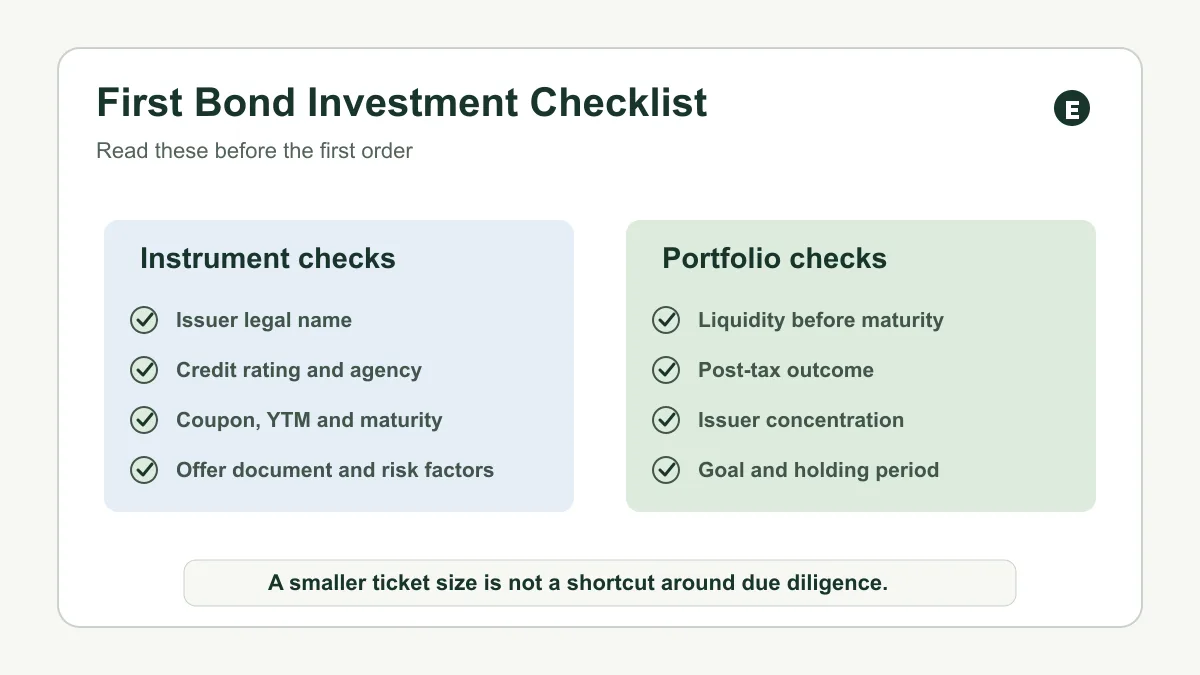
Before placing the first order, run this checklist:
1. What type of bond is this: G-Sec, SDL, T-Bill, corporate bond, NCD, RBI bond, 54EC bond or tax-free bond?
2. Who is the issuer?
3. What route is being used: RBI Retail Direct, OBPP, broker, bank or issuer route?
4. Where will the bond be held: demat, RDG account, Bond Ledger Account or other structure?
5. What is the coupon rate?
6. What is the indicative pre-tax YTM?
7. What is the maturity date and does it match the goal?
8. What are the credit rating, agency and outlook, if applicable?
9. What does the offer document or scheme document say about risks?
10. What happens if you need to exit before maturity?
11. How will interest and gains be taxed?
12. How much of your fixed-income allocation will sit with this issuer or instrument?
If you cannot answer these questions, pause. The right next step may be to read the documents, compare another route, or speak to a qualified advisor.
Where Equirize Fits as a SEBI-Registered OBPP
Equirize is a SEBI-registered Online Bond Platform Provider and stock broker in the debt segment of BSE and NSE. SEBI Registration Number: INZ000323730.
For listed corporate bonds and eligible listed debt securities, Equirize facilitates access, information review, onboarding and transaction flow. The platform can help investors compare issuer details, rating, maturity, coupon, indicative YTM, offer documents and settlement information.
But the boundary is important. Equirize is not the issuer. Equirize does not provide investment advice. Equirize does not guarantee repayment, liquidity, yield or suitability.
For an investor, that boundary is useful. It keeps the decision focused on the instrument: issuer quality, risk factors, price, maturity, liquidity, tax and allocation size.
You can explore listed corporate bond options on Equirize when you are ready to compare instruments with those checks in mind.
How to Start Investing in Bonds in India with Clarity
The right first bond investment is not necessarily the one with the highest visible yield. It is the one whose route, issuer, holding structure, maturity, liquidity and risk you understand.
If you want government securities, learn RBI Retail Direct and interest-rate risk. If you want listed corporate bonds, learn demat settlement, credit rating, offer documents and issuer risk. If you want RBI Floating Rate Savings Bonds, learn the bank route and scheme rules. If you want tax-linked bonds, understand the tax condition before the yield.
That is the practical answer to how to invest in bonds in India: choose the bond type first, then the route, then the risk checklist, and only then the order.