Fixed Deposits vs Bonds: Which is Better for Your Money?


For many Indian investors, the question of fixed deposits vs bonds begins with one simple thought: both look like fixed-income products, so which one should I choose?
The honest answer is that neither is universally better. A fixed deposit is not a bond with a different name. A listed corporate bond is not an FD with a higher yield. They are different instruments, built around different legal structures, risks, liquidity routes, tax outcomes, and investor responsibilities.
A bank fixed deposit may fit money that needs simplicity, known terms, and deposit-insurance coverage within defined limits. A corporate or NBFC fixed deposit may offer different terms, but it carries issuer risk and is not covered by DICGC. A listed corporate bond may offer coupon cash flows, a market price, and the possibility of selling before maturity, but it also carries credit risk, interest-rate risk, and liquidity risk.
The useful comparison is not "which product wins?" It is: what job does this money need to do?
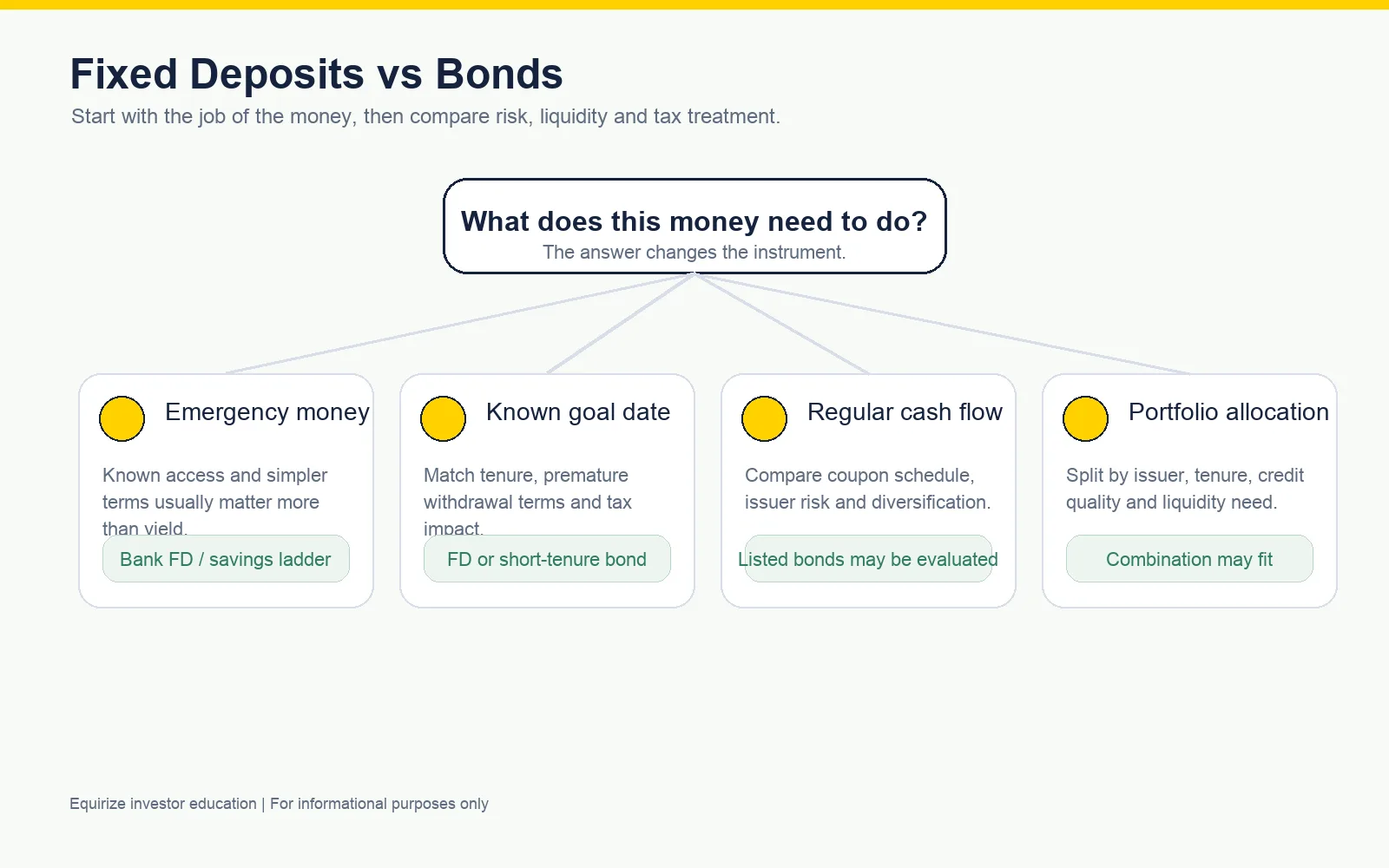
FD vs Bonds: The Short Answer Depends On The Job Of The Money
The FD vs bonds decision becomes clearer when you divide your money by purpose.
Money that may be needed quickly for a medical expense, job transition, or family emergency usually needs stability of access more than a marginal yield difference. For that bucket, a bank FD or savings-linked ladder may be easier to understand and manage, especially within the DICGC insurance boundary.
Money set aside for a known goal, such as a school fee, home down payment, or planned expense, needs a tenure match. Here, both FDs and bonds may be considered, but only after checking whether the exit route is reliable before the goal date.
Money meant to create periodic cash flow has a different job. A bond with scheduled coupons may be relevant, provided the investor understands issuer risk, payout dates, credit rating, and liquidity. But the coupon is not the same as a guarantee. It is a contractual payment dependent on the issuer meeting its obligations.
Longer-term portfolio money can use a more layered approach. Some investors may hold bank FDs for near-term reserves and use listed bonds for income planning or fixed-income allocation. The point is not to replace one product with another. It is to avoid forcing every rupee into the same structure.
Equirize has a broader explainer on fixed income investments in India for investors who want to compare the wider fixed-income universe before narrowing the choice.
What Is A Fixed Deposit In India? Bank FD And Corporate FD Basics
A fixed deposit is a deposit placed with an issuer for a defined tenure at an agreed interest rate. At maturity, the investor receives principal and interest according to the terms of the deposit. Depending on the issuer and product, interest may be paid monthly, quarterly, annually, or at maturity.
In everyday conversation, many investors say "FD" and mean bank FD. But that shortcut can be misleading. In India, fixed deposits can be issued by banks, corporates, and NBFCs. The risk and regulatory position are not identical.
A bank FD is a deposit with a bank. It usually offers straightforward tenure choices, premature withdrawal terms, and interest that is taxable as per the investor's applicable slab. For many households, this simplicity is the main appeal.
A corporate or NBFC FD is different. It is a deposit with a company or NBFC, not a bank deposit. It may have different rates, credit ratings, payout structures, and withdrawal conditions. The investor must evaluate the issuer's ability to repay.
Equirize facilitates access to bank and corporate fixed deposits, but product-specific rates, issuers, and terms should always be checked from the live platform and issuer documents before investing.
Bank FD vs Corporate FD: DICGC Insurance And Issuer Risk
The most important FD distinction is the DICGC boundary.
Bank fixed deposits are insured by DICGC up to ₹5 lakh per depositor per bank, including principal and interest, subject to applicable rules. The DICGC guide and RBI's DICGC FAQ both describe this maximum insurance amount for eligible bank deposits.
Corporate and NBFC fixed deposits are not covered by DICGC. Their repayment depends on the issuer's ability to pay. That does not automatically make every corporate FD unsuitable, but it means the investor must look beyond the word "fixed". Credit rating, issuer financials, tenure, concentration, and withdrawal terms matter.
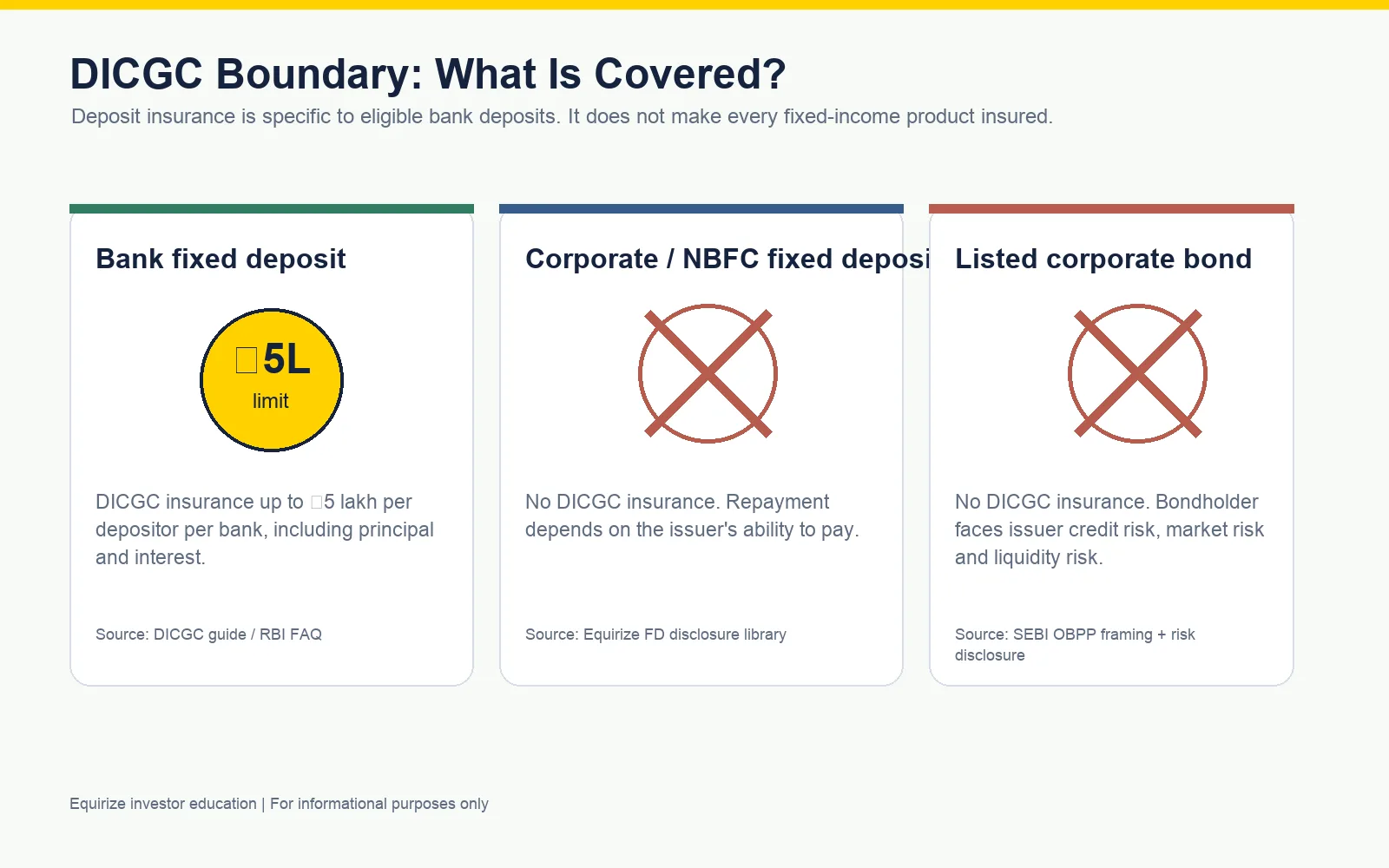
This distinction also matters for content and advertising. It is not accurate to say "FDs are insured" without specifying bank FDs and the applicable limit. It is also not accurate to transfer bank-FD comfort to corporate FDs or bonds.
What Are Listed Corporate Bonds In India? Coupons, YTM And Maturity
A listed corporate bond is a debt security issued by a company and listed on a recognised stock exchange such as NSE or BSE. The investor lends money to the issuer by subscribing to or buying the bond. In return, the issuer is expected to pay scheduled coupons and repay face value at maturity, subject to its ability to meet those obligations.
Unlike an FD, a listed bond is a security held in the investor's demat account. It has an ISIN, face value, coupon rate, maturity date, credit rating, and offer document. If purchased in the secondary market, it also has a market price that may be above or below face value.
This is where bonds vs fixed deposits becomes a mechanism question.
An FD rate is agreed with the deposit issuer for a specific tenure. A bond's coupon may be fixed, but the investor's yield can differ from the coupon because the purchase price may differ from face value. If a bond is bought at a discount, yield to maturity may be higher than the coupon. If bought at a premium, yield to maturity may be lower.
Investors new to listed bonds can read a beginner guide to bond investing before comparing live instruments.
Bond Yield vs FD Interest Rate: Why Coupon And YTM Differ
The bond yield vs FD interest rate comparison is often misunderstood.
An FD interest rate tells you the agreed interest for that deposit, subject to the issuer terms and tax treatment. A bond coupon tells you the periodic interest rate on the bond's face value. Yield to maturity, or YTM, goes further. It estimates the annualised return if the bond is bought at a given price, held to maturity, and all scheduled payments are made.
That last phrase matters: held to maturity, and all scheduled payments are made.
If you sell a bond before maturity, your realised return may differ from the YTM seen at purchase. The market price may have moved because interest rates changed, credit perception changed, or there were fewer buyers in the secondary market. If the issuer delays or defaults on payments, the outcome changes again.
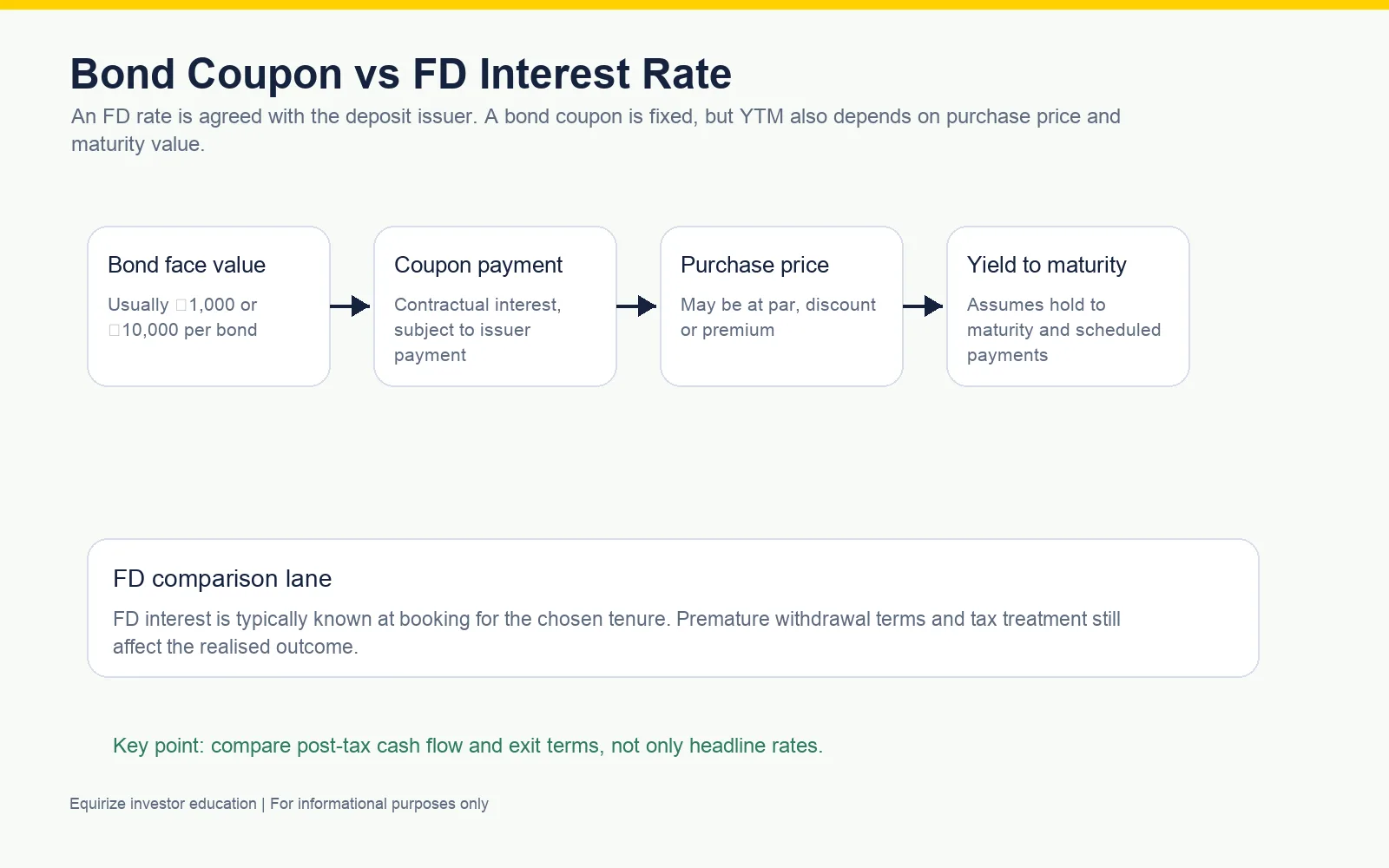
This is why the article should not compare a headline FD rate with a headline bond yield in isolation. The fair comparison is post-tax cash flow, risk, tenure, liquidity, issuer quality, and the investor's ability to hold through the intended period.
For a deeper explanation, see Equirize's [yield to maturity guide](https://www.equirize.com/resources/blogs/yield-to-maturity-guide).
Bonds vs FD India: Key Differences At A Glance
The table below gives a practical view of bonds vs FD India comparisons.
| Factor | Bank fixed deposit | Corporate / NBFC fixed deposit | Listed corporate bond |
| Legal structure | Deposit with a bank | Deposit with a company or NBFC | Listed debt security |
| Regulator context | RBI_regulated bank deposit | Company/NBFC-specific framework | SEBI/exchange-listed security framework |
| Insurance | DICGC up to ₹5 lakh per depositor per bank | No DICGC insurance | No DICGC insurance |
| Return path | Agreed FD interest | Agreed deposit interest, subject to issuer ability | Coupon plus maturity value, subject to issuer ability and purchase price |
| Main risk | Bank risk above insured amount, premature withdrawal terms, tax | Issuer credit risk, liquidity restrictions, downgrade risk | Credit risk, interest-rate risk, liquidity risk, price risk on early sale |
| Liquidity | Premature withdrawal may be allowed with penalty | Varies by issuer terms | Secondary-market sale possible, but price and liquidity can vary |
| Tax | Interest generally taxed at slab rate; TDS may apply | Interest generally taxed at slab rate; TDS may apply | Coupon interest generally taxed at slab rate; capital gains may apply on sale |
| Investor work | Lower | Moderate | Higher |
| Useful for | Simplicity short-to-medium goals, emergency laddering | Yield-seeking FD investors who can evaluate issuer risk | Investors who can evaluate credit, price, YTM, tenure, and liquidity |
This table is not a ranking. It is a way to identify which risks are being accepted.
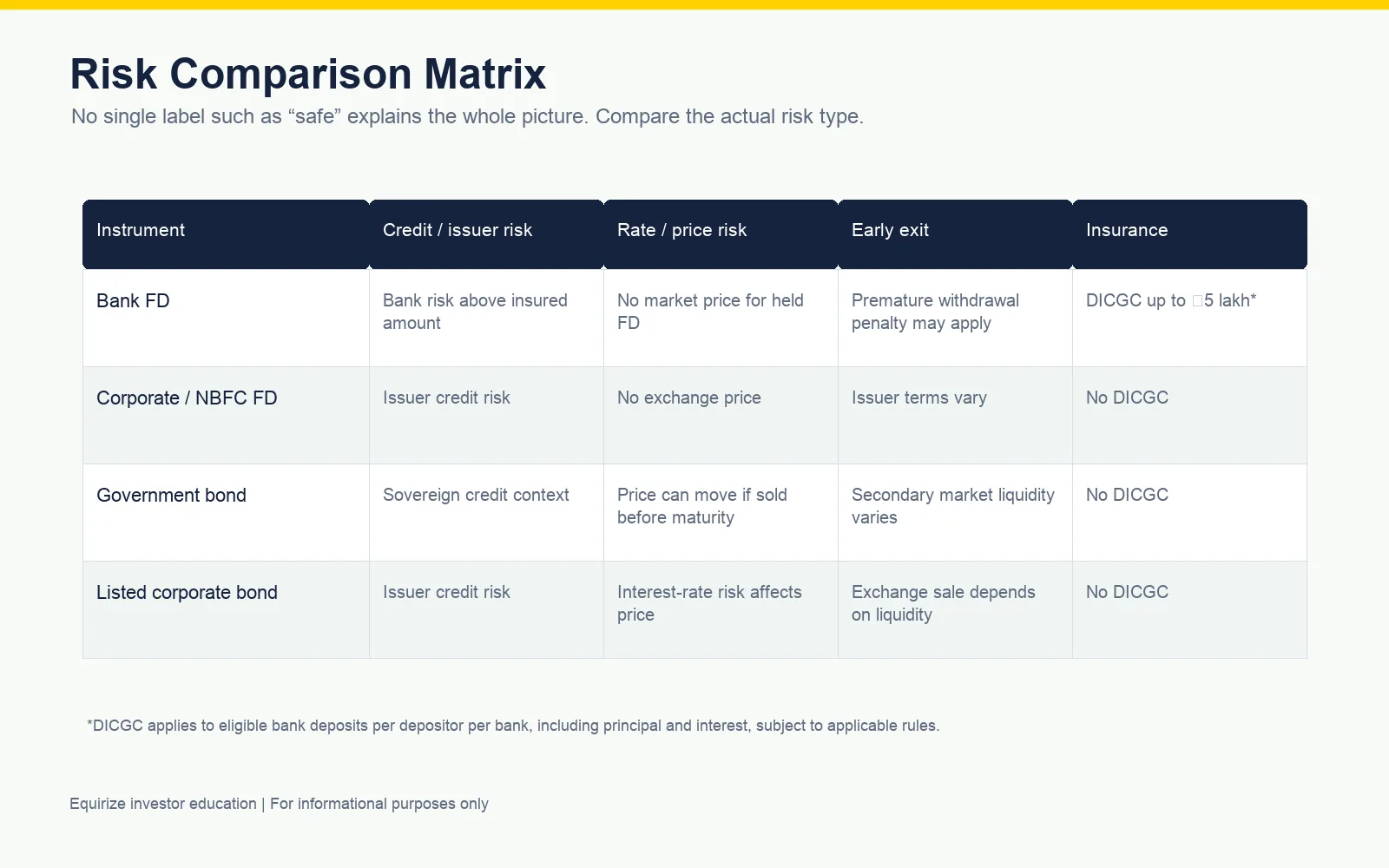
Are Bonds Safer Than Fixed Deposits? Compare The Actual Risks
Are bonds safer than fixed deposits? is one of the most common questions in this category. It is also the question most likely to produce a misleading answer if asked too broadly.
Compared with what kind of FD? What kind of bond? Held until maturity or sold early? Government bond or corporate bond? Bank FD within DICGC limits or corporate FD issued by an NBFC?
A bank FD within the DICGC limit has a specific insurance framework. A corporate FD does not. A government security has a different credit profile from a corporate bond, but its market price can still move if sold before maturity. A listed corporate bond carries issuer credit risk, interest-rate risk, and liquidity risk.
SEBI's OBPP framework regulates online bond platform providers and brings listed bond transactions into a defined regulatory perimeter. But regulation does not remove investment risk. It structures the platform and disclosure environment. The investor still needs to evaluate the security.
Equirize is a SEBI-registered Online Bond Platform Provider (OBPP) and stock broker in the debt segment of BSE and NSE. EquiRize Securities Private Limited carries SEBI Registration Number (Stock Broker): INZ000323730. This registration should be read as regulatory status, not as SEBI approval or endorsement of any specific security.
For regulatory context, Equirize's article on SEBI rules for bond investors explains what the framework does and does not do.
Credit Risk, Interest-Rate Risk And Liquidity Risk In Bonds
Listed bonds have three risk layers investors should understand before subscribing.
Credit risk is the risk that the issuer cannot meet coupon or principal obligations on time. Credit ratings from agencies such as CRISIL, ICRA, CARE, India Ratings, and others can help investors assess this risk, but a rating is not a guarantee. Ratings can change.
Interest-rate risk matters because bond prices and market yields usually move in opposite directions. If market rates rise after purchase, an existing bond's price may fall in the secondary market. This is especially relevant if the investor sells before maturity.
Liquidity risk is the risk that an investor may not find enough buyers at the expected price when trying to sell. A bond can be listed and still trade infrequently. "Can be sold" and "can be sold immediately at the price you want" are not the same statement.
Equirize has a separate guide on selling bonds before maturity, which is useful for investors comparing bond liquidity with FD premature withdrawal.
Fixed Deposit Safety: What DICGC Covers And What It Does Not
FD comfort also needs boundaries.
DICGC insurance applies to eligible bank deposits up to ₹5 lakh per depositor per bank, including principal and interest, subject to applicable rules. It is not a universal shield for every rupee in every bank account if the depositor's total eligible amount exceeds the limit.
It also does not apply to corporate or NBFC FDs. It does not apply to listed corporate bonds. It does not remove taxation or premature withdrawal terms.
For bank-FD investors, the practical question is how much exposure sits with each bank and whether the total amount exceeds the insured limit. For corporate-FD investors, the question shifts to issuer credit quality, rating, liquidity terms, and concentration.
Bonds vs FD Taxation In India: Interest, TDS And Capital Gains
Tax can change the answer to bonds vs FD taxation in India, especially for investors in higher tax brackets.
FD interest is generally taxable as income according to the investor's applicable slab. TDS may apply when interest crosses the relevant threshold. Eligible individuals may use applicable declaration forms where the law permits, but the correct position depends on age, income, tax liability, residential status, and the current rules.
Bond coupon income is also generally taxed as income according to the investor's applicable slab unless a specific instrument has a different treatment. If a listed bond is sold before maturity, capital gains tax may apply. The applicable rate and holding period depend on the type of bond, date of transfer, investor status, and prevailing tax law.
The Income Tax Department's current long-term capital gains guidance describes a general 12.5% LTCG rate for transfers of capital assets on or after 23 July 2024, without indexation benefit. Investors should not apply this blindly to every bond situation without checking whether the bond is listed or unlisted, the holding period, and the specific tax provisions applicable at the time of sale.
| Tax event | Bank FD | Corporate / NBFC FD | Listed corporate bond |
| Periodic interest | Generally taxed at slab rate | Generally taxed at slab rate | Coupon interest generally taxed at slab rate |
| TDS | May apply as per rules | May apply as per rules | May apply depending on instrument and rules |
| Sale before maturity | Usually premature withdrawal, not market sale | Usually governed by issuer terms | Capital gains may apply if sold in secondary market |
| Tax planning focus | Slab rate, TDS, Form 15G/15H or applicable declarations | Slab rate, TDS, issuer terms | Coupon tax, capital gains, holding period, documentation |
Tax treatment depends on individual circumstances and may change. Please consult a qualified tax advisor.
For bond-income planning, Form 121 guidance can help eligible investors understand a specific TDS-related declaration framework. It should not be treated as a universal tax-saving tool.
Bond Liquidity vs FD Premature Withdrawal: What Happens If You Need Cash Early
The bond liquidity vs FD premature withdrawal comparison is not as simple as "FDs can be broken and bonds can be sold".
With a bank FD, premature withdrawal is usually governed by the bank's terms. The investor may receive a lower interest rate than originally booked and may pay a penalty. The process is generally familiar, but the exact outcome depends on the bank and deposit type.
With a corporate or NBFC FD, early withdrawal can be more restrictive. Some issuers may allow it after a minimum period. Some may apply penalties. Some may have process limitations. The investor should read the deposit terms before investing.
With a listed bond, the investor may be able to sell in the secondary market before maturity. But the selling price is not fixed. It depends on market yield, demand, credit perception, accrued interest, and available liquidity. If there are few buyers, the investor may have to accept a lower price or wait.
This is one of the biggest differences in the fixed deposits vs bonds comparison. An FD has issuer-defined premature withdrawal terms. A listed bond has market-linked exit terms. Both can involve cost. The cost simply appears in different ways.
Corporate Bonds vs Fixed Deposits: A Suitability Checklist
Before choosing between corporate bonds vs fixed deposits, use a checklist rather than a headline return comparison.
| Question | Why it matters |
| Is this emergency money? | Emergency money usually needs known access and low complexity. |
| Can I hold until maturity? | Bond YTM assumes holding to maturity and scheduled payments. |
| Do I understand the issuer? | Both corporate FDs and corporate bonds depend on issuer ability to pay. |
| Have I checked credit rating and rating agency? | Rating is not a guarantee, but it is a useful starting filter. |
| What is the payout need? | FD payout options and bond coupon schedules may differ. |
| What happens if I exit early? | FD penalties and bond market prices are different exit mechanisms. |
| What is the post-tax outcome? | Slab rate, TDS, and capital gains can change realised returns. |
| Am I concentrated in one issuer? | Diversification can reduce concentration risk but does not eliminate risk. |
This is also where platform behaviour matters. A good comparison does not push investors toward the highest visible yield. It helps them read the structure behind the yield.
Emergency Money: When Bank FDs Usually Fit Better Than Bonds
Money kept for emergencies should not depend on a thin secondary market or a favourable exit price. For many investors, a savings balance plus staggered bank FDs may be simpler for this job.
This does not mean every rupee must sit in a bank FD. It means the first layer of financial resilience should usually prioritise access, certainty of process, and low decision load.
Income Planning: When Bond Coupons May Be Worth Evaluating
For investors who already have emergency money set aside, listed bonds may be evaluated for scheduled coupon cash flows. The evaluation should include credit quality, payout frequency, maturity date, YTM, offer document, taxation, and issuer concentration.
A coupon schedule can help with cash-flow planning, but it should be paired with risk review. Investors should think about coupon timing, tax, issuer quality, and reinvestment risk together.
Portfolio Allocation: When Fixed Income Investments India Should Be Split
Many investors do not need one winner. They need a structure.
Bank FDs may serve near-term reserves. Corporate FDs may be evaluated by investors comfortable with issuer risk and deposit terms. Listed corporate bonds may serve a defined fixed-income allocation for investors who can assess credit, tenure, liquidity, and price.
Equirize's article on bond allocation in a portfolio explains how investors can think about fixed income by goal, not only by age.
Who Should Invest In Bonds vs FDs? A Practical Decision Framework
The question "who should invest in bonds vs FDs?" is better answered by investor situation than by product preference.
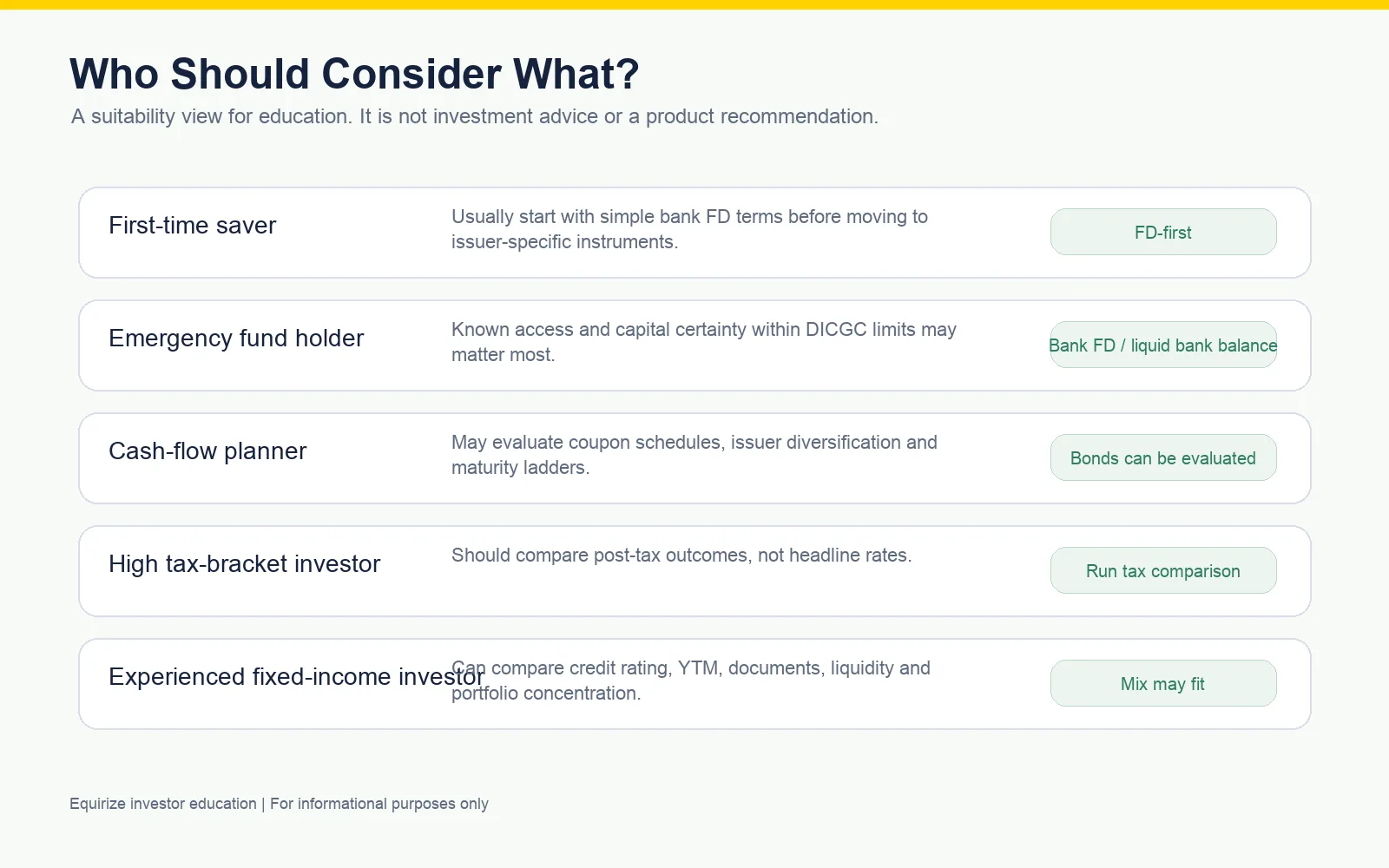
A first-time saver may prefer bank FDs while learning how fixed income works. The structure is familiar, documentation is simpler, and premature withdrawal terms are usually easier to understand.
A senior citizen may need regular income, but should still separate capital that must remain accessible from money that can be locked into a defined schedule. Senior citizen FD rates, SCSS, RBI Floating Rate Savings Bonds, and listed bonds all have different rules and risks. The decision should be cash-flow-led, not product-led.
A higher tax-bracket investor may find that post-tax returns matter more than headline rates. This investor should compare FD interest taxation, bond coupon taxation, capital gains treatment, and TDS mechanics before choosing.
An experienced fixed-income investor may use a mix of instruments. Such an investor may compare bank FDs for reserves, corporate FDs for issuer-specific deposit opportunities, and listed bonds for coupon schedules, maturity matching, and diversification across issuers.
An investor who cannot read an offer document, understand a credit rating, or tolerate price movement before maturity should be cautious with listed bonds. Simplicity has value.
How To Compare Fixed Deposits And Bonds On Equirize Without Chasing Yield
Equirize gives investors access to listed bonds and fixed deposits, but a careful **fixed deposits vs bonds** comparison should not begin with the highest number on screen.
Start with the issuer. Who is borrowing or accepting the deposit? Is it a bank, NBFC, corporate, or government entity?
Then check the structure. Is it a deposit or listed security? Is there an offer document? Is there a demat holding? Is the instrument exchange-listed?
Next, check the risk indicators. For bonds, look at rating, rating agency, maturity, coupon, YTM, security cover where applicable, liquidity, and issuer concentration. For FDs, look at bank vs corporate issuer, DICGC applicability, tenure, payout frequency, premature withdrawal terms, and TDS.
Then compare post-tax cash flow. A pre-tax figure may look attractive, but the in-hand outcome depends on slab rate, TDS, and whether any capital gain or loss arises on sale.
Finally, ask whether you can hold the instrument for the intended tenure. If the answer is no, early-exit terms become central to the decision.
Investors can explore listed bonds on Equirize and fixed deposits on Equirize after reviewing the relevant risk, issuer, tax, and liquidity details. Equirize facilitates access; it does not provide investment advice.
Conclusion: The Better Choice Is The One That Fits The Money's Job
In the bonds vs fixed deposits decision, the better product is the one that fits the purpose of the money.
Use bank FDs where simplicity, known terms, and deposit-insurance boundaries are central. Evaluate corporate FDs only after understanding issuer risk and the absence of DICGC insurance. Evaluate listed corporate bonds when you can assess credit quality, YTM, maturity, liquidity, tax treatment, and the possibility that market price may move before maturity.
The more useful habit is not choosing a side. It is asking better questions before allocating money.