Tax-Free Bonds in India: Meaning, Returns and How to Buy


Tax-free bonds in India look simple at first glance. A public sector or government-backed issuer raises money. The bond pays a coupon. The qualifying interest is exempt from income tax for the bondholder.
That is the attractive part. The practical part is more layered.
Most tax-free bond issues that retail investors discuss today are older listed bonds. Fresh public issues have not been a regular source of supply in recent years, so investors usually evaluate existing bonds in the secondary market. That changes the decision. The question is not only "what is the coupon?" It is also "what price am I paying, what is the yield to maturity, how liquid is the bond, and what tax applies if I sell before maturity?"
This guide explains tax-free bonds meaning, returns, tax treatment, risks, and how to buy them in India through a demat or regulated bond-access route.
Tax treatment depends on individual circumstances and may change. Please consult a qualified tax advisor.
Tax-Free Bond Meaning Under Section 10(15)(iv)(h)
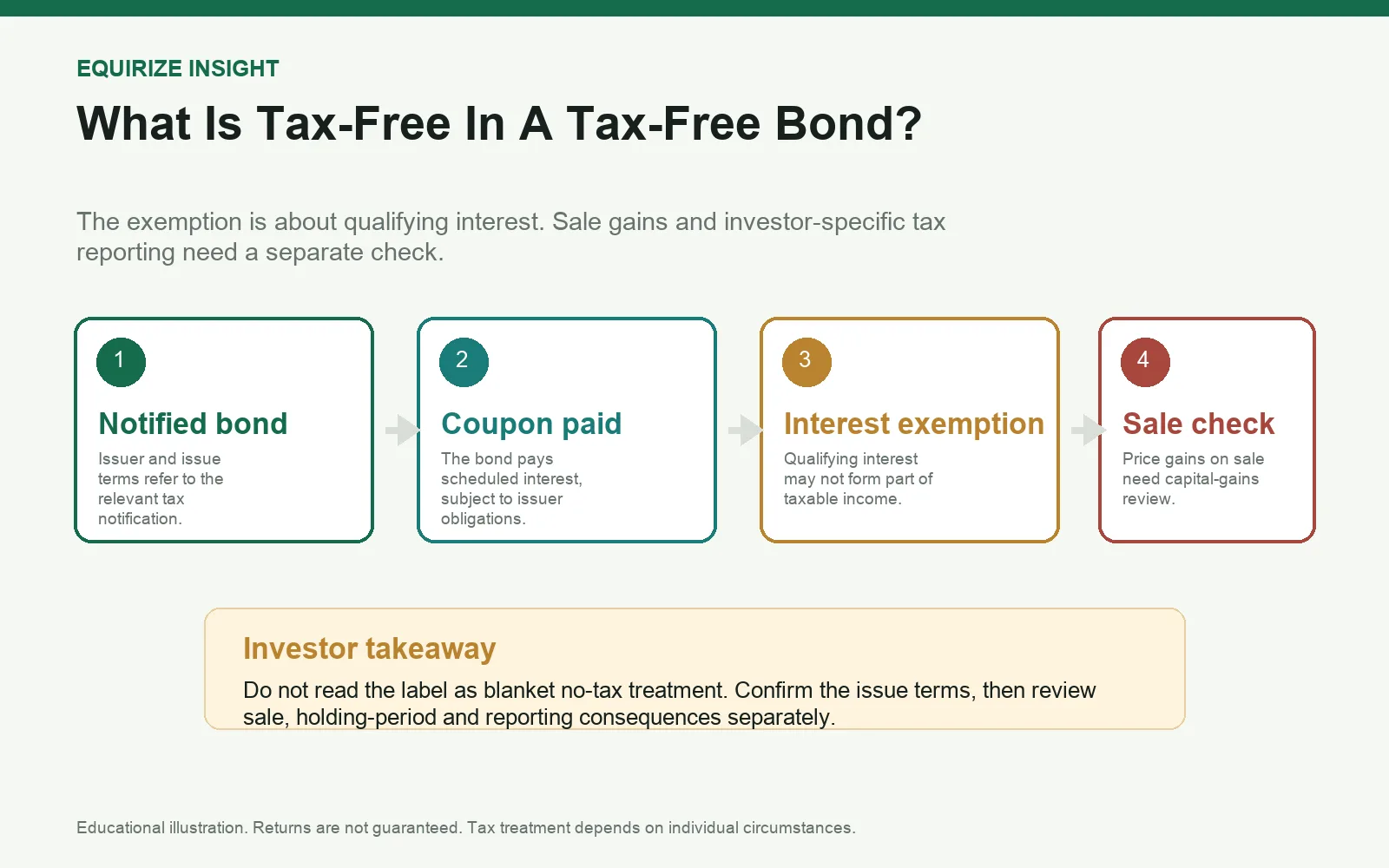
A tax-free bond is a debt security where qualifying interest income is exempt from income tax under a notified provision, commonly cited in older issue documents as Section 10(15)(iv)(h) of the Income-tax Act, 1961.
In plain English, the issuer borrows money from investors. In return, it pays a stated coupon at defined intervals and repays principal at maturity, subject to the issuer meeting its obligations. The special feature is that the interest on specified notified bonds does not form part of taxable income for eligible holders.
Historically, such bonds were issued by public sector and infrastructure-linked entities such as NHAI, REC, PFC, IRFC, HUDCO, NABARD, NTPC, NHPC and similar institutions, depending on the specific issue year and notification.
This is why many investors loosely call them "government tax-free bonds". That phrase needs care. Some issuers may be government-owned or government-backed, but the actual credit support depends on the specific issuer, instrument, offer document, and whether any explicit guarantee exists. Government ownership should not be read as automatic sovereign guarantee.
The useful definition is narrower:
| Feature | What it means |
| Instrument | A bond or debenture issued by a notified issuer |
| Tax feature | Qualifying interest income is exempt from tax |
| Holding format | Often listed and held in demat form, depending on issue terms |
| Issuer type | Usually public sector, infrastructure, municipal or government-linked entities |
| Investor return | Coupon and YTM depend on issue terms and market price |
| Key caveat | Credit, interest-rate, liquidity and reinvestment risks can still apply |
Before buying, the investor should verify the ISIN, issuer, issue document, coupon, maturity date, tax notification reference, listing status, and current market price.
Tax-Exempt Interest Income Is Not the Same as No Tax
The most common mistake is assuming that "tax-free bond" means no tax of any kind.
For qualifying tax-free bonds, the interest income may be exempt. But a separate tax question can arise if the bond is sold before maturity at a profit. The profit on sale is generally analysed as capital gains, subject to the applicable law, holding period, investor status, and transfer date.
This distinction matters in the secondary market. Suppose a bond has a face value of ₹1,000 and an annual coupon of 6%. If the investor buys it at ₹1,180 because market demand is high, the annual coupon may still be exempt if the bond qualifies. But if the investor later sells at ₹1,230, the ₹50 price gain is not automatically sheltered merely because the coupon is tax-exempt.
The clean way to think about tax-free bonds in India is:
- interest exemption is the core tax feature
- sale gains need a separate capital-gains review
- price paid changes the effective yield
- tax reporting can depend on investor-specific facts
- documentation matters
For a broader treatment of coupon taxation across debt instruments, see Equirize's guide to bond interest taxation in India.
Tax-Free Bonds in India 2026: Are New Issues Available?
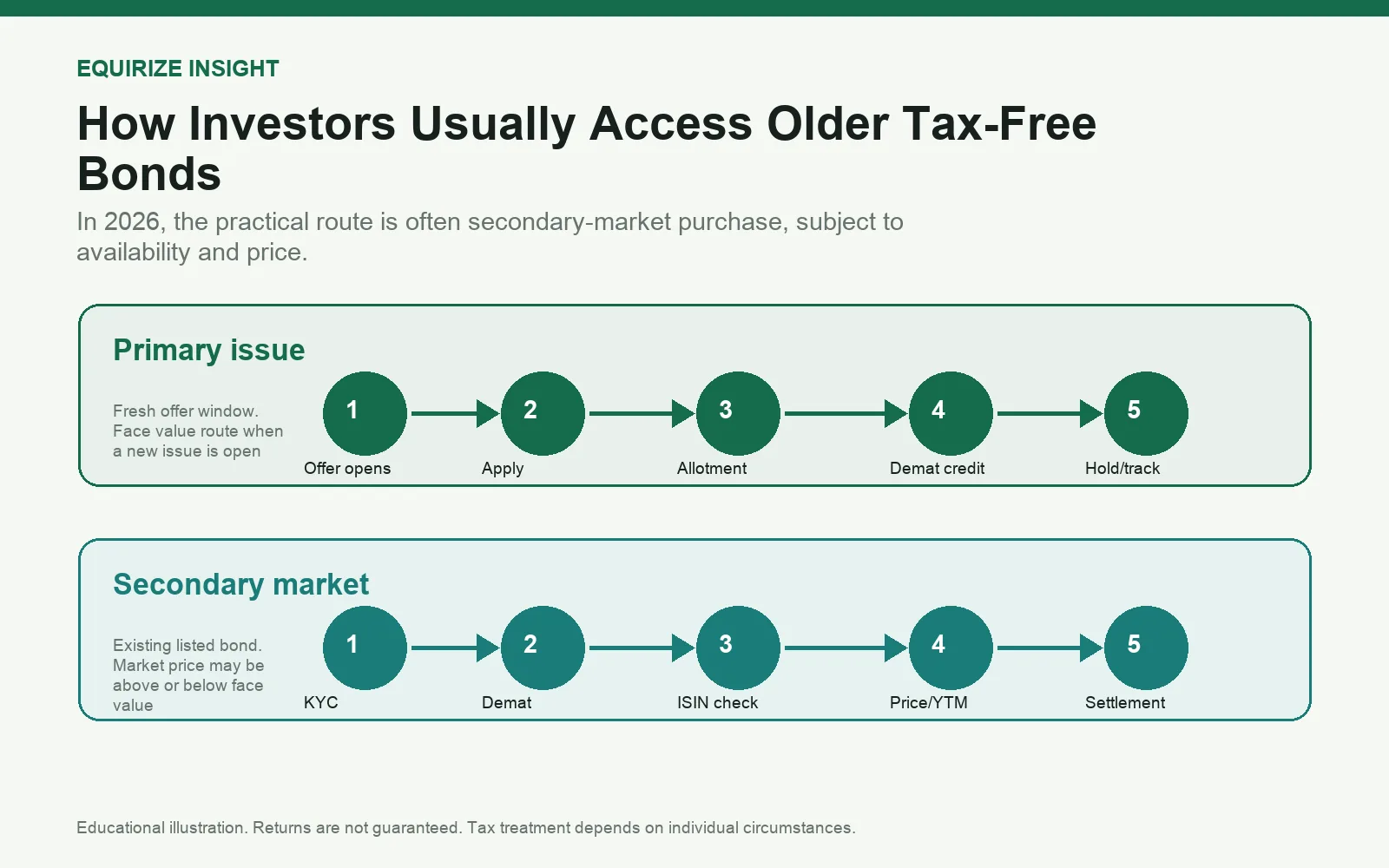
For most retail investors in 2026, the practical route is the secondary market.
Many well-known tax-free bond series were issued in earlier years and continue to be listed. Investors may be able to buy or sell them through exchange-linked trading channels, brokers, or SEBI-registered Online Bond Platform Providers, subject to availability.
That is different from applying in a fresh public issue at face value.
In a new issue, investors subscribe during the offer window at the issue price and receive allotment based on the issue terms. In the secondary market, investors buy from another holder. The traded price may be above or below face value, and the available quantity can vary by day, ISIN, maturity, issuer, and market demand.
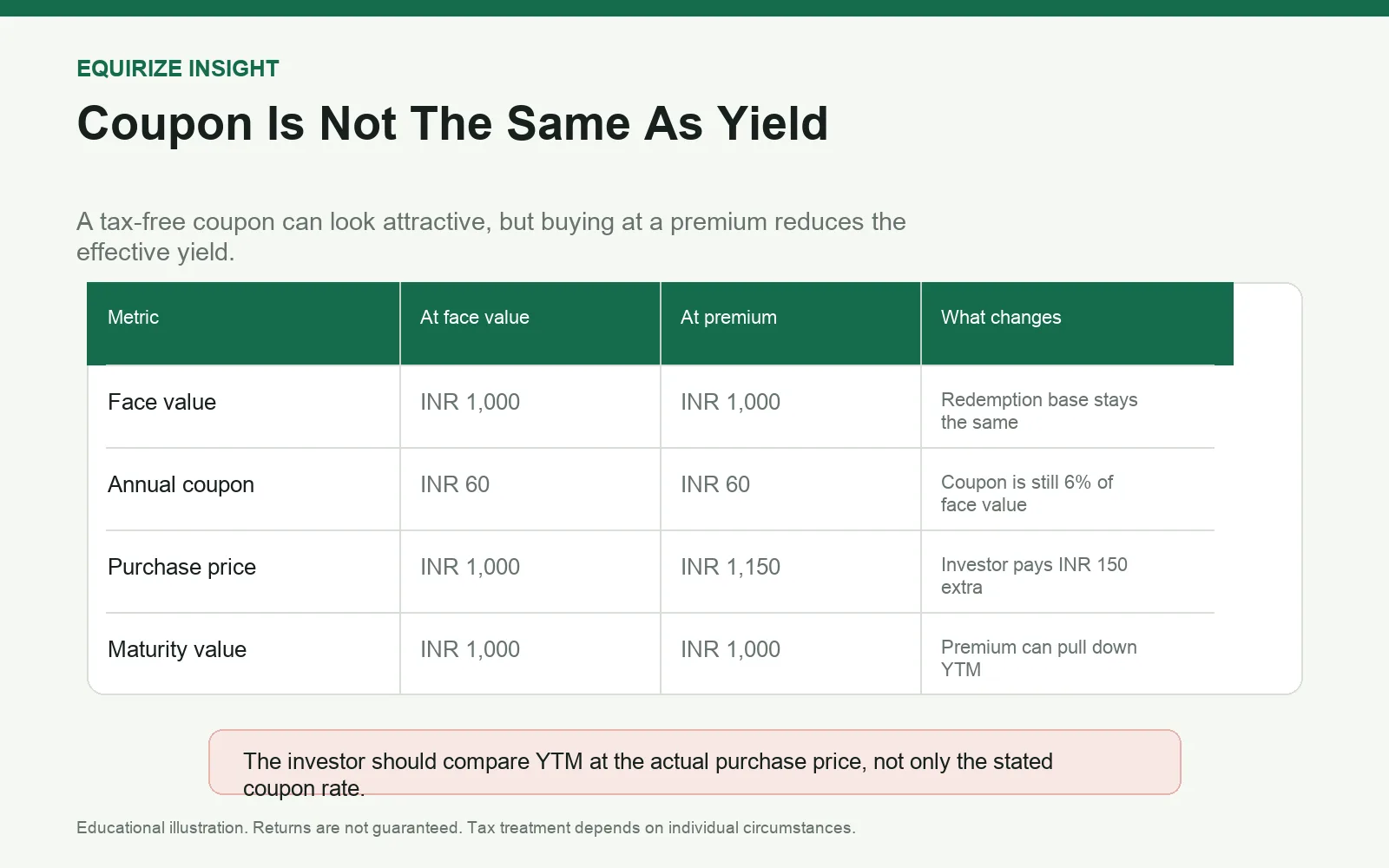
This changes the return calculation. An older bond with a 6% coupon may not produce a 6% yield for a new buyer if the buyer pays a premium. The coupon rate remains fixed on face value, but the purchase price is higher. Yield to maturity captures that difference more clearly than coupon alone.
Secondary Market Tax-Free Bonds on NSE and BSE
Listed tax-free bonds may trade on recognised exchanges such as NSE and BSE, depending on the specific bond. The investor usually needs KYC, a demat account, and a route to place or execute the order.
There are three practical routes:
| Route | What it means | Investor check |
| Broker or trading account | Buy listed bonds through a broker-linked platform | Confirm ISIN, price, quantity, settlement and charges |
| OBPP route | Use a SEBI-registered Online Bond Platform Provider for listed bond access | Confirm the platform role, risk disclosure and offer documents |
| Dealer / wealth route | Buy through a relationship manager or debt-market desk | Confirm pricing transparency, settlement route and documentation |
Secondary-market bond trades often use concepts that equity investors may not see every day.
Clean price is the quoted price before accrued interest. Dirty price includes accrued interest and is closer to the settlement amount. Accrued interest reflects interest earned between the last coupon date and the trade date. If you are comparing two bonds, do not compare only the displayed coupon. Compare the all-in price, YTM, maturity date, liquidity, tax treatment and risk.
Equirize is a SEBI-registered Online Bond Platform Provider and stock broker in the debt segment of BSE and NSE. Investors can use the platform to review listed bond opportunities, issuer details, credit ratings, maturity dates, coupon schedules and offer documents before making an investment decision. Equirize does not provide investment advice.
For a broader route map, read Equirize's guide on how to invest in bonds in India.
Tax-Free Bond Market Data to Check Before Comparing Prices
Secondary-market data can make the same bond look different on different days. A bond may show an attractive last traded yield, but the last trade may have been small, old, or unavailable at the quantity you want.
Before treating a quote as actionable, check the date and size of the last trade. Then compare it with the current bid and ask, if visible. The last traded price tells you where a trade happened earlier. The bid tells you where a buyer may be willing to buy now. The ask tells you where a seller may be willing to sell now. A wide gap between bid and ask is a liquidity signal.
For tax-exempt bonds, the maturity bucket also matters. A bond maturing in two years and a bond maturing in twelve years should not be compared only on coupon. Longer maturity usually brings more interest-rate sensitivity. If market yields move, the longer bond can see a larger price movement before maturity.
Also check whether the bond is trading cum-interest or ex-interest around coupon dates, and whether accrued interest is included in the settlement amount. Two quotes that look similar can lead to different cash outflows once accrued interest and charges are included.
The practical investor question is:
| Market-data check | Why it matters |
| Last traded date | Shows whether the visible price is fresh or stale |
| Traded quantity | Indicates whether the price was a meaningful size |
| Bid-ask spread | Helps estimate the cost of entering or exiting |
| Remaining maturity | Affects duration and exit-price sensitivity |
| Accrued interest | Changes settlement amount and cash-flow timing |
| Yield at ask price | More relevant for a buyer than coupon alone |
This is where a patient investor has an advantage. Tax efficiency is useful, but price discipline decides whether the tax feature is bought sensibly.
Tax-Free Bond Returns: Coupon, YTM and Premium Price
Tax-free bond returns are often misunderstood because investors use the word "return" for different numbers.
The coupon rate is the interest rate stated on the bond's face value. If the face value is ₹1,000 and the coupon is 6%, the annual coupon is ₹60, subject to the issue terms. If the bond qualifies as tax-free, that ₹60 may be exempt interest income for an eligible holder.
Yield to maturity, or YTM, is different. It estimates the annualised return based on the price paid, expected coupon flows, maturity value, and time left until maturity, assuming the issuer makes scheduled payments and the investor holds the bond until maturity.
That assumption is important. YTM is not a promised result. It is an indicative pre-tax calculation based on inputs.
Here is the mechanism:
| Item | Illustration |
| Face value | ₹1,000 |
| Coupon rate | 6.00% |
| Annual coupon | ₹60 |
| Current market purchase price | ₹1,150 |
| Redemption value at maturity | ₹1,000 |
| Result | Coupon is based on ₹1,000, but the investor paid ₹1,150 |
If an investor buys at ₹1,150 and holds to maturity, they receive coupon income along the way but may also move from a ₹1,150 purchase price to a ₹1,000 redemption value. The effective yield is therefore lower than the coupon rate. The market price has already capitalised part of the tax benefit.
The reverse can also happen. If a bond trades at a discount to face value, YTM may be higher than the coupon because the investor pays less than the redemption value. But discount can also reflect interest-rate movement, weak liquidity, issuer perception, or other market factors. A discount is not automatically an opportunity.
Here is a more investor-like reading of the same point.
Assume two qualifying bonds have similar issuer quality and both mature in five years. Bond A has a 6.00% coupon and trades at ₹1,160. Bond B has a 5.50% coupon and trades at ₹1,020. A quick reader may prefer Bond A because the coupon is higher. A careful reader asks a second question: what is the yield at my purchase price?
If Bond A is bought far above face value, the investor collects a higher annual coupon but gives up part of the premium at maturity if the bond redeems at face value. Bond B pays a lower coupon, but the purchase price is closer to face value. The ranking can change when YTM is calculated.
This is also why "current yield" is incomplete. Current yield divides annual coupon by current price. It can be useful for cash-flow comparison, but it does not account for the pull toward maturity value. YTM is better suited for hold-to-maturity comparison because it includes coupons, purchase price, redemption value and time.
Even YTM has limits. It assumes all scheduled payments are made. It assumes you hold until maturity. It usually does not solve your personal tax situation. If you sell early, your realised return can differ from the displayed number.
For investors comparing tax-free bonds with taxable bonds, bank FDs, debt funds or other listed bonds, YTM is usually more useful than coupon. It compresses price, coupon and maturity into one comparison number. It still needs to be read with risk, liquidity and tax.
For a fuller explanation, see Equirize's yield to maturity guide.
Taxable-Equivalent Yield for Tax-Free Bonds by Slab
Tax-free bonds become more relevant when the investor is in a higher tax bracket, because taxable interest loses more to tax.
A simple taxable-equivalent yield formula is:
Taxable-equivalent yield = tax-free yield / (1 - marginal tax rate)
For example, if a qualifying bond offers a 5.50% tax-free yield and the investor's marginal tax rate is 30%, the simplified taxable-equivalent yield is:
5.50% / (1 - 0.30) = 7.86%
This does not mean the tax-free bond is automatically preferable to every taxable instrument at a lower or higher headline rate. It only shows the taxable yield that would be needed to match the tax-free yield before considering surcharge, cess, credit risk, liquidity, maturity mismatch, reinvestment, platform costs and investor-specific tax facts.
| Tax-free yield | Marginal tax rate | Simplified taxable-equivalent yield |
| 5.00% | 10% | 5.56% |
| 5.00% | 20% | 6.25% |
| 5.00% | 30% | 7.14% |
| 5.50% | 10% | 6.11% |
| 5.50% | 20% | 6.88% |
| 5.50% | 30% | 7.86% |
| 6.00% | 10% | 6.67% |
| 6.00% | 20% | 7.50% |
| 6.00% | 30% | 8.57% |
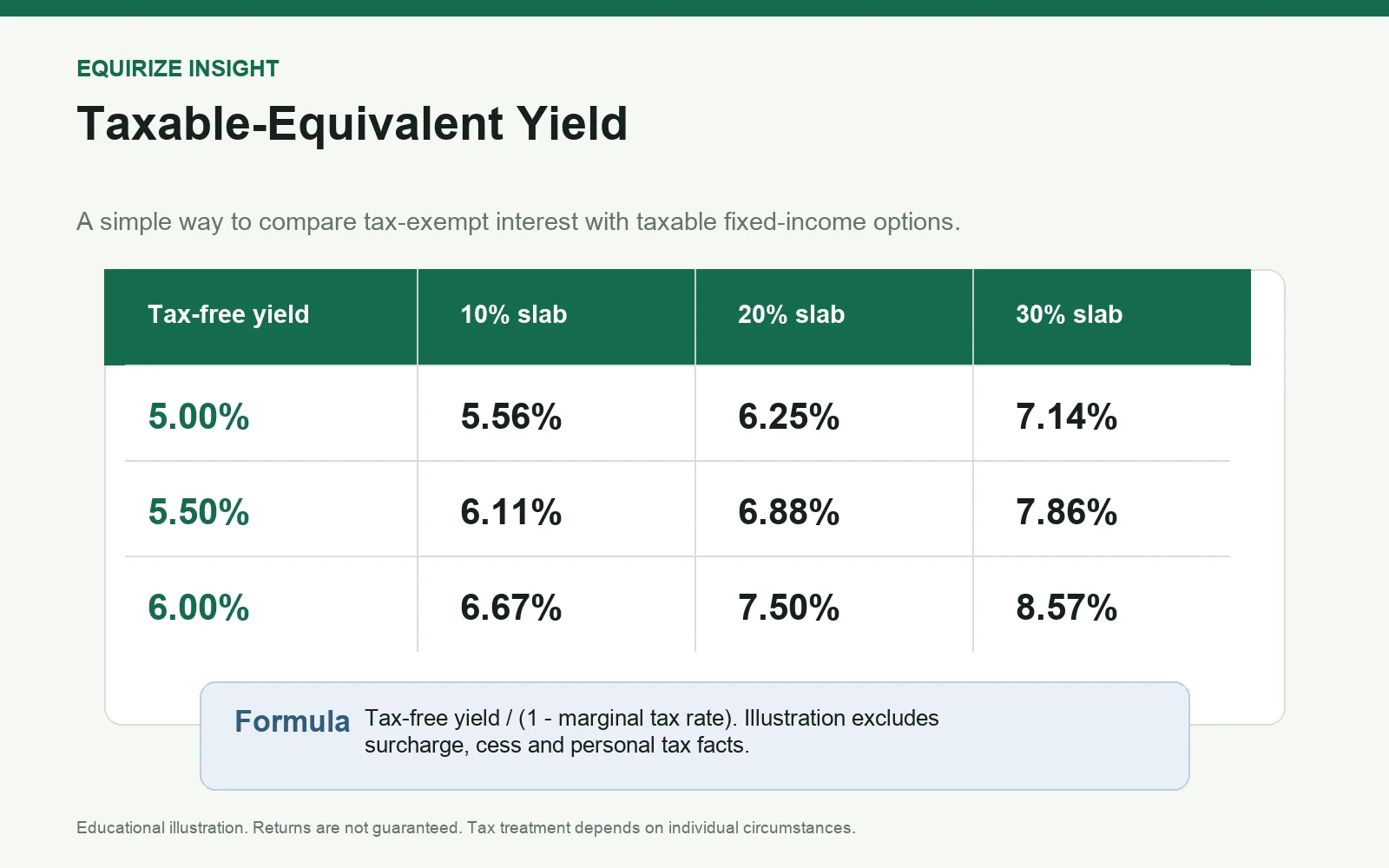
For high-income investors, this table can change the first impression. A 5.50% tax-free yield may compare more closely with a taxable instrument above 7.50% for someone in the 30% slab. But the comparison is still incomplete until maturity, issuer quality, liquidity, sale tax and portfolio concentration are evaluated.
Tax-Free Bond Capital Gains Tax on Sale Before Maturity
If you hold a qualifying tax-free bond until maturity, the expected tax feature is linked to coupon interest. If you sell before maturity, a separate question arises: did you sell at a profit or loss compared with your acquisition cost?
That gain or loss is generally analysed under capital gains rules. The applicable treatment can depend on whether the bond is listed, how long it was held, when it was sold, the type of bond, and the investor's tax status.
This matters because the market price of a tax-free bond can move.
Bond prices generally move in response to market yields, remaining maturity, credit perception, liquidity and demand. If interest rates fall, older bonds with attractive coupons may trade at a premium. If yields rise, the same bond may trade lower. Tax-free status may support demand, but it does not freeze the price.
Consider a simplified case:
| Step | Amount |
| Investor buys listed tax-free bond | ₹1,120 |
| Investor sells later in secondary market | ₹1,180 |
| Price gain before expenses | ₹60 |
| Tax treatment | Needs capital-gains review |
The tax-exempt interest feature should not be used as a shortcut for the sale-gain answer. If your plan depends on selling before maturity, read the capital-gains rules before buying, not after the exit.
For deeper detail, read Equirize's guide to capital gains on bonds tax rules.
Tax-Free Bond Liquidity Risk and Exit Price
Tax-free bonds may be listed, but listed does not always mean liquid at the price you want.
Liquidity depends on the specific ISIN. Some bonds may have better demand because of issuer familiarity, maturity profile, coupon, tax-exempt status or lot size. Others may trade infrequently. A buyer may be available, but only at a price that changes your realised return.
Before buying, check:
- last traded price and date
- bid and ask quotes, where visible
- traded quantity
- remaining maturity
- coupon date and accrued interest
- yield to maturity at your purchase price
- likely buyer depth if you need to exit
- transaction costs and taxes on sale
An investor planning to hold until maturity faces lower exit-price uncertainty than an investor planning to sell in six months. That does not remove issuer risk. It simply changes which risk matters most.
How to Buy Tax-Free Bonds in India Through Demat and OBPP Routes
The buying process is straightforward only after the investor knows what to check.
Step 1: Complete KYC and demat readiness
You need completed KYC and a demat account to hold most listed bonds in electronic form. Check that your PAN, bank account, mobile number, email and demat details match across records. Operational mismatches can delay settlement, interest credit or redemption communication.
Step 2: Search by issuer, ISIN and maturity
Do not rely only on the issuer name. A large issuer may have multiple bond series with different coupon rates, maturity dates and tax status. Use the ISIN and issue details to identify the exact bond.
Step 3: Confirm the tax-free status
Check the offer document, issue note or reliable platform information to confirm that the bond is a qualifying tax-free issue. The word "PSU" or "government-backed" does not by itself make the interest exempt.
Step 4: Compare coupon, price and YTM
A bond with a high coupon may trade at a premium. A bond with a lower coupon may trade closer to face value. Compare YTM at your purchase price, not only the stated coupon.
Step 5: Read liquidity and maturity together
If you can hold until maturity, the main focus is issuer repayment, coupon schedule, tax treatment and portfolio fit. If you may exit early, liquidity and market price become central.
Step 6: Place the order through a regulated route
You may use a broker, exchange-linked platform, wealth desk or SEBI-registered OBPP, subject to availability. Confirm the exact settlement amount, including accrued interest if applicable.
Step 7: Track coupon, statements and redemption
Once allotted or purchased, bonds should reflect in your demat account. Keep contract notes, statements, coupon credits, tax documents and redemption communication. Tax-free interest may still need proper disclosure or recordkeeping even if it is exempt.
For the regulatory context behind platform access, read Equirize's explainer on OBPP license and SEBI rules.
Tax-Free Bond Checklist Before Placing an Order
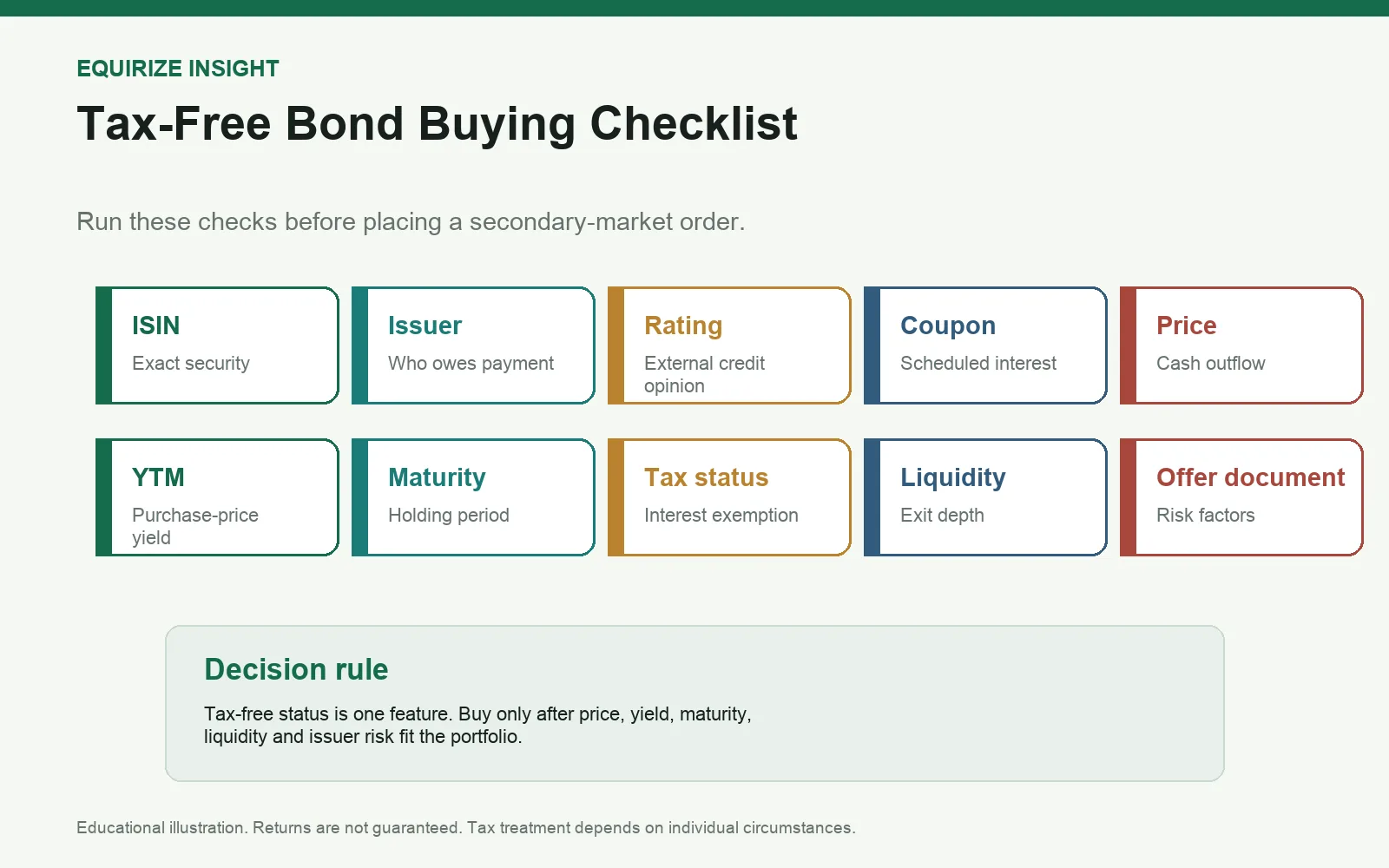
Use this checklist before buying:
| Check | Why it matters |
| ISIN | Identifies the exact security |
| Issuer | Shows who owes coupon and principal |
| Credit rating and rating agency | Gives an external credit opinion, not a guarantee |
| Coupon | Shows scheduled interest on face value |
| Purchase price | Decides your actual yield |
| YTM | Helps compare price, coupon and maturity |
| Maturity date | Shows holding period and duration exposure |
| Tax-free reference | Confirms whether interest exemption applies |
| Liquidity | Helps estimate exit feasibility before maturity |
| Offer document | Contains risk factors and terms |
| Concentration | Avoids overexposure to one issuer or maturity bucket |
The investor's job is not to find the highest-looking coupon. It is to find the instrument where tax treatment, issuer quality, maturity, liquidity and price make sense together.
Tax-Free Bond Records and NRI Checks
Resident and non-resident investors should keep the document trail clean. At minimum, preserve the contract note, demat statement, bank statement for coupon credits, purchase price, sale price if sold, and any issue document or platform report that identifies the bond's tax status.
For NRIs, the answer can be more layered. Eligibility to buy a specific listed bond may depend on the issue terms, platform rules, account type, FEMA route, demat status, bank account, tax residency and treaty position. A bond that is tax-exempt for Indian income-tax purposes may still have reporting consequences in another country of tax residence.
This is especially relevant for investors who split financial lives across India and another jurisdiction. The Indian label "tax-free" should not be assumed to travel automatically into foreign tax law. NRIs should confirm whether the income needs to be reported overseas and whether any local tax applies.
Family holdings need similar discipline. If bonds are bought across spouses, parents, HUFs or family entities, each holder's PAN, demat account, bank account and tax reporting should match the actual beneficial ownership and transaction flow. A clean record matters more than a neat spreadsheet prepared later.
Tax-Free Bonds vs 54EC Bonds vs Tax-Saving FDs
Tax-free bonds are often confused with 54EC bonds and tax-saving fixed deposits. They solve different tax problems.
| Feature | Tax-free bonds | 54EC / capital gain bonds | Tax-saving fixed deposits |
| Main tax feature | Qualifying interest may be exempt | Eligible long-term capital gain from land/building may be exempt if conditions are met | Deposit may qualify for deduction within the applicable 80C-style limit, subject to current law |
| Interest tax | Generally exempt for qualifying bonds | Generally taxable | Generally taxable |
| Typical use case | Tax-efficient coupon income for eligible holders | Reducing eligible property capital gains tax | Deduction-linked deposit planning |
| Availability | Usually secondary market for older listed bonds | New subscription route may be available through specified issuers, subject to current issue status | Through eligible banks |
| Liquidity | Can be sold if listed and buyer exists, subject to price | Lock-in applies; early transfer can affect exemption | Lock-in applies |
| Return metric | Coupon and YTM at purchase price | Coupon plus value of capital-gain exemption | FD interest rate |
| Main risk | Issuer credit, interest-rate, liquidity and tax interpretation | Lock-in, issuer, taxable interest and documentation | Bank credit risk above insured limits and reinvestment risk |
The key difference is this:
- tax-free bonds focus on tax-exempt interest
- 54EC bonds focus on eligible capital-gains exemption
- tax-saving FDs focus on deduction-linked investment, with taxable interest
For a detailed property-sale explainer, see Equirize's article on 54EC bonds for capital gains tax.
Tax-Free Bonds vs Tax-Saving Bonds and FDs
The phrase "tax-saving bond" can mislead investors because different products save tax in different ways.
Some instruments reduce taxable income or capital gains if specific conditions are met. Some provide tax-exempt interest. Some provide no special tax feature at all but may still be part of a fixed-income portfolio. The tax result depends on the instrument, section, investor status, year, holding period and documentation.
Bank fixed deposits should also be compared carefully. A bank FD has deposit insurance up to ₹5 lakh per depositor per bank under DICGC rules, subject to applicable conditions. A listed bond is a security and does not have the same deposit-insurance structure. On the other hand, a qualifying tax-free bond may have interest exemption that a normal FD does not provide.
For a broader comparison, read Equirize's guide to bonds vs fixed deposits.
Who May Consider Tax-Free Bonds in India
Tax-free bonds may be relevant for investors who want coupon income with a specific tax feature and can evaluate listed bond risks.
They may suit:
- investors in higher tax brackets who compare post-tax income
- investors who can hold until maturity and do not need immediate liquidity
- investors seeking exposure to known public sector or infrastructure-linked issuers, subject to due diligence
- retirees or HNIs who want tax-efficient coupon cash flow within a larger fixed-income allocation
- investors who understand that secondary-market price can change
The strongest use case is usually not "I found a tax-free bond." It is "after checking YTM, maturity, liquidity, issuer risk and tax position, this bond improves my post-tax fixed-income allocation."
That is a narrower and more disciplined decision.
Who Should Avoid Tax-Free Bonds
Tax-free bonds may not suit every investor.
They may be unsuitable for investors who:
- may need to exit at short notice
- do not want to track secondary-market price
- are in a low tax bracket where the interest exemption has limited value
- are comparing only coupon and ignoring YTM
- assume government-linked issuer means no credit risk
- want a short-term parking product
- need high trade liquidity
- already have concentrated exposure to similar issuers or long maturities
There is also a behavioural trap. The word "tax-free" can make an investor overlook price. Paying too much for a tax-free coupon can reduce the actual yield. Tax efficiency helps only when the purchase price and risk are sensible.
Tax-Free Bond Risks Investors Should Read Before Buying
Tax-free bonds are fixed-income securities, but they are not free of risk.
The main risks are:
| Risk | What it means |
| Credit risk | The issuer may face difficulty meeting coupon or principal obligations |
| Interest-rate risk | The bond's market price can fall if yields rise |
| Liquidity risk | You may not find a buyer at your desired price before maturity |
| Reinvestment risk | Future coupons may need to be reinvested at lower rates |
| Concentration risk | Too much exposure to one issuer or maturity can distort the portfolio |
| Tax interpretation risk | Investor status, sale timing or documentation may change the tax outcome |
| Premium-price ask | Buying far above face value can reduce YTM despite tax-exempt interest |
Credit rating is useful, but it is not a guarantee of repayment. Listing improves market access, but it does not guarantee exit liquidity. Tax exemption improves post-tax cash flow for eligible holders, but it does not make the whole investment free of risk.
This is the discipline investors need in 2026: treat tax-free status as one feature, not as the full investment thesis.
Tax-Free Bond Summary: What to Check Before You Buy
Before buying tax-free bonds in India, move through this order:
- Confirm the exact bond by ISIN.
- Verify that the bond's interest is tax-exempt under the relevant notification or issue terms.
- Check issuer, rating, maturity date and offer document.
- Compare coupon with YTM at your actual purchase price.
- Check whether the bond is trading at a premium or discount to face value.
- Review liquidity if you may sell before maturity.
- Understand capital-gains implications on sale.
- Compare taxable-equivalent yield with other fixed-income options.
- Avoid concentration in one issuer, tax feature or maturity bucket.
- Keep records for coupon, demat holding, purchase price and sale proceeds.
Tax-free bonds can be useful when the interest exemption, issuer profile, maturity and market price fit the investor's plan. They can be poor choices when bought only for the label.
The final judgement should be post-tax and risk-aware. A lower-looking tax-exempt yield can be attractive for one investor and irrelevant for another. A premium-priced bond can still make sense if the YTM, maturity and liquidity fit the plan. A familiar issuer can still be unsuitable if the bond is too long, too illiquid or too concentrated for the portfolio.
That is the right frame for fixed income: not "which product sounds better", but "which cash flow, risk and tax treatment fit the need I actually have?"
Equirize helps investors review listed bond opportunities, issuer details, credit ratings, maturity dates, coupon schedules and offer documents within a SEBI-registered OBPP framework. The final decision should be based on your risk profile, tax position, liquidity needs and independent advice.