10 Common Bond Investing Mistakes Investors Should Avoid


Bond investing mistakes usually begin with one of two assumptions: that a bond is simple because it pays a coupon, or that a listed bond is automatically easy to exit because it is listed.
Both assumptions can be expensive.
Listed corporate bonds can play a useful role in a fixed-income portfolio, but they are not deposits. They carry issuer credit risk, interest-rate risk, liquidity risk, tax impact, reinvestment risk and documentation risk. SEBI's investor education material also notes that bond prices can fluctuate because of market conditions and issuer creditworthiness, and that selling before maturity can lead to gains or losses.
The better approach is not to avoid bonds. It is to avoid avoidable mistakes.
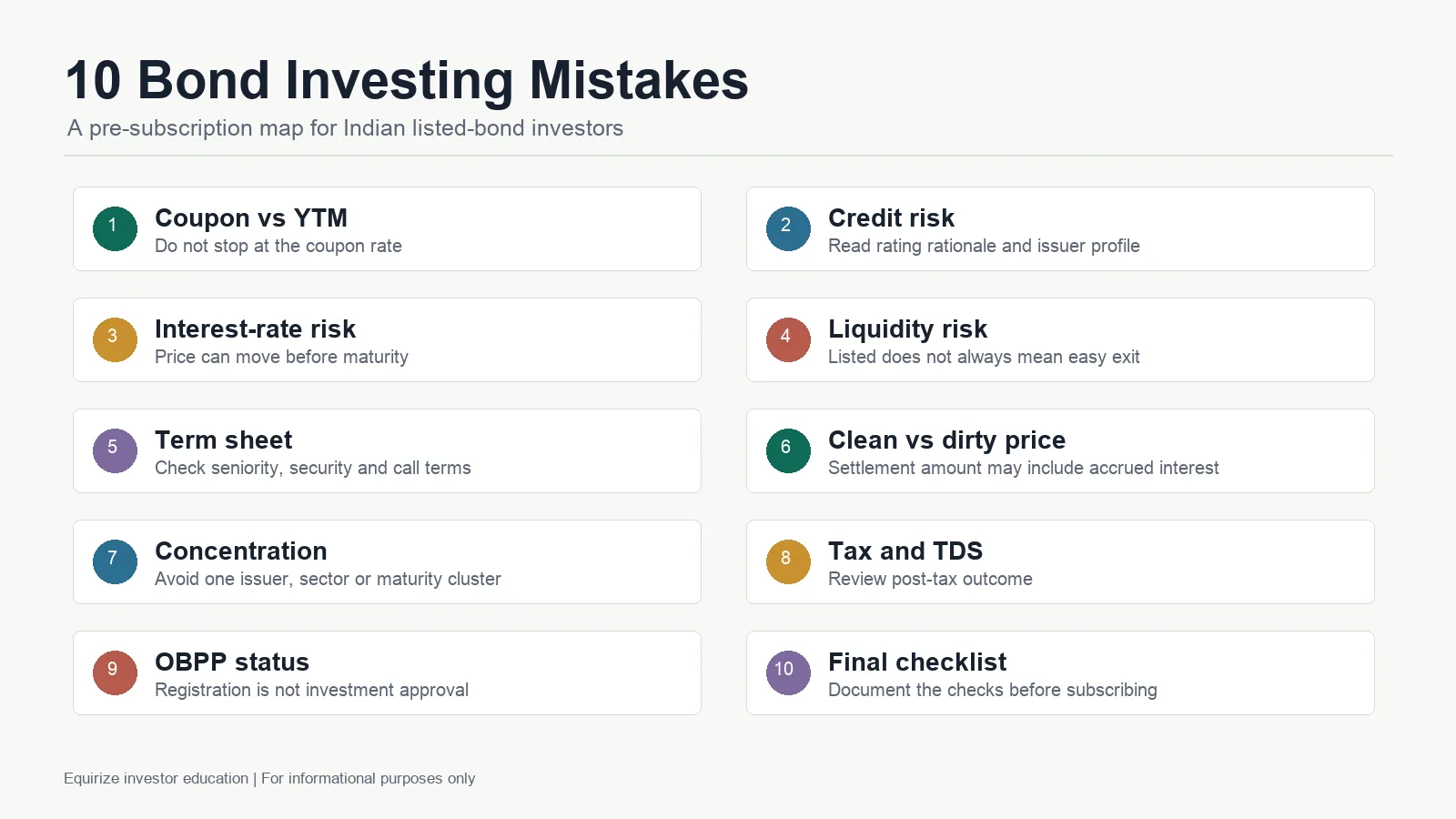
This guide explains 10 common mistakes in bond investing and the checks Indian investors should complete before subscribing to a listed bond.
Why Bond Investment Mistakes Happen In India
For a long time, direct bond investing in India was difficult for most individual investors. Information was fragmented, minimum ticket sizes were often high, and execution was largely offline or relationship-led.
Online access has changed that. Investors can now compare listed bond opportunities by issuer, tenure, coupon structure, rating, indicative yield and documents from a screen.
That convenience creates a new responsibility. A clean interface can make a bond look simpler than it is. The investor still has to ask: What am I buying? Who is the issuer? What can go wrong? What price am I paying? Can I hold until maturity? What happens if I need to exit early?
If you are still building the foundation, Equirize's guide to investing in bonds in India with ₹10,000 explains the basic bond journey. This article assumes you know the basics and want to reduce avoidable errors.
Mistake 1: Chasing Coupon Rate Instead Of Indicative Pre-Tax YTM
The coupon rate is not the same as the investor's total return.
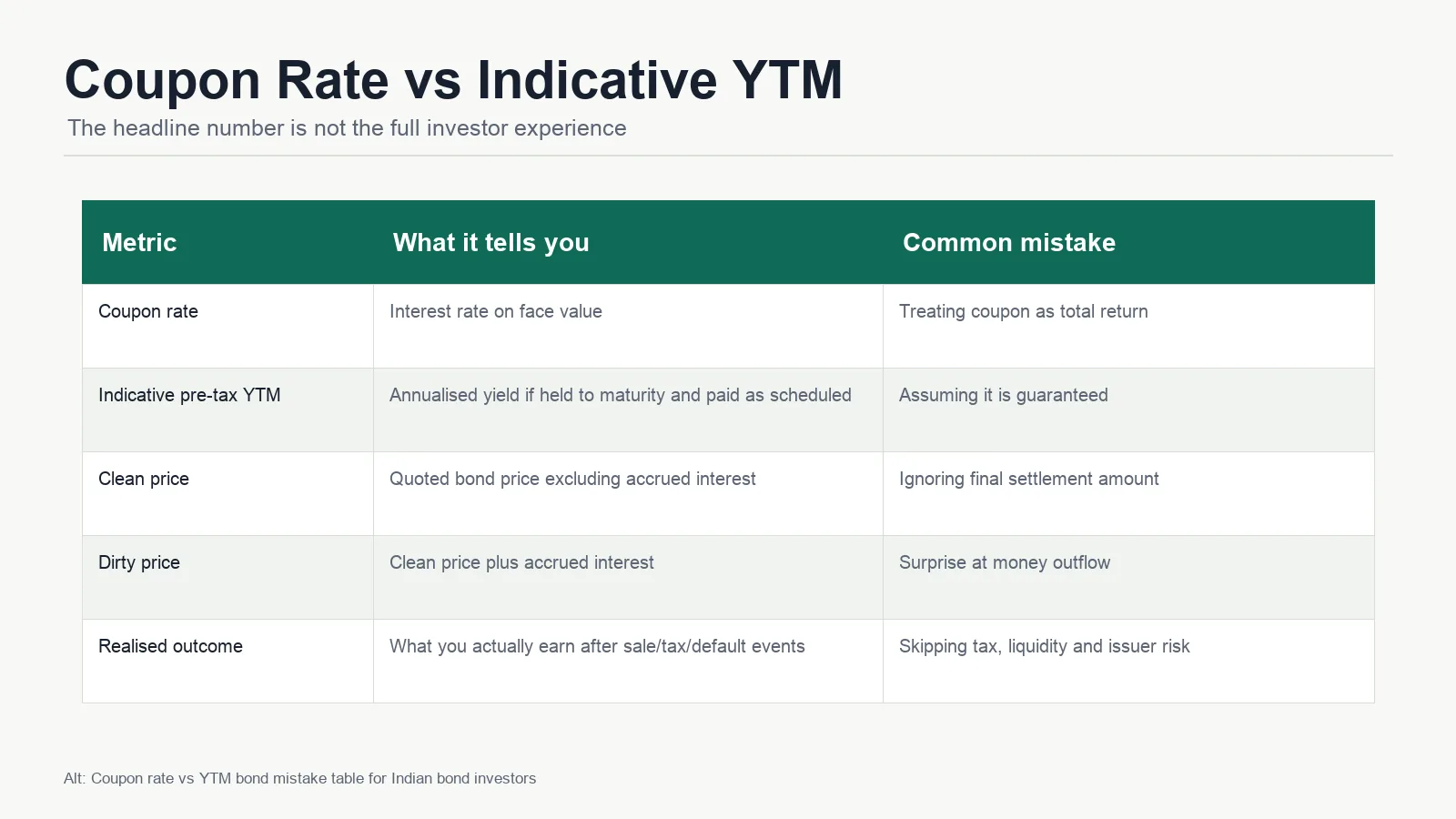
Coupon rate is the stated interest rate on the bond's face value. If a bond has a face value of ₹1,000 and a coupon rate of 8%, the annual coupon is based on that face value. But investors rarely evaluate bonds only at face value. The market price may be above or below face value, accrued interest may be payable at settlement, and taxes may reduce the final post-tax outcome.
Indicative pre-tax yield to maturity, or YTM, is a more complete number because it considers price, coupon, redemption value and time to maturity. Even then, YTM is not a promised outcome. It usually assumes the bond is held until maturity and scheduled payments occur as expected.
The mistake is reading coupon, YTM or a platform card as if it answers the whole question. It does not.
Before subscribing, compare:
| Check | Why it matters |
| Coupon rate | Shows periodic interest on face value |
| Indicative pre-tax YTM | Shows annualised yield based on price and maturity assumptions |
| Clean price | Shows quoted price excluding accrued interest |
| Dirty price | Shows settlement price including accrued interest |
| Tax impact | Changes post-tax outcome |
| Exit need | Can change realised return if sold before maturity |
For a deeper view of price, spread and YTM, see Equirize's guide to bond platform fees, spread, yield and price.
Mistake 2: Ignoring Credit Risk In Bonds
Credit risk in bonds is the risk that the issuer may not meet coupon or principal obligations on time.
A bond is a loan to an issuer. That issuer may be a government, public-sector entity, bank, NBFC, corporate, municipality or other permitted borrower. The quality of the issuer matters because bond investors are exposed to its repayment ability.
Credit rating is a useful starting point, but it is not a substitute for reading. SEBI's investor education material specifically says investors should not rely solely on credit ratings and should also review factors such as past bond issues, profitability, solvency ratios and other credit metrics.
The practical check is simple: if a bond offers a higher indicative yield than similar-tenure instruments, ask what risk explains the difference. It may be credit quality, liquidity, structure, tenure, security, sector perception or market demand.
Equirize's explainer on credit spread in bonds is useful here because spread helps investors ask why one bond pays more than another.
Credit Rating In Bonds Is A Filter, Not A Guarantee
A rating is an opinion from a credit rating agency. It can change.
When reviewing a bond rating, check the agency, rating date, outlook, watch status and latest rating rationale. The rationale often explains leverage, liquidity, profitability, sector risks, group support, recent events and rating sensitivities.
Do not stop at the symbol. Two bonds with the same rating can still differ by maturity, security cover, seniority, issuer group, liquidity and market perception.
Mistake 3: Overlooking Interest-Rate Risk In Bonds
Interest-rate risk in bonds is the risk that market price changes as interest rates or yields move.
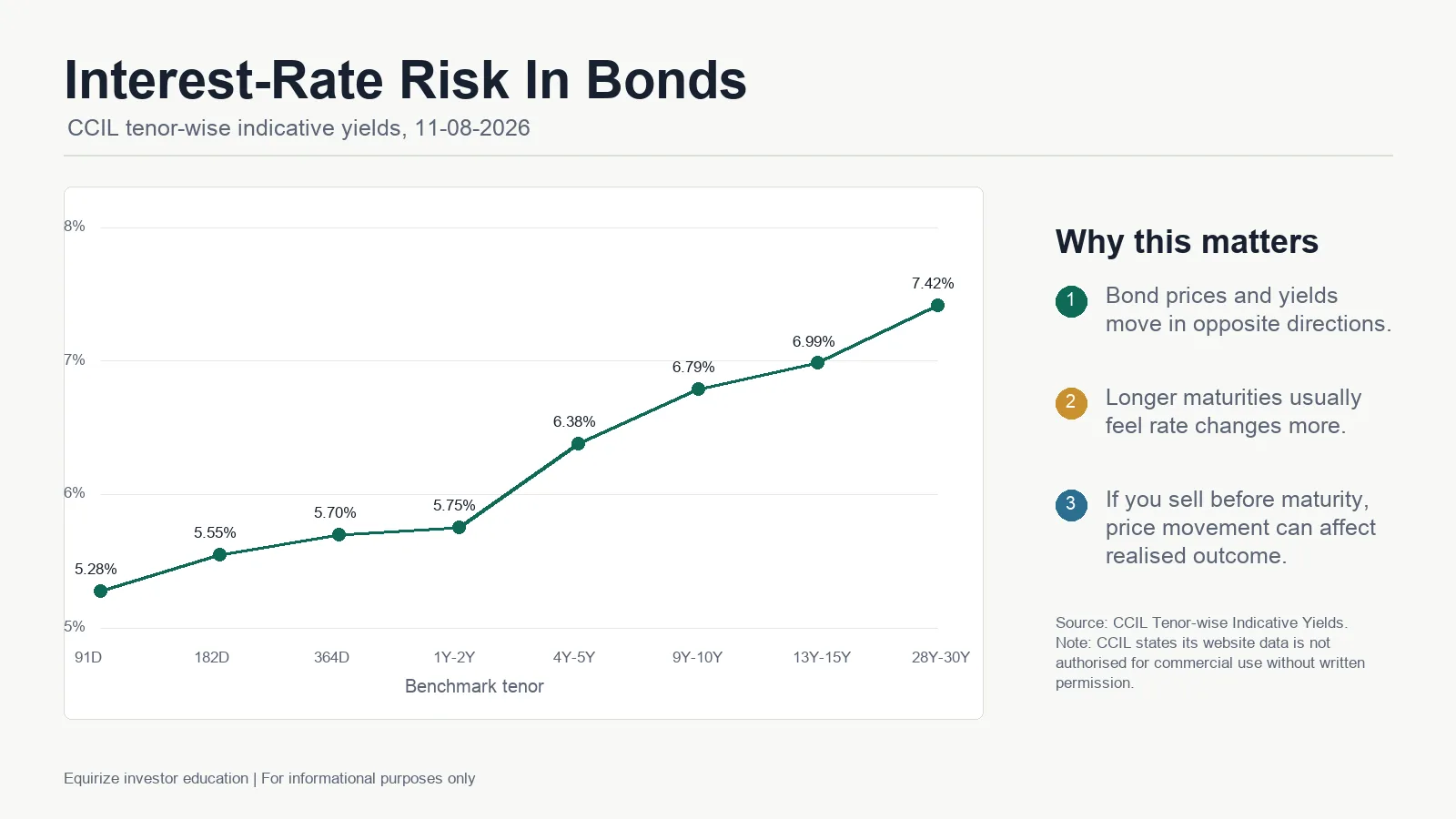
Bond prices and yields generally move in opposite directions. If market yields rise after you subscribe to a fixed-rate bond, the market price of your bond may fall. If market yields fall, the price may rise. This matters most if you sell before maturity.
If you hold a bond until maturity and the issuer pays as scheduled, interim price movement may not affect the final redemption. But life is rarely as neat as a spreadsheet. Investors may need money earlier, rebalance their portfolio, or respond to a credit event. At that point, market price matters.
Longer-maturity bonds usually carry more sensitivity to interest-rate movement than shorter-maturity bonds. That is why maturity and duration should be reviewed before yield.
The CCIL tenor-wise indicative yield table for 11-08-2026 showed government-security benchmark YTMs ranging from 5.278% for 91-day Treasury Bills to 7.4191% for the 28-30 year bucket. The point is not to predict rates. It is to see that the yield curve differs by tenor, and tenor affects how the bond may behave before maturity.
If early exit is a possibility, read Equirize's guide on how to sell bonds before maturity in India.
Mistake 4: Assuming Liquidity Risk In Bonds Is Minor
Liquidity risk in bonds is the risk that you may not be able to sell at the time or price you want.
"Listed" does not always mean "actively traded." A bond may be listed on an exchange and still have limited secondary-market depth. If few buyers are available, the seller may need to accept a lower price, wait longer, or hold the bond until maturity.
This is why investors should not put money needed for near-term expenses into a bond only because the bond appears available for secondary sale. The better question is: can I comfortably hold this bond until maturity if the secondary market is thin?
Check recent trading activity, bid-ask spread, issue size, remaining maturity, rating and investor demand. If the bond is structurally complex or issued by a less-followed issuer, liquidity can be more limited.
Liquidity is not only a product feature. It is also a personal finance feature. Emergency funds and short-term obligations should be planned before subscribing to less-liquid fixed-income instruments.
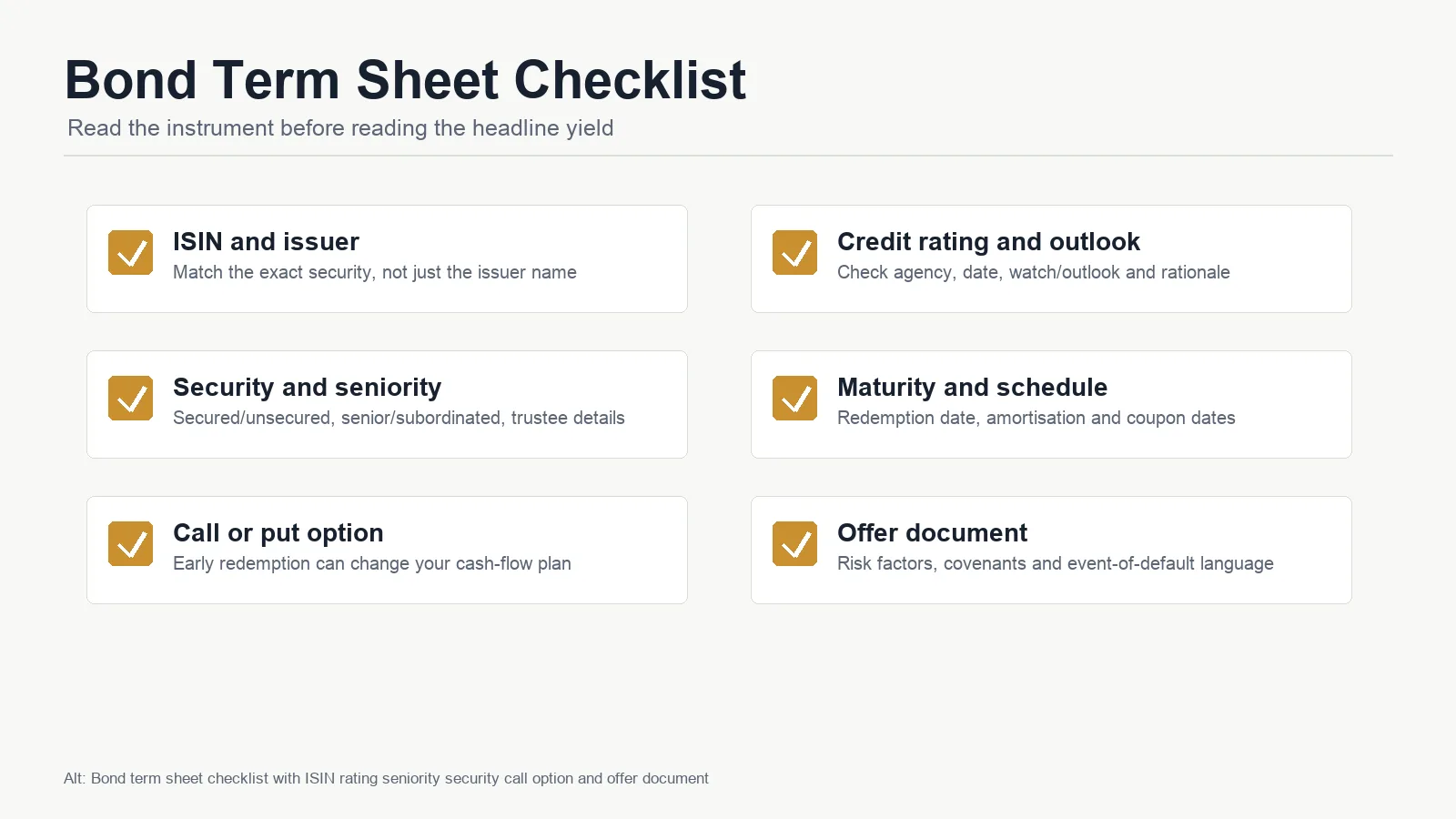
Mistake 5: Skipping The Bond Term Sheet Checklist
A bond term sheet is not paperwork after the decision. It is part of the decision.
The term sheet and offer document tell you what the instrument actually is. The same issuer may have several bonds with different maturity dates, coupon schedules, security cover, seniority, call options and repayment structures. Reading only the issuer name or headline yield can lead to the wrong comparison.
At minimum, check:
- ISIN and exact security name.
- Issuer legal name.
- Credit rating, agency and rating rationale.
- Coupon rate and payment frequency.
- Maturity date and redemption structure.
- Whether the bond is secured or unsecured.
- Whether it is senior, subordinated or otherwise lower in the repayment hierarchy.
- Whether call or put options exist.
- Clean price, dirty price and accrued interest.
- Offer document and risk factors.
Equirize's guide to SEBI rules for bond investors explains the disclosure checks investors should expect on regulated online bond platforms.
Seniority, Security Cover And Call Options In Bonds
Three clauses deserve special attention.
Seniority tells you where the bond may sit in the repayment hierarchy if the issuer faces stress. Security cover tells you whether specific assets support the debt and how that security is structured. A call option may allow the issuer to redeem the bond before maturity, often when market conditions make early redemption attractive to the issuer.
These features can change the investor experience even when coupon and maturity look familiar.
Mistake 6: Confusing Clean Price, Dirty Price And Accrued Interest
Bond settlement can surprise first-time investors because the quoted price is not always the final settlement amount.
Clean price generally excludes accrued interest. Dirty price includes accrued interest. If you buy a bond between coupon dates, the seller may be entitled to interest accrued up to the settlement date. The buyer pays that accrued interest as part of the settlement amount and then receives the full coupon on the next coupon date, subject to issuer payment.
This is normal bond-market mechanics. The mistake is not accounting for it.
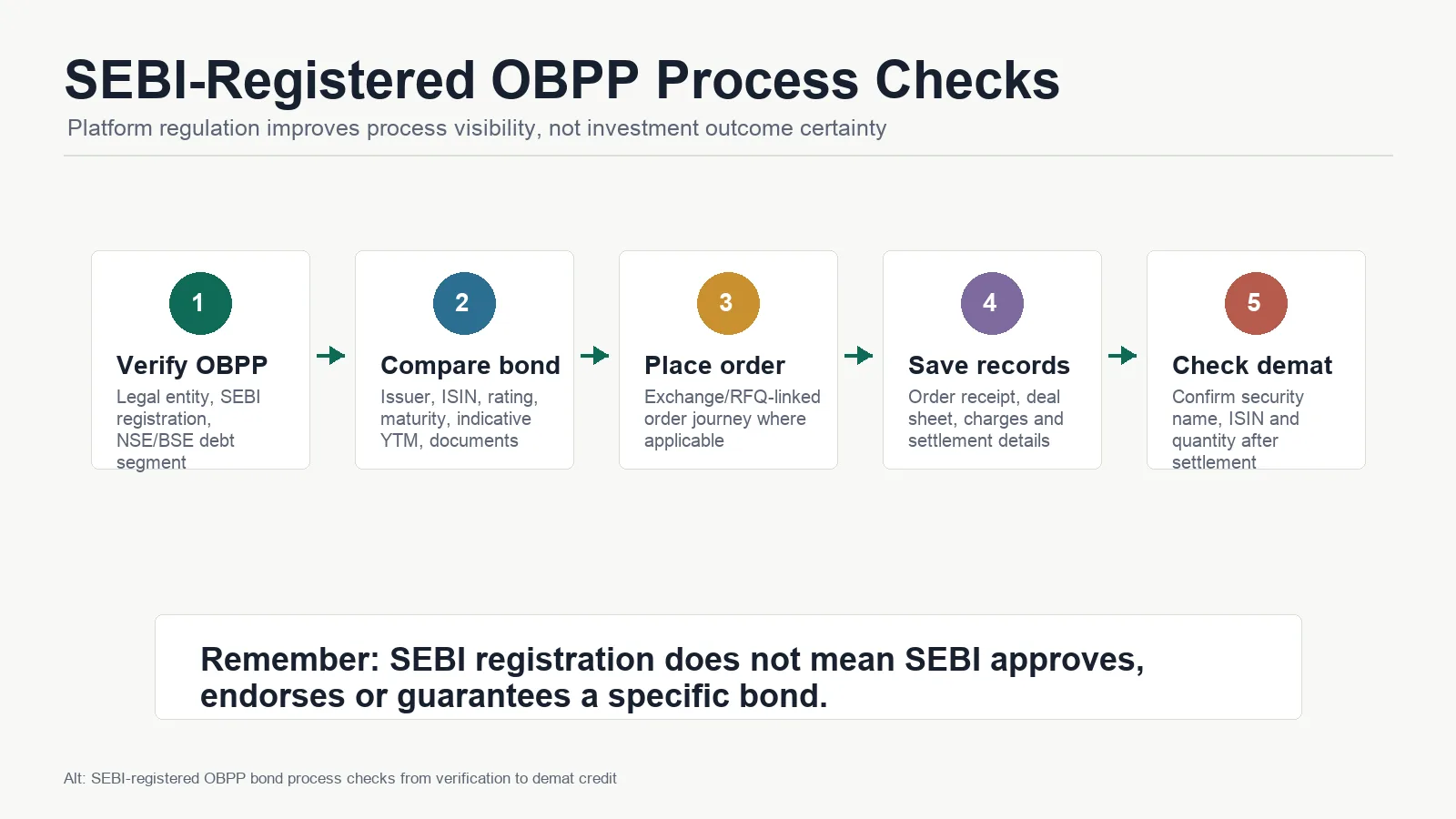
Before confirming an order, compare the displayed clean price, accrued interest, dirty price, taxes, charges and total settlement amount. After execution, save the order receipt and deal sheet. Then verify the bond credit in your demat account using ISIN, quantity and security name.
Mistake 7: Concentrating Too Much In One Issuer, Rating Or Maturity
Concentration risk in bonds is often underestimated because bonds feel more structured than equities.
An investor may diversify across five bonds but still be concentrated in one sector. Another may hold bonds from different issuers but all maturing in the same year. A third may hold several bonds with similar ratings, similar business models and similar liquidity risk.
Useful diversification checks include:
- Issuer and group exposure.
- Sector exposure.
- Rating-band exposure.
- Secured vs unsecured exposure.
- Seniority or subordinated exposure.
- Coupon dates and cash-flow timing.
- Maturity-year clustering.
- Liquidity profile.
Diversification does not eliminate risk. It only reduces the chance that one event dominates the whole fixed-income allocation.
Mistake 8: Forgetting Tax, TDS And Post-Tax Bond Returns
Pre-tax yield is not the same as post-tax outcome.
Bond interest is generally taxed according to the investor's applicable tax slab, unless a specific tax treatment applies to the instrument. Capital gains treatment can depend on the bond type, holding period, listing status and current tax law. TDS may also apply in certain cases, depending on instrument and payment route.
This article is not tax advice. The point is narrower: do not compare bonds only on pre-tax YTM if your real decision is post-tax cash flow.
Before subscribing, ask:
- How will coupon interest be taxed for me?
- Is any TDS applicable?
- What happens if I sell before maturity?
- Does the bond have deep-discount or zero-coupon features?
- Do I need a tax advisor for my situation?
Tax treatment depends on individual circumstances and may change. Please consult a qualified tax advisor.
Mistake 9: Treating SEBI-Registered OBPP Status As Investment Approval
A SEBI-registered Online Bond Platform Provider, or OBPP, operates within a defined regulatory framework. SEBI's OBPP framework was issued through its circular dated 14 November 2022, and SEBI also publishes a page linking the registered OBPP lists for NSE and BSE.
This matters. Investors should prefer a regulated process over an unclear online route. A SEBI-registered OBPP should help investors see standardised information, order details, documents and process records.
But registration is not a quality stamp on any specific bond.
Equirize is a SEBI-registered Online Bond Platform Provider (OBPP) and stock broker in the debt segment of BSE and NSE. EquiRize Securities Private Limited carries SEBI Registration Number (Stock Broker): INZ000323730.
Registration with SEBI as an Online Bond Platform Provider does not constitute SEBI's approval, endorsement, or guarantee of any specific security listed on the platform. Investments are subject to market risks. Please read the offer document and risk factors carefully before subscribing.
The investor's job remains the same: review issuer, rating, yield basis, documents, liquidity, taxation and suitability.
RFQ Platform, Deal Sheet And Demat Credit Checks
A strong process leaves evidence.
When subscribing through an online bond platform, investors should preserve the order receipt, deal sheet, payment record, settlement details and final demat credit. These records matter if there is a mismatch, delay or grievance later.
The demat account is especially important. A platform screen can show a transaction journey, but the investor should still confirm that the correct security has been credited to the demat account.
Mistake 10: Not Using A Bond Investor Checklist Before Subscribing
The final mistake is relying on memory.
Bond investing has too many moving parts for a casual mental checklist. A written bond investor checklist reduces the chance of missing the detail that matters.
Use this before subscribing:
| Checklist item | Investor question |
| Purpose | Why am I adding this bond to my portfolio? |
| Holding period | Can I hold until maturity if liquidity is limited? |
| Issuer | Do I understand the issuer and its business? |
| Rating | Have I read the latest rating rationale? |
| Yield | Is the YTM indicative, pre-tax and assumption-based? |
| Price | Have I checked clean price, dirty price and accrued interest? |
| Structure | Is the bond secured, senior, subordinated, callable or amortising? |
| Liquidity | What does recent secondary-market activity suggest? |
| Tax | What is my post-tax outcome likely to be? |
| Concentration | Does this increase issuer, sector or maturity concentration? |
| Platform | Is the platform a SEBI-registered OBPP or otherwise properly regulated? |
| Documents | Have I saved the offer document, order receipt and deal sheet? |
Equirize helps investors compare listed bonds by issuer details, credit rating, maturity, coupon structure, indicative yield and documents. The comparison is a starting point, not a substitute for your own assessment.
Bond Investing Mistakes: Final Take For Indian Investors
Most bond investing mistakes do not come from a lack of intelligence. They come from shortcuts.
The shortcut is to compare coupon rates without checking YTM. To trust a rating without reading the rationale. To assume listed means liquid. To read platform registration as bond approval. To skip tax, term-sheet clauses and demat verification.
Bonds reward patient reading. Before subscribing, slow the decision down enough to understand the instrument, the issuer, the price, the risks and the process.
That discipline will not remove risk. It can, however, make the risk visible before your money is committed.