Retirement Income from Bonds: A Steady Cash-Flow Guide for Indian Investors



Retirement income from bonds is not about finding one instrument and expecting it to solve every future expense. A better starting point is cash-flow design: what money is needed each month, what can wait, what should stay liquid, and what risks the retiree can still afford to take.
Bonds can help create visible coupon and maturity dates. That visibility is useful when salary income has stopped or reduced. But it is not the same as certainty. Coupon payments depend on issuer performance, secondary-market exits can happen at uncertain prices, and post-tax income may differ from the number that first appears on a bond page.
This guide explains how Indian investors can use bonds for retirement income planning without treating them as a promise of fixed outcomes.
Bonds for Retirement Income: The Short Answer
Bonds for retirement income may make sense when an investor wants planned cash flows, defined maturity dates, and a clearer view of when money may come back. In a retirement portfolio, bonds can play several roles: generate scheduled coupon payments, match maturities to known future expenses, reduce dependence on equity withdrawals during volatile periods, and help separate income needs from long-term growth capital.
The trade-off is that bonds carry risks. Corporate bonds carry issuer credit risk. Long-tenure bonds can lose market value if interest rates rise and the investor sells before maturity. Some bonds may not have enough secondary-market liquidity when the investor wants to exit. Tax can also reduce the usable income.
So the practical answer is not "use bonds for retirement" or "avoid bonds in retirement". It is: use bonds only after defining the cash-flow job, checking risk capacity, and reading the offer document.
Retirement Cash Flow Planning Starts Before Bond Selection
Before selecting any bond, map the retirement cash-flow need. Start with essential expenses: household costs, healthcare, insurance premiums, family support, rent or maintenance, and predictable annual outflows. Then separate those from discretionary expenses such as travel, gifting, and lifestyle upgrades.
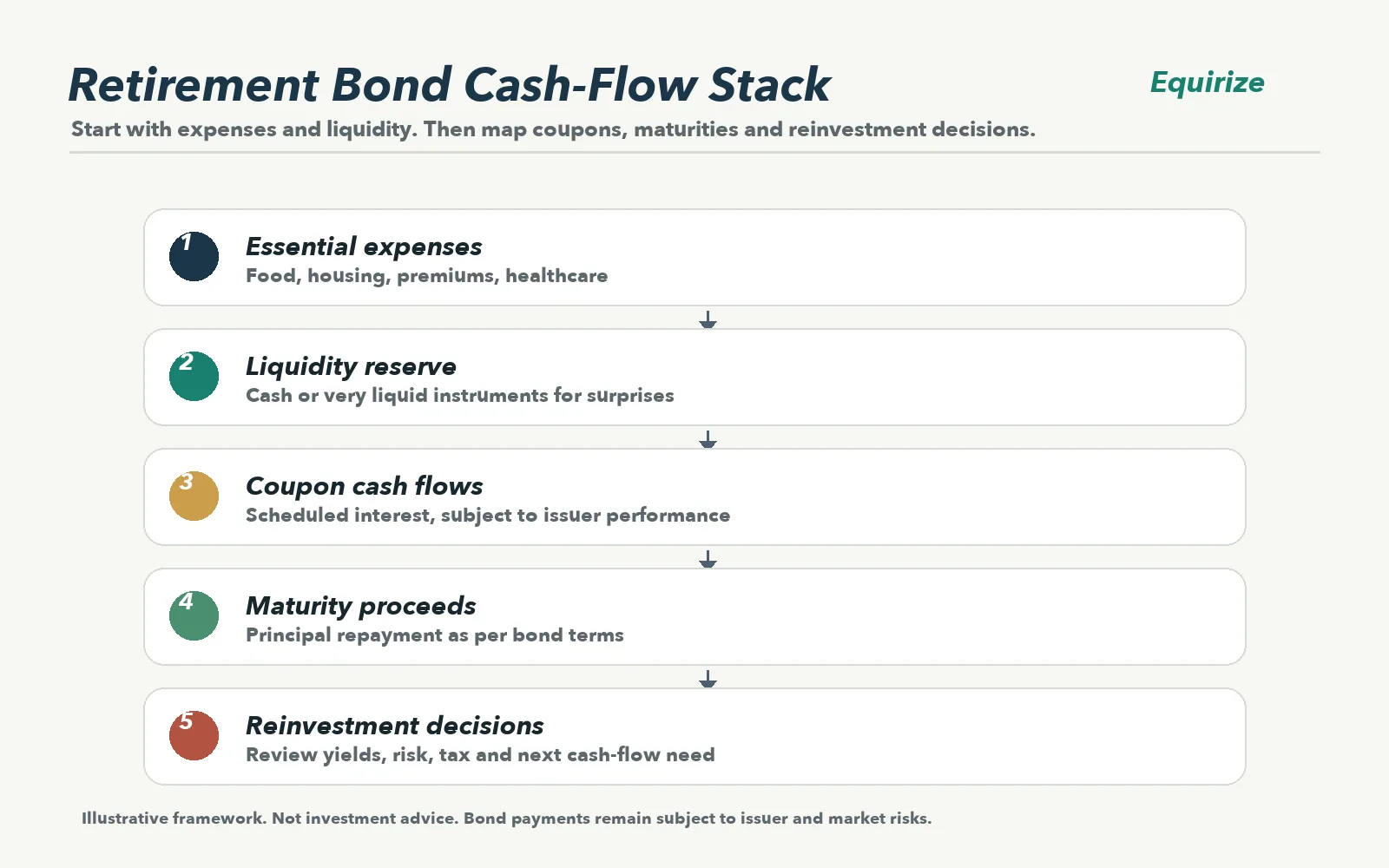
The next layer is existing income. This may include pension, rental income, annuity payments, dividends, systematic withdrawals, or family support. Bonds should be evaluated against the gap that remains, not against an abstract yield target.
For a broader allocation view, Equirize's guide on bond allocation in portfolio explains why emergency money, near-term goals, retirement income, and long-term portfolio stability should not be forced into one percentage rule.
Map Monthly Expenses Before Reading a Bond Coupon Schedule
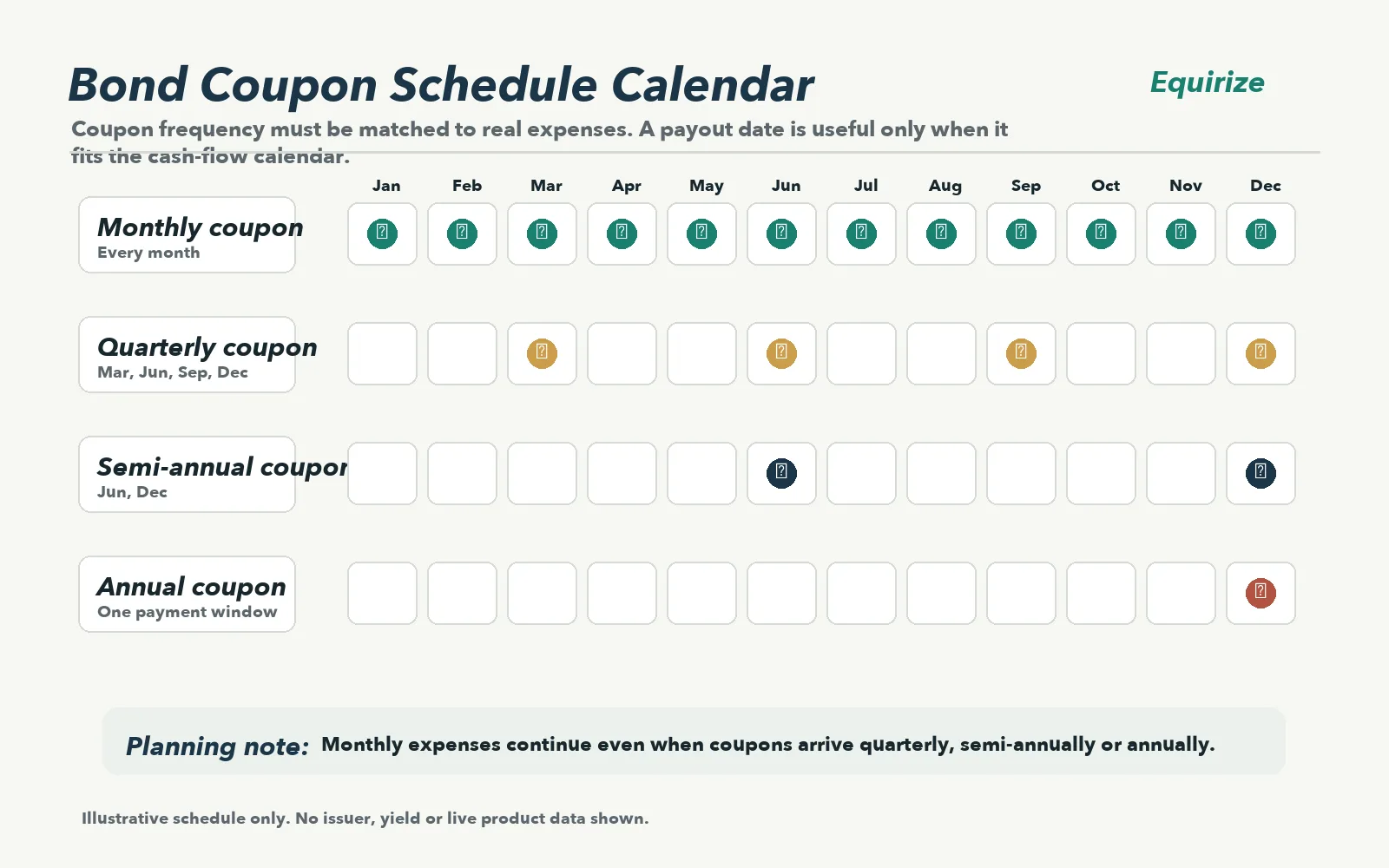
A bond coupon schedule tells you when the issuer is expected to pay interest: monthly, quarterly, semi-annually, annually, or at maturity. Your expenses may not follow that pattern.
For example, medical insurance may be annual, groceries are monthly, and family support may be quarterly. If coupons arrive semi-annually but expenses are monthly, the investor still needs a cash buffer. Otherwise, a good-looking coupon can create a practical mismatch.
The job is to convert bond cash flows into a usable calendar.
Keep a Liquidity Reserve Before Building Bond Income
Retirement planning should not assume that every unexpected expense can be handled by selling a bond. Listed bonds may be transferable, but liquidity depends on market demand, price, lot size, and the specific security. Selling before maturity can also expose the investor to price movement.
For senior citizens and retirees, a separate healthcare and emergency reserve is important. Equirize's guide to bonds for senior citizens covers this income-risk-liquidity trade-off in more detail.
How Bond Coupon Payments Create Retirement Income in India
Bond income usually comes from coupon payments. A coupon is the interest rate stated in the bond terms, calculated on the face value of the bond. Depending on the security, coupons may be paid monthly, quarterly, semi-annually, annually, or cumulatively.
This is different from yield to maturity, or YTM. YTM is an annualised pre-tax return estimate that depends on the bond's coupon, purchase price, time to maturity, and redemption value. It usually assumes the investor holds the bond until maturity and that scheduled payments happen as expected.
That distinction matters in retirement. A bond may have an attractive indicative YTM but still pay coupons only once or twice a year. Another bond may have a lower YTM but a coupon schedule that fits the retiree's expense calendar better.
Monthly Income from Bonds Is About Payout Dates, Not Just Yield
Monthly income from bonds can come from a bond that pays monthly coupons, or from a portfolio where different bonds pay at different points in the year. The second route is often more practical because not every suitable bond will have a monthly payout structure.
For a deeper cash-flow example, read Equirize's guide to monthly income from bonds.
Maturity Proceeds Need a Reinvestment Plan
When a bond matures, the principal repayment can either fund expenses or be reinvested. If the retiree depends on that maturity value for future income, reinvestment risk matters.
Reinvestment risk is the possibility that when money comes back, comparable bonds are available only at lower yields, different tenures, or different risk levels. This is why retirement income from bonds should be reviewed periodically, not treated as a one-time setup.
Bond Ladder for Retirement Income: How It Works
A bond ladder for retirement income spreads investments across different maturity dates. Instead of putting the entire bond allocation into one maturity year, the investor may hold bonds maturing in different years or quarters.
The ladder can serve three purposes. First, it creates a schedule of maturity proceeds. Second, it reduces dependence on one interest-rate environment. Third, it can help the retiree review and reinvest gradually instead of making one large reinvestment decision.
A ladder still carries risk. If one issuer delays or defaults, that rung can be affected. If the investor has to sell before maturity, the exit price may differ from the expected redemption value. If the ladder is concentrated in one sector or rating band, diversification may be weaker than it appears.
Equirize's full guide to bond laddering in India explains the framework in more depth.
Sample Coupon Calendar for a Retirement Bond Ladder
An illustrative retirement bond ladder may include:
| Rung | Purpose | Example maturity window | Cash-flow role |
| Rung 1 | Near-term expenses | 1 year | Creates early maturity visibility |
| Rung 2 | Healthcare reserve support | 2 years | Keeps a shorter-tenure layer |
| Rung 3 | Income bridge | 3 years | Supports medium-term cash flow |
| Rung 4 | Reinvestment flexibility | 4 years | Reduces one-date reinvestment pressure |
| Rung 5 | Longer retirement bucket | 5 years | Extends maturity visibility |
This is only an educational structure. The actual mix should depend on expenses, tax bracket, risk appetite, liquidity needs, and advice from a qualified professional.
Government Bonds, Corporate Bonds and Tax-Free Bonds for Retirees
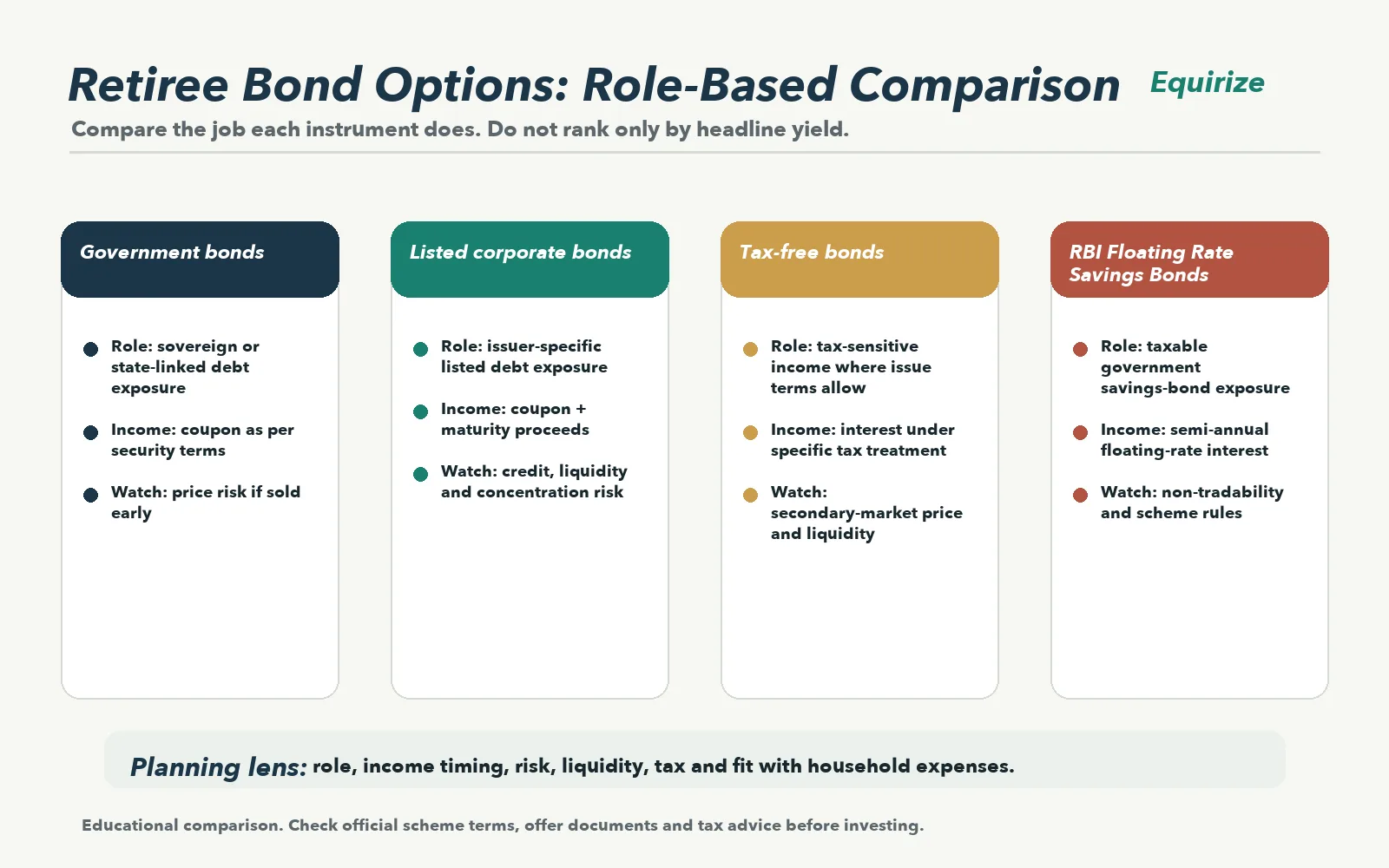
Different bonds perform different jobs in a retirement portfolio. A government security is not the same as a listed corporate bond. A tax-free bond is not the same as an RBI Floating Rate Savings Bond. The useful comparison is not which one is universally superior, but what each instrument is being asked to do.
Government Bonds for Senior Citizens and Retirees
Government securities are issued by the Central Government or State Governments. They can be accessed through channels such as RBI Retail Direct and exchange/broker routes, depending on the security and investor setup.
Their main role in retirement is credit-quality anchoring because repayment is linked to the sovereign or state issuer. However, market price can still move before maturity. Long-tenure government securities may be sensitive to interest-rate changes if sold early.
Corporate Bonds for Retirement Income
Corporate bonds are issued by companies and other eligible issuers. Listed corporate bonds may offer defined coupon and maturity terms, but repayment depends on the issuer's ability to meet obligations.
For retirement income planning, the review should go beyond the coupon. Check the issuer's legal name, credit rating and rating agency, rating rationale, security cover if any, seniority, call or put features, maturity date, coupon frequency, offer document, and liquidity.
Equirize facilitates access to listed corporate bonds as a SEBI-registered Online Bond Platform Provider (OBPP). It does not provide investment advice.
Registration with SEBI as an Online Bond Platform Provider does not constitute SEBI's approval, endorsement, or guarantee of any specific security listed on the platform. Investments are subject to market risks. Please read the offer document and risk factors carefully before subscribing.
Tax-Free Bonds for Retirees in Higher Tax Slabs
Tax-free bonds, generally issued in earlier windows by eligible public-sector or infrastructure-related issuers, can be relevant for investors in higher tax slabs because interest income may be exempt under the specific issue terms. Availability is usually through the secondary market, and prices can trade at a premium or discount.
Retirees should not evaluate them only by the tax label. Price paid, residual maturity, liquidity, issuer quality, and post-tax comparison with other options all matter.
RBI Floating Rate Savings Bonds in a Retirement Portfolio
RBI Floating Rate Savings Bonds are taxable, non-tradable savings bonds issued by the Government of India. Their interest rate is reset periodically based on the applicable scheme terms, and interest is paid semi-annually.
They may suit some retirees who want government-backed savings-bond exposure, but they are not listed corporate bonds and do not provide exchange liquidity. Investors should check the latest official scheme terms, taxation, lock-in, and premature withdrawal rules before investing.
Post-Tax Bond Income Matters More Than Headline Yield
Retirement income should be measured after tax. Coupon interest from bonds is generally taxable according to the investor's applicable tax treatment, unless a specific instrument has a tax-exempt structure. Capital gains treatment may differ based on the bond type, holding period, and applicable tax law.
This is why the same bond can have different practical value for two retirees. One investor may be in a lower tax bracket. Another may be in a higher tax bracket and care more about post-tax cash flow. A third may qualify for specific TDS declarations but still owe final tax depending on total income.
Tax treatment depends on individual circumstances and may change. Please consult a qualified tax advisor.
Risks of Using Bonds for Retirement Income
Bonds can bring structure to a retirement portfolio, but retirement reduces room for error. A 35-year-old investor may recover from a poor credit decision more easily than a 70-year-old investor who depends on the cash flow.
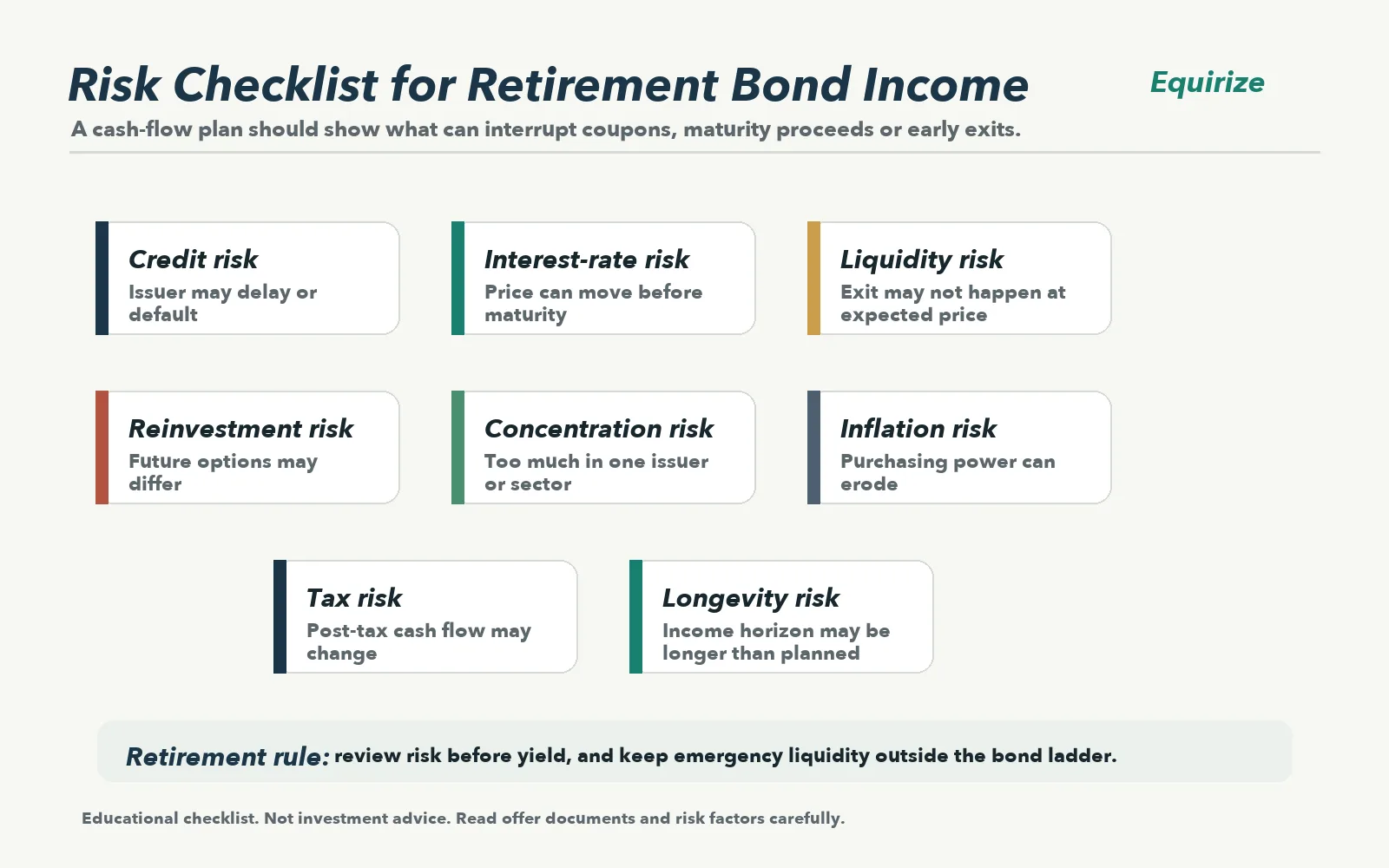
That is why risk review should sit inside the planning process, not at the bottom of the page.
Credit Risk and Issuer Concentration in Retirement Portfolios
Credit risk is the risk that the issuer is unable to pay interest or principal on schedule. Credit ratings help, but they are not guarantees. Read the rating rationale, track rating changes, and avoid over-concentration in one issuer, group, sector, or rating band.
Concentration can be quiet. A portfolio may hold five bonds but still depend on one sector or related issuer group.
Interest-Rate Risk, Liquidity Risk and Early Exit
If interest rates rise, existing bond prices can fall. This matters most when the investor sells before maturity. Holding until maturity may reduce price-volatility concerns, but it does not remove issuer credit risk.
Liquidity risk is separate. A listed bond may not always have enough buyers at the expected price when the investor wants to exit. Retirees should be especially careful about placing emergency money in bonds that may need to be sold suddenly.
Inflation and Longevity Risk in Bond Income Planning
Inflation can reduce the purchasing power of fixed coupon cash flows. Longevity risk is the possibility of outliving the planned income period. A bond portfolio that looks adequate at age 60 may need review at 70, 75, and 80.
For many investors, bonds are one layer of the retirement plan. They may need to sit alongside liquid reserves, pension income, insurance planning, and growth assets, depending on the household.
How to Invest in Bonds for Retirement Through an OBPP
An Online Bond Platform Provider can help investors discover and evaluate listed bonds in one place. In India, OBPPs operate within SEBI's regulatory framework and must follow platform, disclosure, and process requirements.
For a retirement-focused investor, the platform is a discovery and transaction layer. It is not a substitute for suitability assessment. The investor should still review the issuer, rating, offer document, coupon schedule, maturity, liquidity, tax treatment, and concentration risk.
For platform due diligence, Equirize's guide on how to choose an online bond platform provider in India explains how to verify registration, check process risk, and evaluate listed-bond information.
Checklist Before Subscribing to Listed Bonds on an OBPP
Before using listed bonds for retirement income, check:
- Does the maturity date match a real cash-flow need?
- What is the coupon frequency: monthly, quarterly, semi-annual, annual, or cumulative?
- Is the yield shown as pre-tax or post-tax?
- What is the credit rating, and which rating agency issued it?
- What does the rating rationale say about the issuer's business, leverage, and cash flows?
- Is the bond secured or unsecured, senior or subordinated?
- Are there call or put options that can change the expected cash-flow path?
- What is the minimum lot size?
- How liquid is the bond in the secondary market?
- What happens if you need to sell before maturity?
- How much exposure do you already have to the same issuer, group, sector, or rating band?
- Have you read the offer document and risk factors?
After doing this work, investors can compare listed bonds on Equirize with a clearer understanding of cash flow, risk, and suitability.
Retirement Income from Bonds: Final Checklist
Use this final checklist before making bonds part of a retirement income plan:
| Question | Why it matters |
| What monthly expense gap am I trying to cover? | Prevents yield-led selection |
| Which expenses need liquid cash, not bonds? | Protects emergency flexibility |
| When do coupons arrive? | Matches income timing to spending |
| When does principal mature? | Plans reinvestment or withdrawals |
| What is the post-tax income? | Converts headline yield into usable cash flow |
| What can disrupt the plan? | Brings credit, liquidity, inflation and reinvestment risk into view |
| Have I reviewed concentration? | Avoids hidden dependence on one issue or sector |
| Have I read the offer document? | Anchors the decision in actual terms |
Retirement income from bonds works well when the investor treats bonds as planned cash-flow instruments with risk, not as income promises. The more specific the cash-flow map, the more disciplined the bond selection can become.