Perpetual bonds and AT1 Bonds: Meaning, Risks and Returns


Perpetual bonds can look simple at first glance. They pay coupons. They may carry a higher coupon than many regular bonds. Some have a call date after a few years, which can make them appear similar to fixed-maturity debt.
That first glance is not enough.
A perpetual bond has no fixed maturity date. In India, the most discussed version is the Additional Tier 1 bond, or AT1 bond, issued by banks as part of regulatory capital. AT1 bonds are not ordinary corporate bonds. They are designed to absorb losses under defined stress conditions, and that design affects coupon payments, repayment expectations, exit options and suitability.
This guide explains how these instruments work, how returns should be read, what risks matter, and what an investor should check before treating an AT1 coupon as the whole story.
What Are Perpetual Bonds?
Perpetual bonds are debt securities with no fixed maturity date. A regular bond usually has a maturity date on which the issuer repays principal, subject to issuer performance. A perpetual bond does not give the investor that same scheduled principal repayment date.
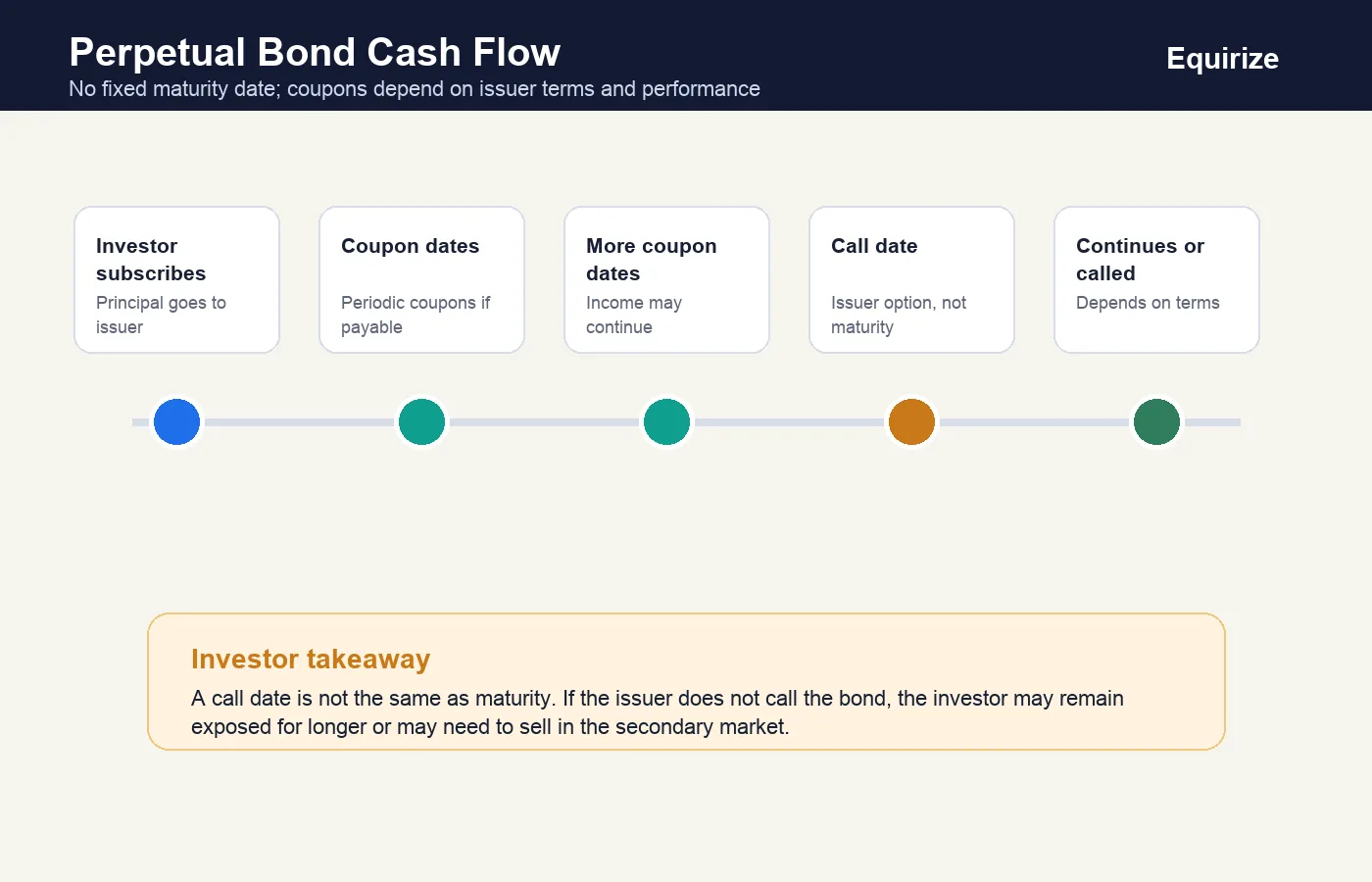
Instead, the issuer may pay coupons for an indefinite period, subject to the terms of the instrument. Many instruments also include a call option, which allows the issuer to redeem the bond after a specified date if conditions are met. The call option belongs to the issuer, not the investor.
That distinction matters. A call date is not a maturity date. If the issuer does not exercise the call, the bond may continue beyond the first call date. The investor may then either continue holding the bond or try to sell it in the secondary market, where the realised price depends on liquidity and market conditions.
In plain terms, a perpetual bond asks the investor to accept three unusual features:
| Feature | What it means for the investor |
| No fixed maturity | There may be no scheduled principal repayment date |
| Issuer call option | The issuer may redeem, but is not necessarily required to redeem, on a call date |
| Market exit dependence | If the investor wants to exit, the secondary-market price and liquidity matter |
This does not make every such instrument unsuitable by default. It does mean the investor should not read it like a normal fixed-maturity bond.
For context on how regular fixed-income instruments work, see Equirize's guide to fixed income investments in India.
How Perpetual Bonds Work in India
In India, the most important category for investors to understand is the bank-issued AT1 bond. AT1 stands for Additional Tier 1. These instruments form part of a bank's regulatory capital under the RBI's Basel III capital framework.
Banks need regulatory capital because lending involves risk. Capital acts as a buffer when losses arise. Under the Basel III framework, bank capital is organised into layers, including Common Equity Tier 1, Additional Tier 1 and Tier 2 capital.
AT1 instruments are built to be loss-absorbing. RBI's Basel III capital regulations discuss Perpetual Non-Cumulative Preference Shares and Perpetual Debt Instruments as Additional Tier 1 instruments, and include criteria for write-down, write-off or conversion in defined stress situations. RBI's Basel III circular also states that banks should not issue Additional Tier 1 capital instruments to retail investors.
SEBI subsequently issued guidelines for the issuance, listing and trading of AT1 instruments, including restrictions intended to limit unsuitable retail participation.
The practical point is simple: in India, "perpetual bond" often means a bank-capital instrument, not merely a long-term income instrument.
AT1 Bonds as Additional Tier 1 Capital
AT1 bonds are part of a bank's capital stack. They sit closer to equity than ordinary senior debt. They are typically unsecured, subordinated and perpetual. They may carry coupon-payment restrictions. They can also be written down or converted under specified conditions.
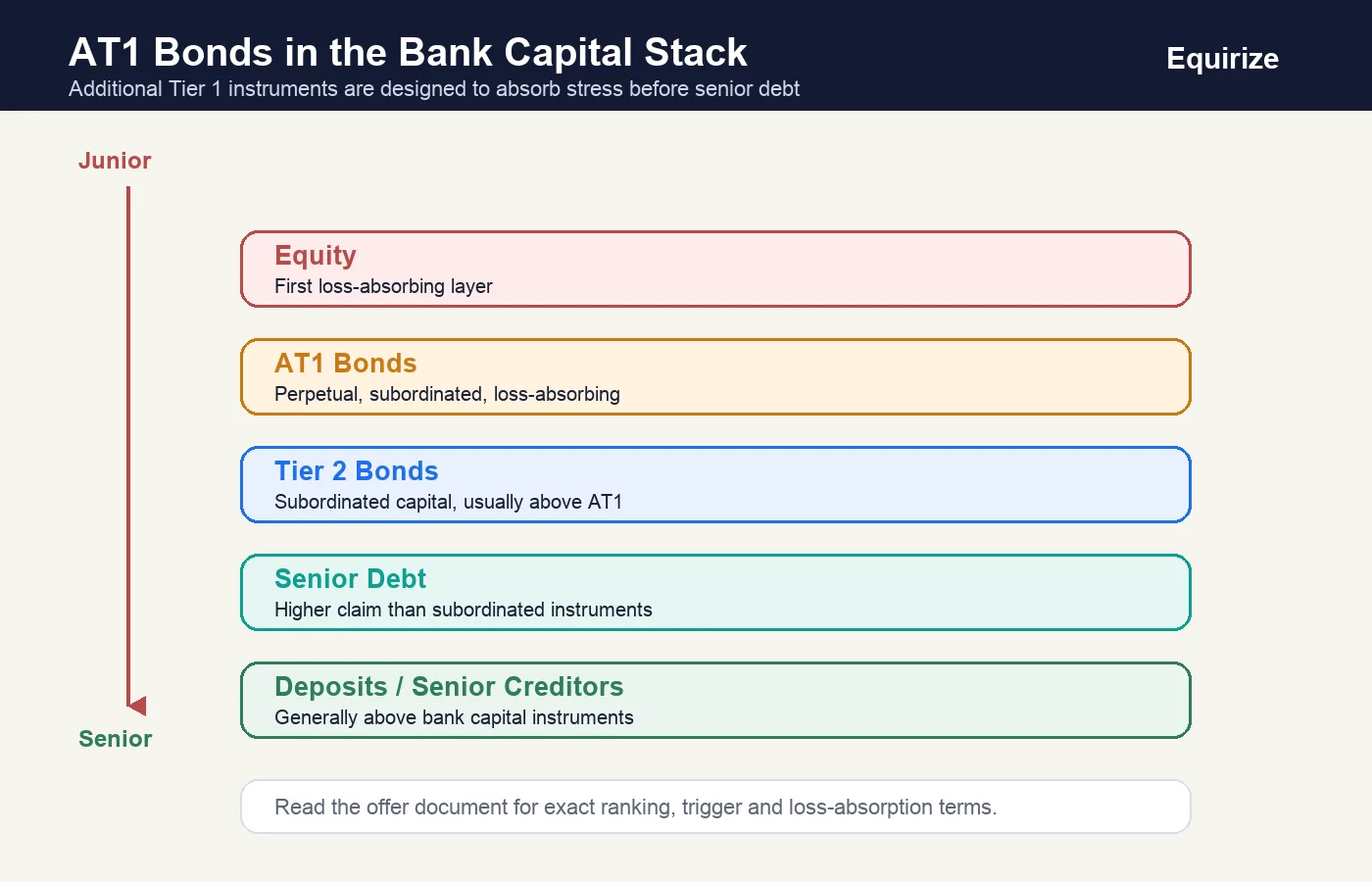
This capital-stack position is why AT1 bonds may offer higher coupons than many senior debt instruments from similar issuers. The coupon is not a free premium. It compensates for a different risk profile.
An investor should therefore ask: What risk is the coupon compensating me for?
The answer may include no fixed maturity, coupon discretion, lower repayment priority, write-down or conversion risk, and lower secondary-market liquidity.
Perpetual Bond Maturity vs Call Option
The most common misunderstanding is treating the first call date as maturity.
A fixed-maturity bond has a scheduled repayment date. A callable bond may have a maturity date and an early redemption option. A perpetual bond may have a call date but no fixed maturity date. If the issuer chooses not to call, the instrument may continue.
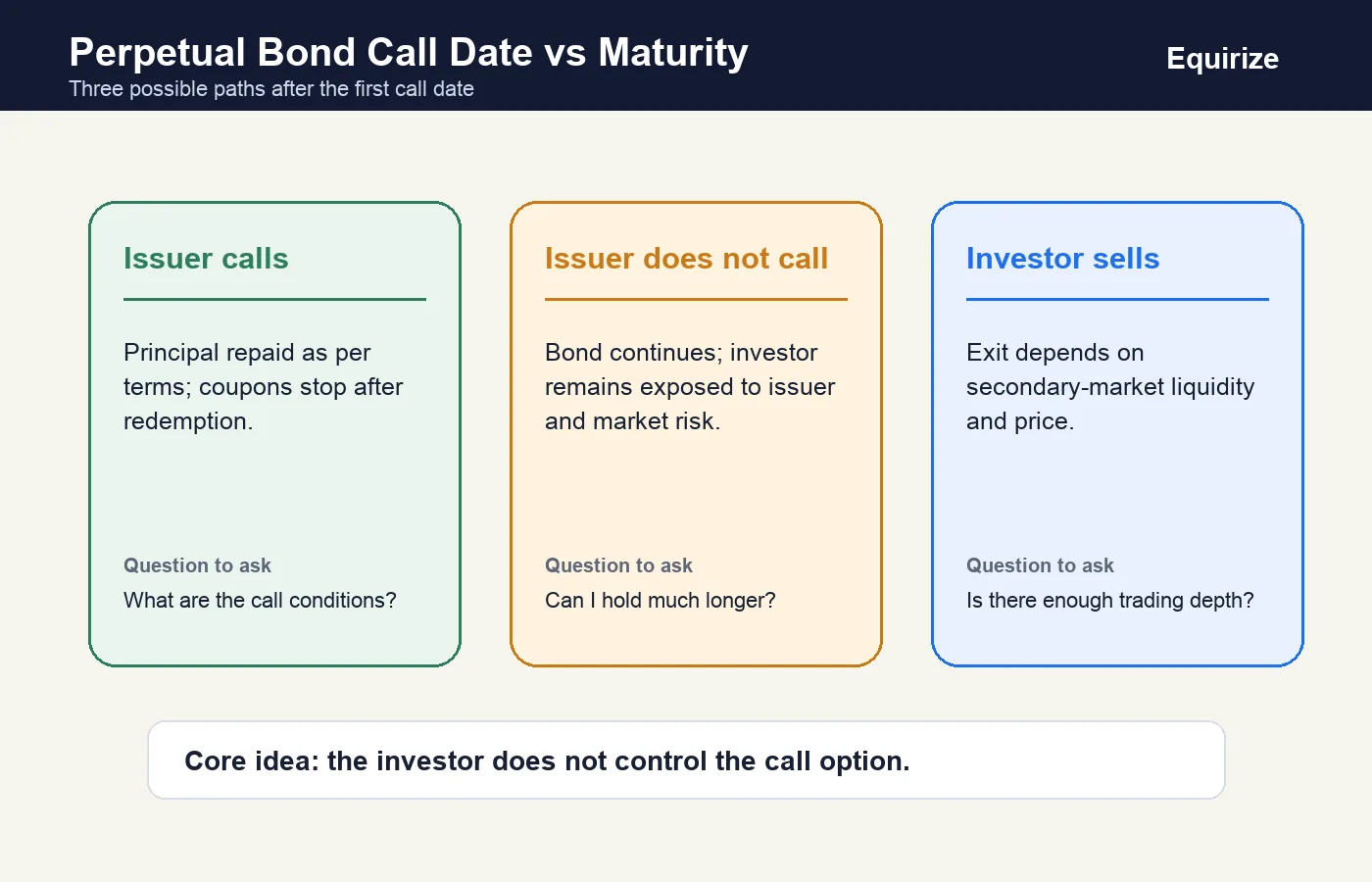
For an investor, three scenarios matter:
| Scenario | What happens | Investor question |
| Issuer calls the bond | Principal is repaid as per terms and coupons stop | What are the call conditions and approvals? |
| Issuer does not call | The instrument continues beyond the call date | Can I hold it for much longer than expected? |
| Investor sells before call | Exit depends on market price and liquidity | Is there enough secondary-market depth? |
If an investor assumes the first call date is guaranteed redemption, the return calculation can become misleading.
Perpetual Bond Returns: Coupon, Current Yield and Yield-to-Call
Returns on these instruments need careful language. A coupon is not the same as a realised return. A displayed yield is only as useful as the assumption behind it.
For a regular fixed-maturity bond, yield to maturity, or YTM, can be a useful comparison metric. It estimates the annualised return if the investor buys at the current price, holds until maturity and receives scheduled payments as expected.
For a perpetual bond, the word "maturity" becomes complicated. If there is no fixed maturity date, a conventional YTM may not be the right default metric. Investors may instead see current yield, yield-to-call, or another assumption-based figure.
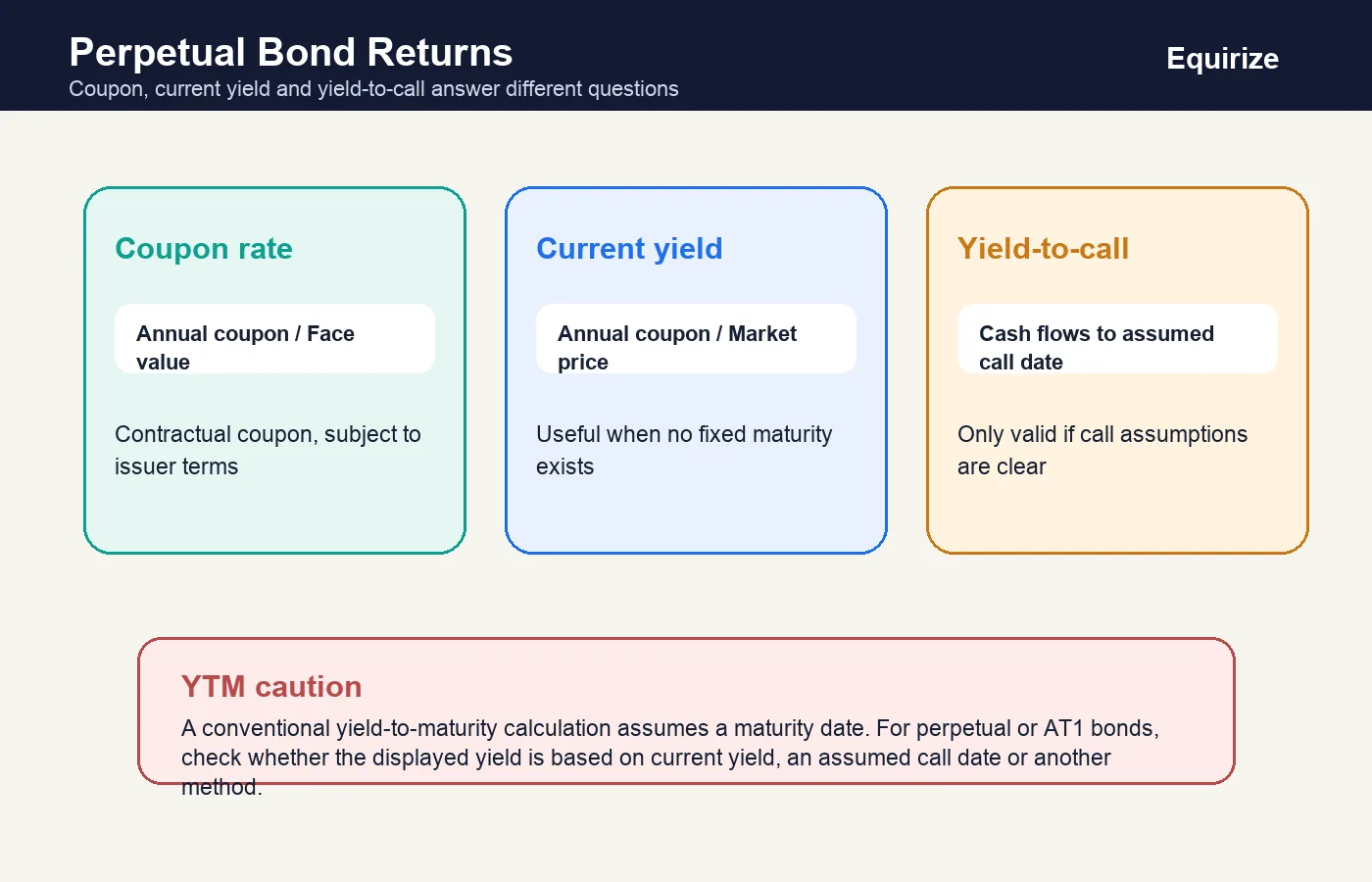
The key return terms are:
| Term | Formula or meaning | Caution |
| Coupon rate | Annual coupon as a percentage of face value | Subject to instrument terms and issuer performance |
| Current yield | Annual coupon divided by current market price | Ignores future price movement and call assumptions |
| Yield-to-call | Annualised return assuming the issuer calls on a specified date | Depends on a call assumption that may not happen |
| Yield-to-maturity | Annualised return assuming hold to maturity | Not a clean fit where there is no fixed maturity |
For a deeper explanation of YTM in regular bonds, see Equirize's guide on how yield to maturity works in regular bonds.
Why YTM Can Mislead in Perpetual Bonds
The danger is not the formula. The danger is using the wrong assumption.
If a platform, factsheet or investor calculation assumes the instrument will be called on the first call date, the resulting number may look like a normal maturity-based return. But if the issuer does not call, the investor's actual experience can differ sharply.
The investor may continue receiving coupons, subject to payment conditions. The market price may move. Liquidity may vary. Tax treatment may affect the final outcome. If the investor sells, the realised return will depend on the sale price, not only the coupon.
So the better question is not "What is the YTM?" It is:
- Is this a current yield, yield-to-call or yield-to-perpetuity style number?
- What call date has been assumed?
- What happens if the bond is not called?
- What price could I realistically get if I needed to sell?
- Are coupons cumulative or non-cumulative?
- Can coupon payment be restricted under the terms?
For related reading, Equirize's guide to bond platform fees, spread, yield and price explains why yield comparison should include price and assumptions.
Simple Perpetual Bond Yield Calculation
The simplest current-yield formula is:
Current yield = Annual coupon amount / Current market price
Assume an illustrative bond has a face value of Rs. 1,00,000 and an annual coupon of Rs. 8,500. If it trades at Rs. 95,000, the current yield is:
Rs. 8,500 / Rs. 95,000 = 8.95%
This is only a current-yield illustration. It does not show whether the issuer will call the bond, whether the market price will change, whether coupons will continue, or what tax will apply.
If a yield-to-call calculation is used, the investor must know the assumed call date, call price, coupon dates and purchase price. If the call does not happen, the calculation no longer describes the investor's actual path.
AT1 Bond Risks Investors Should Read First
AT1 bonds are complex because their risks are not incidental. They are part of the design.
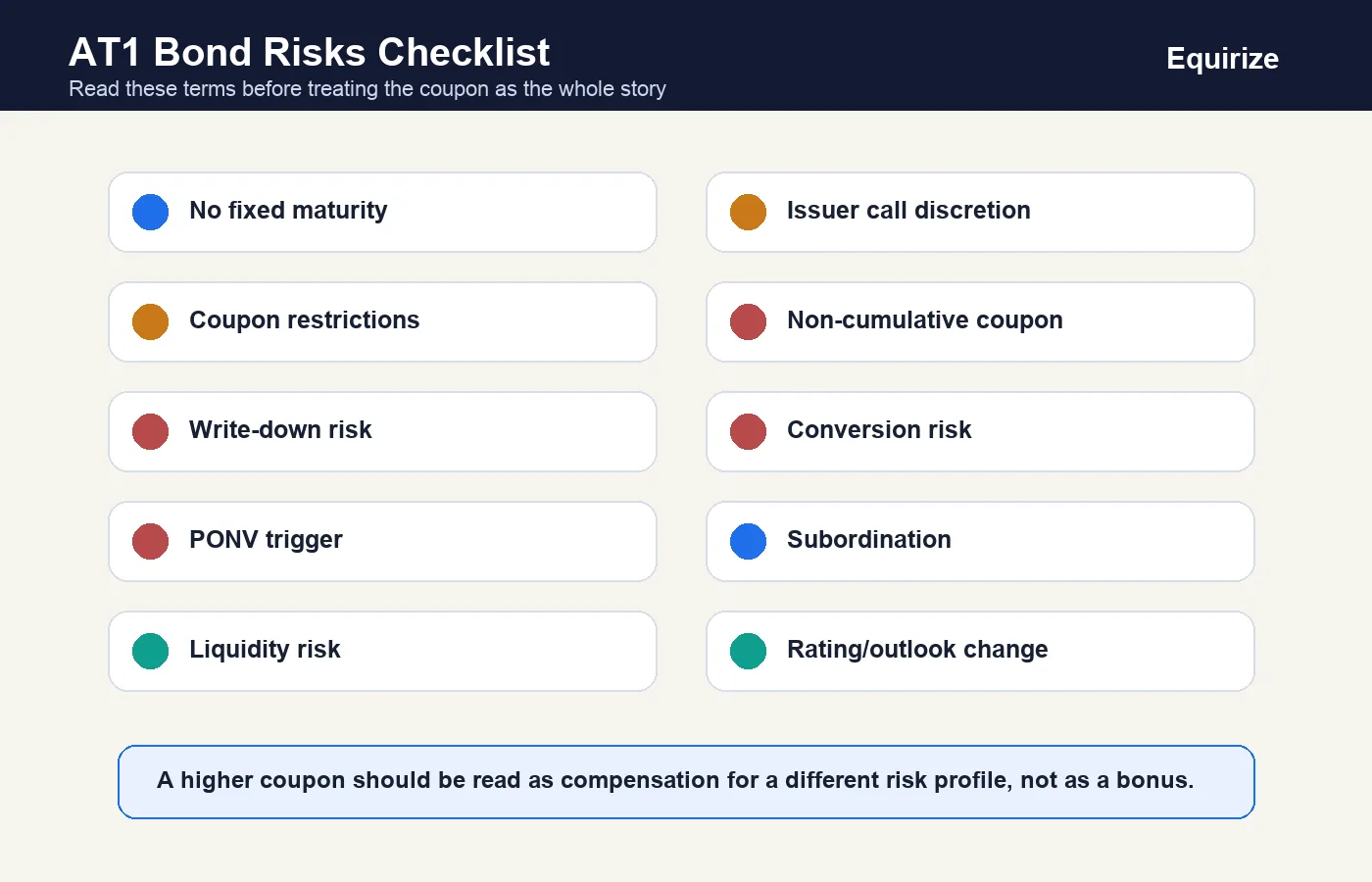
The main risks include:
| Risk | What to understand |
| No fixed maturity | Principal may not be repaid on a scheduled date |
| Issuer call discretion | The issuer may choose not to call, subject to terms and regulatory conditions |
| Coupon restrictions | Coupons may be payable only if conditions are met |
| Non-cumulative coupons | Missed coupons may not accumulate for later payment |
| Write-down risk | Principal can be reduced under defined stress conditions |
| Conversion risk | Some instruments may convert into equity as per terms |
| PONV risk | RBI may determine a point of non-viability trigger |
| Subordination | AT1 ranks below senior debt and Tier 2 in the capital structure |
| Liquidity risk | Secondary-market exit may be limited or price-sensitive |
These risks should sit near any discussion of higher coupons. Separating the coupon from the risk is how mis-selling narratives begin.
Write-Down and Conversion Risk in AT1 Bonds
RBI's Basel III framework includes loss absorption through conversion, write-down or write-off of AT1 instruments on breach of specified triggers and at the point of non-viability.
In February 2021, RBI issued a Basel III review stating that the pre-specified trigger for loss absorption through conversion or write-down of AT1 instruments would rise to 6.125% of risk-weighted assets from October 1, 2021.
This matters because a regular bondholder usually thinks in terms of issuer default and recovery. An AT1 holder must also think in terms of regulatory capital triggers and loss-absorption features.
The offer document should explain whether the instrument can be written down temporarily or permanently, whether conversion into equity is possible, what trigger applies, and how the point of non-viability clause works.
Coupon Discretion and Non-Cumulative Interest Risk
Some AT1 instruments have coupon-payment restrictions. Coupon may depend on distributable items, regulatory capital position, issuer performance and terms specified in the offer document.
Non-cumulative coupon language is especially important. If a coupon is skipped and the instrument is non-cumulative, the investor may not have a right to receive that skipped coupon later.
That makes AT1 coupon income different from the way many retail investors think about ordinary bond interest.
The right reading is not: "The coupon is fixed, so the income is fixed." A more accurate reading is: "The coupon rate may be stated, but payment depends on issuer terms and regulatory conditions."
Subordination and Liquidity Risk in Perpetual Bonds
Subordination means the instrument ranks below other claims. AT1 bonds are generally junior to Tier 2 instruments and senior debt. That ranking matters if the issuer faces stress.
Liquidity risk is separate. Even if the issuer is current on payments, an investor who wants to sell before any call date depends on buyers being available at an acceptable price. Many fixed-income instruments in India can be listed but still trade thinly.
Before buying, review recent trades, issue size, bid-ask spread, lot size and the likely buyer base. If you cannot hold the instrument for longer than expected, this structure may not fit your liquidity needs.
AT1 Bonds vs Regular Bonds: Key Differences
AT1 bonds should not be compared with regular bonds only by coupon rate. The instrument design is different.
| Factor | Regular fixed-maturity bond | AT1 bond |
| Maturity | Has a scheduled maturity date | Typically perpetual |
| Principal repayment | Expected at maturity, subject to issuer performance | No fixed maturity; call may be issuer option |
| Coupon | Generally payable as per terms, subject to issuer performance | May be subject to additional restrictions |
| Coupon accumulation | Depends on instrument | Often non-cumulative |
| Seniority | Can be senior, secured, unsecured or subordinated | Subordinated bank-capital instrument |
| Loss absorption | Default/recovery framework is central | Can include write-down or conversion triggers |
| Return metric | YTM is often useful if held to maturity | Current yield and yield-to-call assumptions need scrutiny |
| Suitability | Varies by issuer and terms | Generally complex and suited to sophisticated investors |
If you are evaluating more conventional listed debt, Equirize's guide on how to invest in corporate bonds in India explains the basic process and checks.
Who Should Consider Perpetual Bonds or AT1 Bonds?
The better question may be: who should not consider them?
These instruments are usually not appropriate for investors who need predictable principal repayment on a known date, require reliable early liquidity, cannot tolerate price volatility, or are not comfortable reading detailed offer documents.
They may be studied by sophisticated investors who understand bank capital, subordination, call mechanics, coupon restrictions, liquidity risk and tax impact. Even then, position size and portfolio concentration matter.
Investors should also be aware of regulatory suitability signals. RBI's Basel III circular states that banks should not issue Additional Tier 1 capital instruments to retail investors. SEBI's AT1 issuance/listing/trading framework also tightened participation and lot-size norms for such instruments.
For senior citizens or investors building cash-flow plans, the absence of fixed maturity and the possibility of coupon restrictions deserve special caution. Equirize's guide to bonds for senior citizens explains why income planning should begin with risk, liquidity and time horizon, not only coupon.
How to Review an AT1 Bond Offer Document
If you are reviewing an AT1 bond, the offer document is not a formality. It is the instrument.
Use this checklist:
- Exact security name and ISIN.
- Issuer legal name.
- Instrument type: AT1, PDI, PNCPS or another structure.
- Whether the instrument is perpetual.
- First call date and later call dates, if any.
- Whether the call requires regulatory approval or other conditions.
- Whether the investor has any put option.
- Coupon rate and payment frequency.
- Whether coupons are discretionary or subject to restrictions.
- Whether coupons are cumulative or non-cumulative.
- Credit rating, rating agency, rating rationale and outlook.
- Seniority and subordination language.
- Loss-absorption trigger.
- Point of Non-Viability clause.
- Write-down or conversion language.
- Recent traded price and liquidity.
- Tax treatment for your profile.
- Trustee, exchange listing and settlement process.
Equirize's guide to bond investing mistakes to avoid is useful here because many AT1 mistakes begin with the same broader habit: reading the headline yield before reading the instrument.
Equirize View on Perpetual Bonds and Listed Debt Securities
Perpetual bonds and AT1 bonds are worth understanding because they teach a larger fixed-income lesson: the name of the issuer is not the whole instrument.
The same bank can issue senior debt, Tier 2 bonds and AT1 bonds. These securities can differ in maturity, seniority, coupon terms, loss absorption, liquidity and rating. A higher coupon should be read as compensation for a different risk profile, not as a standalone attraction.
Equirize helps investors review listed bond information, issuer details, coupon schedule, ratings, indicative pre-tax YTM and available documents where applicable. Equirize does not provide investment advice.
You can review listed bond information on Equirize, but the decision should come after reading the offer document, understanding the risks and checking personal suitability.