PSU Bonds in India: Meaning, Risks, Tax and How to Invest



PSU bonds in India sit in an interesting part of the fixed-income market. They are issued by public sector undertakings, which means the issuer is a company or institution where the government has majority ownership. That ownership can influence how investors read the issuer's credit profile.
But a PSU bond is still a bond issued by an entity. It is not automatically the same as a Government of India security. It is also not automatically a legally guaranteed instrument.
That distinction matters. A careful investor should evaluate the issuer, credit rating, maturity, coupon, indicative yield to maturity, liquidity, taxation and offer document before subscribing. The PSU label is useful context. It is not a substitute for due diligence.
This guide explains what these instruments are, how they work, how they compare with government bonds and private corporate bonds, what risks to check, how tax applies, and how investors can access them through regulated bond-market routes.
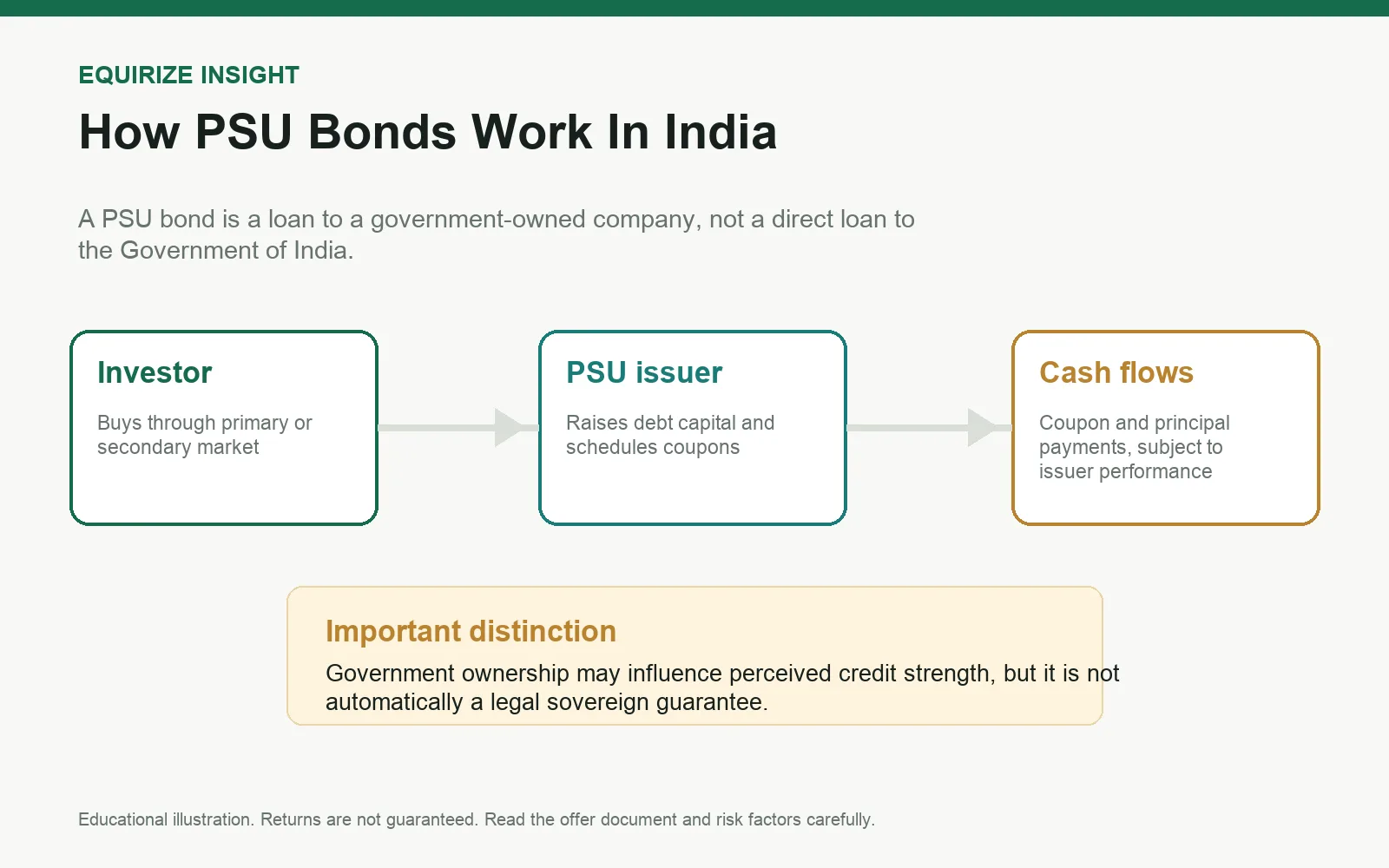
Public Sector Undertaking Bonds Meaning in India
Public sector undertaking bonds are debt securities issued by PSUs to raise money. A PSU may issue bonds for infrastructure projects, business expansion, refinancing, working capital, regulatory capital, or other permitted corporate purposes.
When an investor subscribes to or buys a PSU bond, the investor is lending money to the PSU issuer. In return, the issuer is expected to pay coupon as per the bond terms and repay principal at maturity, subject to issuer performance and the instrument documents.
In India, PSU bond issuers can include large government-owned companies, public sector financial institutions, public sector banks, infrastructure-linked entities and other government-owned enterprises. Some PSU-linked issuers are highly rated. Others may have weaker ratings or more complex instrument structures.
That is why this category should not be read as uniform. A bond issued by a large, highly rated central PSU, a subordinated bond from a public sector bank, and a bond from a weaker public sector entity may sit in very different risk buckets.
PSU Bonds Full Form and Who Issues Them
PSU bonds full form is Public Sector Undertaking bonds.
The issuer is typically a government-owned company or institution, not the sovereign itself. In many descriptions, a PSU is understood as an entity where the central or state government holds majority ownership. Investors should still verify the legal issuer name in the offer document or information memorandum.
The issuer name matters because similar-sounding securities can differ by ISIN, maturity, coupon, seniority, rating, security cover, call option, put option and tax status. Always identify the exact security, not just the issuer family.
How PSU Bonds Work: Coupon, YTM and Maturity
These bonds work like other listed debt securities. The issuer raises money. The investor receives scheduled coupon payments if the issuer meets its obligations. At maturity, the issuer is expected to repay principal as per the bond terms.
The visible numbers can be confusing at first. Coupon rate is the stated interest rate on face value. It does not automatically equal the investor's annualised outcome, especially if the bond is bought in the secondary market at a premium or discount.
Indicative yield to maturity, or YTM, is more comprehensive because it considers price, coupon, redemption value and time left to maturity. Even then, YTM is an estimate based on assumptions. It is not a promised return.
For secondary-market bonds, the final settlement amount may also include accrued interest. A bond screen may show clean price, while the payable amount may be based on dirty price. The clean price usually excludes accrued interest. The dirty price includes it.
If this sounds technical, slow down. These details affect what you pay, what you receive, and how you compare two bonds that appear similar on coupon alone.
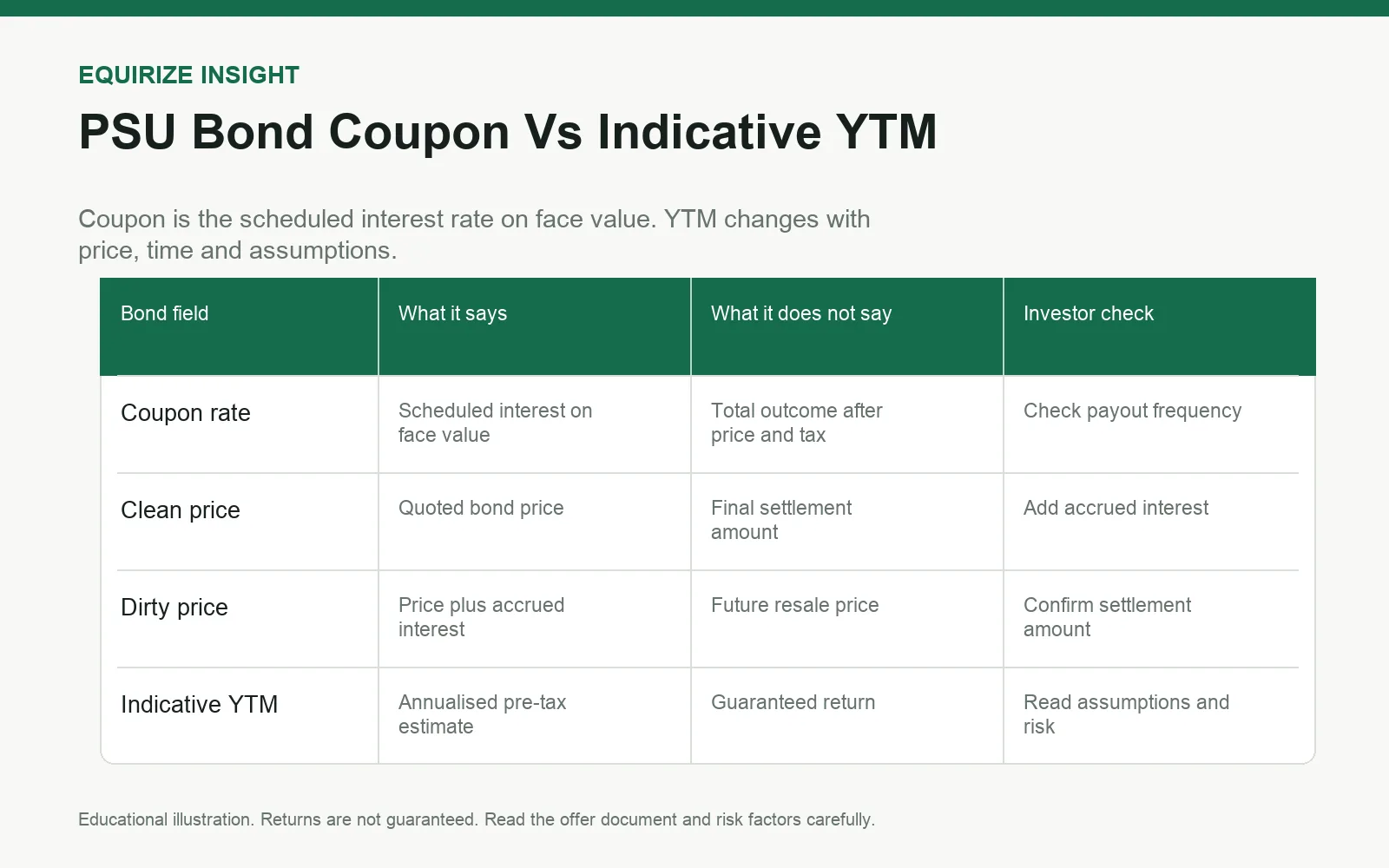
Coupon Rate vs Yield to Maturity in PSU Bonds
Coupon and YTM answer different questions.
Coupon answers: what interest rate is scheduled on the bond's face value?
YTM answers: based on the current price, maturity value, coupon schedule and time left, what is the indicative annualised pre-tax yield if the bond is held until maturity and scheduled payments happen?
That second question has more moving parts. It is also more useful for comparing PSU bonds with government securities, private corporate bonds, tax-free bonds or fixed deposits.
For example, a bond with an 8% coupon bought above face value can have a YTM lower than 8%. The same coupon bought below face value can have a YTM higher than 8%. Taxes can then change the post-tax outcome.
This is why an investor should not rank the category only by coupon rate.
PSU Bonds vs Government Bonds: Not the Same Risk
The most important distinction in this topic is simple: public-sector issuer debt and government bonds are not the same instrument.
Government securities, or G-Secs, are issued by the Government of India. They are generally treated as the rupee credit-risk benchmark because the issuer is the sovereign. RBI's investor education material still notes that even G-Secs carry risks such as market risk, reinvestment risk and liquidity risk if sold before maturity.
These securities are issued by government-owned entities. Government ownership may support investor perception of the issuer. It may also influence credit-rating analysis. But unless the specific bond document contains an explicit guarantee, the investor should not assume a legal sovereign guarantee.
That difference becomes especially important when comparing yields. If a PSU bond offers a yield above a comparable G-Sec, the extra spread may reflect issuer risk, liquidity risk, structure, maturity, tax treatment or market demand. It should not be treated as free extra return.
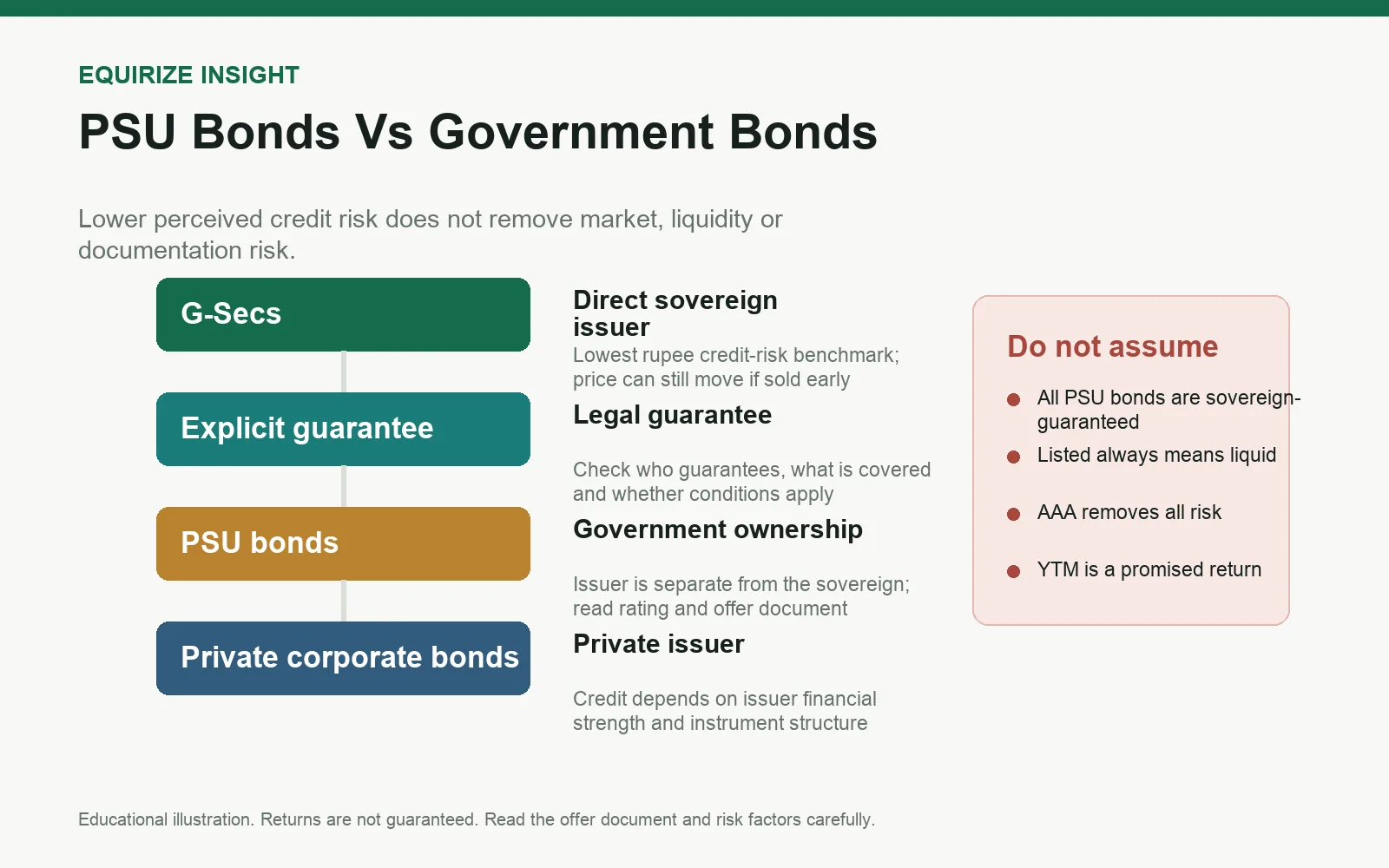
Explicit Guarantee vs Government Ownership in PSU Bonds
There are three different ideas investors should keep separate.
First, sovereign issuance. A G-Sec is issued by the Government of India.
Second, explicit guarantee. Some bonds may carry a stated guarantee from a government or other guarantor, subject to the exact terms. This has to be checked in the offer document. The presence, scope and conditions of the guarantee matter.
Third, government ownership. A PSU bond issuer may be majority government-owned, but the issuer is still a separate legal entity. Ownership is not automatically the same as a guarantee.
This is where many explanations become too loose. Words like "backed" and "safe" can hide the legal and credit distinction. A better phrase is: "These bonds may carry perceived credit support due to government ownership, but investors should verify whether any explicit guarantee exists in the bond documents."
PSU Bonds vs Corporate Bonds: Credit Rating and Spread
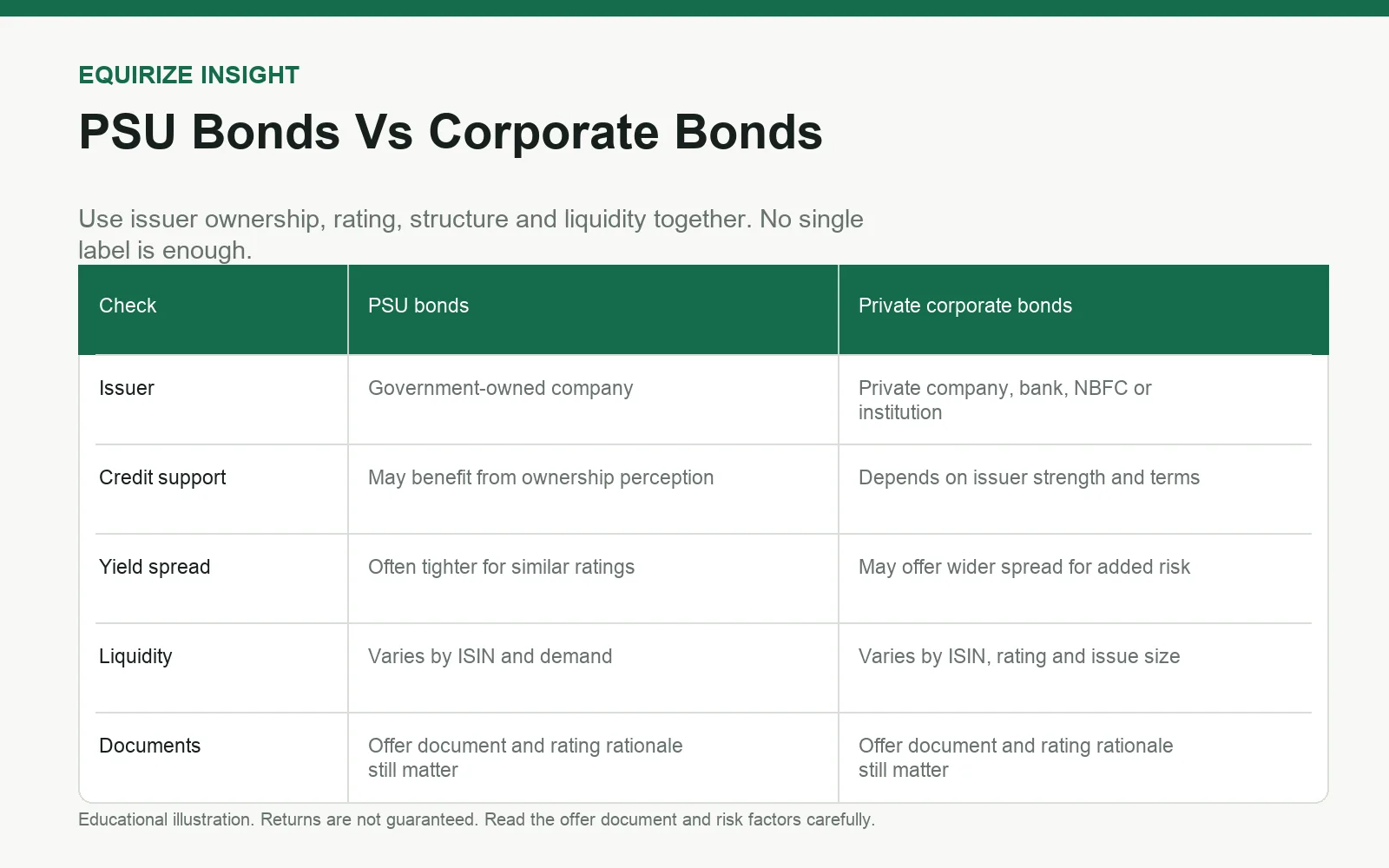
This is a type of non-sovereign debt security. In market conversations, it is often compared with private corporate bonds because both categories depend on issuer-level credit, instrument terms and market pricing.
The difference is ownership. PSU issuers are government-owned. Private corporate issuers are not. That ownership can affect investor perception, rating agency assessment and yield spread.
But investors should avoid lazy comparisons. A AAA-rated PSU bond and a AAA-rated private corporate bond may both carry strong ratings, yet they can differ in liquidity, maturity, security cover, seniority, call features and supply-demand dynamics. A lower-rated PSU bond may carry more credit risk than a higher-rated private issuer.
The useful question is not "PSU or corporate?" The useful question is: what exactly is the bond, who exactly is the issuer, what is the rating rationale, what is the structure, and what compensation is the yield offering for the risk?
PSU Bond Risks Investors Should Check Before Investing
These instruments may be perceived as lower credit-risk options than many private corporate bonds, especially when the issuer is large and highly rated. That does not remove risk.
Credit risk is the risk that the issuer may delay or fail to meet coupon or principal obligations. A credit rating helps, but it is not permanent. Ratings can change when the issuer's financial position, sector outlook, support assumptions or instrument structure changes.
Interest-rate risk is the risk that bond prices fall when market yields rise. If you hold a bond until maturity and scheduled payments occur, interim price movement may matter less. If you need to sell before maturity, it can matter a lot.
Liquidity risk is the risk that you may not find a buyer at the price or time you expect. A listed bond is not automatically liquid. Some ISINs trade frequently. Others may trade rarely or in larger lots.
Reinvestment risk arises when coupons or maturity proceeds need to be reinvested at lower rates than expected. This matters for investors building income plans.
Concentration risk appears when too much money is placed in one issuer, one sector, one maturity bucket or one type of bond. PSU ownership does not remove the need for diversification.
Structure risk also matters. Some bonds may be secured, unsecured, senior, subordinated, callable, puttable, perpetual, amortising or zero-coupon. The issuer name is only one part of the risk profile.
Equirize helps investors compare listed bonds by issuer details, credit rating, maturity, coupon structure, indicative yield and available documents. The comparison is a starting point, not a recommendation or a substitute for your own assessment.
Tax on PSU Bonds and Tax-Free PSU Bonds in India
Tax on PSU bonds depends on the specific instrument and the investor's facts.
For most taxable PSU bonds, coupon interest is generally taxed as income according to the investor's applicable slab rate. The post-tax outcome can therefore differ meaningfully between investors.
Tax-free PSU bonds are different. Some bonds issued by specified public sector or government-linked entities in earlier periods carried tax-free interest under applicable law. But the PSU label alone does not make a bond tax-free. You need to verify the instrument's tax status.
If a listed PSU bond is sold before maturity, capital gains or losses may arise based on the sale price, purchase price, holding period and applicable tax rules. The exact treatment can change with law and individual circumstances.
Do not compare the category only on pre-tax YTM. Compare post-tax outcomes as well. A taxable bond with a higher pre-tax YTM may not always have a better post-tax result than another instrument for a high-tax-bracket investor.
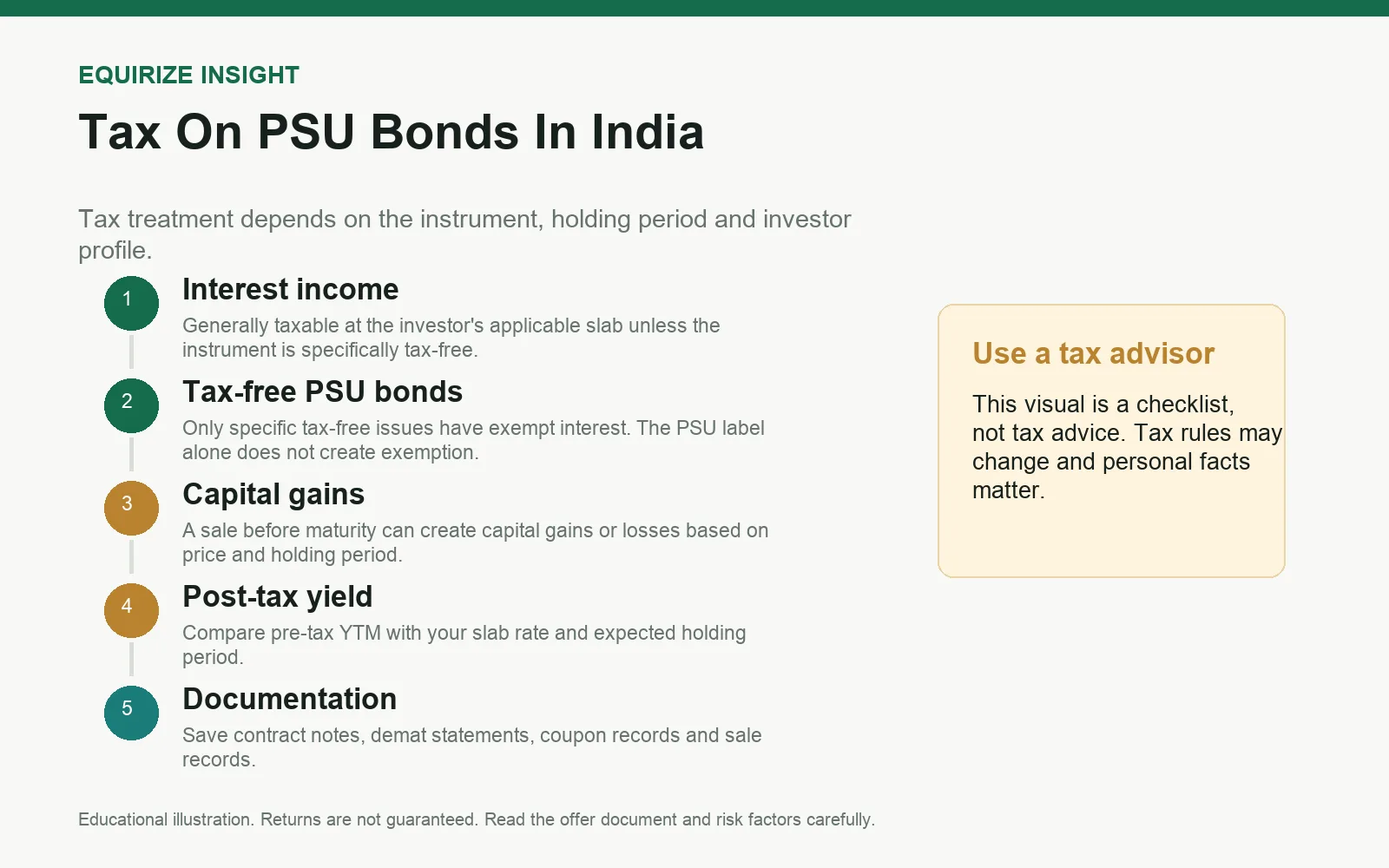
Tax treatment depends on individual circumstances and may change. Please consult a qualified tax advisor.
How to Invest in PSU Bonds Online Through an OBPP
Investors can access these bonds through primary issues, secondary-market routes, stockbrokers, and SEBI-registered Online Bond Platform Providers, or OBPPs, depending on availability and eligibility.
In a primary issue, the issuer raises money by offering new debt securities. Investors apply during the issue window. Allotment, listing and credit timelines depend on the issue terms.
In the secondary market, investors buy an already-issued bond from an existing holder. The price may be above or below face value. The final settlement amount can include accrued interest. Liquidity depends on the specific ISIN and market conditions.
For listed debt securities placed through an OBPP, SEBI's framework brings online bond platforms into a regulated perimeter. Equirize is a SEBI-registered Online Bond Platform Provider and stock broker in the debt segment, with SEBI Registration Number `INZ000323730`.
Platform registration does not mean SEBI approves or guarantees any bond listed on the platform. It means the platform operates within the applicable regulatory framework. The investment decision still belongs to the investor.
If you are new to the post-order process, read Equirize's guide to the bond settlement process from order to demat credit. Settlement is complete only when the bond is credited to the relevant demat account or depository record.
PSU Bond Checklist: Rating, ISIN, Price, Yield and Offer Document
Before investing in PSU bonds in India, use this checklist:
| Item | Investor Question |
| Purpose | Why am I adding this bond to my portfolio? |
| Holding period | Can I hold until maturity if liquidity is limited? |
| Issuer | Do I understand the issuer and its business? |
| Ownership | Is this central PSU, state PSU, public sector bank or another entity? |
| Guarantee | Is there an explicit guarantee in the documents, or only government ownership? |
| Rating | Have I checked the latest rating and rationale? |
| Yiled | Is the YTM indicative, pre-tax and assumption-based? |
| Price | Have I checked clean price, dirty price and accrued interest? |
| Structure | Is the bond senior, subordinated, secured, unsecured, callable or puttable? |
| Liquidity | What does recent trading activity suggest? |
| Tax | What is the likely post-tax outcome for my profile? |
| Platform | Am I using a properly regulated route? |
| Documents | Have I saved the offer document, order receipt and deal sheet? |
For broader mistakes to avoid, see Equirize's guide on bond investing checks before you buy. For yield comparison, read the guide to yield to maturity. For pricing mechanics, see bond platform fees, spread, yield and price.
Who Should Consider PSU Bonds in a Fixed-Income Portfolio
This category may be relevant for investors who want listed fixed-income exposure, can read bond terms, understand credit and liquidity risk, and have a defined holding period.
They may appeal to investors who prefer issuers with government ownership, want cash-flow visibility, or are comparing PSU issuers with government securities, private corporate bonds, fixed deposits and debt mutual funds.
But suitability depends on the investor. A retired investor depending on regular income, a high-tax-bracket investor, a young professional building a long-term portfolio, and a business owner parking surplus cash may need different instruments.
Start with the job the bond must do. Is it income planning, maturity matching, diversification, capital parking, or portfolio stability? Then check whether the bond's maturity, risk, liquidity and tax profile match that job.
For allocation thinking, see Equirize's guide on how much to allocate to bonds in a portfolio.
PSU Bonds in India: Final Evaluation Framework
The right way to evaluate PSU bonds in India is not to start with the issuer label alone. Start with a sequence.
First, identify the exact security using issuer name and ISIN.
Second, read the instrument terms: coupon, maturity, seniority, security, call or put options, tax status and settlement details.
Third, read the credit rating and rating rationale. Look for the reason behind the rating, not only the symbol.
Fourth, compare indicative pre-tax YTM with comparable G-Secs, PSU bonds and private corporate bonds of similar maturity and rating. The spread is a question, not an answer.
Fifth, check whether you can hold the bond until maturity. If you may need early liquidity, secondary-market trading activity becomes more important.
Sixth, calculate the post-tax outcome. Pre-tax yield is not what ultimately reaches the investor.
Finally, use a regulated access route and preserve the transaction trail: order receipt, deal sheet, settlement details and demat credit.
Public-sector issuer debt can be a useful part of India's listed debt market. It can also be misunderstood when government ownership is treated as a shortcut for risk analysis. The better approach is steadier: read the document, understand the issuer, compare the yield, check the tax, and know what could go wrong before investing.
You can explore listed bond information on Equirize, compare available terms and review documents where available. Equirize does not provide investment advice.