Bond Market Outlook 2026: What August Holds for Indian Investors


The bond market outlook 2026 has changed from a simple rate-cut conversation into a more careful reading of data. By August, Indian investors are not only watching the RBI repo rate. They are also watching the G-Sec yield curve, crude oil, rupee movement, credit spreads, liquidity and the possibility that different parts of the bond market may behave differently.
That distinction matters. A government security, a AAA corporate bond, a lower-rated NBFC bond and a long-tenure bond bought in the secondary market do not respond to August 2026 conditions in the same way. The same market headline can mean one thing for a short-term investor and something very different for someone building a five-year income ladder.
This guide explains the August 2026 bond market outlook for Indian investors in practical terms: what the yield curve is showing, why the RBI pause still matters, how corporate bond yields should be read, and what investors should check before comparing listed bonds.
India Bond Market Outlook 2026: The August Snapshot
The India bond market outlook 2026 entered August with three broad signals.
First, policy rates were no longer moving in a straight line in investors' minds. The RBI's August 2026 Monetary Policy Committee communication kept the repo-rate discussion data-dependent rather than directional. That means investors should avoid reading an unchanged policy rate as "nothing happened." In bond markets, expectations often move before official rates do.
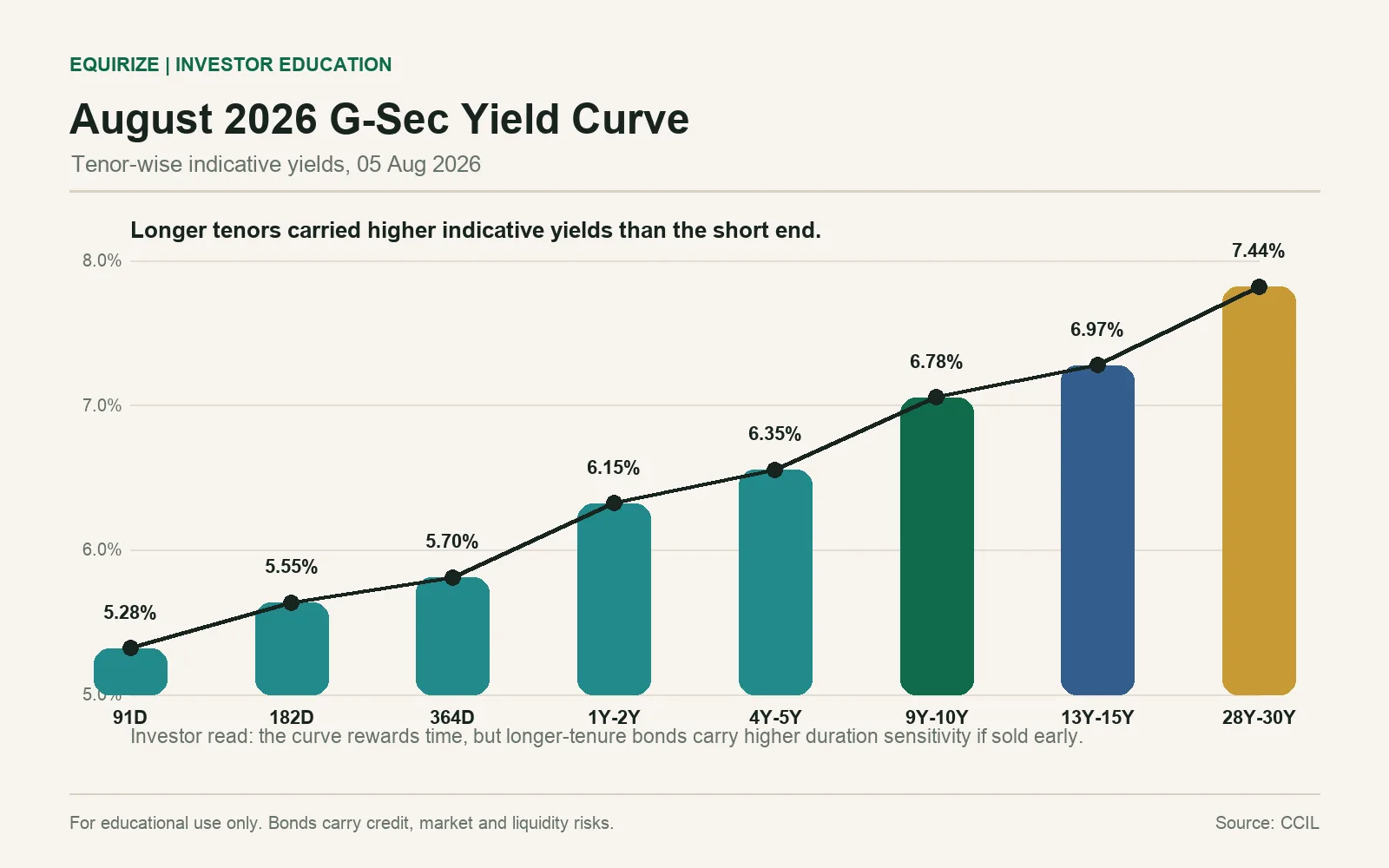
Second, the G-Sec curve showed a clear difference between short money and long money. CCIL's tenor-wise indicative yield table for 05-08-2026 showed 91-day Treasury Bills at 5.278%, the 4Y-5Y G-Sec bucket at 6.3465%, the 9Y-10Y bucket at 6.7787%, the 13Y-15Y bucket at 6.9733%, and the 28Y-30Y bucket at 7.4433%. That upward slope tells investors that longer-tenure money still demands more compensation for time, inflation uncertainty and duration risk. [CCIL Tenor-wise Indicative Yields]
Third, global and domestic signals were competing. Softer inflation expectations may support bonds, but crude oil, rupee movement, global yields and fiscal supply can still push yields around. For investors, August is less about making a one-line prediction and more about understanding which signal matters for the specific bond being evaluated.
G-Sec Yield August 2026: What the Curve is Saying
The G-Sec yield August 2026 curve is useful because it acts as the benchmark layer for much of the bond market. Corporate bond yields are not priced in isolation. They usually sit above comparable government-security yields, with the extra yield reflecting issuer credit risk, liquidity, structure, tenure and market demand.
A 10-year G-Sec yield near 6.78% does not tell investors what a corporate bond should yield by itself. But it does give a reference point. If a corporate bond with a similar maturity offers a higher indicative pre-tax YTM, the investor should ask what the spread is compensating for. It may be credit risk. It may be lower liquidity. It may be a longer maturity, a call option, subordinated structure, or simply market demand at that point in time.
RBI Repo Rate and Bond Yields: Why a Pause Still Matters
The link between the RBI repo rate and bond yields is not mechanical. The RBI sets short-term policy rates and manages liquidity. The market prices the future path of inflation, growth, liquidity, supply and risk appetite across the yield curve.
That is why bond yields can move even when the repo rate is unchanged. If investors believe inflation pressure is easing, medium-tenure yields could soften. If crude oil rises, the rupee weakens sharply, or global yields move higher, longer-tenure yields could rise even without a repo-rate change.
The August takeaway is simple: do not watch the repo rate alone. Watch the language around inflation, liquidity, currency, food prices, global conditions and fiscal borrowing. These can influence the curve before policy rates actually change. For the underlying mechanism, see Equirize's explainer on RBI repo rate and bond yields.
Indian Bond Yields 2026: Short-End, Long-End and Yield Curve Signals
Indian bond yields 2026 should be read by tenor, not as one blended number.
The short end of the curve, including Treasury Bills and shorter government securities, is usually more sensitive to liquidity and near-term policy expectations. If market participants expect no immediate policy shift, short-tenure yields may remain closer to the operating policy-rate environment.
The middle of the curve often reflects a mix of policy expectations and investor demand. Many investors evaluating one-year to five-year bonds care about this zone because it lines up with common cash-flow goals, laddering plans and direct bond maturities.
The long end of the curve carries more uncertainty. A 15-year or 30-year bond has more price sensitivity to interest-rate changes. It can also react to fiscal supply, insurance and pension demand, inflation expectations and global bond-market moves.
This is where the bond yield curve India investors see in August becomes more than a chart. It becomes a map of risk. A flat or inverted curve would say one thing. An upward-sloping curve says another. The current shape suggests that longer-tenure investors are still being paid more yield, but that extra yield comes with greater price sensitivity if they need to sell before maturity.
| Yield move | What it may mean for bond prices | Investor question |
| Yields rise after purchase | Existing bond prices may fall | Can I hold until maturity, or might I need an early exit? |
| Yields fall after purchase | Existing higher-coupon bonds may become more valuable | Am I evaluating price gain, future reinvestment risk, or income stability? |
| Short-end yields stay firm | Near-term rates remain anchored | Does my cash-flow need match a short-tenure instrument? |
| Long-end yields move sharply | Duration risk is active | Am I taking more tenure risk than I understand? |
Duration Risk in Bonds When Yields Move
Duration risk in bonds is the risk that market prices move because yields change. It is most visible when investors sell before maturity.
If an investor buys a fixed-coupon bond and market yields rise later, the bond's market price may fall because new buyers can get a higher yield elsewhere. The longer the remaining maturity and the lower the coupon, generally the more sensitive the price can be.
This does not mean every price move becomes a realised loss. If the investor holds the bond until maturity and the issuer makes scheduled payments, interim price changes may matter less. But if the investor may need liquidity before maturity, duration risk becomes practical rather than theoretical.
August 2026 is a good time to check this explicitly. The question is not only "what is the yield?" It is also "how much price movement can I tolerate if I need to sell early?"
Reinvestment Risk in Bonds When Rates Soften
Reinvestment risk in bonds is the opposite problem. If yields fall after an investor receives coupons or maturity proceeds, the next available bond may offer a lower yield than the earlier instrument.
This matters for investors using bonds for cash-flow planning. A high coupon today does not automatically solve future income needs if the money has to be redeployed later at a lower rate. Callable bonds can add another layer: if the issuer has the right to redeem early, the investor may receive money back when market yields are less attractive.
That is why a laddered approach can sometimes be more useful than a single maturity bet. It spreads reinvestment dates across time. It does not remove risk, but it can reduce dependence on one rate environment.
For investors comparing direct bonds, yield to maturity should be read with maturity date, coupon schedule, call features, taxation and liquidity, not in isolation.
Corporate Bond Yields India 2026: Reading Spreads Beyond the Headline YTM
Corporate bond yields India 2026 are likely to attract attention because they can appear more attractive than government securities on a headline yield basis. But the headline number is only the beginning.
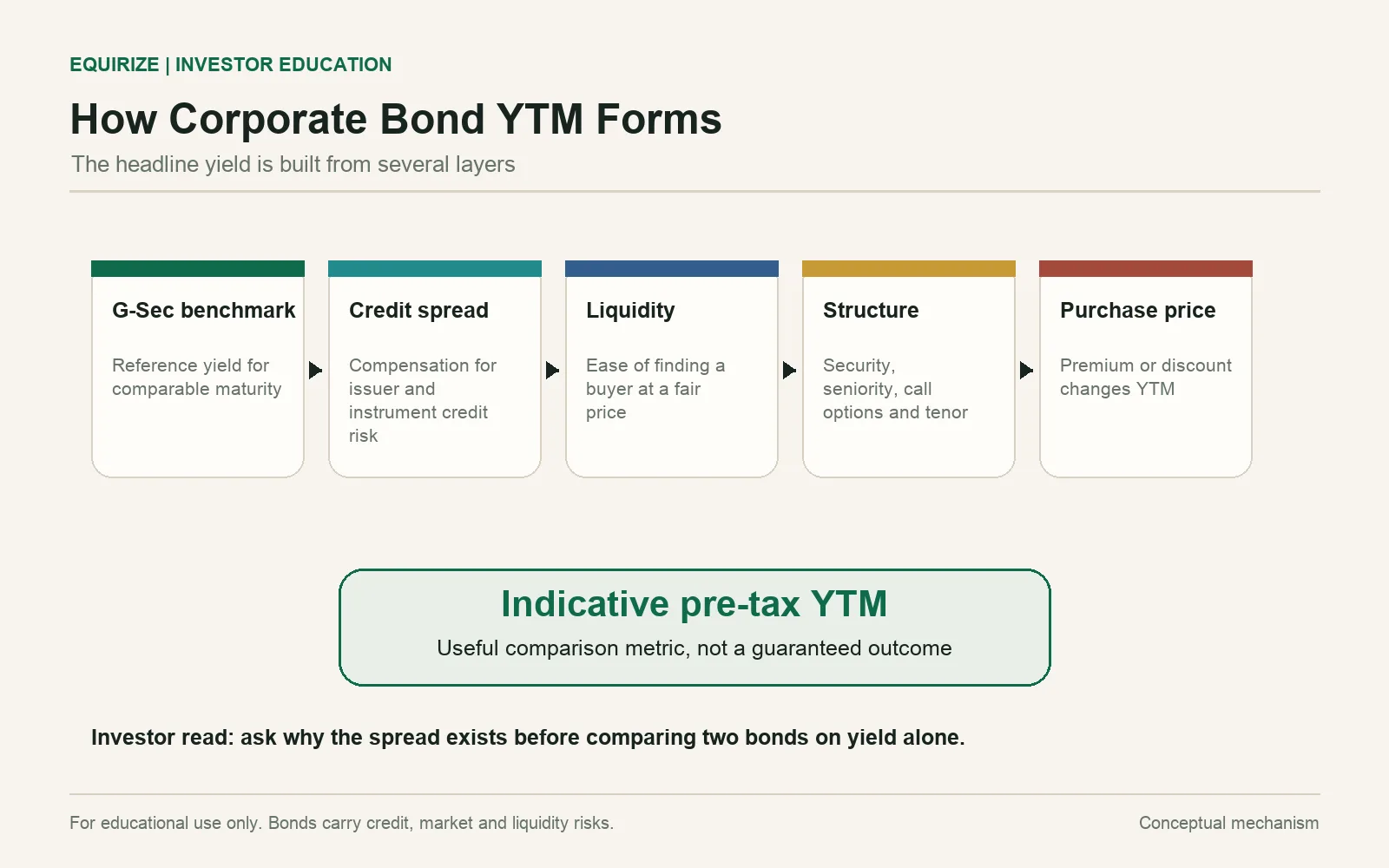
A corporate bond's indicative pre-tax YTM usually reflects at least five layers:
| Layer | What it means |
| Benchmark G-Sec yield | The reference yield for comparable maturity government securities |
| Credit spread | Extra yield for issuer and instrument-level credit risk |
| Liquidity | Compensation for how easy or difficult it may be to sell |
| Structure | Security, seniority, call/put options, coupon frequency and covenants |
| Price | The market price at which the investor is buying |
The investor's job is not to chase the largest number. It is to understand why the number exists.
For example, two bonds may show similar indicative YTMs but carry different risks. One may be secured and senior, with a stronger rating and shorter maturity. Another may be subordinated, longer-tenure, lower-rated, or less liquid. The YTM alone will not tell the full story.
This is also where comparison with fixed deposits can become misleading if done casually. A bank FD, a corporate FD and a listed corporate bond have different legal structures, liquidity terms, tax treatment and risk. A bond yield should not be compared with an FD rate unless tenure, issuer risk, liquidity and tax are considered together.
Credit Spread in Bonds: What Extra Yield May Be Compensating For
Credit spread in bonds is the extra yield over a comparable benchmark, often a government security. It is not free return. It is usually the market's compensation for risk and structure.
A wider spread may reflect a lower credit rating, weaker liquidity, sector concerns, longer maturity, subordinated status, lower investor demand or uncertainty around the issuer. It may also reflect market-wide risk aversion rather than a problem with one issuer.
This is why spreads should be read with the rating agency's rationale, rating outlook, latest rating action, issuer financials, security cover and maturity profile. A credit rating is useful, but it is not a guarantee. Ratings can be revised if the issuer's credit profile changes.
Equirize's guide to credit rating downgrades explains why investors should look beyond the rating symbol and read the direction of change.
Yield to Maturity vs Coupon Rate in a Volatile Month
Yield to maturity and coupon rate answer different questions.
The coupon rate is the stated interest rate on the bond's face value. It tells investors the scheduled coupon cash flow, subject to the issuer making payments as per the terms.
Yield to maturity estimates the annualised return implied by the purchase price, coupon cash flows and maturity value, assuming the investor holds until maturity and the issuer makes scheduled payments. If a bond trades below face value, YTM can be higher than the coupon. If it trades above face value, YTM can be lower.
In a volatile month, this distinction becomes important. A bond with a familiar coupon can become more or less attractive depending on market price. Investors should therefore compare coupon, clean price, accrued interest, YTM, maturity, tax and liquidity together.
When comparing listed bonds, review the issuer, rating, maturity, cash-flow schedule, indicative pre-tax YTM and offer document together.
Bond Market Risks 2026: What Could Change the August View
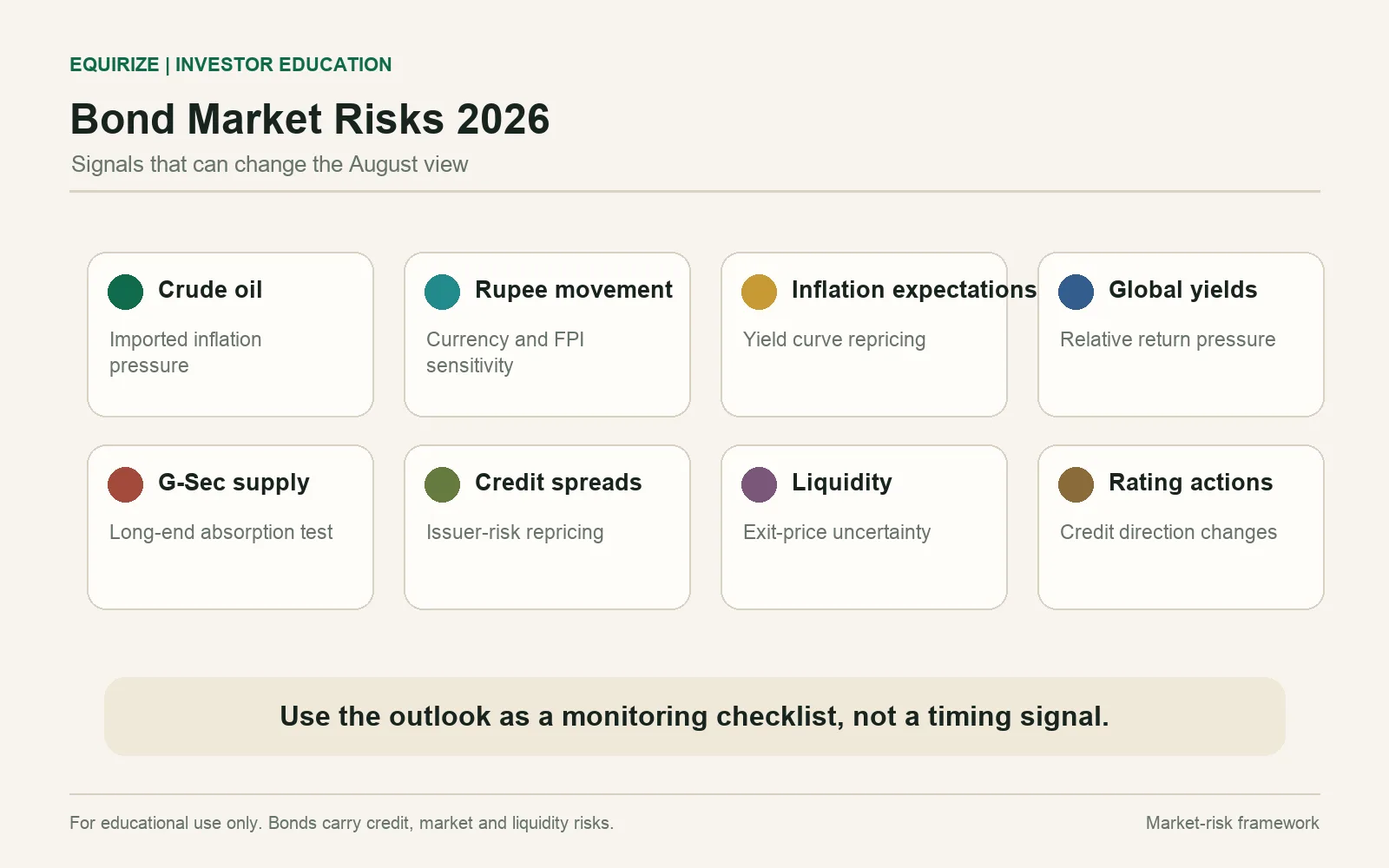
The bond market risks 2026 investors should watch are not only domestic. They sit across macro, market and issuer layers.
At the macro layer, crude oil matters because India imports a large part of its energy needs. Higher oil prices can affect inflation expectations, the rupee and current-account concerns. If the market starts pricing higher inflation or currency pressure, bond yields may move higher.
At the policy layer, the RBI's communication matters. Even when the repo rate is unchanged, commentary on inflation, liquidity, currency and growth can shift expectations.
At the market layer, global yields matter. If US Treasury yields rise sharply or global risk appetite weakens, emerging-market bond flows can become more selective. Indian government bonds may still benefit from structural demand, but short-term flows can move both ways.
At the issuer layer, corporate bond spreads can widen if investors become more cautious about credit risk. This may happen because of sector stress, rating actions, liquidity events or simply because investors demand more compensation for taking credit exposure.
None of these risks means investors should avoid bonds. It means the August outlook should be used as a checklist, not a timing signal.
Crude Oil, Rupee Movement and Inflation Expectations
Crude oil and rupee movement can affect bond yields through inflation expectations.
If crude rises and the rupee weakens at the same time, markets may worry about imported inflation. That can push yields higher, especially if investors expect monetary policy to stay tighter for longer. The effect is not automatic. It depends on the size of the move, government policy response, global conditions, domestic demand and the RBI's interpretation.
If crude stabilises and the rupee remains orderly, bond investors may become more comfortable with the inflation path. That can support demand for medium-tenure bonds. But even then, investors should avoid assuming a one-way fall in yields.
The better question is: which part of my bond portfolio is sensitive to this signal? A short-tenure bond held to maturity, a long-duration G-Sec, and a lower-rated corporate bond may react differently.
Secondary-Market Liquidity and Credit Rating Watchpoints
Listed does not always mean liquid.
A listed bond may have a secondary-market route, but the available exit price depends on demand, trade size, remaining maturity, issuer perception and market conditions. If many investors want to sell at the same time, liquidity can become thinner. If a bond is held to maturity and the issuer pays as scheduled, this may matter less. If an investor needs early exit flexibility, it matters more.
Credit rating watchpoints also deserve attention. Investors should check the rating agency, rating outlook, recent rating actions, security cover, seniority and sector context. A stable rating and a negative outlook are not the same signal. A rating under watch deserves more attention than a rating that has been recently affirmed with stable outlook.
This is why the offer document and rating rationale are not formalities. They are part of the investment decision.
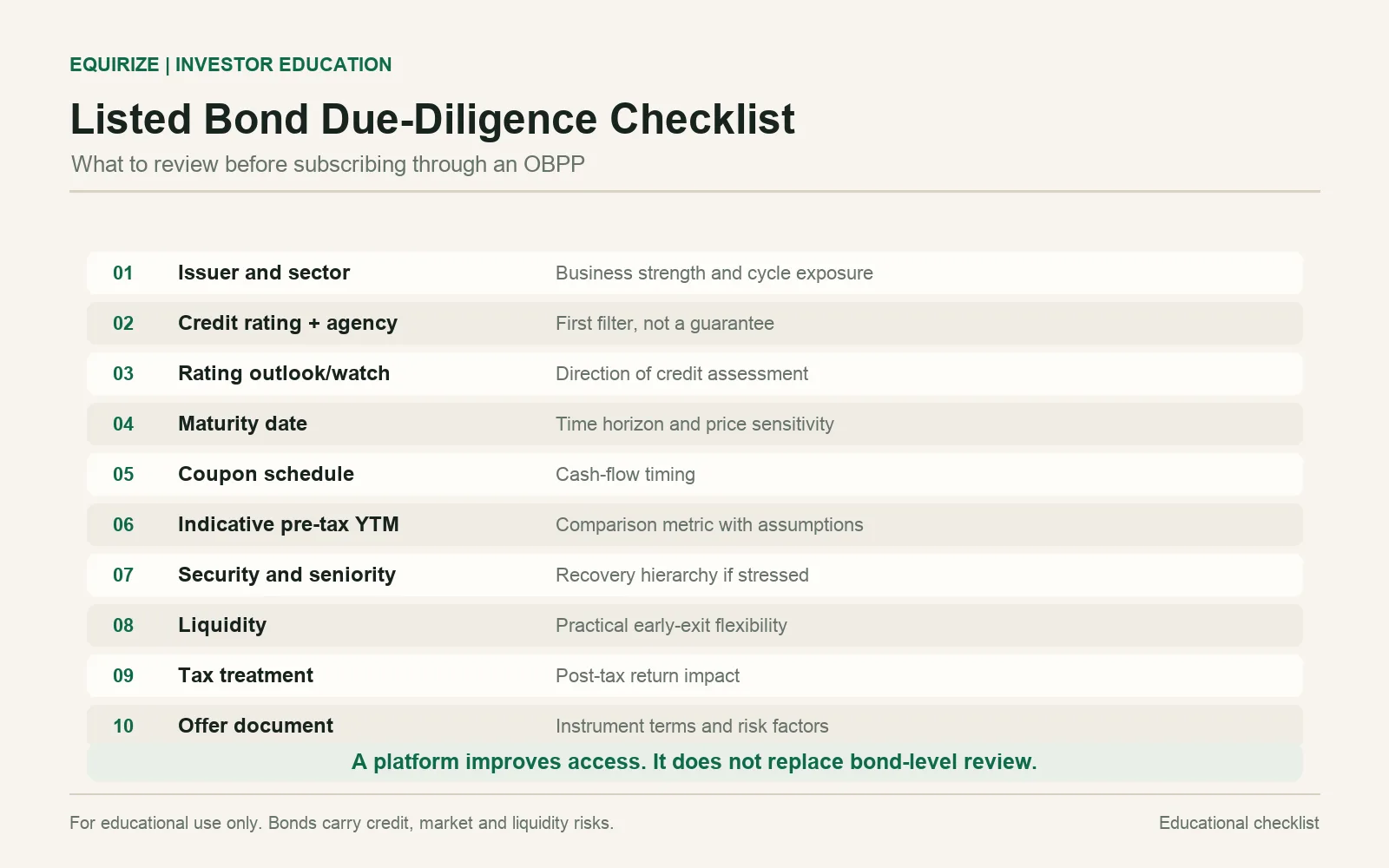
How to Invest in Bonds in India 2026: A Practical August Checklist
Search interest around how to invest in bonds in India 2026 has grown because access has changed. Retail investors can now evaluate listed bonds through SEBI-registered Online Bond Platform Providers, or OBPPs, and exchange-linked market infrastructure.
SEBI's OBPP framework, introduced through the 14 November 2022 circular, brought online bond platforms within a defined regulatory perimeter. OBPPs are required to operate under the applicable framework rather than as informal distribution channels. SEBI OBPP framework circular
That improves the access framework, but it does not remove investment risk. Investors still need to evaluate the bond.
Use this August checklist before comparing listed bonds:
| Check | Why it matters |
| Issuer and sector | Repayment depends on issuer strength and business conditions |
| Credit rating and agency | First filter for assessed credit risk |
| Rating outlook or watch | Shows direction of credit assessment |
| Maturity date | Determines time horizon and price sensitivity |
| Coupon schedule | Helps plan cash flows |
| Indicative pre-tax YTM | Comparison metric, subject to assumptions |
| Security and seniority | Affects recovery hierarchy if stress occurs |
| Liquidity | Determines practical exit flexibility |
| Tax treatment | Post-tax return depends on investor circumstances |
| Offer document | Source for risk factors and instrument terms |
| Concentration | Avoids excessive exposure to one issuer or sector |
For process detail, see Equirize's guide on how to invest in corporate bonds in India.
Listed Corporate Bonds on an OBPP: What to Review Before Subscribing
An OBPP can make discovery and access easier. It should not make the investor skip the work.
Before subscribing to a listed corporate bond, review the issuer name, instrument type, credit rating, rating agency, maturity, coupon frequency, indicative yield, face value, minimum investment, accrued interest, settlement process and offer document. If the bond has a call option, put option, step-up feature, subordinated structure, secured structure or unusual cash-flow pattern, read that section carefully.
Equirize facilitates access to listed corporate bonds with issuer details, ratings, maturities, indicative yields and offer documents. Equirize does not provide investment advice.
Tax should also be part of the evaluation. Coupon income and capital gains can be taxed differently depending on the instrument, holding period and investor profile. Tax treatment depends on individual circumstances and may change. See Equirize's guide to bond interest taxation in India for a deeper explanation.
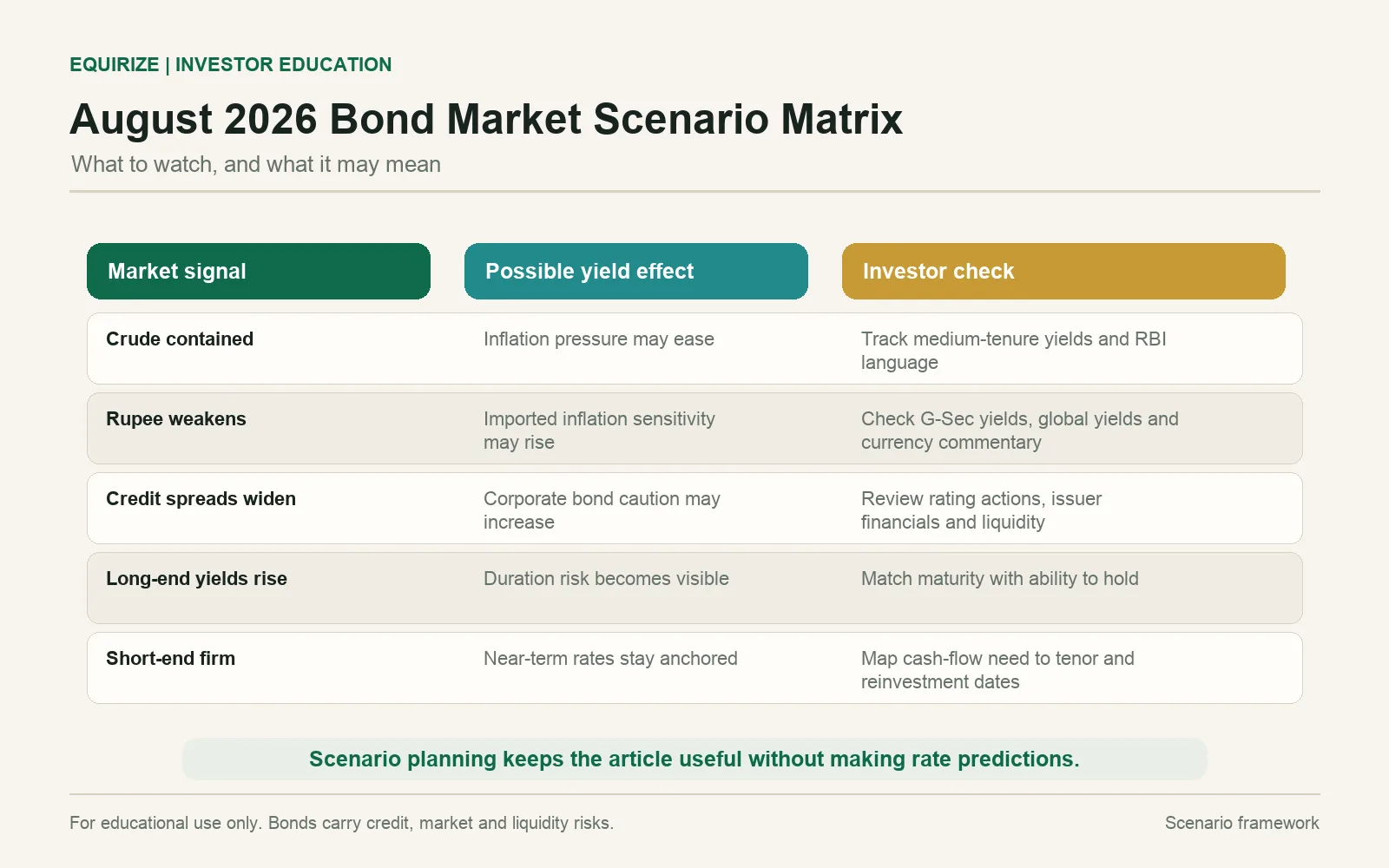
August 2026 Bond Market Outlook: What Investors Should Watch Next
The August 2026 bond market outlook should be tracked through scenarios.
| If this changes | What it may mean | What investors should check |
| Crude oil stays contained | Inflation pressure may look more manageable | Medium-tenure yield movement and RBI commentary |
| Rupee weakens sharply | Imported inflation and FPI sensitivity may rise | G-Sec yields, currency commentary and global yields |
| Credit spreads widen | Corporate bond market may be pricing more caution | Rating actions, issuer financials and liquidity |
| Long-end yields rise | Duration risk becomes more visible | Early-exit needs and maturity profile |
| Short-end yields stay firm | Near-term policy expectations remain anchored | Cash-flow goals and reinvestment dates |
This framework is more useful than asking whether August is "good" or "bad" for bonds. A market environment can be supportive for one investor and unsuitable for another.
An investor with a three-month parking need should not read a five-year bond outlook as directly relevant. An investor building predictable coupon cash flows should focus on maturity matching, issuer quality, tax and reinvestment dates. An investor who may need to sell early should pay closer attention to duration and secondary-market liquidity.
The same applies to credit. A higher indicative yield may be appropriate compensation for one investor and excessive risk for another. Suitability depends on the investor's objective, risk tolerance, liquidity need, tax position and portfolio concentration.
Conclusion
The August fixed-income outlook is not a call to predict the next rate move. It is a reminder to read the market in layers.
Start with the G-Sec curve. Then look at RBI policy communication, crude oil, rupee movement, inflation expectations and global yields. For corporate bonds, add credit spread, rating outlook, liquidity, structure, tax and documentation.
For Indian investors, the practical lesson is discipline. Use the August outlook as a checklist, not as a timing signal. Compare listed bonds on Equirize only after reviewing risk, tax, liquidity and documentation.