Bond Default Risk: Warning Signs To Watch For Before And After You Invest


Bond default risk is the possibility that the issuer of a bond is unable to pay interest or repay principal on time. For a listed corporate bond investor, this risk is not visible from the coupon alone. A bond can have a fixed coupon schedule and still carry credit risk, liquidity risk, interest-rate risk, and the possibility of delay or default in payment.
That is why default risk in bonds should be reviewed as a system of signals. The credit rating matters. The rating rationale matters more. The offer document matters. So do issuer financials, refinancing ability, security structure, sector conditions, trading behaviour, and the investor's own concentration in one issuer or sector.
This guide explains bond default warning signs in a practical way: what to check before buying a listed corporate bond, what to monitor after investing, and what a warning sign does - and does not - mean.
What Default Risk In Bonds Actually Means
Default risk in bonds is the risk that the issuer cannot meet its scheduled obligations. Those obligations usually include coupon payments during the bond's life and principal repayment at maturity. In some cases, a default may also be linked to a breach of specific terms in the bond documents, such as security cover, covenant requirements, or other events of default described in the offer document.
This is different from ordinary market-price movement. A listed bond may trade below its purchase price because interest rates moved, market liquidity changed, or buyers are demanding a higher yield. That price movement can affect an investor who sells before maturity. A default is more direct: the issuer has failed, or is expected to fail, to meet a contractual obligation.
The two can interact. If the market begins to worry about issuer creditworthiness, the bond price may weaken and the yield may rise. That does not automatically mean the issuer will default. It does mean investors should ask why the market is asking for more compensation.
For a retail investor, the practical point is simple: do not treat "bond" as a single risk category. Government securities, AAA-rated corporate bonds, lower-rated corporate bonds, secured NCDs, unsecured NCDs, subordinated instruments, and structured debt exposures can behave very differently. Even within listed corporate bonds, issuer quality, maturity, security, seniority, and liquidity shape the default-risk profile.
SEBI's investor education material also cautions investors not to rely solely on credit ratings. Ratings are an opinion from a credit rating agency and can change. Investors should review profitability, solvency ratios, issuer financial health, and other credit metrics before investing in bonds.
Bond Default Warning Signs Investors Should Track
No single warning sign is enough to conclude that a bond will default. A rating action may reflect higher risk, but not necessarily imminent payment failure. A wider credit spread may reflect liquidity, tenure, or market conditions. A delayed result may be procedural, or it may point to deeper stress.
The value lies in patterns. Bond default risk becomes more concerning when several signals appear together: rating pressure, weak cash flow, rising leverage, refinancing difficulty, sector stress, governance concerns, and price weakness in the secondary market.
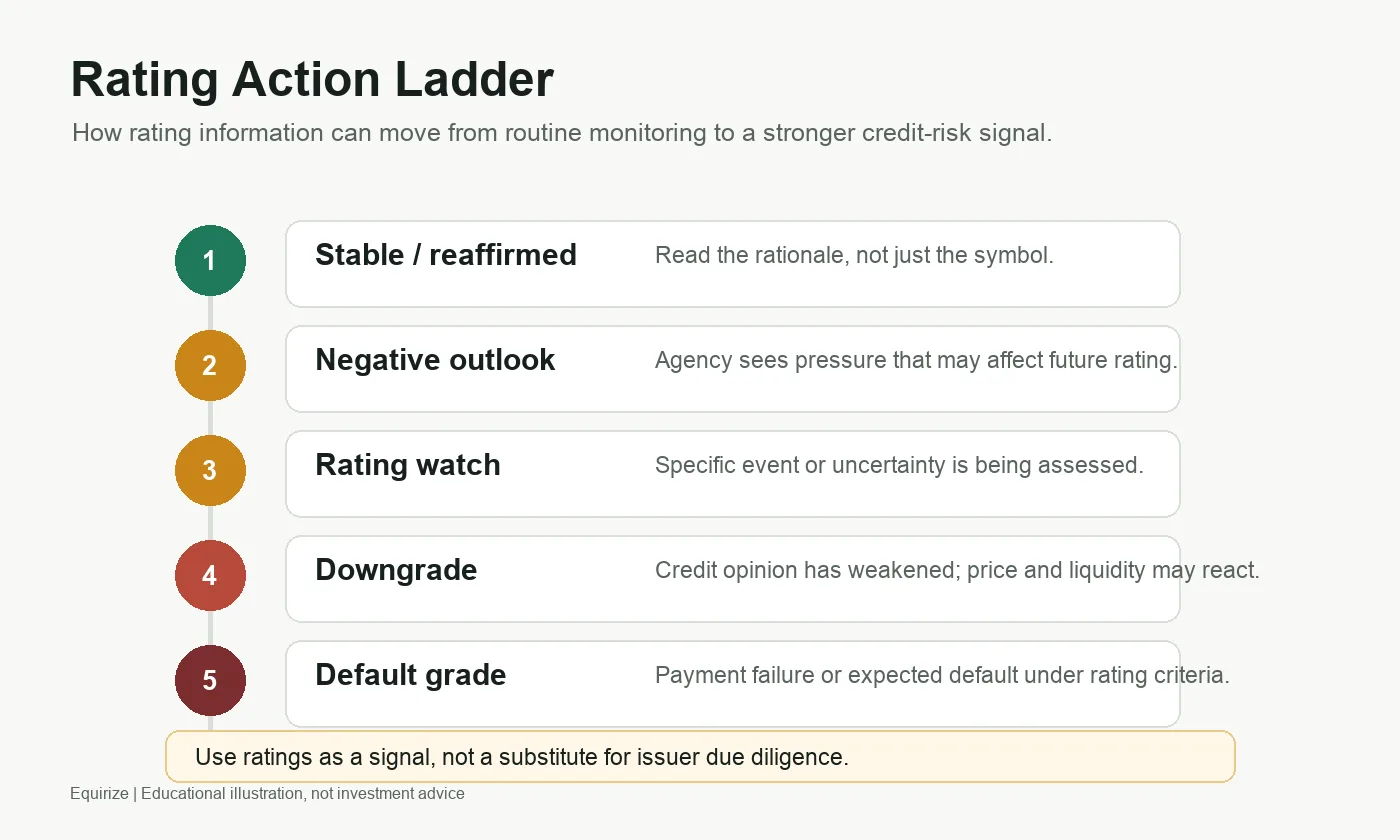
Bond Rating Downgrade, Rating Watch And Negative Outlook
A bond rating downgrade is one of the most visible bond default warning signs. It means a credit rating agency has revised its opinion of the issuer or instrument downward. The downgrade may be one notch or multiple notches. The lower the rating moves, the more carefully investors should review the reason.
But a downgrade is not the only rating signal. Investors should also track:
| Rating signal | What it usually means | What to check |
| Negative outlook | The agency sees pressure that could affect the rating over time | Latest rating rationale, rating sensitivities, sector comments |
| Rating watch with negative implications | A specific event or uncertainty is under review | Event details, expected timeline, management response |
| Rating downgrade | Credit opinion has weakened | Reasons for downgrade, liquidity position, debt maturity profile |
| Multi-notch downgrade | Credit risk has changed materially | Payment record, refinancing ability, trustee notices |
| Rating withdrawal | Agency has stopped rating the instrument or issuer | Reason for withdrawal, whether another rating exists, disclosure gaps |
The common mistake is to look only at the rating symbol. A bond may remain investment grade while the rationale beneath the rating becomes less comfortable. Conversely, a downgrade may already be priced into the bond. The rating action is a starting point for review, not a mechanical investment instruction.
For a deeper rating-symbol comparison, see Equirize's guide to AAA vs AA bond rating differences.
Rating Rationale In Bonds: What Changed Beneath The Symbol
The rating rationale is often more useful than the rating label. It explains why the rating agency assigned, reaffirmed, upgraded, downgraded, placed on watch, or withdrew a rating. If you are assessing corporate bond default risk, read the rationale for changes in tone.
Look for:
- weaker operating performance;
- pressure on margins or profitability;
- increase in leverage;
- stretched liquidity;
- high near-term debt repayment;
- dependence on refinancing;
- asset-quality pressure for lenders and NBFCs;
- sector headwinds;
- adverse regulatory or legal developments;
- reliance on promoter support or group support;
- negative rating sensitivities that appear close to being triggered.
A reaffirmed rating can still contain useful caution. For example, the agency may reaffirm the rating but mention weakening liquidity, pressure on collections, higher borrowing cost, or dependence on timely refinancing. The symbol has not changed, but the credit story may have become less comfortable.
This is why a good bond review does not stop at "rated A" or "rated AA". It asks: what does the latest rationale say, what changed from the previous rationale, and what conditions could trigger another rating action?
Credit Spread In Bonds And Sudden Price Weakness
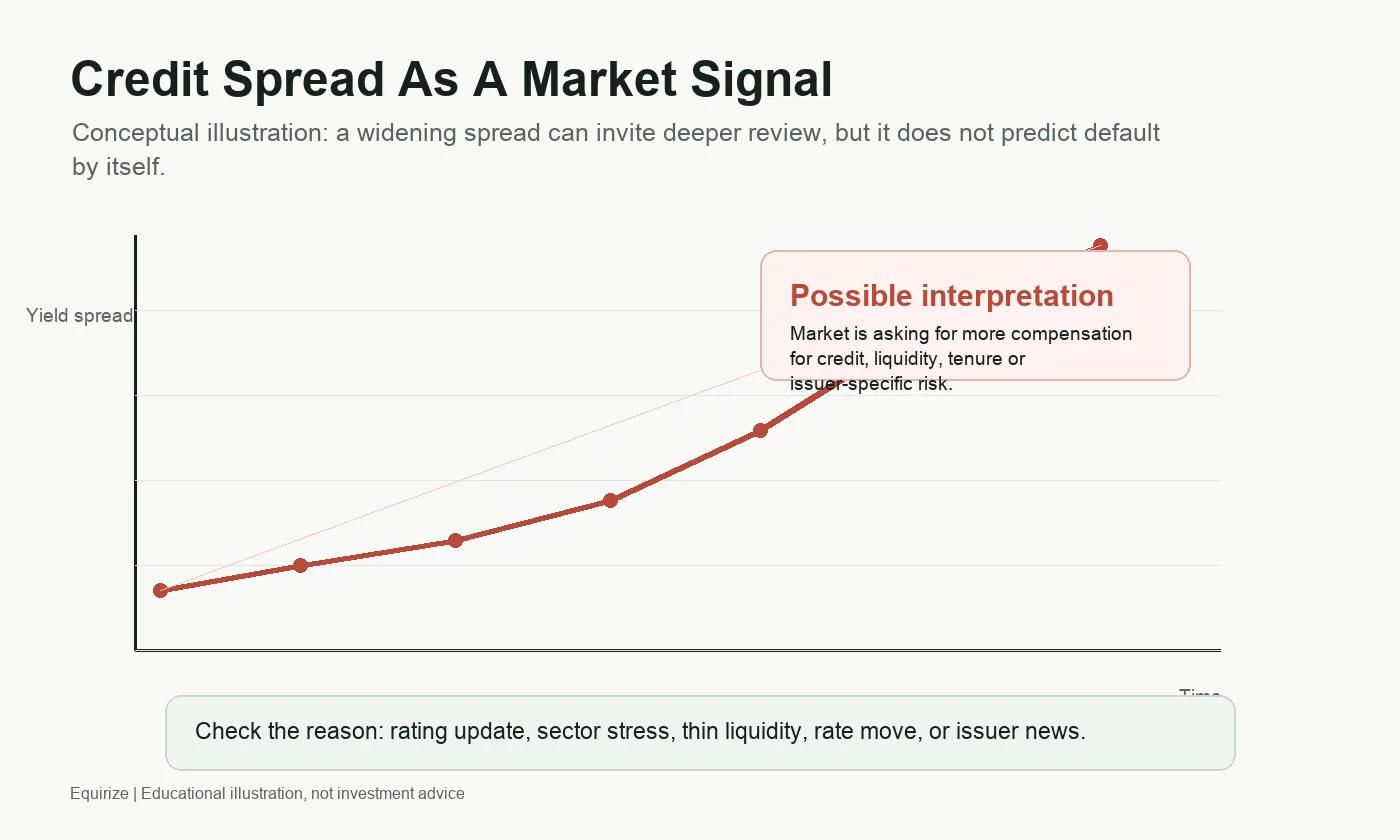
Credit spread in bonds is the extra yield a corporate bond offers over a comparable government security or lower-risk benchmark. It is one way the market expresses compensation for credit risk, liquidity risk, tenure, complexity, and issuer-specific uncertainty.
When a bond's price falls, its yield rises. If that yield rises sharply relative to comparable bonds or government securities, the widening spread may be a signal that investors are demanding more compensation. This can happen because of issuer-specific credit concern. It can also happen because the bond is illiquid, market rates have moved, or sellers need an exit.
The useful question is not "did the yield rise?" The useful question is "why did the yield rise?"
| Spread or price signal | Possible explanation | Investor review |
| Spread widens across the issuer's bonds | Issuer-level credit concern or sector repricing | Check rating updates, financials, sector news |
| One ISIN weakens sharply | Thin liquidity, seller pressure, structure-specific concern | Check trading depth, maturity, security, seniority |
| Lower-rated peers also weaken | Sector-wide stress or broader risk aversion | Compare sector conditions and funding access |
| Yield rises without visible news | Market may be pricing uncertainty before formal disclosure | Review exchange filings and rating rationale |
Interest Coverage Ratio and Cash-Flow Stress
Interest coverage ratio is a simple way to ask whether the issuer's earnings can cover its interest cost. The common form is earnings before interest and tax divided by interest expense. A stronger ratio suggests more room to service debt. A weaker ratio suggests that a decline in earnings or rise in borrowing cost can make coupon servicing harder.
For lenders and NBFC issuers, the analysis may look different from a manufacturing company. Investors may need to review net interest margins, asset quality, collection efficiency, liquidity buffers, capital adequacy, and funding access. The principle is the same: is the issuer generating enough cash and maintaining enough liquidity to meet obligations on time?
Warning signs include:
- interest cost rising faster than operating income;
- weakening profitability across multiple quarters;
- negative operating cash flow without a clear explanation;
- dependence on short-term borrowing to fund longer-term assets;
- reduced access to bank lines or capital markets;
- large debt repayments due before expected cash inflows.
This is where the offer document and rating rationale complement each other. The offer document gives the investor the terms, risk factors, and security structure. The rating rationale gives a credit analyst's view of the issuer's ability and willingness to meet obligations.
Debt-To-Equity Ratio, Refinancing Risk And Rising Borrowing Cost
Debt-to-equity ratio is not a default predictor by itself. Some sectors naturally operate with higher leverage. Financial institutions, infrastructure entities, housing finance companies, and manufacturing companies do not have the same balance-sheet structure.
Still, rising leverage deserves attention when it appears with weak profitability, stretched cash flow, short maturity debt, or refinancing dependence. Refinancing risk matters because a bond issuer may be able to meet obligations only if it can raise new debt, roll over existing debt, sell assets, or receive group support at the right time.
Bond default risk rises when an issuer's debt maturity profile and cash inflows no longer match comfortably.
Useful checks:
- How much debt matures in the next 12 months?
- Does the issuer have committed bank lines or liquid investments?
- Are borrowings secured against already-pledged assets?
- Is the issuer repeatedly refinancing rather than reducing debt?
- Has borrowing cost increased materially?
- Are lenders, banks, or markets still willing to provide funding?
If an issuer needs continuous market access, a rating downgrade or sector shock can become more serious. The downgrade may raise borrowing cost. Higher borrowing cost can weaken coverage. Weaker coverage can increase concern about the next refinancing. The warning sign is the loop, not one number in isolation.
Sector Stress And Issuer-Specific Credit Risk In Bonds
Corporate bond default risk is partly issuer-specific and partly sector-linked. A good issuer can operate in a difficult sector. A weak issuer can deteriorate even when the sector is stable. Investors need to identify which risk they are seeing.
Sector stress may show up through:
- regulatory changes affecting revenue or collections;
- funding stress for a category of borrowers;
- asset-price decline in collateral-heavy sectors;
- commodity-price shocks;
- demand slowdown;
- repayment stress among end customers;
- rising delinquencies in lending portfolios.
For example, an NBFC bond investor may need to watch asset quality, collection trends, funding mix, capital adequacy, and liquidity. A real-estate-linked issuer may require attention to project cash flows, inventory sales, refinancing, pledged assets, and promoter funding. An infrastructure issuer may need assessment of project completion, receivables, regulatory approvals, and counterparty payments.
The article should not turn every sector headline into a default alarm. Many issuers absorb sector stress. The point is to know which sector indicators affect the issuer's ability to pay bondholders on time.
Delayed Results, Auditor Qualifications And Governance Signals
Some bond default warning signs are less numerical and more behavioural. Delayed financial results, repeated auditor changes, qualified audit opinions, emphasis-of-matter paragraphs, related-party complexity, promoter pledging, or unexplained resignation of key finance personnel may all deserve review.
These signals do not prove default risk by themselves. But they can reduce confidence in the clarity of information available to investors. When the investor does not have timely and reliable information, the risk of being surprised increases.
Governance-related checks include:
| Signal | Why it matters | Where to check |
| Delayed financial results | Timely information is central to credit review | Exchange filings, issuer investor-relations page |
| Auditor qualification | May point to accounting, valuation, receivable, or going-concern concerns | Annual report, audit report |
| Promoter share pledging | Can indicate holding-company stress, though context matters | Shareholding disclosures, exchange filings |
| Frequent management exits | May signal instability in finance or control functions | Corporate announcements |
| Related-party transactions | Can complicate cash-flow assessment | Annual report, notes to accounts |
Retail investors do not need to become forensic accountants. But if a bond depends on the issuer's ability to pay, investors should care about the quality and timeliness of information.
Corporate Bond Default Risk Checklist Before Buying
A practical corporate bond default risk review starts before the investor subscribes. The aim is not to eliminate risk. That is not possible. The aim is to understand the risk, price it sensibly, and avoid relying on one comforting label.
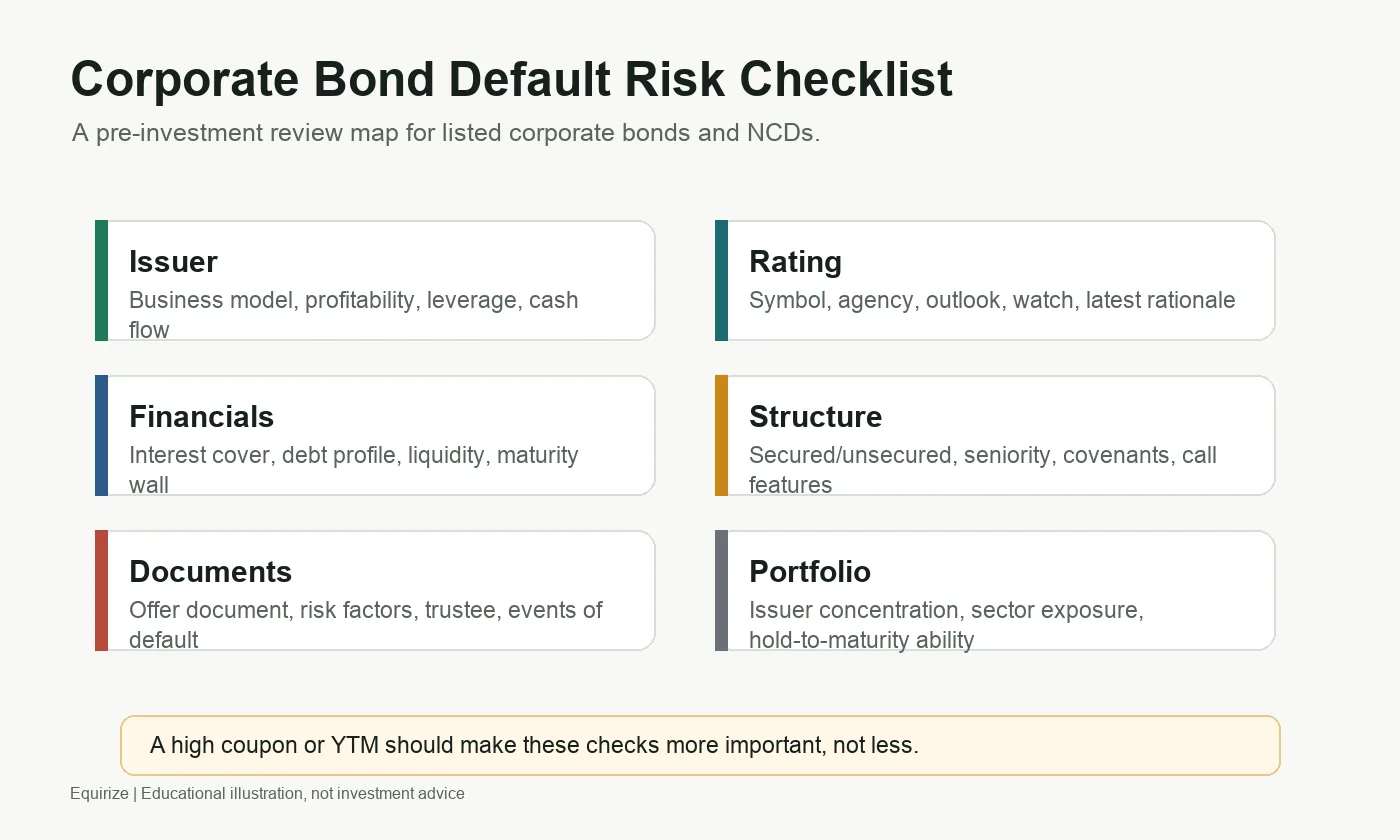
Before buying a listed corporate bond, review:
1. Issuer legal name and business model.
2. Credit rating, agency, outlook, watch status, and latest rating rationale.
3. Coupon, maturity date, payment frequency, and indicative pre-tax YTM.
4. Financial performance, leverage, interest coverage, liquidity, and debt maturity profile.
5. Whether the bond is secured, unsecured, senior, subordinated, callable, or puttable.
6. Offer document risk factors and events of default.
7. Debenture trustee name and trustee-related disclosures.
8. Secondary-market liquidity and likely ability to hold until maturity.
9. Tax treatment based on the investor's circumstances.
10. Portfolio concentration by issuer, sector, maturity, and rating.
If one of these checks is hard to complete, that is itself useful information. A bond investment should be easier to evaluate when the issuer, structure, rating, documents, pricing, and risk factors are transparent.
Offer Document And Covenant Checks For Bond Default Risk
The offer document is not a formality. It is where investors can find the terms that matter if conditions deteriorate.
Key sections to review include:
- risk factors;
- objects or use of proceeds;
- issuer financial information;
- security creation and security cover, if applicable;
- seniority and ranking;
- events of default;
- covenants;
- call or put options;
- repayment schedule;
- debenture trustee details;
- credit rating letter or rating rationale references.
Covenants are especially important. They describe promises the issuer makes during the life of the bond. These may relate to security cover, additional borrowing, asset sale, information reporting, or other restrictions. A covenant breach is not always the same as payment default, but it can be an early signal that the investor should pay attention.
Events of default matter because they define what counts as default under the bond documents. Investors should not rely only on a generic definition. The terms of the specific bond matter.
Secured Vs Unsecured Bonds Default Recovery Checks
Secured vs unsecured bonds default analysis is often misunderstood. A secured bond has specified collateral or security backing the instrument. An unsecured bond does not have a specific asset charge. But "secured" does not mean repayment certainty, and "unsecured" does not automatically mean unsuitable.
For secured bonds, review:
- what assets are pledged;
- stated security cover;
- whether the charge is first-ranking, second-ranking, exclusive, or pari passu;
- whether security has been created and perfected;
- how often security cover is tested;
- what happens if security cover falls;
- whether asset value is easy to realise in stress.
For unsecured bonds, review:
- issuer financial strength;
- seniority;
- whether the bond is subordinated;
- whether there are loss-absorption or perpetual features;
- claims that may rank ahead of bondholders;
- liquidity and market pricing.
For a deeper structural comparison, read Equirize's article on secured vs unsecured bonds and default recovery.
Debenture Trustee And Recovery Expense Fund Checks
For listed debt securities, the debenture trustee acts on behalf of debenture holders according to the transaction documents and applicable regulations. The trustee's role becomes especially important if there is a default, breach, security enforcement issue, or bondholder voting matter.
Before investing, check the name of the debenture trustee and where trustee communications can be found. After investing, keep records of statements, payment confirmations, ISIN details, offer documents, and any trustee notices.
The Recovery Expense Fund is intended to support prompt enforcement or legal proceedings by debenture trustees in case of default in listed debt securities. Investors do not need to treat it as a recovery guarantee. It is a process support mechanism, not protection against issuer credit risk.
This distinction matters. Platform regulation, exchange listing, demat holding, trusteeship, and disclosures improve process and transparency. They do not make every issuer equally creditworthy.
How To Monitor Bond Default Risk After Investing
Bond default risk monitoring should continue after purchase. The investor's job is not over once the bond enters the demat account.
Post-investment monitoring can be simple:
- confirm each coupon or principal payment when due;
- save payment records and statements;
- check rating actions and rationales;
- review quarterly or annual issuer results;
- watch sector developments relevant to the issuer;
- track maturity dates and large refinancing windows;
- monitor whether the bond is trading at a materially different yield from earlier levels;
- review concentration in the same issuer or sector.
For investors building an income schedule, missed or delayed cash flow can affect planning. Equirize's monthly income from bonds cash-flow plan explains why coupon frequency and cash-flow planning should be reviewed with risk, not separately from it.
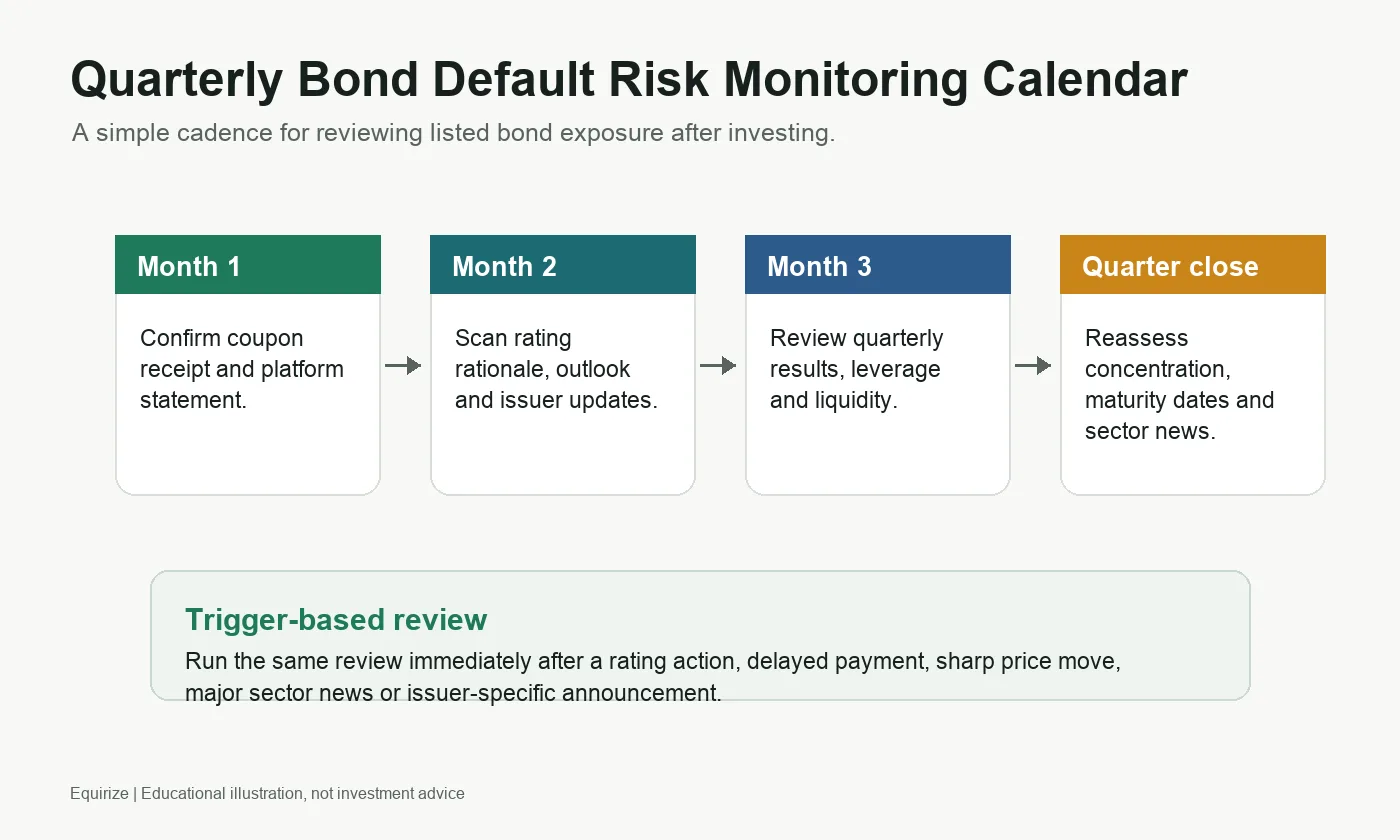
Quarterly Bond Default Risk Review Cadence
A quarterly review is usually enough for many long-term listed bond investors, unless a specific trigger appears. The review does not need to be elaborate.
Quarterly checklist:
| Review item | Question to ask |
| Payment status | Were coupon or principal payments received as scheduled? |
| Rating update | Did the rating, outlook, watch status, or rationale change? |
| Issuer results | Did leverage, profitability, liquidity, or asset quality weaken? |
| Sector context | Did sector risk change materially? |
| Market signal | Did the bond's yield or price move sharply versus comparable bonds? |
| Concentration | Is too much of the portfolio exposed to one issuer, sector, or maturity period? |
| Maturity/refinancing | Is a large repayment or refinancing event approaching? |
Trigger-based review should happen sooner. Do not wait for the quarter-end if there is a rating action, delayed payment, auditor qualification, sharp price move, trustee notice, major regulatory change, or issuer-specific announcement.
When A Warning Sign Is Not Yet A Bond Default
This distinction is important enough to repeat: a warning sign is not a default.
A downgrade is not always a payment failure. A wider spread is not always a default signal. A sector headline does not affect every issuer equally. A covenant breach may be cured. A delayed result may have an explanation. A secured bond may still recover poorly, while an unsecured bond from a stronger issuer may continue paying on schedule.
The right response to a warning sign is review, not panic. Investors should check primary documents, rating rationales, issuer filings, trustee communications, and their own liquidity needs. If the decision has portfolio-level consequences, it may be appropriate to consult a SEBI-registered investment advisor.
What Happens After Bond Default In India
If a bond issuer fails to pay interest or principal on time, the next steps depend on the bond documents, applicable regulations, trustee action, investor approvals, and the issuer's financial situation.
In broad terms, the sequence may involve:
1. Missed or delayed payment.
2. Verification against the payment schedule and any cure period.
3. Issuer communication and exchange/trustee disclosure.
4. Debenture trustee engagement with issuer and bondholders.
5. Bondholder meetings or voting where required.
6. Enforcement of security, restructuring discussions, insolvency proceedings, or other recovery steps depending on the case.
Recovery is uncertain. It can depend on whether the bond is secured or unsecured, where it ranks in the repayment order, what assets are available, whether the security is enforceable, how long proceedings take, what costs are incurred, and whether the issuer remains a going concern.
Investors should be careful with two extremes. The first is assuming that default always means total loss. The second is assuming that security or trusteeship ensures full and timely recovery. Both are too simplistic.
In a default or stress situation, documentation becomes central. Investors should keep:
- ISIN and bond details;
- demat statements;
- purchase and payment records;
- offer document;
- rating rationale and rating action records;
- trustee notices;
- issuer communications;
- tax records connected to interest and capital gains or losses.
This article is educational and does not provide legal advice. Where a default has occurred, investors should follow official trustee communications and consult qualified professionals where needed.