Secured vs Unsecured Bonds: Risks, Yields & Default Recovery


Secured vs unsecured bonds is one of the first comparisons investors meet while evaluating listed corporate bonds or non-convertible debentures (NCDs). The label looks simple. A secured bond has specified security backing it. An unsecured bond does not have a specific asset charge backing it.
But the practical meaning is more nuanced.
Secured does not mean guaranteed. Unsecured does not mean automatically unsuitable. The better question is: what claim does the investor have, where does that claim rank, what assets or cash flows support it, and how realistic is recovery if the issuer faces stress?
This guide explains secured bonds meaning, unsecured bonds meaning, the key differences between the two, and the checks investors should make before relying on either label.
For Indian investors, the secured bonds vs unsecured bonds India comparison is most useful when it is tied to documents rather than assumptions. The label should point you toward the offer document, rating rationale, security cover, seniority clause, trustee disclosures and liquidity checks.
Secured Bonds Meaning In India
A secured bond is a debt security backed by a charge on specified assets, receivables, cash flows, or other collateral of the issuer. The details should be described in the offer document, key information document, debenture trust deed, or other issue documents.
In India, listed debt securities are issued within a SEBI-regulated framework. SEBI's rules and circulars require documentation around issue terms, debenture trustees, and security creation where applicable. For secured debt securities, the security structure is not just a marketing label. It should be traceable to documents that describe what is secured, how the security is created, who monitors it, and what happens if the issuer breaches the terms.
A secured bond may therefore give bondholders a defined claim over identified assets if the issuer defaults. That claim can improve the investor's position compared with unsecured creditors, but it does not remove credit risk, interest-rate risk, liquidity risk, or recovery uncertainty.
Investors should treat the secured label as the start of diligence, not the end of it.
In a secured bonds vs unsecured bonds comparison, this is the first distinction: secured bonds add an asset-backed claim layer, while unsecured bonds place more weight on the issuer's overall ability and obligation to pay.
Collateral In Bonds And The Role Of Pledged Assets
Collateral in bonds can take several forms. It may include property, plant and machinery, receivables, loan pools, cash flows, financial assets, or other eligible assets stated in the issue documents. Some collateral is easier to value and enforce. Some may be illiquid, already pledged, subject to depreciation, or dependent on future cash collections.
This matters because collateral is useful only to the extent it has value, can be enforced, and ranks correctly against other claims. A charge over weak, hard-to-liquidate, or already encumbered assets may offer less practical comfort than the word secured suggests.
The investor should ask:
- What asset or cash flow has been pledged?
- Is the charge first-ranking, second-ranking, or pari passu with other lenders?
- How frequently is the asset value tested?
- Who monitors the security?
- What happens if the required security cover falls?
Bond Security Cover And Charge Ranking
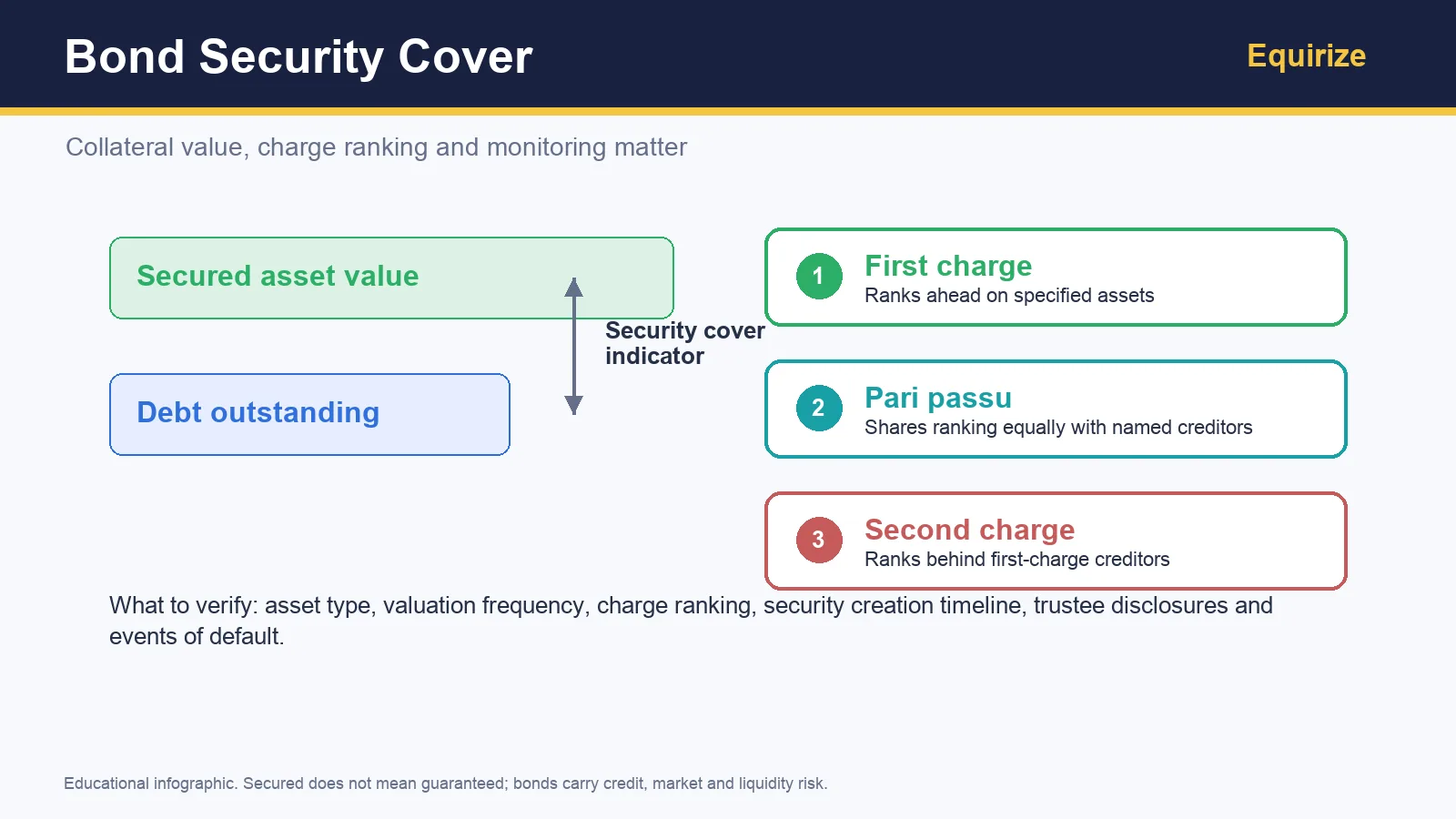
Bond security cover is the relationship between the value of secured assets and the outstanding debt they support. For example, if an issue requires security cover above the debt outstanding, the issuer may need to maintain assets of sufficient value throughout the life of the bond.
The number is useful, but it is not a promise. Asset values can change. Receivables can deteriorate. Collateral may be shared with other lenders. Enforcement can take time. Recovery can also depend on insolvency proceedings, trustee action, documentation quality, and the ranking of claims.
Charge ranking is just as important as cover. A first charge usually means the claim ranks ahead of later charges on the same asset. A pari passu charge means the claim ranks equally with other specified creditors. A second charge sits behind the first charge and may recover only after the first-ranking creditor is addressed.
This is why two secured bonds can have very different risk profiles even if both use the same label.
Unsecured Bonds Meaning In India
An unsecured bond is a debt security that does not have a specific asset charge backing the instrument. The investor relies primarily on the issuer's general obligation to pay interest and repay principal according to the bond terms.
That does not mean unsecured bondholders have no claim. They are still creditors of the issuer. It means they do not have a specific pool of pledged assets set aside for their bond. Their recovery position depends on the issuer's financial strength, seniority of the instrument, legal terms, and the claims that rank ahead of them.
Unsecured bonds are common in many markets. Strong issuers may raise unsecured debt because investors are comfortable with their balance sheet, business model, cash flows, regulatory position, or credit profile. At the same time, unsecured instruments from weaker issuers can carry materially higher credit risk.
So the right question is not "secured or unsecured?" in isolation. The right question is: secured or unsecured, from which issuer, at what rating, with what maturity, in what seniority position, at what yield, and with what liquidity?
This is why the difference between secured and unsecured bonds cannot be reduced to one word. A high-quality unsecured issuer and a weak secured issuer may present very different risk questions.
Issuer Creditworthiness In Unsecured Bonds
Issuer creditworthiness becomes central in unsecured bonds. Investors should review the credit rating, rating agency, latest rating rationale, outlook, issuer financials, leverage, liquidity position, sector risk, repayment schedule, and any rating sensitivities.
The coupon or indicative yield does not answer these questions. A higher yield may simply be compensation for higher credit risk, lower liquidity, longer maturity, subordination, or weaker demand. NSE and BSE have also cautioned investors that YTM is not guaranteed and that payments depend on the issuer's financial health and credit reliability.
Senior Unsecured Bonds And Subordinated Debt
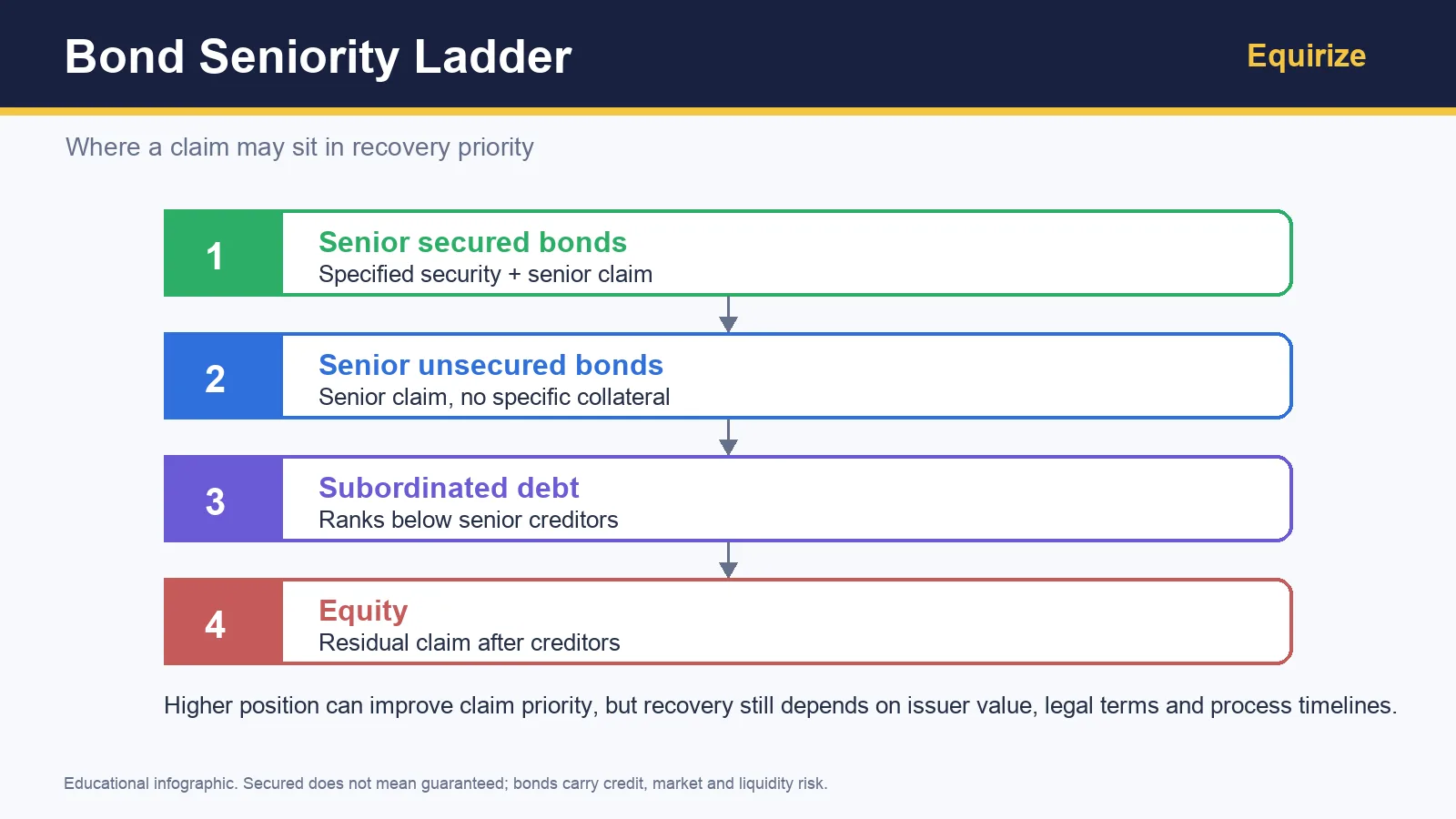
Not all unsecured bonds rank equally. A senior unsecured bond may rank alongside other senior creditors of the issuer. A subordinated unsecured bond sits below senior debt and may absorb stress earlier in a default or resolution scenario.
This distinction is especially important in financial-sector bonds, bank bonds, perpetual bonds, and capital instruments, where subordination and loss-absorption features can materially change the investor's position.
When reading an unsecured bond, check whether it is senior, subordinated, perpetual, callable, or subject to any special loss-absorption terms.
Secured Bonds vs Unsecured Bonds India: Comparison Table
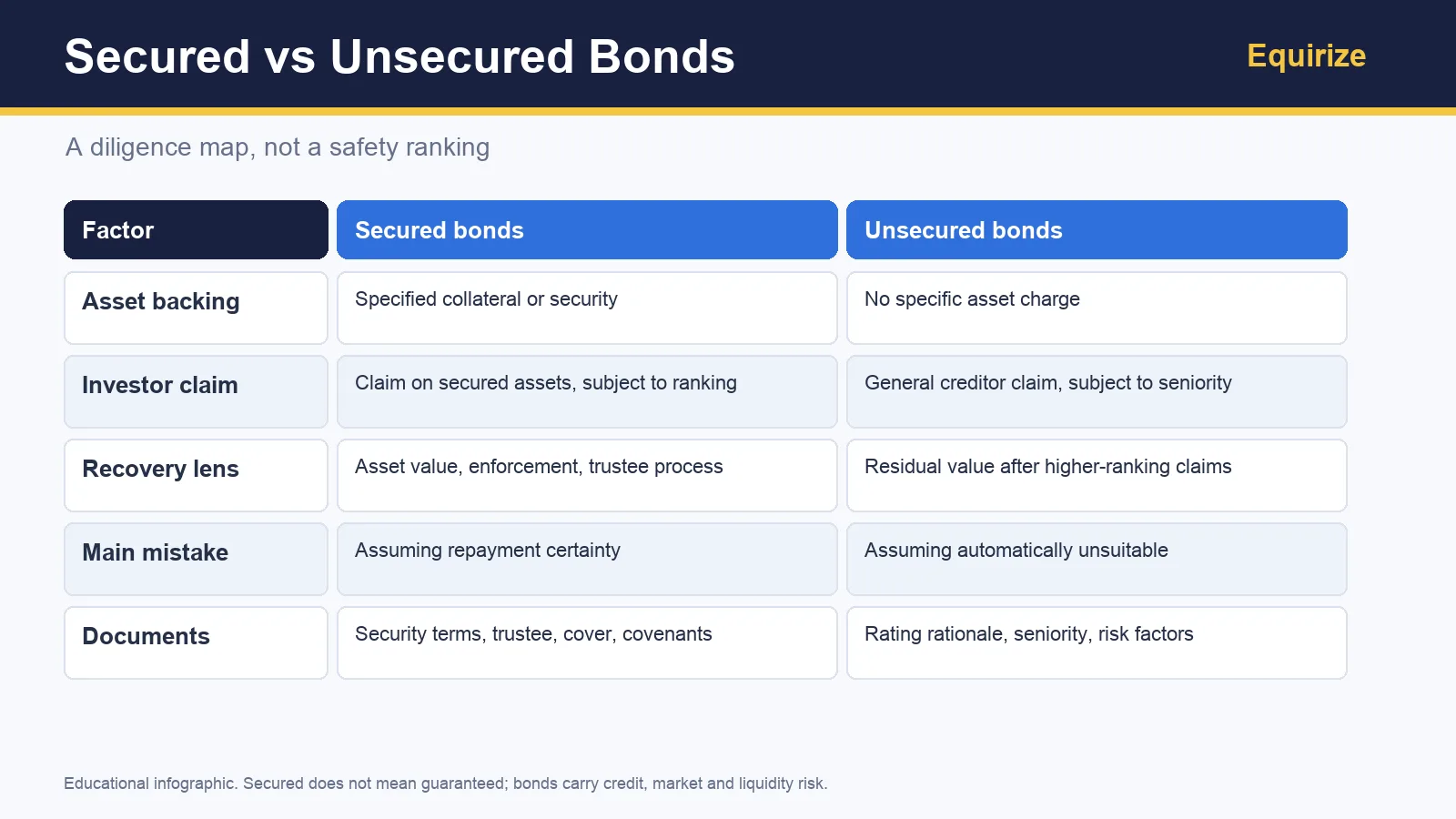
The table below summarizes the core differences. It is intentionally not a safety ranking. It is a diligence map.
Use this secured and unsecured bonds comparison after matching issuer, rating, maturity and liquidity. Otherwise, the table can make two very different bonds look more comparable than they really are.
| Factor | Secured bonds | Unsecured bonds |
| Asset backing | Backed by specified collateral or security | No specific collateral backing the bond |
| Main investor claim | Claim over secured assets, subject to terms and ranking | General creditor claim, subject to seniority |
| What to verify | Asset type, security cover, charge ranking, trustee, covenants | Issuer strength, seniority, rating rationale, liquidity |
| Default recovery lens | Recovery may depend on asset value, enforcement, ranking and timelines | Recovery depends on residual value after higher-ranking claims |
| Yield lens | May offer lower yield than comparable unsecured debt from the same issuer | May offer higher yield to compensate for additional risk |
| Main mistake | Assuming secured means repayment certainty | Assuming unsecured means automatically unsuitable |
| Documents to read | Offer document, debenture trust deed, security documents, rating rationale | Offer document, rating rationale, terms of seniority and risk factors |
Secured NCD vs Unsecured NCD: What Changes in the Offer Document
A secured NCD and an unsecured NCD can look similar on the surface. Both may show an issuer name, coupon rate, maturity date, credit rating, face value, payment frequency, and indicative yield. The difference usually appears deeper in the offer document and related transaction documents.
That is why secured NCD vs unsecured NCD analysis should begin with the issue documents, not the product card alone.
For a secured NCD, look for:
- description of the secured assets;
- type of charge and ranking;
- minimum security cover requirement;
- debenture trustee details;
- timelines for security creation;
- valuation and monitoring mechanism;
- covenants linked to security maintenance;
- events of default and enforcement rights.
For an unsecured NCD, look for:
- seniority and subordination terms;
- issuer financials and repayment profile;
- rating rationale and rating sensitivities;
- liquidity and secondary-market trading pattern;
- call, put, or early redemption features;
- risk factors specific to the issuer and sector.
The offer document is where broad labels become concrete investor rights. If the security terms are difficult to understand, that is a reason to slow down and seek qualified advice.
Debenture Trustee In Bonds And Security Monitoring
A debenture trustee acts for debenture holders according to the trust deed and applicable regulations. In secured issues, the trustee's role can include due diligence around security creation, monitoring of security cover, review of issuer submissions, and action when terms are breached.
This role is important, but it should not be confused with repayment assurance. The trustee does not make a weak issuer strong. The trustee does not guarantee market liquidity. The trustee also does not eliminate the possibility that asset values decline or recovery takes time.
Investors should check the name of the debenture trustee, the security creation status, and the trustee-related disclosures in the issue documents.
Bond Offer Document Checks For Security Terms
Before relying on the word secured, read the offer document for these specific terms:
- What is the nature of security?
- What is the stated security cover?
- Is the charge first-ranking, second-ranking, exclusive, or pari passu?
- What assets are excluded?
- How often is security cover tested?
- What is the timeline for security creation?
- What happens if security is not created on time?
- What are the events of default?
- What is the debenture trustee empowered to do?
For unsecured bonds, the equivalent checklist is different:
- What is the issuer's rating and outlook?
- Is the instrument senior or subordinated?
- Are there call or loss-absorption features?
- What claims rank ahead of this instrument?
- How liquid is the ISIN in the secondary market?
- Does the yield compensate for the visible risk?
Bond Recovery In Default: Why Collateral Is Not A Guarantee
Bond recovery in default is the process through which investors may recover part or all of their dues if the issuer fails to meet obligations. For secured bonds, recovery may involve the debenture trustee acting on behalf of bondholders, enforcing security, or participating in a legal or resolution process.
For unsecured bonds, recovery usually depends on the issuer's remaining value after higher-ranking or specifically secured claims are considered.
But recovery is not automatic.
Several things can affect recovery:
- the market value of the pledged assets at the time of default;
- whether the charge was perfected and enforceable;
- whether other lenders have equal or superior claims;
- the liquidity of the collateral;
- insolvency or litigation timelines;
- costs involved in enforcement;
- whether the issuer's business still has going-concern value.
This is why "secured" is better understood as a defined legal claim, not a guaranteed outcome. It can improve the investor's position in a stress scenario, but it cannot make the issuer's credit risk disappear.
Senior Secured Bonds And Recovery Priority
Senior secured bonds usually sit higher in the repayment order than subordinated or unsecured instruments, subject to the actual transaction documents. That seniority can matter in default because creditors do not all stand in the same line.
However, seniority and security must be read together. A senior unsecured bond and a senior secured bond are not the same. A senior secured bond with a first charge is not the same as a secured bond with a second charge. A pari passu secured bond shares the claim with other pari passu creditors.
The practical question is always: who ranks ahead, who ranks equal, and what assets are available?
Credit Risk In Bonds Beyond The Secured Label
Credit risk in bonds remains present whether the bond is secured or unsecured. The issuer may face cash-flow stress, refinancing difficulty, sector pressure, governance issues, asset-quality deterioration, or rating downgrade.
Security can affect recovery. It does not prevent default.
Investors should therefore read the secured or unsecured label alongside:
- credit rating and rating rationale;
- issuer leverage and liquidity;
- maturity and repayment schedule;
- coupon and indicative pre-tax YTM;
- security cover and seniority;
- covenants and call features;
- secondary-market liquidity;
- tax treatment;
- concentration in the investor's portfolio.
How To Choose Between Secured And Unsecured Bonds
Choosing between secured and unsecured bonds is not about treating one category as always preferable. It is about matching the instrument to the investor's risk capacity, time horizon, income need, and ability to understand the terms.
In practice, how to choose between secured and unsecured bonds comes down to a sequence: issuer first, structure second, yield third. Reversing that order can make the higher-yielding option look more attractive than its risk profile supports.
A secured bond may be more appealing when the collateral is clearly described, security cover is adequate, the charge ranking is strong, the trustee role is clear, and the issuer's credit profile is acceptable.
An unsecured bond may still be worth evaluating when the issuer is financially strong, the instrument is senior, the maturity is suitable, the rating rationale is stable, and the yield is reasonable for the risk. Conversely, a secured bond from a weak issuer with poor collateral quality may still be unsuitable for many investors.
The practical framework is:
1. Start with issuer quality.
2. Read the rating rationale, not only the rating symbol.
3. Check maturity and cash-flow timing.
4. Compare yield only after matching risk, tenure, liquidity, and structure.
5. Read security and seniority terms.
6. Check whether the ISIN has actual exit liquidity.
7. Avoid concentration in one issuer, sector, or structure.
The final choice between secured and unsecured bonds should therefore be made after checking both the legal claim and the business reality behind that claim.
Bond Rating Rationale, Maturity And Liquidity Checks
The rating rationale often explains why the issuer has its rating. It may discuss leverage, profitability, liquidity, asset quality, sector risk, refinancing risk, and rating sensitivities. This context is more useful than the rating badge alone.
Maturity matters because credit risk and interest-rate risk can change over time. Liquidity matters because a listed bond is not necessarily easy to sell before maturity at the price the investor expects.
Before subscribing, ask whether you can hold the bond until maturity if secondary-market liquidity is thin.
Bond Seniority And Covenant Checklist
Seniority tells you where the bond sits in the repayment order. Covenants tell you what the issuer has promised to maintain. Together, they shape the investor's position in stress.
Useful checks include:
- Is the bond senior, subordinated, or perpetual?
- Is it secured, unsecured, or partly secured?
- Are there financial covenants?
- What events trigger default?
- What happens if security cover falls?
- Can the issuer call the bond early?
- Are there any structural features that change expected cash flows?
Equirize Checklist For Secured And Unsecured Bonds
For investors comparing secured and unsecured bonds, the label should lead to better questions:
- What is the issuer's credit profile?
- What does the rating rationale say?
- Is the bond secured or unsecured?
- If secured, what assets support the claim?
- If unsecured, where does the instrument rank?
- What is the maturity and cash-flow schedule?
- What is the indicative pre-tax YTM, and what assumptions does it make?
- Can the bond be sold before maturity, and at what likely liquidity cost?
- What does the offer document say about risks?
Equirize is a SEBI-registered Online Bond Platform Provider (OBPP) and stock broker in the debt segment of BSE and NSE. Equirize facilitates access to listed corporate bonds and other eligible listed debt securities. It does not provide investment advice.
The goal is not to choose a bond because it carries a comforting label. The goal is to understand the claim, the issuer, the price, the risk, and the documents before investing.