Housing Finance Company Bonds: What Investors Should Check



Why HFC Bonds Need a Different Checklist
Housing finance company bonds can look simple at first glance: an issuer, a coupon, a maturity date, a credit rating and a price. But investors should not evaluate them only by comparing the coupon or the indicative yield.
An HFC bond is a debt instrument issued by a housing finance company. The investor is lending to the issuer, and the issuer's ability to pay interest and principal depends on its loan book, asset quality, capital position, borrowing profile and liquidity. That makes HFC bonds different from a generic corporate bond issued by a manufacturing company or a utility.
The useful question is not "Which HFC bond shows the larger headline yield?" It is: "What does the yield compensate me for, and have I checked the right documents before investing?"
Investors can use a SEBI-registered Online Bond Platform Provider such as Equirize's listed bonds platform to explore listed bonds, review key terms and access relevant documents. Equirize facilitates access to listed bonds and does not provide investment advice.
What Are Housing Finance Company Bonds?
Housing finance company bonds are debt securities issued by housing finance companies to raise money. The issuer may use the funds for onward lending, refinancing existing borrowings, meeting business requirements or other purposes stated in the offer document.
The Reserve Bank of India defines a Housing Finance Company as an NBFC whose financial assets in housing finance constitute at least 60% of total assets, with not less than 50% of total assets by way of housing finance for individuals, subject to the relevant RBI directions. This definition matters because it tells investors that an HFC is not merely a company with some housing exposure; housing finance is central to its business model. Source: RBI NBFC FAQs.
In practice, HFC bonds may be issued as non-convertible debentures, often called NCDs. They may be secured or unsecured, listed or unlisted, privately placed or publicly issued. For retail investors using an Online Bond Platform Provider, the relevant universe is typically listed or proposed-to-be-listed debt securities that can be held in demat form.
How HFC Bonds Work in India
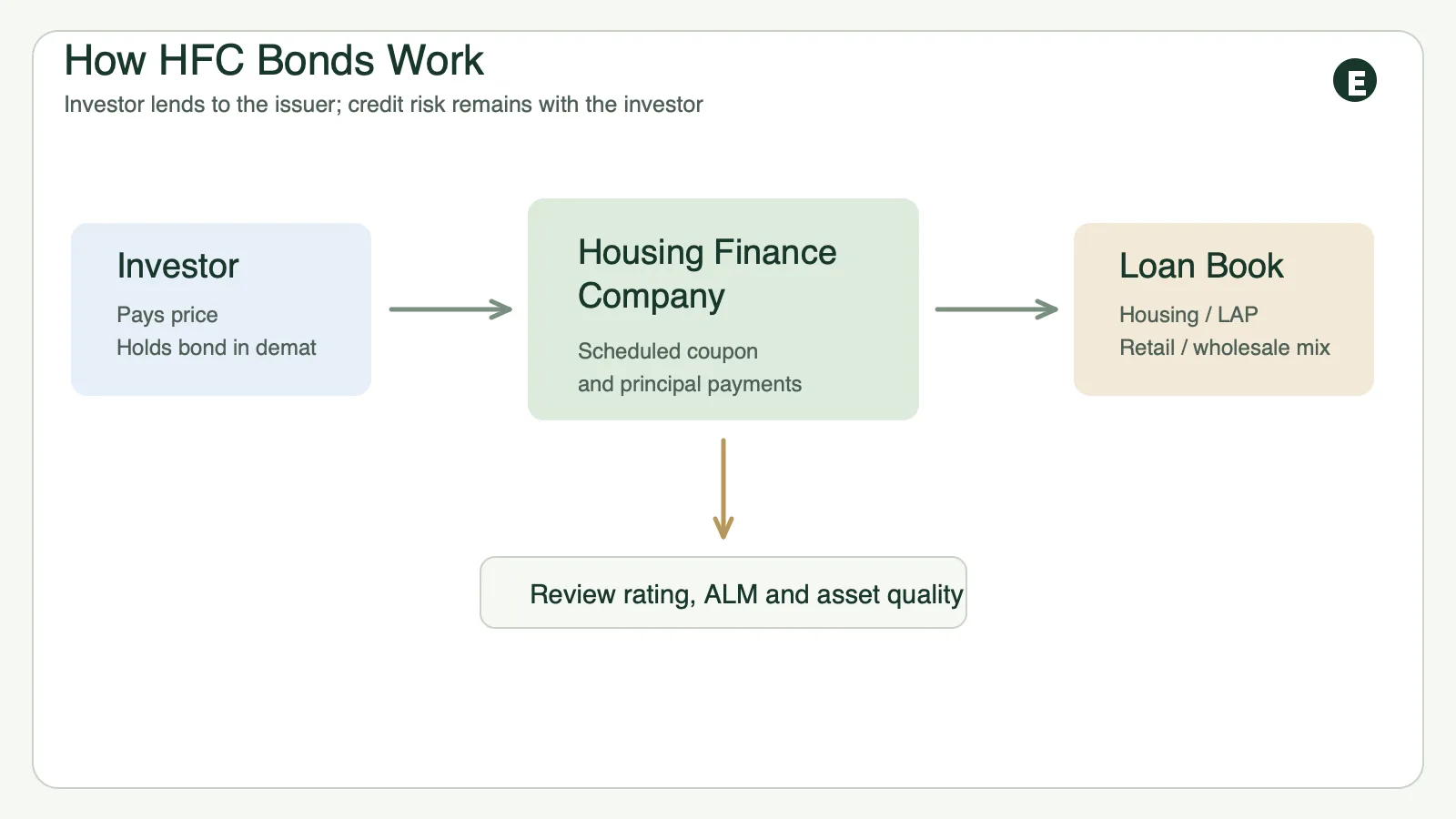
When an investor buys an HFC bond, the basic cash-flow arrangement is straightforward:
- The investor pays the issue price or market price.
- The housing finance company receives debt capital.
- The issuer pays coupon interest on the scheduled dates, subject to its ability to meet obligations.
- The issuer repays principal on maturity, unless the instrument has a different redemption structure.
The coupon is not the same as the investor's return. If the bond is bought above or below face value, the yield to maturity may differ from the coupon. If the investor exits before maturity, the sale price may be affected by interest rates, credit perception, available buyers and market liquidity.
Under SEBI's OBPP framework, online bond platforms operate within a defined regulatory perimeter for eligible listed or proposed-to-be-listed debt securities. SEBI's registration framework for Online Bond Platform Providers was issued through its November 14, 2022 circular. Source: SEBI OBPP circular.
What to Check Before Investing in Housing Finance Company Bonds
Check the Credit Rating and Rating Rationale
The rating symbol is only the starting point. Investors should also read the rating rationale, outlook and recent rating history. A bond rated AA with a stable outlook is not the same as a bond whose rating has recently been downgraded, placed under watch, or assigned a negative outlook.
For HFC bonds, the rating rationale often gives useful clues on asset quality, capital adequacy, liquidity, funding access, promoter support and business concentration. If the rationale repeatedly refers to refinancing pressure, concentrated wholesale exposure or rising delinquencies, that should lead to deeper review before any investment decision.
 Review the Loan Book Mix
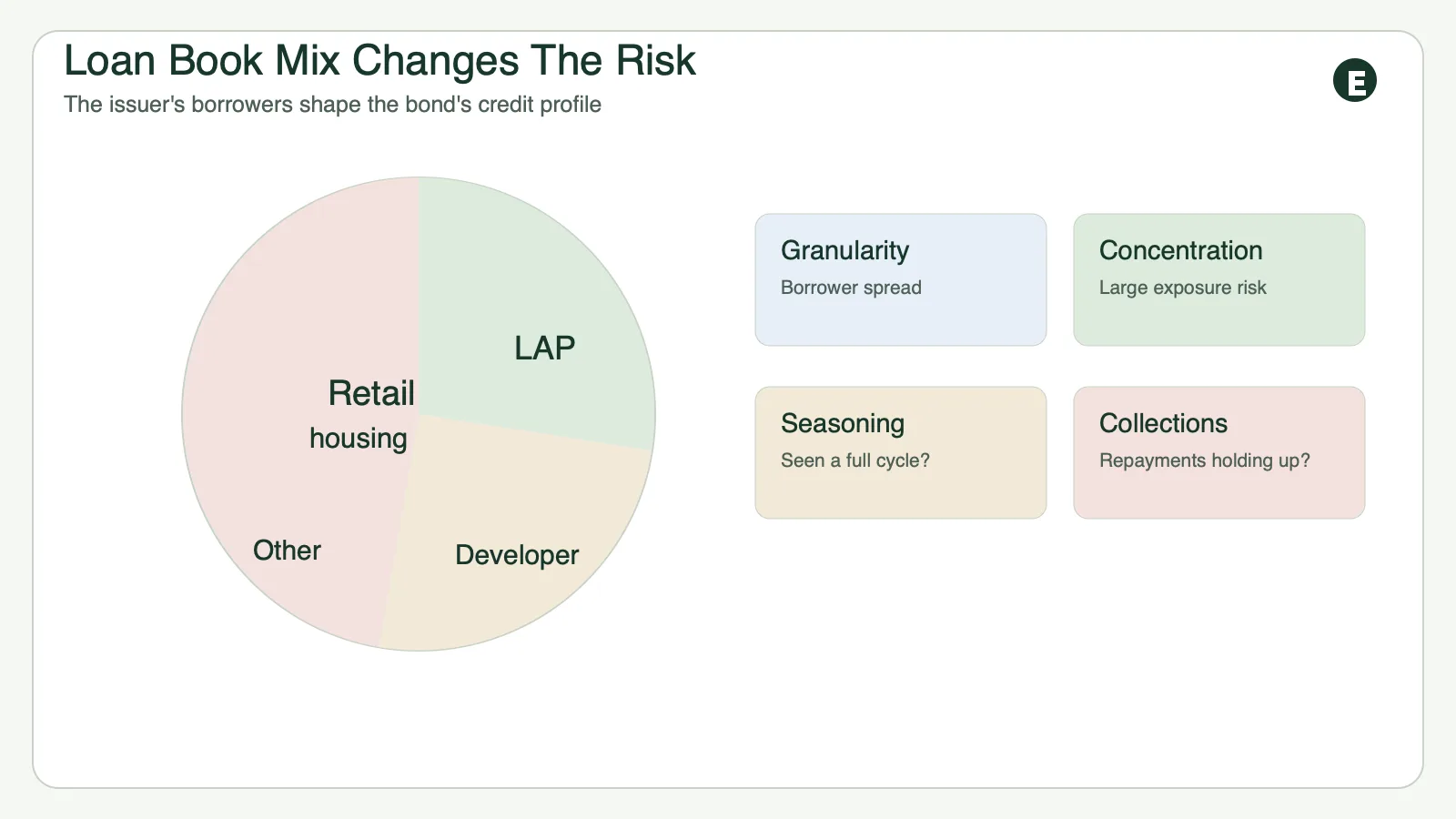
Not all housing finance companies lend to the same borrower profile. Some focus on salaried home-loan borrowers. Some serve self-employed borrowers, affordable housing customers, loan-against-property borrowers or real estate developers. Some have a retail-heavy loan book, while others may carry meaningful wholesale or developer exposure.
This mix matters because different borrower segments can behave differently through economic cycles. A granular retail housing-loan book may have a different risk profile from a concentrated developer-finance book. Investors should check the issuer's annual report, investor presentation, rating rationale and offer document for the split between housing loans, loan against property, developer finance, construction finance and other non-housing exposures.
Look at Asset Quality: GNPA, Stage 3 Assets and Collections
For an HFC, asset quality is central to bond risk. Investors should review gross non-performing assets, net non-performing assets, Stage 3 assets, restructured assets, write-offs, provisioning and collection efficiency where disclosed.
A rising GNPA ratio does not automatically mean default is imminent, but it can indicate stress in the loan book. The trend is often more useful than a single number. A company with improving collections and conservative provisioning may be in a different position from one showing rapid growth alongside weakening asset quality.
CareEdge's HFC rating methodology identifies asset quality as one of the critical parameters for assessing housing finance companies, along with business mix, capital and leverage, profitability, liquidity, resource profile, management systems, size, vintage and market presence. Source: CareEdge Rating Methodology - Housing Finance Companies, March 2025.
Check Capital Adequacy and Leverage
Capital is the cushion available to absorb unexpected losses. HFC investors should look at capital adequacy ratio, net worth, leverage and management's stated capital policy.
Higher leverage can amplify returns for the issuer in good periods, but it can also reduce flexibility during stress. For an investor, the question is not simply whether the issuer is growing. It is whether growth is supported by adequate capital, prudent underwriting and access to stable funding.
Understand Liquidity, ALM and Funding Mix
Housing loans are usually long-tenure assets. HFCs fund these assets using a mix of bank loans, bonds, securitisation, deposits where permitted, commercial paper and other borrowings. If short-term borrowings are used heavily against long-tenure assets, the issuer may face refinancing risk.
This is why asset-liability management matters. Investors should check whether the rating rationale discusses ALM mismatches, short-term repayment obligations, unutilised bank lines, liquid assets and refinancing access. A listed bond may have a fixed maturity date for the investor, but the issuer's ability to meet that maturity depends partly on its liquidity profile.
Read the Security Cover and Seniority Terms
Some HFC bonds are secured. Some are unsecured. Some may be senior instruments, while others may be subordinated. The words matter.
A secured bond may have a charge over specified assets, but security does not eliminate credit risk. If an issuer defaults, recovery can depend on asset quality, legal process, security cover, seniority, documentation and enforcement timelines. Investors should read the offer document and debenture trustee information to understand what backs the instrument, if anything.
Compare Coupon, YTM and Price Together
Investors often notice the coupon first. But the more relevant comparison is usually indicative pre-tax yield to maturity, viewed alongside credit rating, maturity, price, security and liquidity.
A higher yield is not automatically attractive. It may reflect lower credit rating, longer maturity, lower liquidity, recent downgrade risk, sector stress, or a bond trading at a discount. The yield should prompt the next question: what risk is the market pricing?
Check Exit Liquidity Before Maturity
Listed bonds can be sold before maturity, but that does not mean every bond has deep liquidity. The ability to exit depends on market demand, trade volumes, bid-ask spread, remaining tenure, rating, issue size and prevailing interest rates.
Before investing, ask whether you can hold the bond until maturity. If you may need the money earlier, review the bond's liquidity more carefully. A bond that looks suitable on yield may be unsuitable for an investor who needs quick access to funds.
Understand HFC Bonds Taxation in India
Interest from most taxable corporate bonds is generally taxed as income according to the investor's applicable tax slab. Capital gains treatment can depend on the instrument, holding period and prevailing tax rules.
Tax treatment depends on individual circumstances and may change. Please consult a qualified tax advisor.
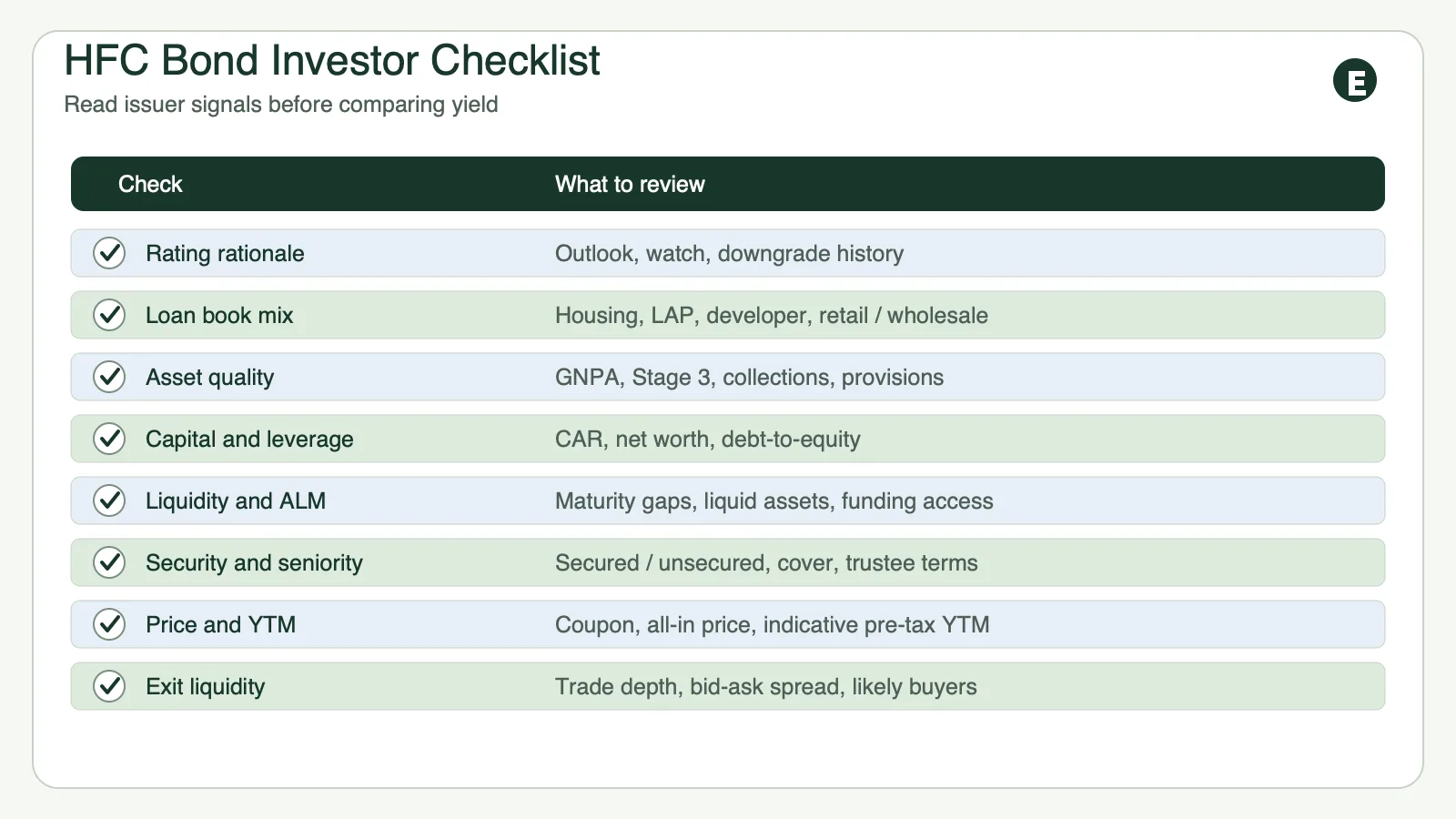
HFC Bond Investor Checklist
| Investor Check | Where to find it | Why it matters |
| Credit rating and outlook | Rating rationale, issue page, offer document | Indicates the rating agency's view on repayment ability |
| Rating history | Rating agency website | Shows upgrades, downgrades or watch actions |
| Loan book mix | Annual report, investor presentation, rating rationale | Helps assess retail, wholesale, LAP and developer exposure |
| GNPA/Stage 3 assets | Financial statements, rating rationale | Signals loan-book stress and credit costs |
| Capital adequacy | Financial statements, rating rationale | Shows loss-absorption cushion |
| ALM and liquidity | Rating rationale, offer document | Highlights refinancing and repayment pressure |
| Security cover | Offer document, debenture trustee disclosures | Explains whether the bond is secured and how |
| Coupon and YTM | Issue page, term sheet, platform display | Helps compare economics after price |
| Exit liquidity | Exchange data, platform quote, trade history | Shows whether early sale may be practical |
| Tax treatment | Tax notes, advisor review | Determines post-tax outcome |
HFC Bonds vs Fixed Deposits: Avoid a Simple Rate Comparison
HFC bonds and fixed deposits are both used by investors seeking debt-oriented allocations, but they are not the same product.
Bank fixed deposits up to the applicable limit are covered by DICGC insurance, while corporate bonds are securities exposed to issuer credit risk and market risk. Corporate or NBFC fixed deposits are different again and should not be treated as bank deposits. Corporate bonds may be listed and held in demat form, but their price can move before maturity.
The right comparison is not just coupon versus FD rate. Investors should compare:
| Factor | HFC Bonds | Fixed Deposits |
| Issuer risk | Depends on HFC credit profit | Depends on bank, NBFC or corporate issuer |
| Market price movement | Relevant if sold before maturity | Usually not market-traded |
| Liquidity | Depends on market depth and buyers | Premature withdrawal terms vary |
| Documentation | Offer document, rating rationale, term sheet | FD terms, issuer disclosure, insurance status where applicable |
| Taxation | Interest generally taxable as per slab, capital gains may apply | Interest generally taxable as per slab |
Investors comparing fixed-income choices can review Equirize's fixed deposits page and fixed income investments guide to understand how different instruments fit different needs.
Where to Find Information Before You Invest
An investor does not need to become a credit analyst, but should know where the important information sits.
Start with the offer document or information memorandum. This is where you will find the instrument terms, use of proceeds, risk factors, security details, redemption schedule and issuer disclosures. Then read the latest rating rationale from the rating agency. It often explains the strengths, constraints and monitorable factors behind the rating.
Next, review issuer financials. For HFCs, pay attention to asset quality, capital, leverage, borrowing mix, liquidity and profit trends. If available, check recent investor presentations for loan-book segmentation and collection updates.
Finally, review the bond-specific terms: ISIN, coupon, maturity, payment frequency, call or put features if any, seniority, listing status and liquidity. On an OBPP, these details should be used as inputs for decision-making, not as a recommendation.
Equirize is a SEBI-registered Online Bond Platform Provider (OBPP). Investors can use Equirize to explore listed bonds, compare key terms and review available documents. Equirize does not provide investment advice.
Red Flags Investors Should Not Ignore in HFC Bonds
Some signals deserve extra caution:
| Red flag | What it may indicate | What to verify |
| Recent downgrade or negative outlook | Rating agency sees higher risk | Latest rating rationale and stated triggers |
| Rising GNPA or Stage 3 assets | Loan-book stress may be increasing | Segment-wise asset quality and provisioning |
| High developer or wholesale exposure | Concentration and cyclical risk | Top exposures and project-level disclosures |
| Rapid loan-book growth | Portfolio may be less seasoned | Vintage, collections and underwriting standards |
| Heavy short-term borrowing | Refinancing risk | ALM profile and liquidity cover |
| Unusually high yield versus similarly rated peers | Market may be pricing additional risk | Rating, liquidity, maturity, security and news flow |
| Weak or unclear security terms | Recovery may be uncertain in stress | Offer document and debenture trustee disclosures |
None of these signals automatically means an investor should reject the bond. They mean the investor should pause, read more and understand the risk being taken.
Who May Consider HFC Bonds And Who Should Be Cautious?
HFC bonds may be considered by investors who understand credit risk, can read basic bond documents, are comfortable holding securities in demat form and can hold the bond until maturity if market liquidity is limited. They may be used as one part of a diversified fixed-income allocation across issuers, ratings and maturities.
Investors should be cautious if they need immediate liquidity, are relying only on the headline coupon, are unable to assess issuer risk, or are uncomfortable with the possibility of price movement before maturity.
For income-focused investors, especially retirees, the key is not simply scheduled coupon frequency. It is whether the bond fits the investor's cash-flow needs, liquidity reserve and credit-risk tolerance. Equirize's guide on bonds for senior citizens covers this income-risk-liquidity balance in more detail.
Conclusion: Start with Documents, Not Yield
Housing finance company bonds can be evaluated with more confidence when investors move beyond headline yield and read the underlying signals. The most important checks are credit rating and rationale, loan-book mix, asset quality, capital adequacy, ALM, funding mix, security cover, liquidity and tax treatment.
The principle is simple: let the documents explain the yield before the yield drives the decision.