Green Bonds in India: Meaning, Issuers and How to Invest



These are fixed-income instruments where the issuer commits to using the proceeds for eligible environmental or climate-linked projects. For an investor, the important phrase is not only "green". It is also "bond".
That means two questions must be answered together. First, what environmental purpose will the money support? Second, who is responsible for paying coupon and principal on time?
This guide explains the meaning of these instruments in India, the main issuer types, how retail investors can access them, and what risks to check before adding them to a bond portfolio.
Equirize facilitates access to listed bonds on Equirize. It does not provide investment advice. Investors should evaluate issuer risk, liquidity, taxation, offer documents, and personal suitability before subscribing.
Green bonds meaning in India: the use-of-proceeds difference
A labelled sustainable debt security earmarks proceeds for environmental projects. These may include renewable energy, clean transportation, energy efficiency, sustainable water management, pollution prevention, climate adaptation, green buildings, biodiversity conservation, or other eligible activities.
The green label is about use of proceeds. It does not mean the bond is automatically lower-risk, more liquid, tax-free, or suitable for every investor.
| Investor question | What to check |
| What makes the bond green? | Eligible project categories, use-of-proceeds policy, proceeds tracking, external review, and impact reporting |
| Who repays the bondholder? | Issuer credit profile, rating rationale, cash flows, security cover, covenants, and repayment terms |
| Can I exit before maturity? | Exchange listing, traded volumes, bid-ask spread, lot size, and secondary-market liquidity |
Use of proceeds in green bonds: what the green label actually covers
In a regular bond, proceeds may fund general corporate purposes, refinancing, working capital, capex, or another stated use. In a labelled use-of-proceeds structure, the issuer commits to using proceeds for eligible projects and is expected to explain how the money will be allocated, monitored, and reported.
This gives investors one additional layer of visibility. It does not remove the need to evaluate the issuer. A well-defined green project can still be financed by an issuer whose balance sheet, cash flows, or liquidity position needs careful review.
Eligible green projects in India: renewable energy, transport and water
India's sovereign green bond framework identifies eligible categories such as renewable energy, energy efficiency, clean transportation, climate-change adaptation, sustainable water and waste management, pollution prevention and control, green buildings, sustainable land use, and biodiversity conservation. The framework was developed by the Government of India for sovereign green bond issuances. [Source: Government of India Sovereign Green Bond Framework]
For corporate or municipal issuances, the exact categories should be checked in the offer document, labelled-debt framework, or related disclosure document. The wording matters. A clear project list is more useful than broad sustainability language.
How green bonds work in India: coupon, YTM, maturity and reporting
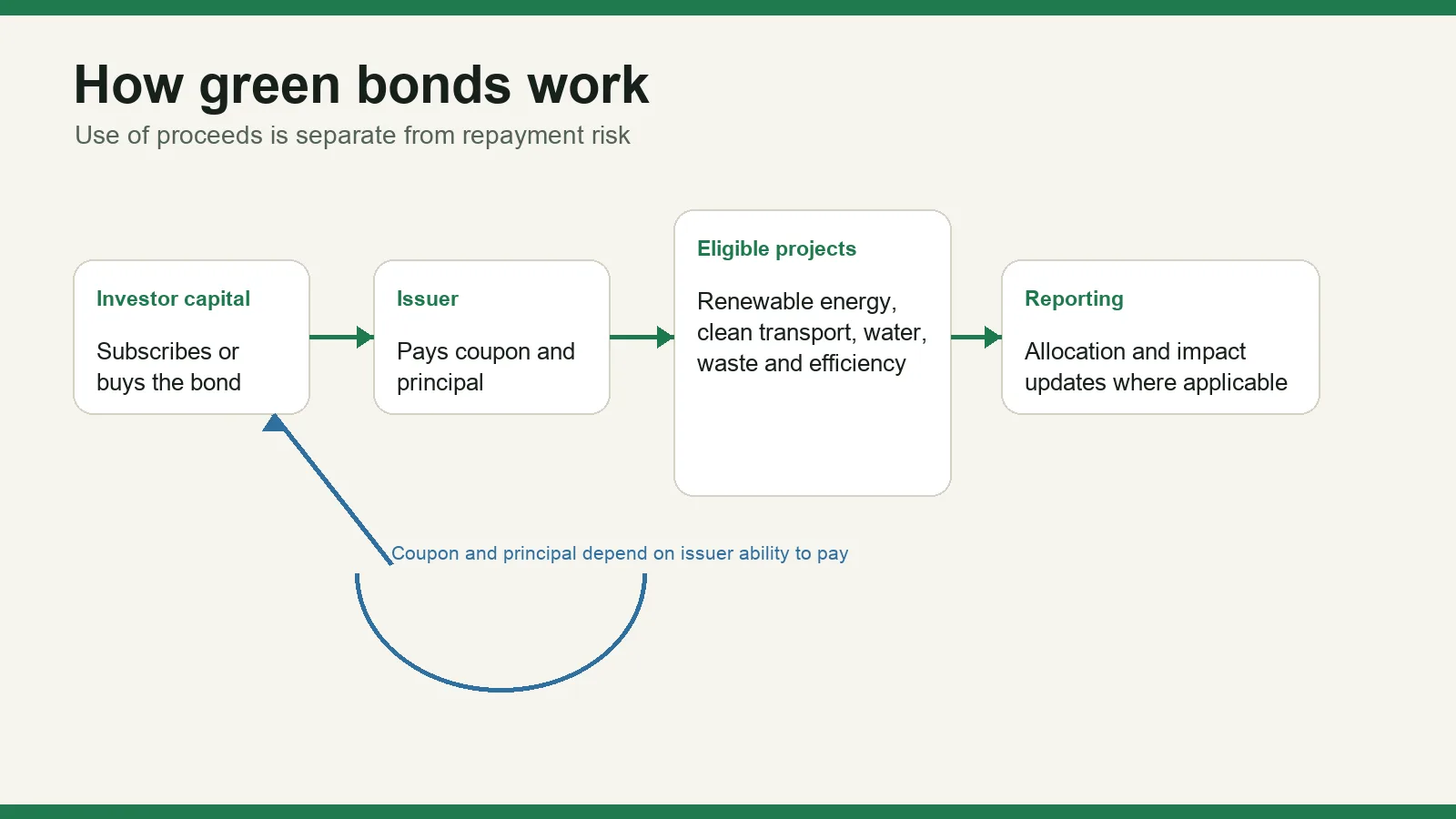
At the cash-flow level, these instruments work like other debt securities. The investor buys or subscribes to a bond. The issuer pays coupon as per the terms. At maturity, the issuer repays principal if it meets its obligations.
The additional green-bond layer sits around proceeds and reporting. Investors should be able to see how eligible projects are selected, how proceeds are tracked, and whether allocation or impact reports will be published.
Green bond coupon and YTM: what investors compare
The coupon rate is the contractual interest rate paid on the bond's face value. Yield to maturity, or YTM, is the annualised return implied by the purchase price, coupon cash flows, and maturity value, assuming the bond is held to maturity and the issuer pays on schedule.
YTM is useful for comparing bonds, but it is not a promise. It depends on the purchase price, reinvestment assumptions, taxes, and issuer performance. Investors comparing labelled sustainable debt should also review how yield to maturity works, especially if the bond is bought in the secondary market rather than at issue.
Green bond reporting: allocation, impact and external review
A credible labelled issuance should not stop at a label. Investors should look for:
- Use-of-proceeds disclosure.
- Eligible project categories.
- Project evaluation and selection process.
- Management of unallocated proceeds.
- External review, verification, or certification, where applicable.
- Post-issuance allocation reporting.
- Impact metrics, where reasonably measurable.
SEBI's revised disclosure requirements for green debt securities, issued in February 2023, focus on disclosure around environmental objectives, project selection, use of proceeds, and reporting. [Source: SEBI green debt securities circular]
Green bond issuers in India: sovereign, corporate and municipal routes
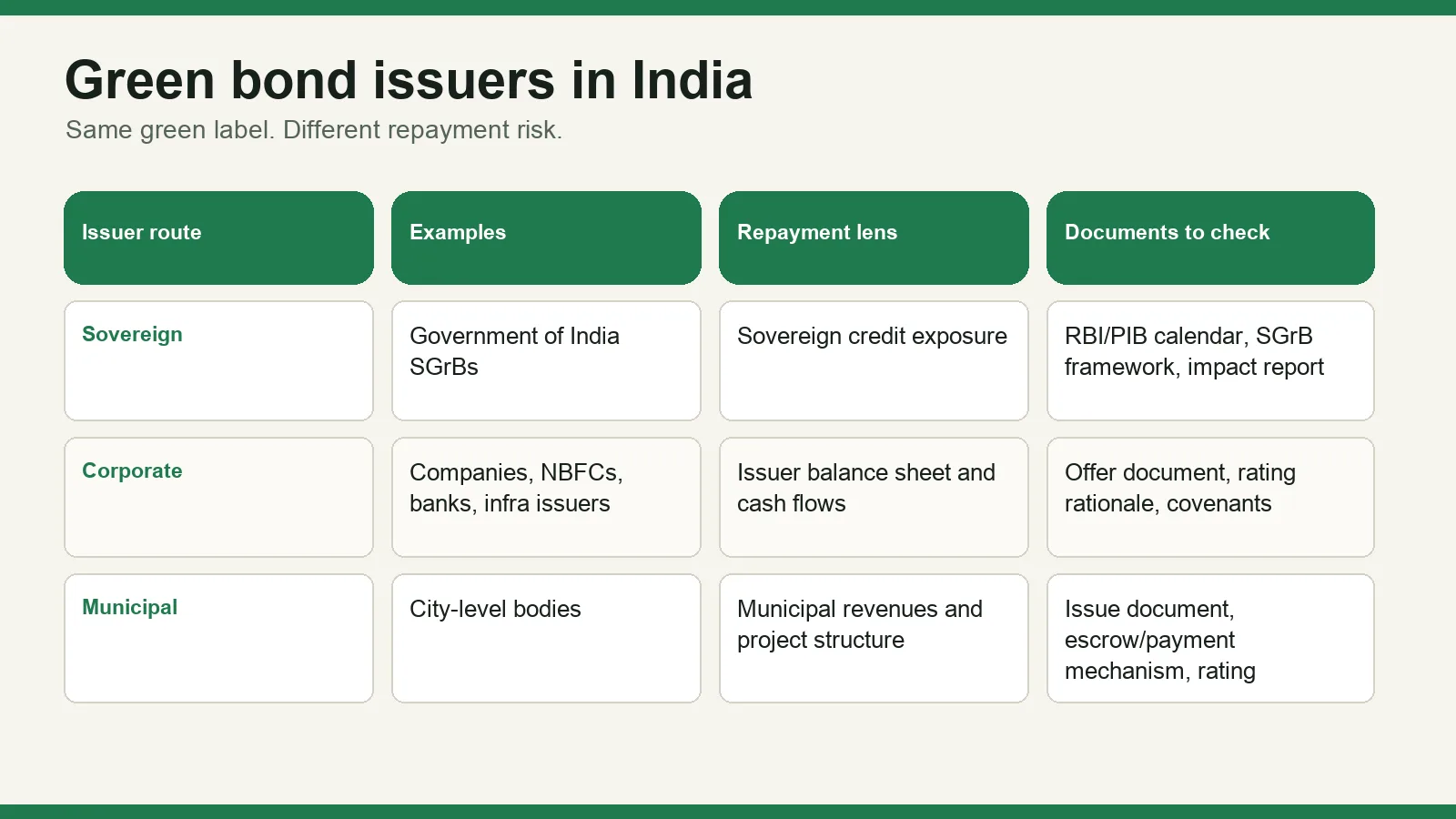
Issuers can include the Government of India, public-sector entities, financial institutions, private companies, infrastructure businesses, renewable-energy companies, and municipal bodies. The green label may be similar, but the repayment risk is not.
Sovereign green bonds India: Government of India SGrBs
SGrBs are issued by the Government of India. The Reserve Bank of India manages government securities auctions on behalf of the Government of India.
For investors, the credit exposure is sovereign. The green aspect relates to the eligible public expenditure financed by the bond proceeds. The Government's FY 2022-23 sovereign green bond impact report noted that a large share of proceeds was allocated to clean transportation projects. Source: DEA Sovereign Green Bond Impact Report FY 2022-23
The Ministry of Finance's April-September 2026 issuance calendar included SGrBs in the dated securities calendar and stated that government securities auctions continue to have a non-competitive bidding facility where five per cent of the notified amount is reserved for specified retail investors. Source: PIB issuance calendar, 27 March 2026
Corporate green bonds India: companies and financial institutions
Corporate issuances may come from companies, NBFCs, banks, renewable-energy businesses, infrastructure companies, and other entities raising capital for eligible projects.
Here, the investor must evaluate the issuer like any other corporate borrower. Review the legal name, rating and rating agency, rating rationale, financial statements, debt maturity profile, security cover, covenants, trustee details, and repayment terms. A company-labelled issue remains subject to corporate credit risk.
Municipal green bonds India: city-level sustainability finance
Municipal issuances can finance city-level infrastructure such as water supply, sewage treatment, clean mobility, waste management, or other sustainability-linked public projects.
The key difference is the issuer. Municipal bonds are linked to a municipal body's revenue, credit profile, project structure, and repayment mechanism. Investors evaluating this route should understand how municipal bonds in India work before relying only on the green label.
Green debt securities and the SEBI green bond framework
SEBI uses the term "green debt securities" for listed debt securities issued to raise funds for certain environmental or climate-related purposes. The regulatory framework is intended to improve disclosures and reduce ambiguity for investors.
In 2025, SEBI also introduced a framework for ESG debt securities other than green debt securities, covering categories such as social bonds, sustainability bonds, and sustainability-linked bonds. This distinction matters because a green bond is usually use-of-proceeds based, while sustainability-linked structures may link financial terms to performance against sustainability targets. Source: SEBI ESG debt securities framework, 5 June 2025
SEBI green debt disclosures: what issuers must explain
For investors, the useful question is practical: does the disclosure help me understand what the issuer will do with the money?
A stronger green-debt disclosure should explain:
- The environmental objective.
- Eligible project categories.
- Project evaluation and selection.
- Management of proceeds.
- External review or certification, where applicable.
- Allocation and impact reporting.
- Any material limitations in measurement or reporting.
For broader investor-protection context, see Equirize's explainer on SEBI rules for bond investors.
Greenwashing risk in green bonds: where disclosure helps and where it does not
Greenwashing risk is the risk that an instrument is represented as environmentally aligned, while the underlying use of proceeds, monitoring, or impact is weak.
Disclosure can reduce this risk, but it cannot eliminate it. Investors should be cautious if the project categories are vague, if there is no clear process for tracking proceeds, if impact reporting is absent, or if the bond relies heavily on broad sustainability language without measurable commitments.
The second point is equally important: even a genuinely green project does not remove issuer risk. Environmental usefulness and repayment ability are different questions.
How to invest in green bonds in India through primary and secondary markets
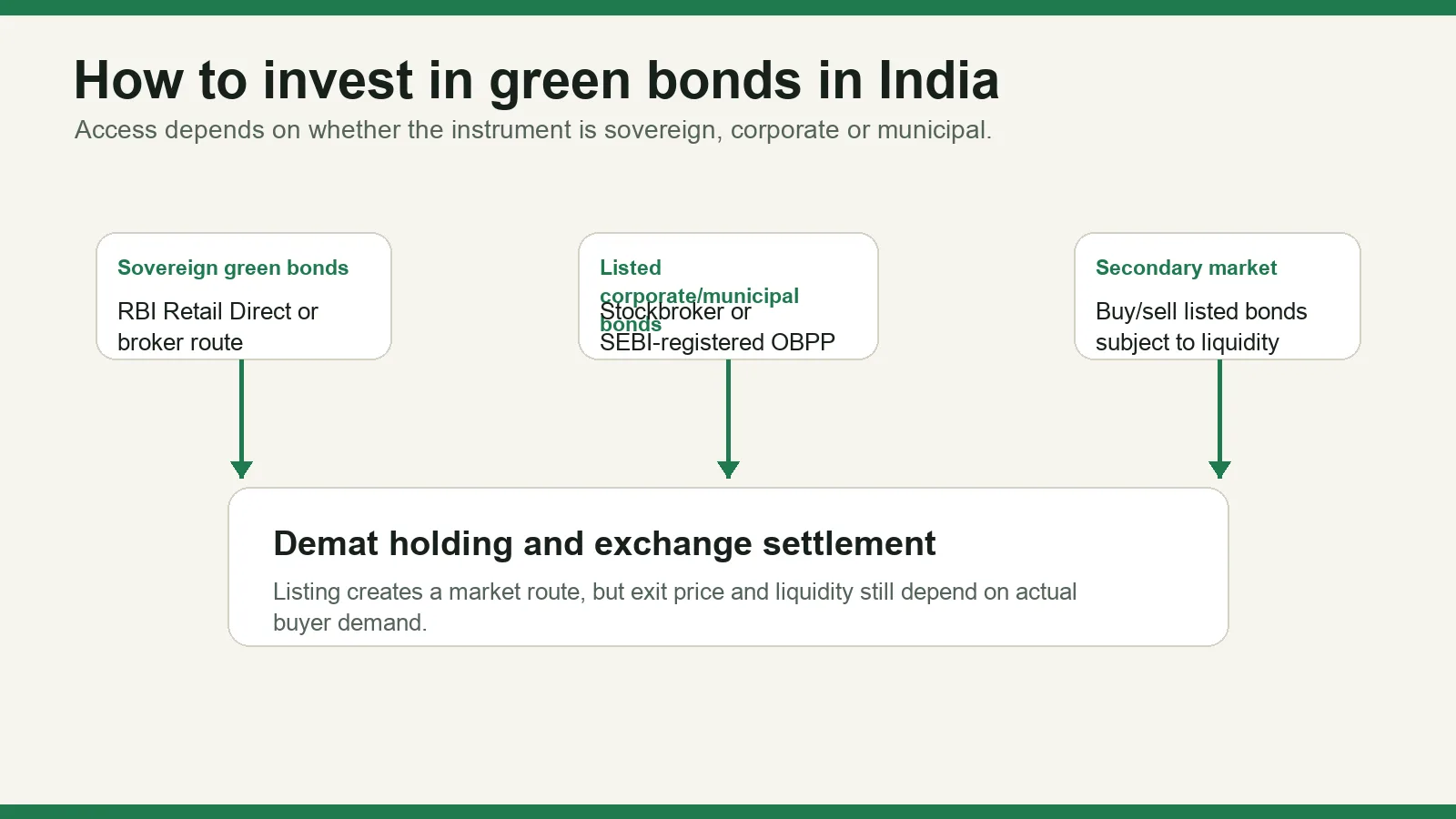
Retail investors can generally access these instruments through the primary market, the secondary market, government securities platforms, stockbrokers, and SEBI-registered online bond platforms, depending on the instrument and availability.
RBI Retail Direct and sovereign green bond access
For government securities, including eligible SGrB issuances, individual investors may use the RBI Retail Direct platform. RBI describes Retail Direct as a one-stop solution to facilitate investment in Government Securities by individual investors. [Source: RBI Retail Direct]
In non-competitive bidding, eligible retail investors do not compete on yield in the same way institutional bidders do. They apply for a specified amount and receive allotment based on auction rules and availability.
Online Bond Platform Provider route for listed green bonds
For listed corporate or municipal debt securities, investors may access bonds through a stockbroker or a SEBI-registered Online Bond Platform Provider.
An OBPP can facilitate access to listed debt securities, provide issue information, surface ratings and documents, and support digital transaction flows. It cannot guarantee returns or principal. It also cannot represent that SEBI has approved any specific bond.
Equirize is a SEBI-registered Online Bond Platform Provider. For a deeper explanation of the regulatory perimeter, see SEBI-registered Online Bond Platform Provider.
Registration with SEBI as an Online Bond Platform Provider does not constitute SEBI's approval, endorsement, or guarantee of any specific security listed on the platform. Investments are subject to market risks. Please read the offer document and risk factors carefully before subscribing.
Demat account and exchange settlement for green bonds
Listed debt securities are generally held in demat form and settle through market infrastructure. A demat account helps ensure the bond is held in the investor's name, while exchange listing can create a secondary-market route.
Listing should not be confused with reliable liquidity. Some listed bonds trade actively; others may have limited traded volumes. If early exit matters, review market depth before investing.
Green bonds vs regular bonds: what changes and what does not
Both structures share the same fixed-income base: an issuer borrows money, pays coupon as per the terms, and repays principal at maturity if it meets its obligations.
What changes is the purpose and disclosure layer.
| Factor | Green bond | Regular bond |
| Use of proceeds | Earmarked for eligible green projects | General corporate or stated business purpose |
| Investor review | Credit risk plus green framework | Credit risk and bond terms |
| Additional disclosure | Proceeds allocation, project categories, impact reporting | Depends on issue terms and regulatory requirements |
| Repayment source | Issuer's ability to pay | Issuer's ability to pay |
| Main misconception | Green means lower risk | Coupon alone explains return |
Green bond credit risk: why issuer quality still matters
Credit risk is the possibility that the issuer delays or fails to pay coupon or principal. Ratings can help investors compare relative credit quality, but ratings are opinions and may change.
Investors should read the rating rationale rather than stopping at the rating symbol. The rationale often explains leverage, profitability, asset quality, liquidity, sector risk, covenants, and any rating sensitivities.
Green bond liquidity risk: why listing is not the same as easy exit
Liquidity risk matters when an investor wants to sell before maturity. A bond may be listed but still trade infrequently. If there are few buyers, the exit price may be lower than expected.
This is especially important for investors who may need cash before maturity. In that case, evaluate bid-ask spreads, recent trades, face value, lot size, and whether the bond is likely to have natural buyer demand.
Green bonds vs fixed deposits: product fit, tax and liquidity
These instruments and fixed deposits both sit in the broad fixed-income conversation, but they are structurally different products.
| Factor | Green bond | Bank FD | Corporate FD |
| Instrument type | Debt security | Bank deposit | Company/NBFC deposit |
| Repayment risk | Issuer-specific | Bank credit risk; DICGC insurance applies up to the applicable limit | Issuer-specific; no DICGC insurance |
| Market exit | Secondary market if listed, subject to liquidity | Premature withdrawal terms and penalty | Premature withdrawal terms vary |
| Tax | Interest/capital gains treatment depends on instrument and investor | Interest taxed as per investor profile | Interest taxed as per investor profile |
| Green-purpose exposure | Yes, if proceeds are earmarked and reported | No direct use-of-proceeds link | No direct use-of-proceeds link unless specified |
The question is not whether one product is universally preferable to fixed deposits. The question is whether the investor understands the additional credit, liquidity, market-price, tax, and documentation work involved.
Green bonds tax benefits India: what investors should not assume
Investors should not assume that a green label makes an instrument tax-free. Tax treatment depends on the specific instrument, holding period, investor status, and applicable law.
Coupon income and capital gains treatment should be evaluated before investing. Equirize has a separate guide to bond interest taxation in India.
Tax treatment depends on individual circumstances and may change. Please consult a qualified tax advisor.
Green bonds for retail investors: suitability checklist
These instruments may be relevant for retail investors who want fixed-income exposure and also care about the purpose of capital. They may not be appropriate if the investor cannot evaluate credit risk, needs reliable early liquidity, or is concentrating too much in one issuer or sector.
Before investing, ask:
- Can I hold this bond until maturity?
- Do I understand the issuer's repayment ability?
- Is the credit rating supported by a clear rationale?
- Is the green use of proceeds specific and documented?
- Would this create concentration in one issuer, sector, or maturity?
- Have I compared post-tax outcomes?
Green bond checklist before investing in India
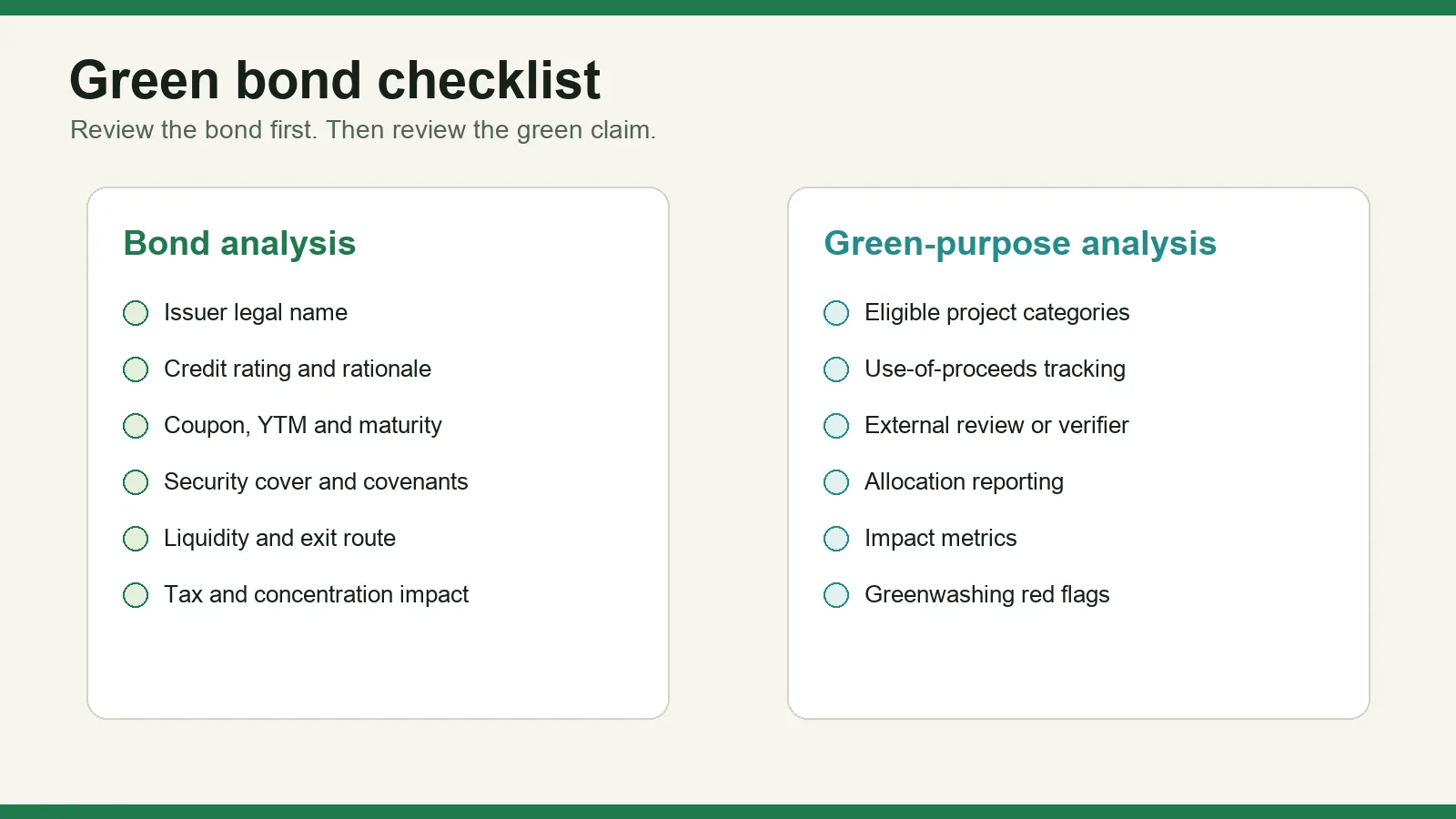
A labelled sustainable debt instrument needs two layers of due diligence. The first is normal bond analysis. The second is green-purpose analysis.
Green bond offer document checklist: issuer, terms and covenants
Review the offer document for:
- Issuer legal name.
- Credit rating and rating agency.
- Coupon rate and coupon frequency.
- Yield assumptions, if shown.
- Maturity date.
- Secured or unsecured status.
- Seniority and security cover.
- Call or put options.
- Debenture trustee details.
- Covenants and events of default.
- Use of proceeds.
- Risk factors.
Do not compare two bonds only by headline yield. A higher indicative yield may reflect higher credit risk, weaker liquidity, longer maturity, or a different security structure.
Greenwashing checklist: external review, proceeds tracking and impact data
For the green layer, review:
- Are eligible project categories clearly stated?
- Are exclusions mentioned?
- Is there an external reviewer, verifier, or second-party opinion?
- How will proceeds be tracked until fully allocated?
- What happens to unallocated proceeds?
- Will allocation reports be published?
- Will impact metrics be reported?
- Are metrics specific or generic?
- Does the project category match credible climate or environmental objectives?
If the green claim is vague, treat that as an information gap rather than a reason to ignore the risk.
Green bonds in India outlook: market data and policy direction
India's sustainable debt market is becoming more structured as regulators, issuers, and investors focus on disclosure, use-of-proceeds clarity, and sustainable finance categories.
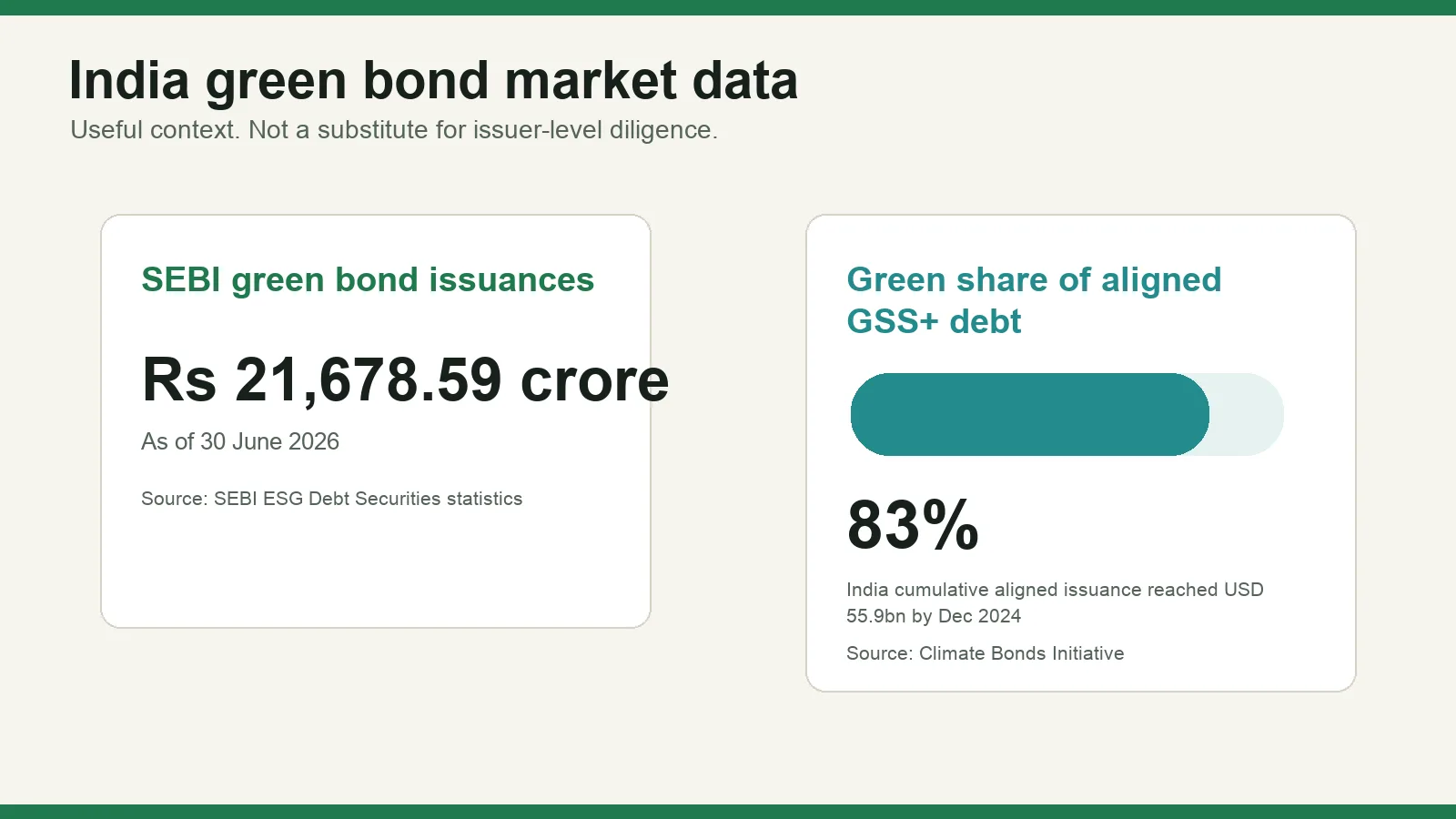
SEBI's ESG Debt Securities statistics page showed green bond issuances of Rs 21,678.59 crore as of 30 June 2026. Source: SEBI ESG Debt Securities statistics
Climate Bonds Initiative reported that India's cumulative aligned green, social, sustainability, and sustainability-linked debt issuance reached USD 55.9 billion by December 2024, with green debt making up 83% of aligned issuance. Source: Climate Bonds India Sustainable Debt State of the Market 2024
India sustainable debt market data: green bonds share and issuance
The data points to a market that is growing, but still requires careful investor scrutiny. More issuance does not automatically mean every instrument is appropriate. It means investors need better tools to compare issuers, structures, disclosures, and liquidity.
This is where a disciplined checklist matters more than broad optimism.
Sovereign green bond impact data: clean transport and public projects
SGrBs can help create benchmarks for India's sustainable debt market. They also show how use-of-proceeds reporting can make the environmental purpose of borrowing more transparent.
For private and municipal issuers, the same logic applies: the stronger the disclosure, the easier it is for investors to understand what they are funding. But the repayment question still sits with the issuer and the bond terms.
Equirize green bond access: what a SEBI-registered OBPP can and cannot do
Equirize is a SEBI-registered Online Bond Platform Provider and stock broker in the debt segment, with SEBI Registration Number `INZ000323730`.
An OBPP can help investors discover listed debt securities, review issue information, access ratings and documents, complete digital flows, and hold securities in demat form. It cannot provide investment advice unless separately registered to do so. It cannot guarantee returns or principal. It cannot represent that SEBI has approved any specific security.
For an investor evaluating these instruments in India, a platform should make the decision process clearer. It should not replace the decision.
This category is most useful when the investor keeps both lenses open: the bond lens and the green-purpose lens. The first asks, "Can the issuer pay?" The second asks, "Is the environmental use of proceeds credible?" Both matter.
Explore listed debt opportunities on Equirize only after reviewing the issuer, offer document, risk factors, liquidity, taxation, and fit with your portfolio.