Bond Prices vs Yields: Why They Move in Opposite Directions


Bond prices and yields move in opposite directions because most bonds promise fixed future cashflows. The coupon payment is usually set when the bond is issued. The market price changes later, as investors compare that fixed cashflow with current yields available in the market.
If the same coupon can be bought at a lower price, the yield for a new buyer rises. If the same coupon becomes expensive to buy, the yield falls. That is the core of the bond price and yield relationship.
For Indian investors, this is not just theory. It affects how a listed corporate bond is displayed on an Online Bond Platform Provider (OBPP), how yield to maturity is read, and what may happen if an investor sells before maturity.
This article explains the mechanism, the role of interest rates, and the practical checks to make before reacting to a bond price movement. The aim is to make bond prices vs yields easier to read on an actual bond platform screen.
What the Bond Price and Yield Relationship Means
A bond has a few moving parts that can look similar but mean different things.
The coupon rate is the periodic interest rate stated by the issuer, usually applied to the bond's face value. A bond with a face value of ₹1,00,000 and a 9% annual coupon pays ₹9,000 a year, subject to the issuer making scheduled payments.
The bond price is what an investor pays to buy that bond in the primary or secondary market. It can be equal to face value, below face value, or above face value.
The yield is the return implied by the price paid for the bond. Yield changes because the market price changes, even when the coupon stays the same.
That distinction matters because a coupon is not the same as the investor's annualised return. If you buy a bond below face value, the same coupon is earned on a lower purchase price. If you buy it above face value, the same coupon is earned on a higher purchase price. The yield changes accordingly. This is the bond price and yield relationship in its most practical form.
For a deeper explanation of how price, coupon and maturity combine into a single annualised figure, see Equirize's guide to yield to maturity in bonds.
Bond Coupon Rate vs Yield: The Fixed Payment Problem
The coupon rate is fixed by the bond's terms. Yield is not fixed in the same way.
Suppose a bond has a face value of ₹1,00,000 and pays a 9% annual coupon. The annual coupon is ₹9,000. That payment does not automatically change because market interest rates move. What changes is the price investors are willing to pay for that ₹9,000 annual cashflow.
If similar bonds are now available at higher yields, the old bond's price may need to fall so that its fixed coupon becomes competitive for a new buyer. If similar bonds are available at lower yields, the old bond's price may rise because its fixed coupon becomes more attractive.
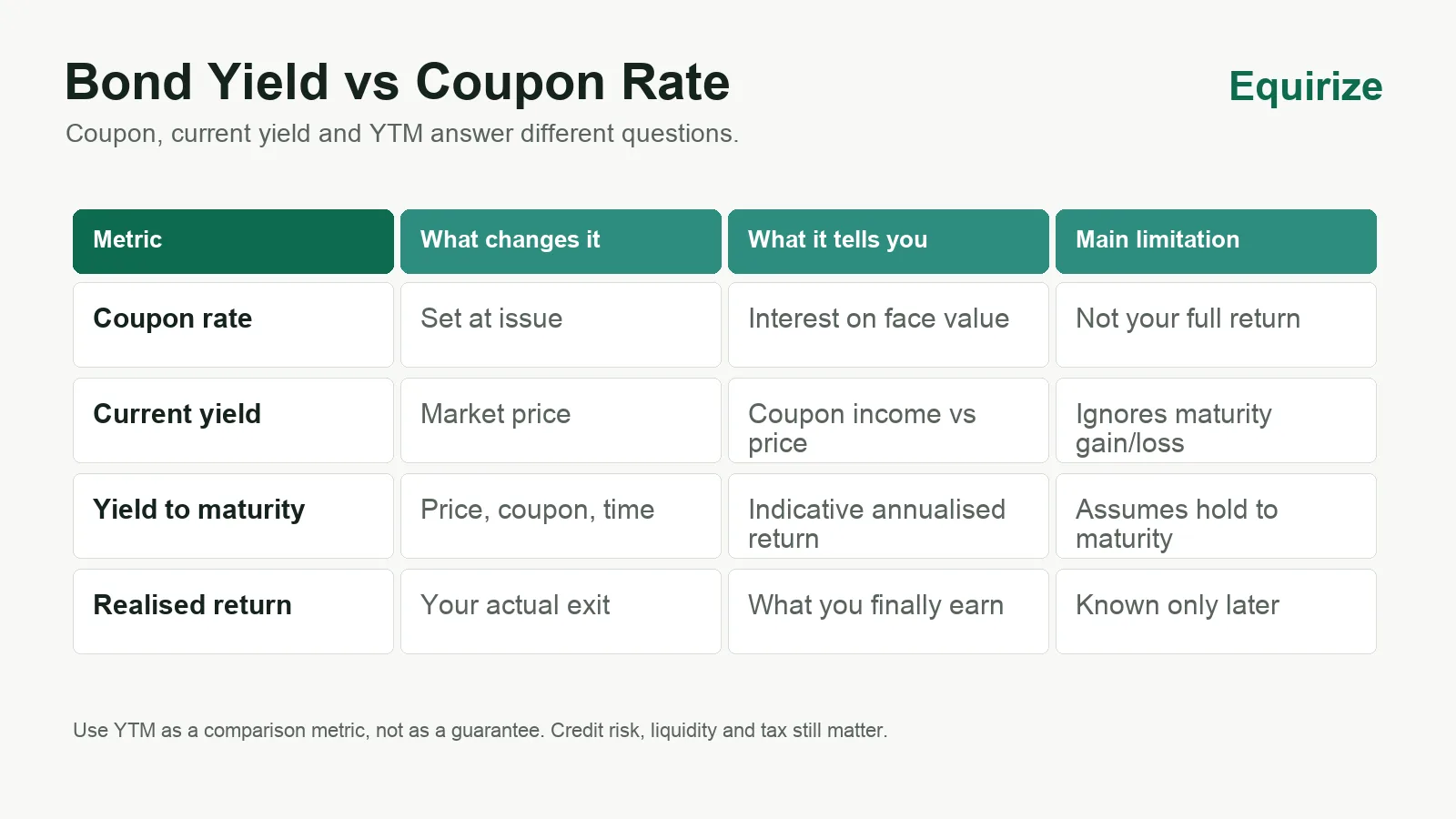
This is why the bond yield vs coupon rate distinction is one of the first concepts to understand. Coupon tells you what the issuer has promised to pay on face value. Yield tells you what that bond may mean at the price available today, subject to credit risk, liquidity, taxes and the assumptions behind the yield calculation.
Current Yield vs Yield to Maturity: Two Different Yield Signals
Current yield is a simple snapshot:
Current yield = Annual coupon / Current market price
It is useful because it shows the cash coupon income relative to today's price. But it ignores what happens between the purchase price and the maturity value.
Yield to maturity, or YTM, goes further. It estimates the annualised return if the investor buys at the current price, holds the bond until maturity, and receives all scheduled coupon and principal payments on time.
That assumption matters. YTM is useful for comparing bonds, but it is not a promise of what the investor will receive in every scenario. The realised outcome can differ if the investor sells before maturity, if the issuer delays or defaults on payments, if taxation changes, or if the bond has features such as call options.
For listed corporate bonds, YTM should be read with the coupon, maturity date, credit rating, rating rationale, liquidity, accrued interest, clean price, dirty price, and offer document.
Why Bond Prices and Yields Move in Opposite Directions
The bond price yield inverse relationship comes from the mathematics of fixed cashflows.
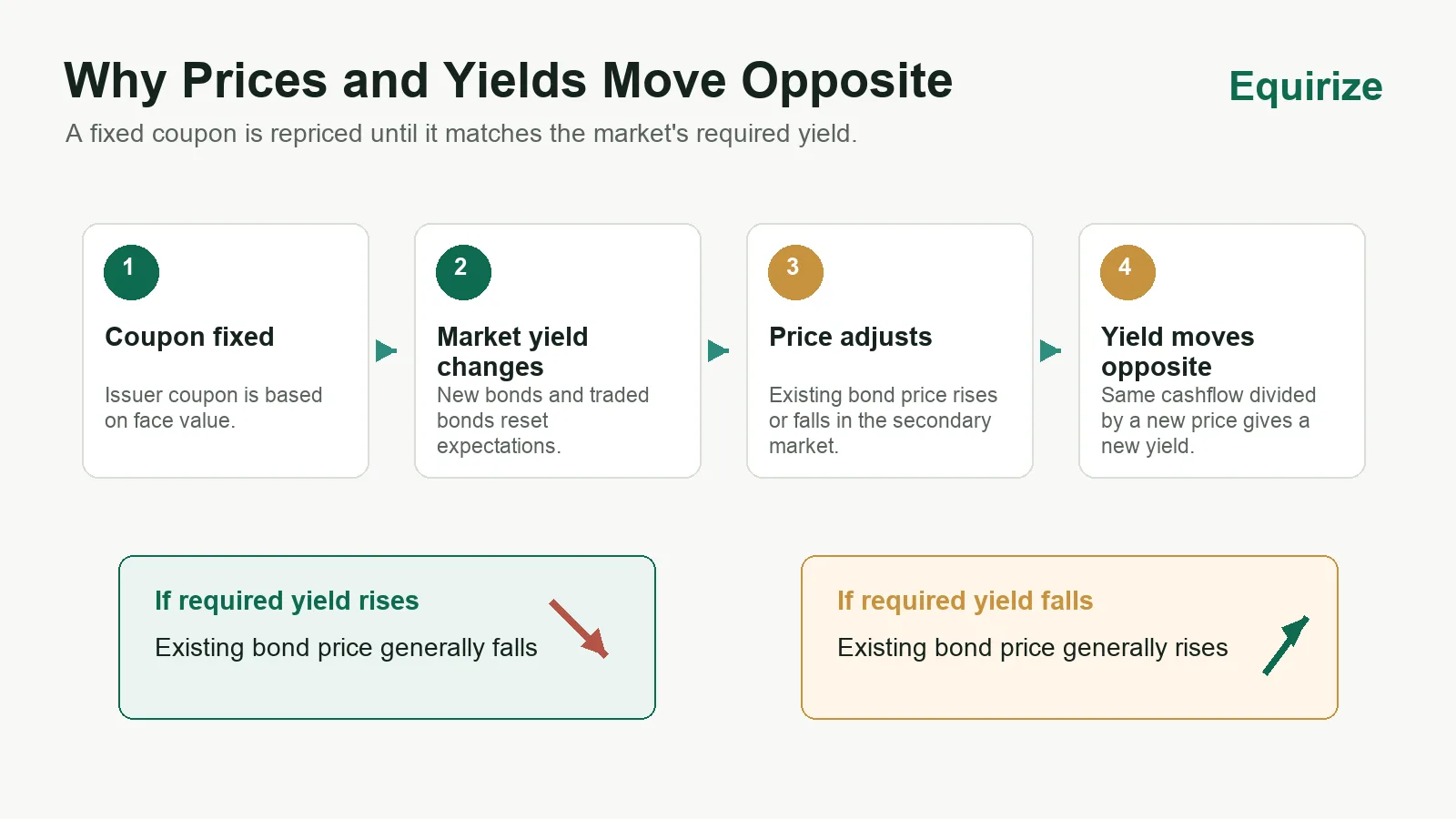
Once a fixed-rate bond has been issued, its coupon schedule is known. The market then asks a different question every day: what price should investors pay today for those remaining cashflows, given current interest rates, credit spreads, liquidity and the time left to maturity?
If investors require a higher yield for a similar bond, the present value of the older bond's fixed cashflows falls. The price must come down for the yield to rise.
If investors require a lower yield, the present value of the older bond's fixed cashflows rises. The price can move up, and the yield for a new buyer falls.
This is the same logic that central banks and investor education sources use when they explain secondary-market bond pricing. The Reserve Bank of Australia notes that once a bond is issued, it offers fixed interest payments, but market interest rates change; as a result, secondary-market prices and expected yields move in opposite directions. The St. Louis Fed similarly explains that when newly issued bonds offer higher interest, an existing lower-coupon bond generally has to sell at a discount to remain attractive.
Premium and Discount Bonds: How Price Changes the Same Coupon
The simplest way to see the mechanism is through premium and discount bonds.
Assume an illustrative bond has a face value of ₹1,00,000 and pays an annual coupon of ₹9,000. If the bond trades at ₹1,00,000, the coupon rate and rough current yield are close. If it trades at ₹96,000, the buyer pays less for the same ₹9,000 coupon. If it trades at ₹1,04,000, the buyer pays more for the same coupon.
The coupon is unchanged. The entry price changes the yield implication.
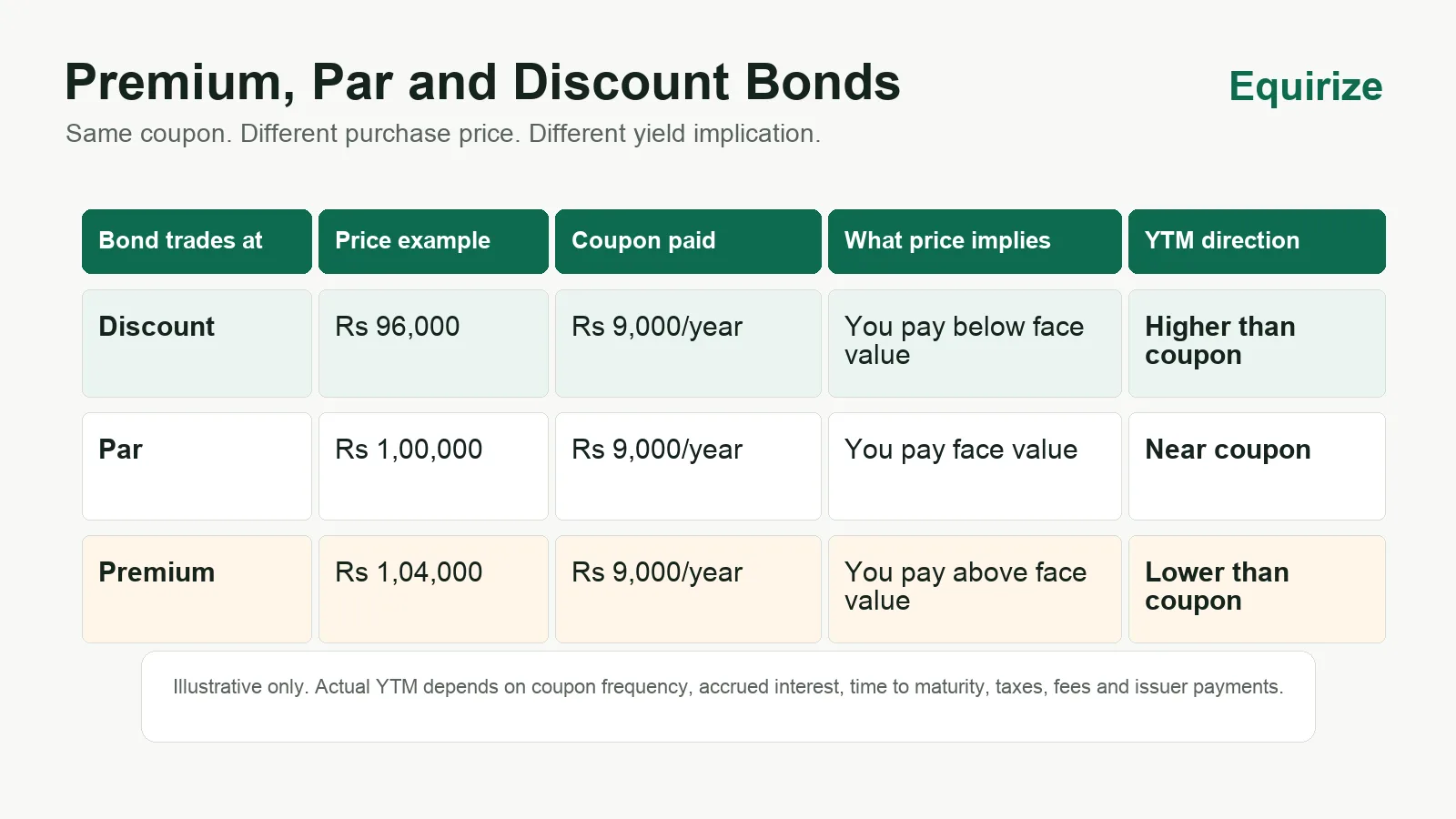
This table is illustrative. In practice, YTM calculations also account for the maturity date, coupon frequency, accrued interest, day-count conventions, price quotation, taxes, fees, and issuer performance.
The useful investor takeaway is this: a bond available at a discount is not automatically better, and a bond trading at a premium is not automatically unsuitable. The price may reflect market yields, issuer credit quality, time to maturity, liquidity, demand, embedded options, or recent information about the issuer. In other words, the bond price and yield relationship explains direction; due diligence explains context.
Why Bond Prices Fall When Interest Rates Rise
The phrase "interest rates rise, bond prices fall" is a simplified version of the same mechanism.
When market yields rise, newly issued bonds may offer higher coupons or trade at yields that better reflect the new interest-rate environment. Existing fixed-rate bonds with lower coupons then become less attractive at their earlier prices. Their prices may fall until the yield becomes more aligned with the market.
This does not mean every bond falls by the same amount. A short-maturity bond, a long-maturity bond, a government security and a lower-rated corporate bond can all respond differently.
Several forces may move at the same time:
| Driver | What it can do to yield | What it can do to price |
| Market interest rates rise | Required yield may rise | Fixed-rate bond price may fall |
| Market interest rates fall | Required yield may fall | Fixed-rate bond price may rise |
| Credit spread widens | Corporate bond yield may rise | Corporate bond price may fall |
| Liquidity weakens | Buyer may demand higher yield | Price may fall or bid-ask spread may widen |
| Time to maturity shortens | Price may move closer to redemption value | Sensitivity may reduce over time |
This is why investors should avoid reading a price move through only one lens. A price fall may reflect rate movement, but it may also reflect credit spread, liquidity, demand, or issuer-specific information. The rule behind bond prices vs yields is useful only when paired with the reason behind the movement.
How RBI Repo Rate and Bond Yields Affect Bond Prices in India
In India, investors often connect the RBI repo rate and bond yields. That connection is relevant, but it is not mechanical one-for-one.
The repo rate influences the short end of the interest-rate environment and affects expectations for borrowing costs, liquidity and future policy direction. Bond yields, especially longer-tenure yields, also respond to inflation expectations, fiscal borrowing, demand from institutions, global yields, rupee movement, crude oil, liquidity and risk appetite.
Government securities, or G-Secs, are often used as a benchmark for the broader bond market. Corporate bond yields usually build on benchmark yields by adding credit spread, liquidity premium and structure-specific considerations.
The Securities and Exchange Board of India formalised the regulatory framework for Online Bond Platform Providers through its circular dated 14 November 2022. For retail investors using an OBPP, this makes the platform role clearer, but it does not remove market risk or issuer risk.
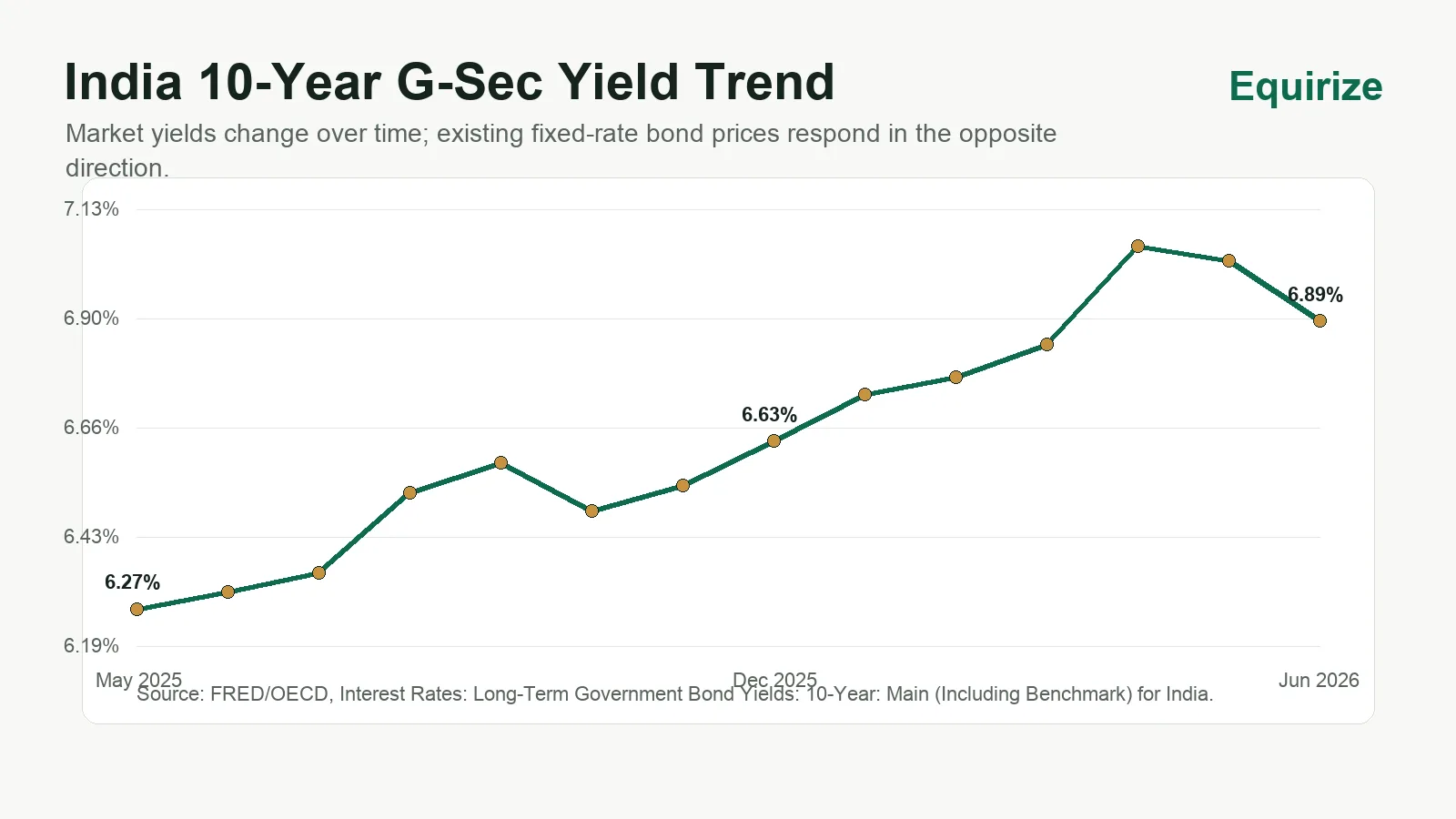
The chart uses the FRED/OECD India 10-year government bond yield series. It is included to show that market yields move over time, not to forecast the direction of future yields.
G-Sec Yields, Corporate Bond Yields and Credit Spreads
A corporate bond yield is not just a G-Sec yield with a coupon attached.
A corporate bond usually carries issuer credit risk. Investors may therefore demand additional yield over a comparable government security. That additional yield is often described as a credit spread.
If benchmark G-Sec yields rise, corporate bond yields may also rise. If the issuer's credit spread widens, the corporate bond's yield may rise even if benchmark yields are stable. If liquidity deteriorates, the price at which an investor can sell may also be affected.
This is why "yield went up" is not enough information. An investor should ask what changed:
- Did the benchmark yield move?
- Did the issuer's credit profile change?
- Did the bond become less liquid?
- Did the remaining maturity change the sensitivity?
- Did a call feature or structure affect expected cashflows?
For a deeper explanation of this layer, see Equirize's guide to credit spread in bonds.
Duration and Bond Price Sensitivity Before Maturity
Duration is a measure of how sensitive a bond's price is to yield changes. In general, longer-duration fixed-rate bonds are more sensitive to interest-rate movements than shorter-duration bonds.
The intuition is straightforward. If a bond's cashflows are far in the future, a change in the discount rate has more time to affect the present value of those cashflows. If a bond matures soon, there is less time for that discounting effect to compound.
This does not mean longer-duration bonds are always inappropriate. It means they need to match the investor's time horizon and tolerance for interim price movement.
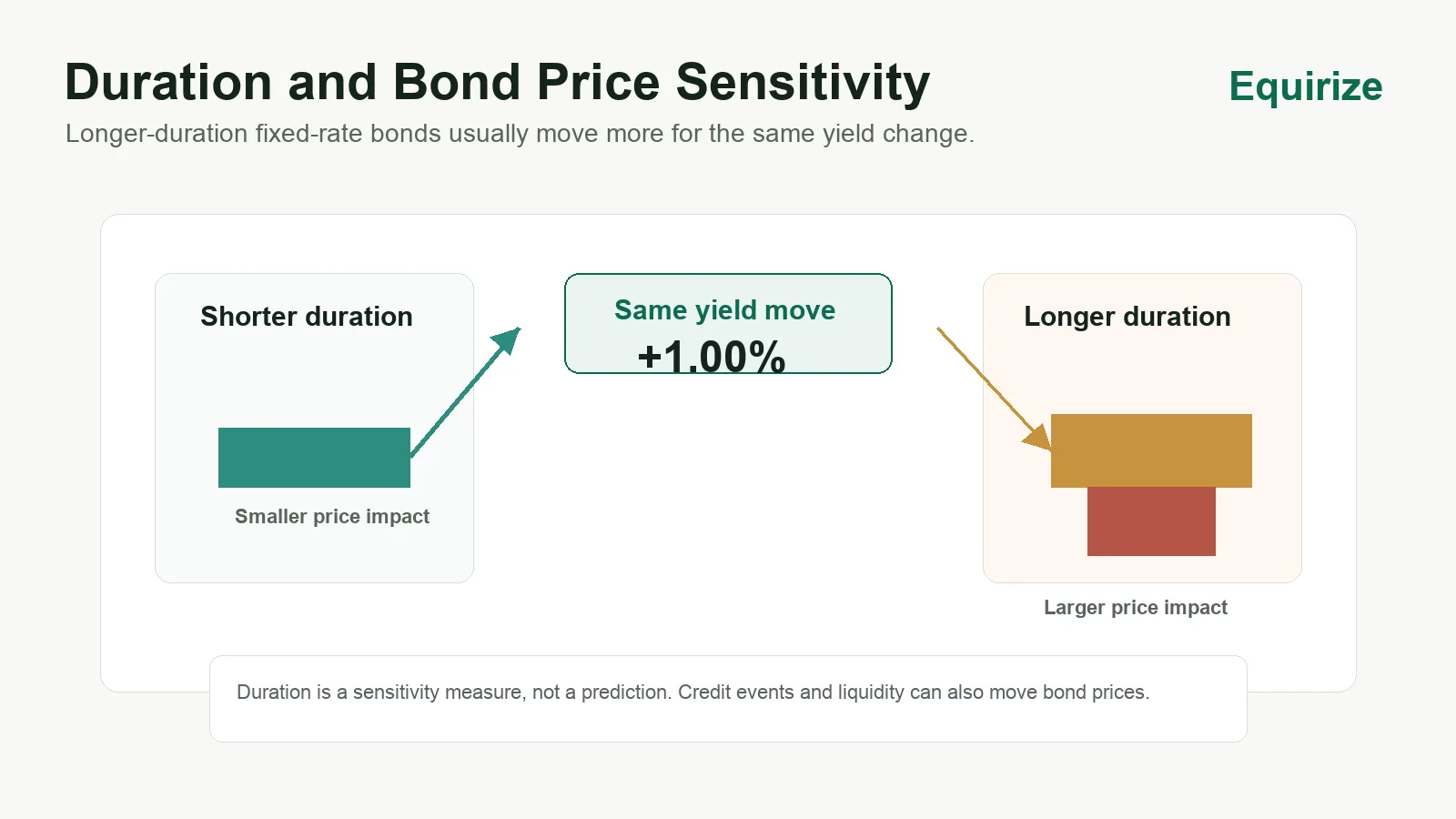
Duration is not the only source of price movement. Credit news, liquidity, tax changes, issue structure, and market demand can also affect price. But duration is one of the cleanest ways to understand why two fixed-rate bonds may react differently to the same change in market yield.
Selling Bonds Before Maturity: Price Risk vs Cashflow Planning
The bond price movement before maturity matters most when an investor may sell before maturity.
If an investor holds a bond until maturity and the issuer makes all scheduled payments, interim market-price movement may not determine the final cashflows. The investor receives coupons and redemption proceeds according to the bond terms, subject to issuer performance.
But if the investor sells before maturity, the sale price depends on market conditions at that time. If yields have risen, the bond's market price may be lower. If yields have fallen, the bond's market price may be higher. Either way, the realised outcome depends on the exit price, accrued interest, taxes, transaction costs and liquidity.
This is why "I will hold to maturity" and "I may need liquidity" are different investor situations. The bond price and yield relationship becomes most visible when liquidity is needed before maturity.
Before buying a listed bond, investors should ask:
| Question | Why it matters |
| Can I hold until maturity? | Reduces dependence on secondary-market exit price, but issuer risk remains |
| How liquid is the bond? | A listed bond may still have limited buyers |
| What is the remaining maturity? | Longer maturity can mean greater price sensitivity |
| What is the credit rating and rationale? | Price can move if credit perception changes |
| What tax treatment applies? | Post-tax outcomes may differ from pre-tax YTM |
| What is my concentration in this issuer? | Diversification does not remove risk, but concentration increases exposure |
For a fuller exit-focused view, see Equirize's guide to selling bonds before maturity.
How to Read Secondary Market Bond Price and YTM on an OBPP
An Online Bond Platform Provider can make bond discovery more organised. But the investor still has to read the bond details carefully.
When reviewing a listed corporate bond on an OBPP, do not stop at the headline yield. Check the following:
| Field | What to check |
| Issuer name | Legal entity issuing the bond |
| ISIN | Unique security identifier |
| Coupon rate | Interest rate on face value |
| Price | Whether the bond is at par, premium or discount |
| Accrued interest | Interest earned since the last coupon date, if applicable |
| Clean price and dirty price | Whether quoted price includes accrued interest |
| Indicative pre-tax YTM | Assumptions behind the annualised yield |
| Maturity date | Remaining holding period |
| Credit rating and agency | Current rating and rating rationale |
| Offer document | Terms, risks, covenants, security, call/put features |
| Liquidity | Whether there may be enough market depth for exit |
The National Stock Exchange's corporate bond market data includes fields such as weighted average price, last trade price, weighted average yield to maturity, last trade yield, value and number of trades. These fields show why price and yield should be read together rather than separately.
Equirize is a SEBI-registered Online Bond Platform Provider and stock broker in the debt segment of BSE and NSE. Investors can use the platform to compare listed bonds, review key terms and documents, and understand whether a bond fits their own risk, liquidity and time-horizon requirements. Equirize does not provide investment advice.
For platform-selection checks, see Equirize's guide to choosing a SEBI-registered Online Bond Platform Provider.
Bond Price Movement Checklist Before You React
A falling bond price can feel alarming, but the first response should be diagnostic.
Ask these questions before deciding what the movement means:
| Check | What it helps separate |
| Did benchmark yields move? | Interest-rate movement vs issuer-specific concern |
| Did the credit rating or outlook change? | Market risk vs credit risk |
| Did liquidity change? | Price movement vs weak bid depth |
| How much maturity remains? | Duration sensitivity |
| Is the bond callable or puttable? | Cashflow uncertainty |
| What is the tax impact of selling? | Pre-tax price move vs post-tax result |
| Does the bond still fit my plan? | Product feature vs investor suitability |
This is also where investor behaviour matters. Reacting only to a yield number can lead to mistakes. A higher displayed YTM may reflect compensation for additional risk, weaker liquidity, longer maturity, or a lower market price. It is not automatically a better opportunity.
For a broader behavioural checklist, see Equirize's guide to common bond investing mistakes.
Bond Yield vs FD Interest Rate: Why the Comparison Can Mislead
Many investors compare a bond's YTM with a fixed deposit interest rate. The comparison can be useful, but only if the units are understood.
An FD interest rate is the contractual rate for that deposit, subject to the issuer's terms, premature withdrawal rules and tax treatment. A bond coupon is the issuer's stated interest rate on face value. A bond's YTM is an indicative annualised return based on purchase price, coupon cashflows, maturity value and assumptions.
This means a bond's YTM and an FD interest rate are not identical data points.
A listed corporate bond may offer price discovery, demat holding and secondary-market exit possibilities. It may also carry credit risk, interest-rate risk and liquidity risk. An FD may have different liquidity rules, insurance treatment depending on whether it is a bank FD or corporate FD, and different product terms.
The better comparison is not "which number is higher?" It is:
- What is the issuer risk?
- What is the tenure?
- What happens if I need liquidity?
- Is the return pre-tax or post-tax?
- What assumptions are built into the yield?
- What documentation supports the product?
For a category-level comparison, see Equirize's guide to [bond yield vs FD interest rate](https://www.equirize.com/resources/blogs/bonds-vs-fixed-deposits).
Final Take: Bond Price and Yield Relationship for Indian Investors
The bond price and yield relationship is simple at the core: when the price of a fixed-cashflow bond rises, the yield for a new buyer falls; when the price falls, the yield rises.
The investor challenge is not memorising the rule. It is knowing what caused the price or yield to move.
A bond price may move because benchmark yields changed. It may move because credit spreads changed. It may move because liquidity changed. It may also move because the bond is getting closer to maturity or because the market has reassessed the issuer.
Read price with YTM. Read YTM with coupon, maturity, rating, liquidity, tax and documents. And before treating a higher yield as attractive, ask what risk or constraint the market may be pricing in. That is the more useful way to apply the bond price and yield relationship.