Social Impact Bonds: Meaning, Structure and Risk



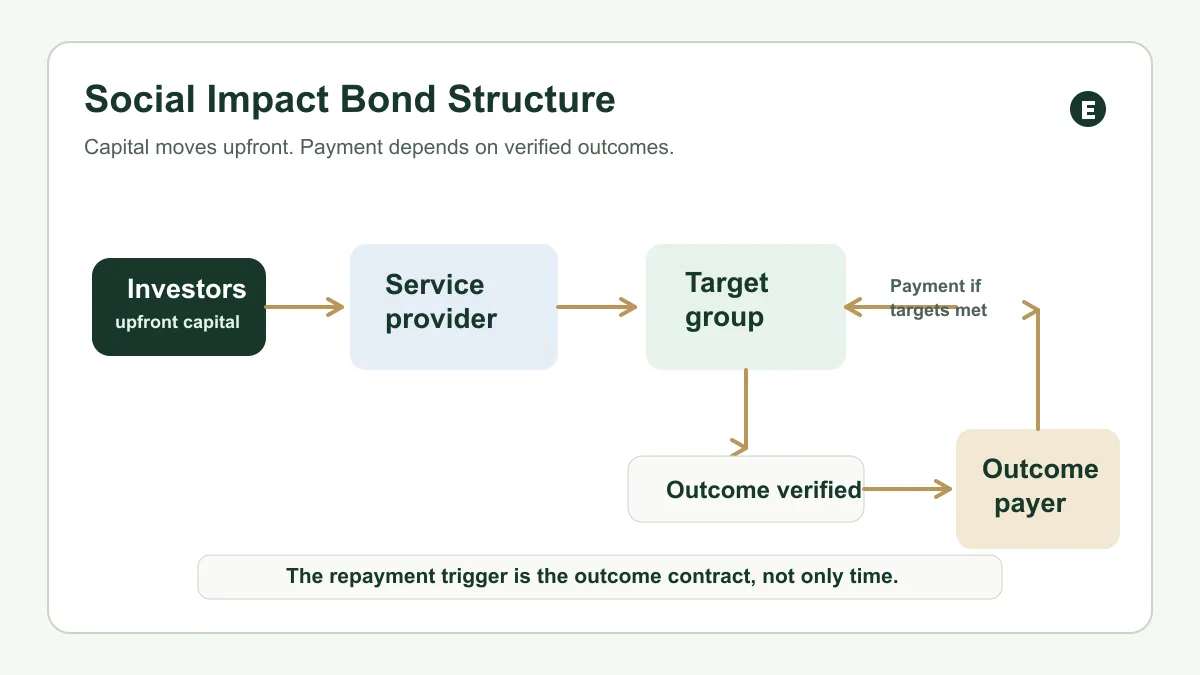
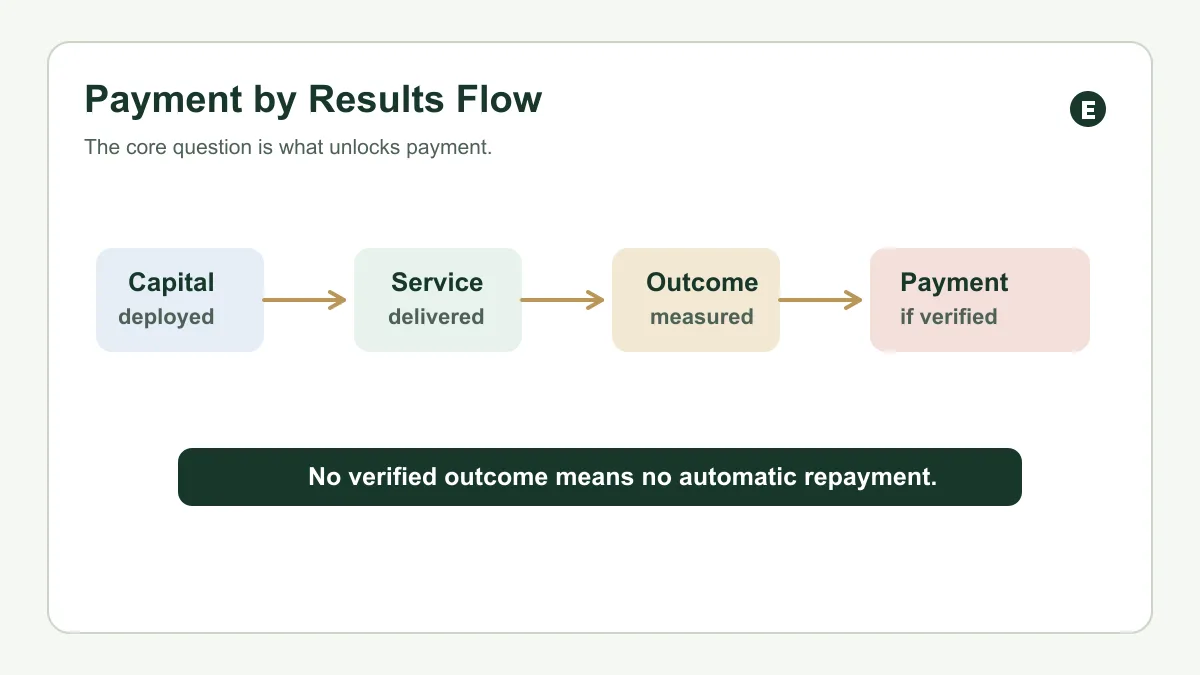
Social impact bonds are outcome-based financing structures. Private investors provide upfront capital for a social programme. A service provider uses that capital to deliver the programme. An outcome payer, often a government body, foundation or donor, repays investors only if agreed social outcomes are achieved and verified.
The word "bond" can be misleading. A social impact bond is usually not a regular fixed-coupon bond where an issuer borrows money and pays interest on a defined schedule. It is closer to a performance-linked contract where financial return depends on social results.
That difference matters for investors. The social purpose may be clear, but repayment still depends on contract design, outcome measurement, delivery execution, documentation, liquidity and the financial strength or commitment of the outcome payer.
For Indian fixed-income investors, social impact bonds sit inside a larger conversation about impact investing, sustainable finance and outcome-based funding. They should be studied with the same discipline used for any debt or structured finance instrument: who owes money, when payment is due, what can go wrong, and which document defines the obligation.
How Social Impact Bonds Work
A social impact bond begins with a social problem that can be translated into measurable outcomes. Examples globally include reducing reoffending, improving education outcomes, increasing employment, addressing homelessness or improving health interventions.
The Government Outcomes Lab at Oxford describes impact bonds as bringing together three key partners: the outcome payer, the service provider and the investor. The investor provides risk capital upfront, the service provider delivers the intervention, and the outcome payer pays if agreed results are achieved. Source: Government Outcomes Lab: Impact bonds.
In practice, many structures also include an intermediary and an independent evaluator.
The investor provides upfront capital
The investor funds the programme before the results are known. This capital allows the service provider to start or scale delivery without waiting for reimbursement after the programme ends.
The investor is taking performance risk. If the programme does not achieve the defined outcomes, repayment may be reduced, delayed or unavailable, depending on the contract.
The service provider delivers the social programme
The service provider is the organisation doing the work. It may be an NGO, social enterprise, training provider, healthcare organisation, education provider or specialised implementation agency.
The quality of the service provider matters because the investor's repayment is linked to delivery outcomes, not only to a borrower balance sheet.
The outcome payer pays for verified success
The outcome payer may be a government agency, donor, foundation, CSR funder or multilateral organisation. It agrees in advance what outcomes matter and how much will be paid if they are achieved.
This is why social impact bonds are often called pay-for-success or payment-by-results structures. Social Finance describes social impact bonds as public-private partnerships that fund effective social services through performance-based contracts. Source: [Social Finance: Social Impact Bonds](https://socialfinance.org/social-impact-bonds/).
The evaluator verifies outcomes
Independent evaluation is central to the model. If measurement is weak, the structure loses credibility. The evaluator checks whether the programme achieved the pre-agreed targets and whether outcome payments should be made.
For investors, the evaluation method is not a technical footnote. It is part of the repayment mechanism.
Social Impact Bond Structure: Who Does What?
The structure can vary, but the basic roles are usually similar.
| Participant | Role in the structure | Investor question |
| Investor | Provides upfront capital | How much capital is at risk and when can it be repaid? |
| Service provider | Delivers the social programme | Does the provider have a credible delivery record? |
| Outcome payer | Pays if outcomes are achieved | Is the payer contractually committed and financially credible? |
| Intermediary | Coordinates contracts, reporting and performance management | Who manages disputes, data and reporting? |
| Independent evaluator | Measures outcomes against agreed metrics | Are the metrics clear, auditable and hard to manipulate? |
The key feature is that payment is tied to outcomes, not activity. Funding a training programme is not the same as achieving job placements. Funding an education programme is not the same as verified learning gains. Funding a health intervention is not the same as measured health improvement.
This is the model's strength and its difficulty. It encourages capital to focus on results, but it also introduces measurement and execution risk that regular bonds may not have in the same form.
Social Impact Bonds vs Regular Bonds vs ZCZP Instruments
Investors should not put every impact-linked instrument into one bucket.
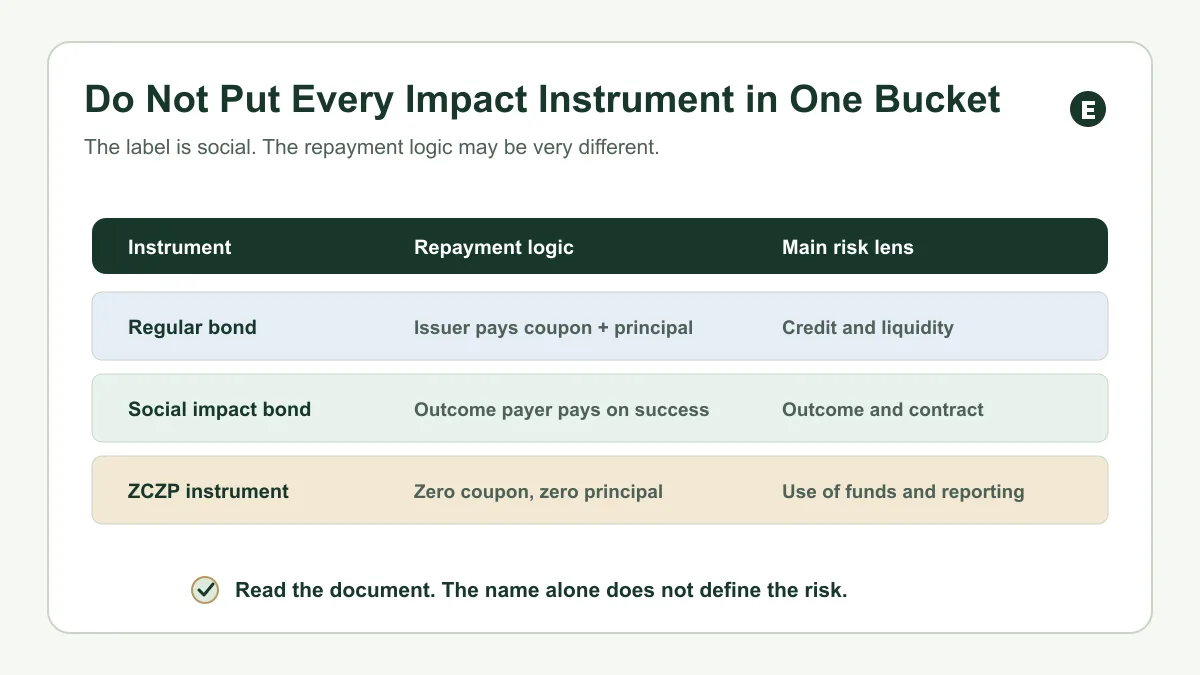
A regular corporate bond is a debt security. The issuer borrows money, pays coupon as per the terms, and repays principal at maturity, subject to issuer credit risk and other bond risks.
A social impact bond is outcome-linked. Payment to investors may depend on whether a programme delivers agreed social results.
A Zero Coupon Zero Principal instrument, or ZCZP, is different again. Under India's Social Stock Exchange framework, eligible not-for-profit organisations can raise funds through ZCZP instruments. These are not return-seeking debt investments for investors; they are structured as zero coupon and zero principal instruments. NSE's Social Stock Exchange FAQ describes development impact bonds as one structured finance product available through the SSE mechanism, while ZCZP instruments are a separate fundraising route for eligible NPOs. Source: NSE Social Stock Exchange FAQs.
| Instrument | Repayment logic | Main risk lens | Suitable question |
| Regular bond | Issuer pays coupon and principal as per terms | Credit, interest-rate, liquidity and documentation risk | Can the issuer meet scheduled obligations? |
| Social impact bond | Outcome payer pays if verified outcomes are achieved | Outcome, execution, contract and payer risk | Will the programme deliver measurable results and trigger payment? |
| ZCZP instrument | No coupon and no principal repayment | Donation/use-of-funds and impact-reporting risk | Is the social project credible and well reported? |
For Equirize readers, this distinction is important. Not every instrument with "social" in its name behaves like a listed corporate bond. Not every Social Stock Exchange instrument is designed to generate financial return.
Social Impact Bonds in India
India's impact-finance conversation has grown alongside financial inclusion, CSR, ESG, blended finance and the Social Stock Exchange framework. The Social Stock Exchange is a segment that allows eligible social enterprises to raise capital and improve standards of impact and financial reporting. NSE describes the SSE as a regulated platform that brings together social enterprises and donors, facilitates funding and growth, and supports robust standards of social impact and financial reporting. Source: NSE Social Stock Exchange.
BSE also operates a Social Stock Exchange segment dedicated to social enterprises. Source: BSE Social Stock Exchange.
However, investors should separate three ideas:
- Social impact bonds as outcome-linked financing contracts.
- Development impact bonds, where donor or development agencies may fund outcomes.
- Social Stock Exchange instruments, including ZCZP instruments for eligible NPOs.
These structures may overlap in purpose, but they are not identical. A social impact bond is defined by the outcome-payment logic. The Social Stock Exchange is a regulated market infrastructure segment for eligible social enterprises and instruments.
The practical takeaway is simple: read the instrument documents. The label tells you the theme. The repayment terms tell you the risk.
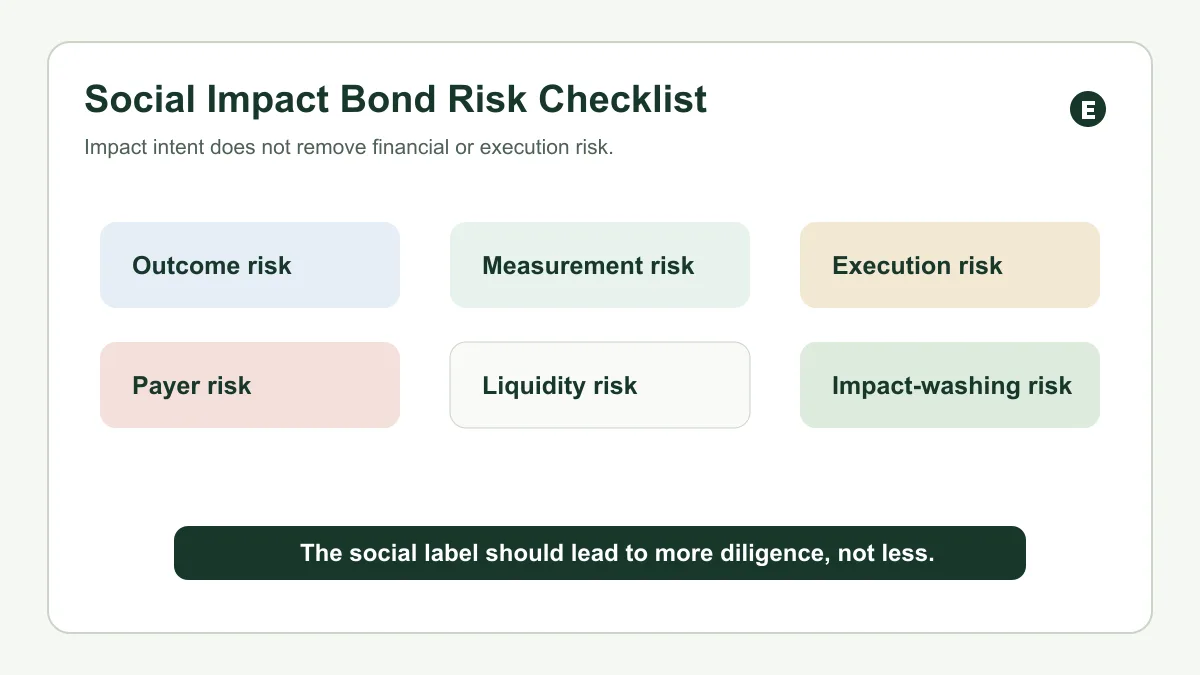
Key Risks in Social Impact Bonds
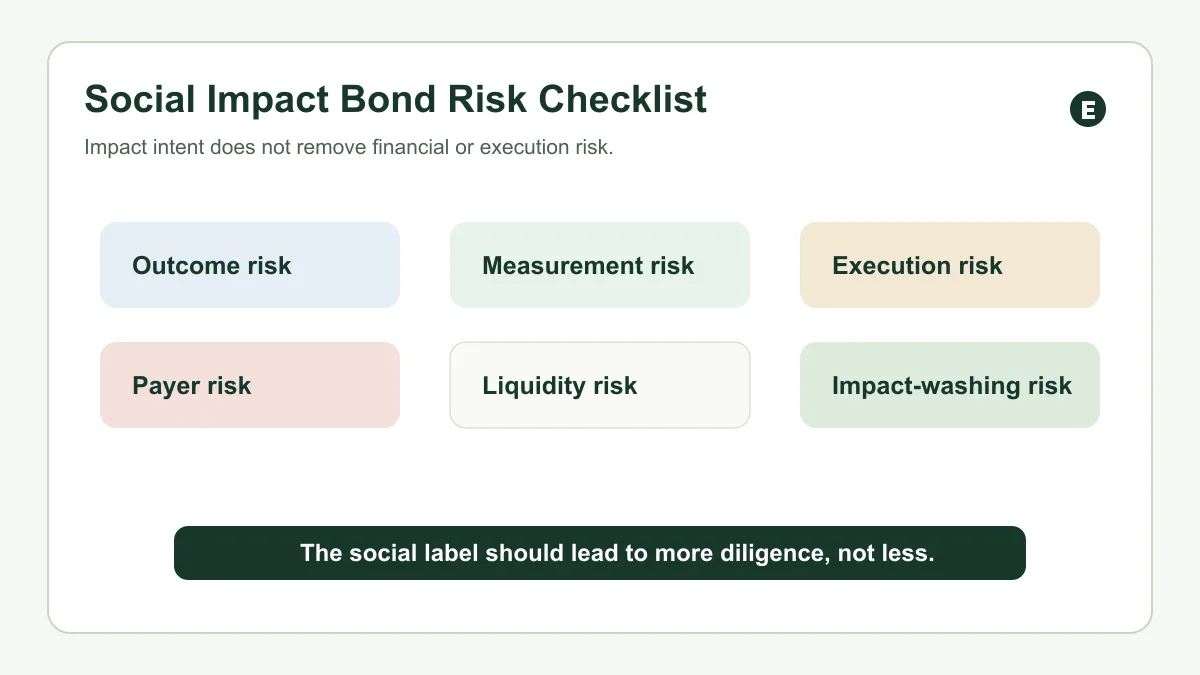
The main risk in a social impact bond is not only whether the issuer can pay. It is whether the programme achieves the outcome that unlocks payment.
Outcome risk
Outcome risk is the risk that the programme does not meet the agreed target. A skilling programme may train participants but not place enough of them in jobs. An education programme may improve attendance but not learning outcomes. A health programme may reach beneficiaries but not meet the measured improvement threshold.
If outcome targets are not met, investor repayment may be reduced or unavailable.
Measurement risk
The result must be measurable. Poorly designed metrics can create disputes. Metrics that are too narrow can miss the real social outcome. Metrics that are too broad can be difficult to verify.
Investors should ask who measures the outcome, how the baseline is set, what data will be used, and how disputes are handled.
Execution risk
Even a well-designed programme can fail during execution. The service provider may face staffing issues, local delivery challenges, beneficiary drop-off, cost overruns, data gaps or implementation delays.
In a regular bond, operating problems may affect issuer credit quality. In a social impact bond, delivery problems may directly affect whether outcome payments are triggered.
Contract and payer risk
The outcome payer's commitment must be clear. Investors should understand who is obligated to pay, what conditions apply, when payments are made, and what happens if budgets, policy priorities or donor commitments change.
The contract is the core credit document.
Liquidity risk
Social impact bonds may not have an active secondary market. Even if a structure is listed or transferable, exit before maturity or outcome verification may be difficult. Investors should not assume easy liquidity unless the offer document and market mechanism clearly support it.
Impact-washing risk
A social label does not guarantee meaningful impact. The programme should have clear beneficiary targeting, credible theory of change, independent assessment, transparent reporting and measurable outcomes.
Impact intent is not the same as impact evidence.
Social Impact Bonds and Impact Investing
Social impact bonds are part of impact investing, but they are not the only route.
Investors may also encounter green bonds, social bonds, sustainability bonds, sustainability-linked bonds, ESG debt funds, microfinance-linked debt, NBFC bonds funding inclusion themes, and Social Stock Exchange instruments.
The discipline remains the same. A good impact story does not replace credit analysis, document review, liquidity assessment, tax review or suitability thinking.
If an instrument is a listed bond, investors should review issuer quality, rating, maturity, coupon, indicative pre-tax YTM, offer document, risk factors and secondary-market liquidity. If it is an outcome-linked structure, investors should additionally review outcome metrics, evaluator independence, payer commitment and programme delivery capability.
Investor Checklist Before Evaluating a Social Impact Bond
Before evaluating a social impact bond, use a checklist that begins with structure.
| Check | Why it matters |
| What is the legal instrument? | The name may say bond, but repayment may be contract-linked |
| Who is the outcome payer? | Repayment depends on the payer's obligation and credibility |
| What outcome triggers payment? | Vague social goals are not enough |
| Who verifies the outcome? | Independent evaluation reduces measurement disputes |
| What happens if targets are partly met? | Some structures may have tiered payments |
| Is principal fully at risk? | Investors need to know downside before considering return |
| Is there any secondary liquidity? | Exit may be limited before outcome verification |
| How are proceeds used and reported? | Use-of-funds and impact reporting protect against weak claims |
| Is the instrument listed or privately placed? | Access, transferability and disclosures may differ |
| What taxes and costs apply? | Post-tax outcome may differ from headline expectation |
For listed bond opportunities on Equirize, investors can review issuer details, ratings, maturities, indicative yields and offer documents where available on the Equirize bonds platform. Equirize is a SEBI-registered OBPP and does not provide investment advice.
Common Mistakes to Avoid
The first mistake is assuming that "impact" means lower risk. It does not. Social purpose may improve the reason for funding, but it does not remove execution, measurement, contract, credit or liquidity risk.
The second mistake is assuming a social impact bond works like a regular coupon bond. Many SIB structures link repayment to outcomes, not only time and principal.
The third mistake is confusing social impact bonds with ZCZP instruments. A ZCZP instrument is zero coupon and zero principal. It is not designed like a return-seeking bond.
The fourth mistake is relying on intent instead of evidence. A credible structure should define the target group, outcome metrics, evaluation method, reporting process and payment waterfall.
The fifth mistake is ignoring the payer. If the outcome payer is weak, unclear or discretionary, the repayment path becomes uncertain even if the programme does good work.
Final Take: Read the Outcome Contract Before the Impact Story
Social impact bonds can make capital more accountable to results. They can help fund programmes where society wants measurable outcomes rather than only activity-based spending.
But they are not ordinary bonds with a social label. They are outcome-linked structures where financial return, if any, depends on the contract, the programme, the evaluator and the outcome payer.
For investors, the right order is: structure first, story second.
Ask who pays, when they pay, what must happen before payment is triggered, who verifies it, what happens if outcomes fall short, and whether there is any practical exit route.
That is how social impact bonds should be evaluated: not as charity, not as a regular bond, and not as a guaranteed-impact product, but as a disciplined financing structure where social outcomes and financial risk are deliberately connected.
Registration with SEBI as an Online Bond Platform Provider does not constitute SEBI's approval, endorsement, or guarantee of any specific security listed on the platform. Investments are subject to market risks. Please read the offer document and risk factors carefully before subscribing.