How Fixed Income Investment Can Fund Women-led Businesses


A small home bakery in Jaipur is scaling up to become a nationwide dessert brand. A fintech startup founded by a woman in Bengaluru, solving credit access for small merchants. A sustainable fashion label in Mumbai is turning local craftsmanship into a thriving online business. Across India, entrepreneurs are building companies with fixed income investment for women-led businesses.
Yet, behind many of these inspiring success stories lies a common challenge — access to funding.
Despite the rapid rise of women-led businesses in India, many entrepreneurs still struggle to secure affordable and consistent capital through traditional financing channels. This funding gap has opened the door for newer and more inclusive financial ecosystems, where investors can play a meaningful role.
This is where fixed income investments are quietly becoming part of a larger economic story.
In simple terms, fixed income investments are financial instruments, such as bonds and other debt securities, that offer relatively stable returns over a fixed period. The capital raised through these instruments is often used by financial institutions and businesses to fund growth, lending, and expansion.
Today, as impact investing in India continues to gain momentum, investors are looking beyond returns alone. Many are exploring opportunities that combine financial stability with measurable social impact. By investing in debt instruments connected to MSMEs, NBFCs, and sustainable lending ecosystems, investors can indirectly contribute to the growth of women entrepreneurship in India while also building diversified portfolios.
The idea is simple — investments can do more than generate wealth. They can help build businesses, create opportunities, and fuel long-term economic inclusion.
The Rise of Women-led Businesses in India
India’s entrepreneurial landscape is undergoing a remarkable transformation, and women are at the center of it. What was once considered a space dominated by large corporations and traditionally male-led enterprises is now witnessing the rise of women entrepreneurs building successful businesses across industries.
From boutique fashion labels and food startups to fintech platforms and wellness brands, women-led businesses in India are building strong market presence while also contributing to job creation and economic growth. The rise of digital platforms, social commerce, and online marketplaces has further made it easier for aspiring entrepreneurs to launch and scale businesses with comparatively lower barriers to entry.
Today, women entrepreneurs are not just participating in the economy — they are actively reshaping it.
Women Entrepreneurs Are Redefining India’s Business Ecosystem
Over the last decade, India has seen a significant increase in women-owned MSMEs and startups.
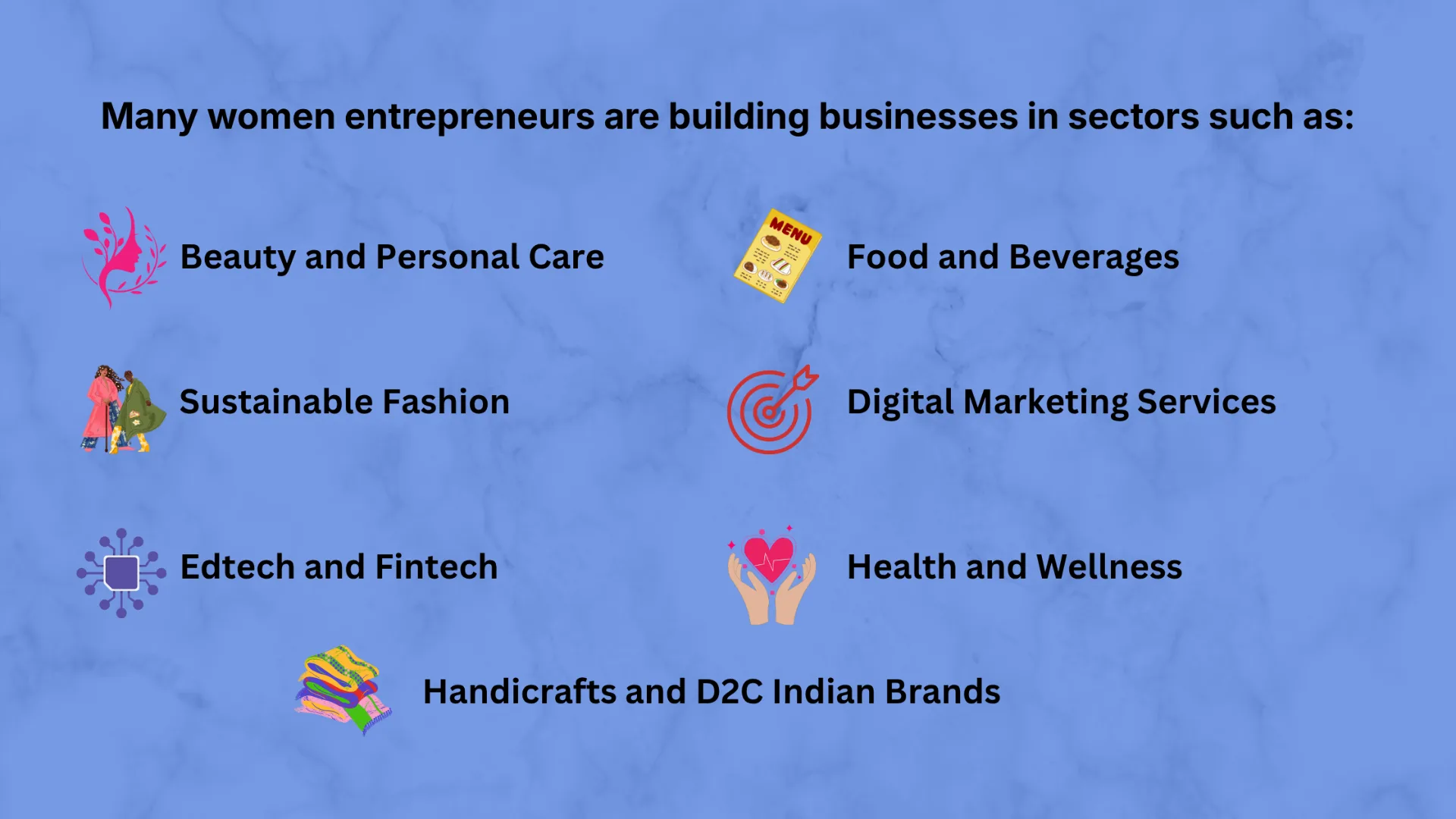
What makes this growth particularly important is that many women-led businesses in India operate with a strong community-driven approach. These businesses often create local employment opportunities, support small supply chains, and contribute to financial inclusion, especially in tier-2 and tier-3 cities.
The rise of social media and e-commerce platforms has also played a major role in empowering women entrepreneurs. Today, a business idea can grow from a small Instagram page into a nationally recognized brand within a few years. This digital-first ecosystem has opened new opportunities for women who previously had limited access to traditional business infrastructure.
Beyond economic contribution, these businesses also create a wider social impact by:
- Encouraging financial independence
- Increasing workforce participation among women
- Supporting local manufacturing and services
- Promoting entrepreneurship in smaller cities and rural regions
As India moves toward becoming a stronger digital and consumer-driven economy, women entrepreneurs are expected to play a much larger role in shaping future business growth.
Government Initiatives Supporting Women Entrepreneurship in India
Recognizing the importance of women-led businesses, the Indian government and financial institutions have introduced several initiatives to improve access to funding and business support. Some key initiatives include:
Pradhan Mantri Mudra Yojana
This scheme provides small-business loans to entrepreneurs, including women-led microenterprises, helping them access working capital and expansion funding.
Stand-Up India Scheme
The Stand-Up India initiative encourages entrepreneurship among women and underserved communities by facilitating bank loans for greenfield businesses.
SIDBI Support Programs
The Small Industries Development Bank of India (SIDBI) has launched multiple programs focused on improving financing access for women-owned MSMEs and small businesses.
These initiatives are helping create a more supportive ecosystem for women's entrepreneurship in India. However, despite the progress, access to affordable and scalable funding remains a major challenge for many women-led businesses — especially during growth stages.
That funding gap is precisely where alternative financing channels and fixed income investment ecosystems are beginning to play a much bigger role.
Why Women-led Businesses Still Face Funding Challenges
India is witnessing a strong rise in women entrepreneurship, but behind the success stories and startup headlines lies a reality that often goes unnoticed — access to funding continues to be one of the biggest roadblocks for women-led businesses in India.
Many women entrepreneurs start with strong ideas, growing customer demand, and scalable business models. However, turning those ideas into sustainable businesses often becomes difficult without consistent financial support.
Limited Access to Traditional Credit Continues to Be a Major Barrier
For many women entrepreneurs in India, securing loans from traditional financial institutions is not always straightforward. One of the biggest reasons is the lack of collateral ownership. Since property and asset ownership in many households is still largely concentrated under male family members, women often struggle to provide the financial backing banks typically require.
Traditional lending systems also tend to favor businesses with long credit histories and established financial records, something many early-stage women-owned MSMEs may not yet have. Common challenges faced by women entrepreneurs include:
- Limited collateral ownership
- Lower access to formal credit history
- Conservative lending practices
- Smaller loan approvals
- Lack of institutional investor networks
Venture Capital and Equity Funding Remain Highly Uneven
India’s startup ecosystem has grown rapidly over the years, but funding distribution remains far from equal. Women-led startups still receive a significantly smaller share of venture capital and private equity investments compared to male-led businesses.
Even when women founders raise funding, the average ticket size is often lower, creating long-term growth limitations.
Working Capital Challenges Affect Business Growth
Beyond startup funding, day-to-day working capital management is another major concern for women-led businesses in India. Many small businesses operate with tight cash flows, making it difficult to manage inventory, supplier payments, or expansion costs.
Without access to affordable financing, scaling becomes difficult even for businesses with strong market potential. This is where alternative financing ecosystems, impact investing, and fixed income investment channels are beginning to play a much bigger role in supporting women-owned MSMEs in India.
How Fixed Income Investments Work in India
Fixed-income investments are financial instruments that offer relatively stable returns over a fixed tenure. In simple terms, investors lend money to governments, companies, or financial institutions in exchange for periodic interest payments.
Unlike equities, where returns largely depend on market performance, fixed income investments are generally designed to provide more consistent income streams.
Common Types of Fixed Income Investments in India
The Indian financial market offers multiple fixed-income investment options catering to different risk appetites and financial goals. Some of the most common fixed-income investments in India include:
- Corporate Bonds - Companies raise capital from investors and pay interest over a specified period.
- Government Securities (G-Secs) - These are debt instruments issued by the Government of India and are generally considered lower-risk investments.
- Fixed Deposits (FDs) - One of the most popular investment options in India offering stable returns over fixed tenures.
- Debentures - These are unsecured debt instruments issued by companies to raise capital from investors.
- Market-linked Debentures (MLDs) - Returns are linked to market performance, offering potentially higher returns compared to traditional debt instruments.
- Debt Mutual Funds - These funds invest primarily in fixed income securities such as bonds, treasury bills, and corporate debt instruments.
How Fixed Income Investments Work
The concept behind fixed income investments is fairly simple. Investors provide capital to institutions or businesses, and in return, earn interest income over a predetermined period.
For example, when an investor purchases a corporate bond, the issuing company uses that capital for business operations, expansion, or financing needs. In return, the investor receives periodic interest payments and the principal amount at maturity. Here’s a simplified breakdown:
- Investors lend money through fixed-income instruments
- Businesses or institutions use the funds for growth and operations
- Investors receive interest income at regular intervals
- The invested amount is repaid after maturity
| Investment Type | Risk Level | Return Potential | Liquidity |
|---|---|---|---|
| Government Bonds | Low | Moderate | Medium |
| Corporate Bonds | Moderate | Higher | Medium |
| Fixed Deposits | Low | Moderate | Low |
| Debt Mutual Funds | Moderate | Moderate | High |
How Fixed Income Investments Can Fund Women-led Businesses in India
While most investors associate bonds and debt instruments with stable returns, the impact of these investments goes far beyond portfolios. The money invested in fixed income products often flows into financial institutions, NBFCs, and lending channels that support MSMEs, startups, and small businesses, including women-owned enterprises.
Non-Banking Financial Companies (NBFCs) play a major role in India’s lending ecosystem, especially for small businesses that may not always qualify for traditional bank loans. Many NBFCs raise capital through:
- Corporate bonds
- Debt instruments
- Market-linked securities
- Institutional borrowing
This capital is then used to provide loans to MSMEs and women entrepreneurs looking for business funding. Women-led businesses often rely on these financing channels for:
- Working capital
- Equipment purchases
- Inventory management
- Business expansion
The impact of women entrepreneurship extends far beyond individual businesses. When women-owned enterprises receive better financial support, the benefits often ripple across families, communities, and local economies.
This is why fixed income investment for women-led businesses is becoming part of a much larger conversation around sustainable and inclusive economic growth in India.
Risks to Know Before Making Fixed Income Investments in India
Fixed income investments are often seen as stable investment options, but like every financial product, they also come with certain risks. Understanding these factors is important for making informed investment decisions and building a balanced portfolio.
The goal is not to avoid fixed income investments altogether, but to invest with better awareness and proper diversification.
Credit Risk
One of the biggest risks of fixed income investments is credit risk. This refers to the possibility that the issuer — whether a company or financial institution — may fail to make timely interest payments or repay the principal amount. This is why checking credit ratings before investing in corporate bonds or debt instruments is extremely important.
Before investing, always evaluate:
- Issuer credibility
- Financial stability
- Credit ratings from recognized agencies
- Repayment history
Interest Rate Risk
Bond prices and interest rates usually move in opposite directions. When interest rates rise, the market value of existing bonds may decline.
This risk mainly affects investors who plan to sell their investments before maturity. Long-term debt instruments are generally more sensitive to interest rate changes.
Liquidity Risk
Some fixed income products may not be easily tradable in the secondary market. This means investors may face difficulty exiting their investments quickly when funds are needed urgently.
Liquidity risk is especially important to consider while investing in lower-rated corporate bonds or long-tenure debt products.
Diversification Helps Reduce Risk
A smart fixed income investment strategy should always include diversification. Instead of concentrating investments in a single issuer or instrument, investors should spread allocations across different products and risk categories.
A safer investing approach may include:
- Investing through SEBI-regulated platforms
- Diversifying across multiple issuers
- Balancing short-term and long-term investments
- Reviewing credit ratings regularly
Wrapping Up
Women-led businesses in India are steadily transforming the country’s entrepreneurial ecosystem, creating jobs, driving innovation, and contributing to long-term economic growth. However, access to funding still remains one of the biggest challenges for many women entrepreneurs, especially during the early and growth stages of business.
This is where fixed income investments can play a much larger role than most investors realize. Beyond offering relatively stable returns and portfolio diversification, these investments indirectly support lending ecosystems, NBFCs, and financial institutions that help fund women-owned MSMEs and small businesses across India.
As impact investing and ESG-focused investing continue to grow, more investors are beginning to look at opportunities that combine financial stability with meaningful social impact. Supporting women entrepreneurship through fixed income investments is not just about responsible investing — it is also about participating in India’s broader growth story.
For investors seeking balanced investment options with long-term potential, fixed income investments linked to inclusive economic growth can become an important part of a diversified portfolio.