Inflation-Indexed Bonds: Do They Protect Your Returns?


Inflation-Indexed Bonds: Do They Protect Your Returns?
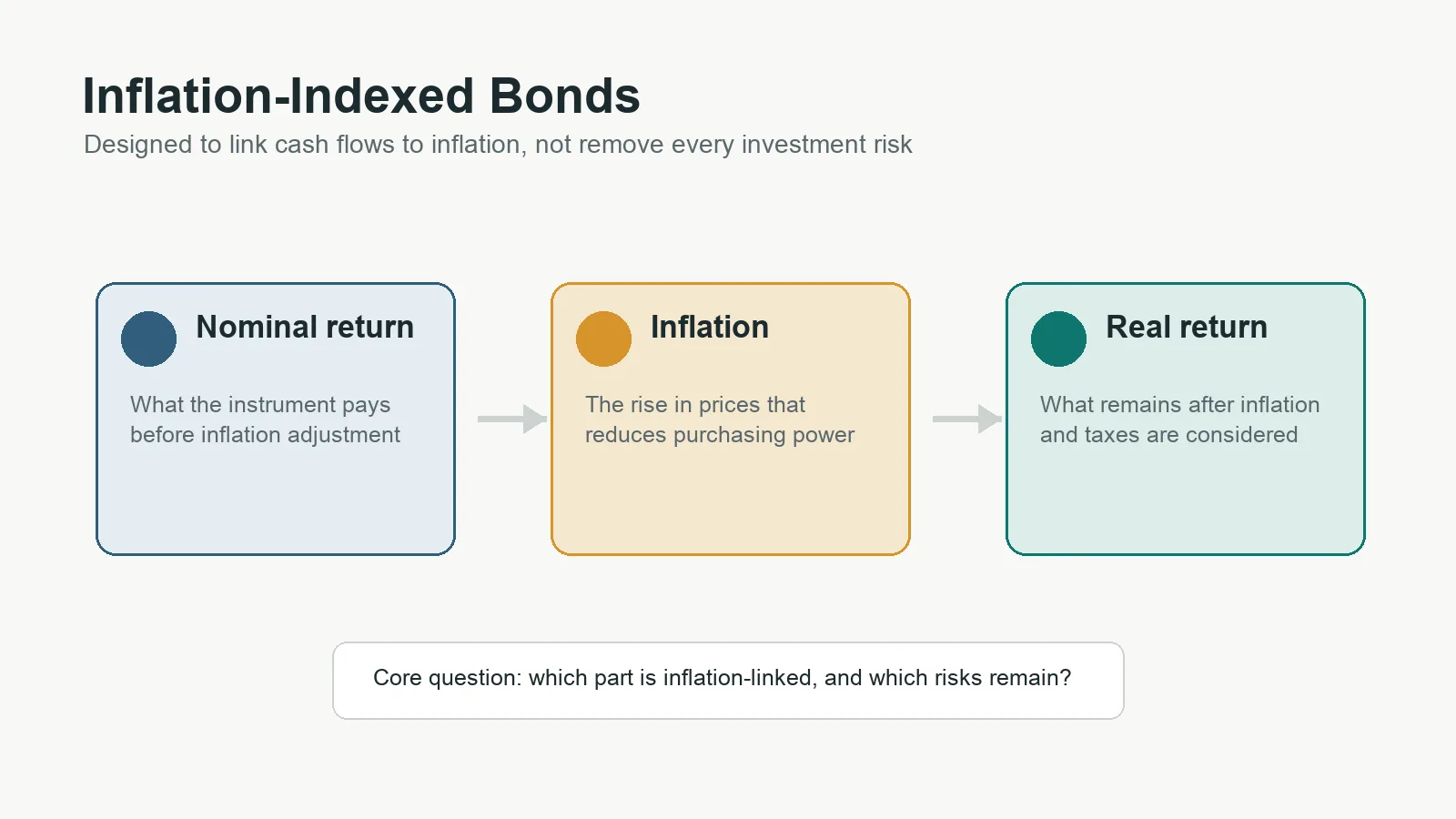
Inflation-indexed bonds are built around a simple problem: the return you see on paper is not always the return you keep in purchasing-power terms.
If a bond pays a fixed coupon while inflation rises, the investor may still receive the scheduled cash flow, but each rupee may buy less. Inflation-indexed bonds try to reduce this gap by linking principal, coupon payments, or both to an inflation index.
That does not mean they guarantee real returns. Tax, liquidity, market price movements, product structure, and availability still matter. In India, the answer is also shaped by the limited history and availability of these instruments.
This guide explains how inflation-indexed bonds work, what they may protect, what they do not protect, and how an investor can evaluate them without treating `inflation-linked` as a blanket comfort label.
What Are Inflation-Indexed Bonds?
Inflation-indexed bonds are debt securities whose cash flows are linked to a recognised inflation index, such as the Consumer Price Index (CPI) or Wholesale Price Index (WPI).
In a regular fixed-rate bond, the coupon is usually set when the bond is issued. If inflation rises later, the coupon does not automatically adjust. The investor may still receive the promised coupon, subject to issuer performance, but the real value of that income can fall.
An inflation-indexed bond works differently. Depending on the structure, the bond may adjust:
- The principal value on which interest is calculated.
- The coupon amount.
- The redemption value at maturity.
- A combination of the above.
The purpose is to link the bond's cash flows to inflation, so that the investment is less exposed to the erosion of purchasing power.
This is why inflation-indexed bonds are also called inflation-linked bonds. The name can sound reassuring, but the structure needs to be read carefully. The index used, the lag in index adjustment, the tax treatment, the maturity, and the exit route can all affect the investor's actual experience.
Why Inflation Changes the Return You Actually Keep
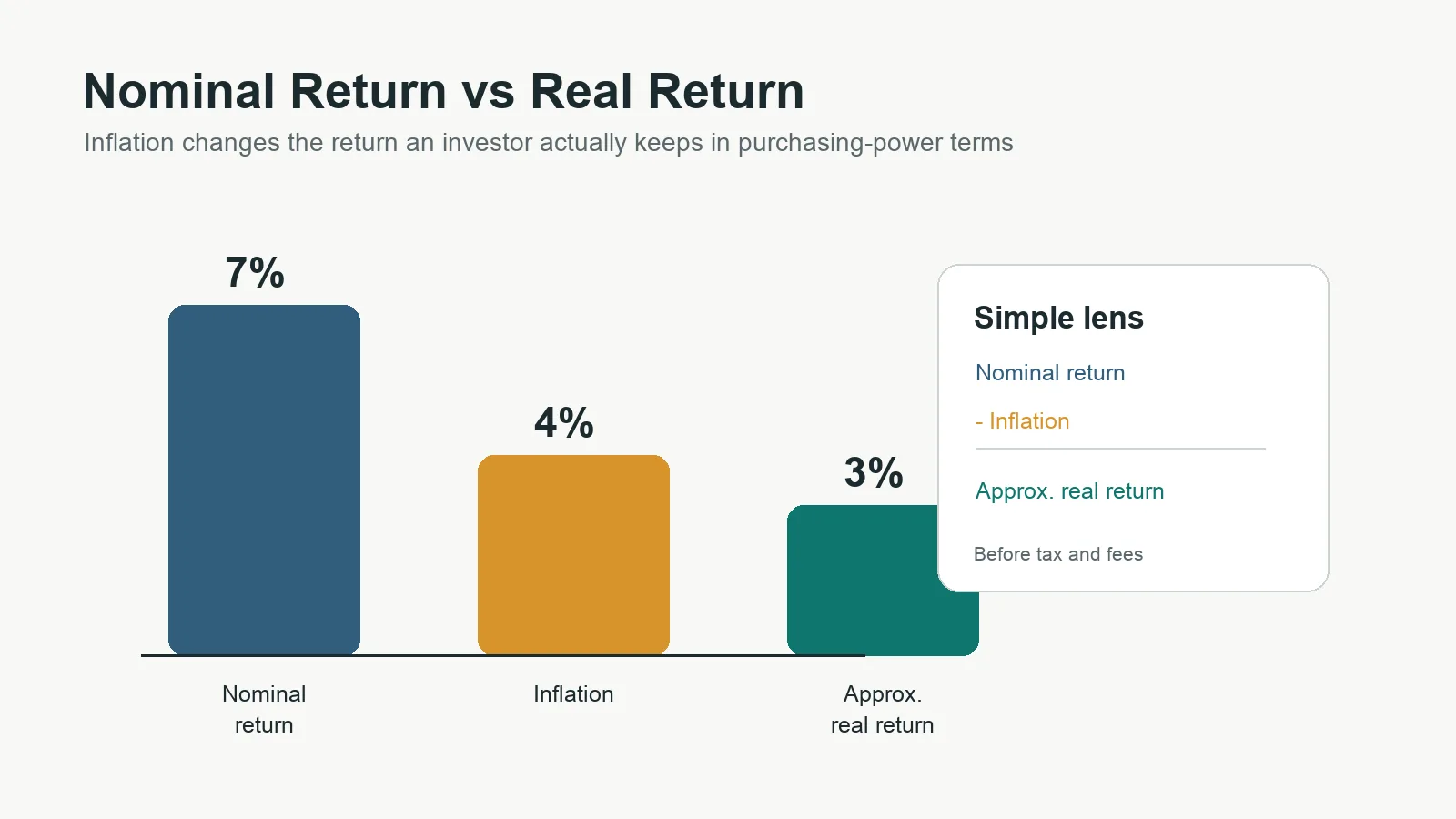
Investors often compare instruments by nominal return. That is the return before adjusting for inflation.
Real return is different. It looks at what remains after inflation has reduced purchasing power.
Approximate formula:
| Metric | Simple Meaning |
| Nominal return | Return before inflation adjustment |
| Inflation | Rise in the general price level |
| Approximate real return | Nominal return minus inflation |
For example, if an instrument earns 7% in a year and inflation is 4%, the approximate real return is about 3% before tax. After tax, the investor's real return may be lower.
This matters because inflation is not theoretical. MoSPI's CPI release dated 13 July 2026 reported all-India CPI inflation of 4.38% for June 2026 over June 2025, with food inflation at 5.32%. That does not predict future inflation, but it shows why fixed-income investors track inflation alongside coupon and yield. [Source: MoSPI CPI Press Release, June 2026
For bond investors, this is also where yield to maturity needs context. YTM can help compare bond cash flows, but it does not automatically tell you what the post-tax, inflation-adjusted return will be.
How Inflation-Indexed Bonds Work
Inflation-indexed bonds usually start with a base value. The bond then uses an inflation index to adjust the principal, coupon, or redemption amount over time.
The exact method depends on the bond terms. A simple structure may work like this:
- The bond is issued with a face value and coupon formula.
- A base inflation index is recorded on or near the issue date.
- Future index values are compared with the base index.
- If the index rises, the adjusted principal or coupon base may rise.
- Coupon and redemption amounts are calculated using the adjusted value, subject to the bond's terms.
RBI's FAQ for the 2013 Inflation Indexed Bonds explains one such structure using WPI-linked index ratios. It also notes that final WPI was used with a lag and that daily reference WPI values were interpolated between monthly reference points. [Source: RBI FAQ on Inflation Indexed Bonds
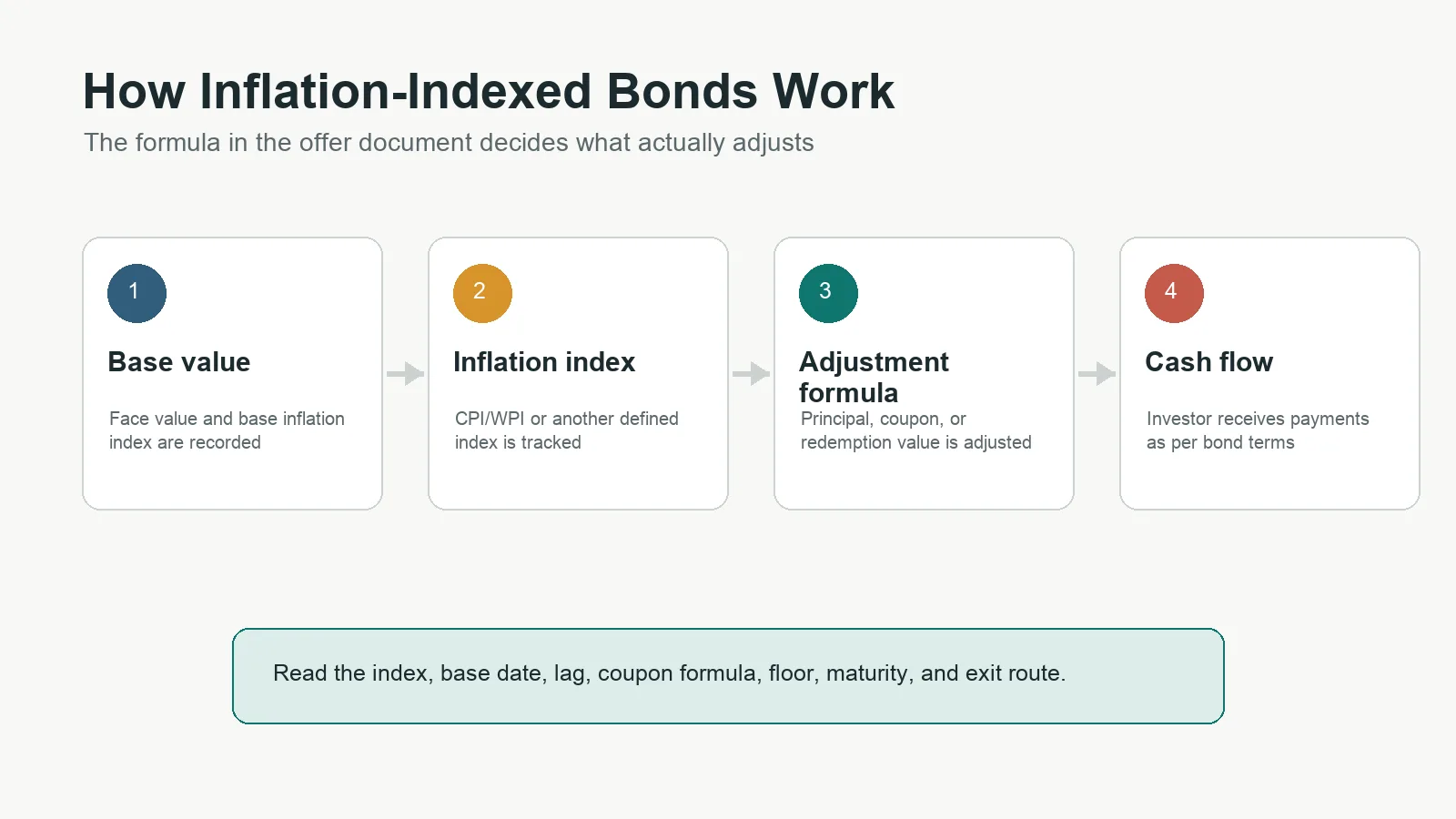
The important lesson is not that every inflation-indexed bond follows the same formula. It is that the formula matters. Investors should not rely only on the label `inflation-indexed`.
Principal Adjustment vs Coupon Adjustment
Some inflation-indexed bonds adjust the principal. In that structure, the coupon may be calculated on an inflation-adjusted principal amount.
Other instruments may adjust the coupon more directly. Some may include a redemption floor. Some may use CPI, while others may use WPI. Some may include indexation lags.
These details change the investor outcome.
For example, a bond that adjusts principal but pays a low real coupon is different from a regular bond paying a higher fixed coupon. A bond linked to WPI may not perfectly match the inflation felt by a household, which is often closer to CPI. A bond that can be sold before maturity may still face market-price risk.
A Simple Illustration of Inflation Indexation
Assume an inflation-indexed bond has:
- Face value: ₹1,00,000
- Real coupon: 2% per year
- Inflation index increase over the period: 5%
- Adjusted principal for coupon calculation: ₹1,05,000
In this simplified illustration, the annual coupon would be calculated as:
2% x ₹1,05,000 = ₹2,100
The investor receives a coupon linked to the adjusted principal rather than the original face value. This can help the cash flow move with inflation.
But this example leaves out tax, secondary-market price, reinvestment, and liquidity. It is only a mechanism illustration, not a return estimate or investment recommendation.
Do Inflation-Indexed Bonds Protect Your Returns?
The short answer: inflation-indexed bonds may help protect purchasing power against inflation, but they do not protect the investor from every risk that affects actual returns.
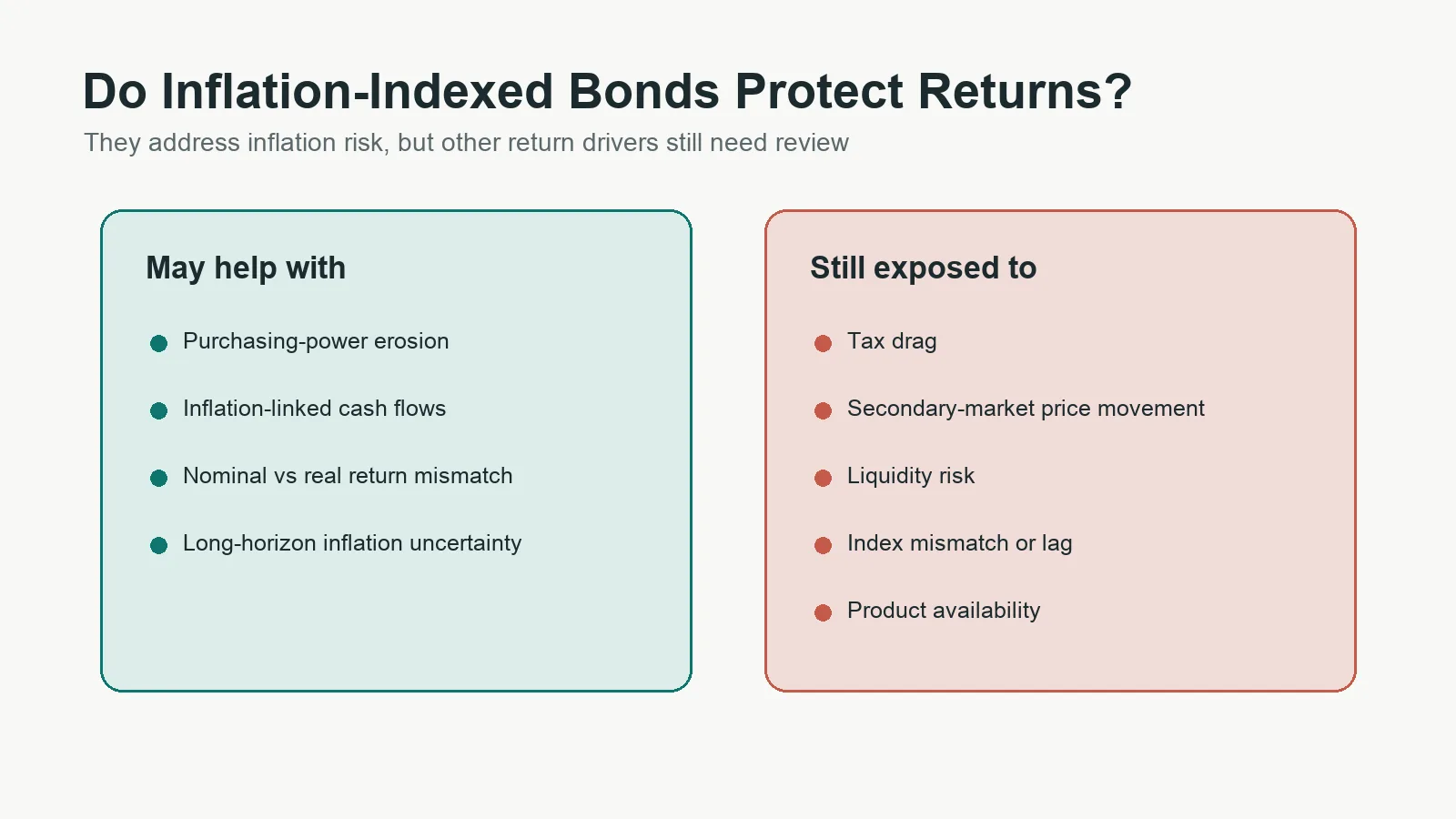
This distinction matters. The word `protect` can be misleading if it is read as a promise. Inflation-indexed bonds are designed to address one specific risk: inflation reducing the real value of fixed cash flows. They are not designed to remove tax, liquidity, credit, or market-price risk.
What Inflation-Indexed Bonds May Protect Against
Inflation-indexed bonds may help reduce the erosion of purchasing power when inflation rises.
If the bond's structure links principal or coupon payments to an appropriate inflation index, the cash flows can adjust upward with inflation. This can make the real value of the bond's income and redemption amount more resilient than a comparable fixed nominal cash flow.
They may be useful for investors who think in real-return terms rather than only nominal coupon terms. They can also help explain why a higher headline coupon is not always the same as a stronger real outcome.
What Inflation-Indexed Bonds Do Not Protect Against
Inflation-indexed bonds do not remove all risks.
| What they may help with | What still needs review |
| Inflation-linked cash flows | Tax can reduce post-tax real return |
| Purchasing-power erosion | Secondary-market prices can move |
| Nominal-vs-real return mismatch | Liquidity may be limited |
| Long-horizon inflation uncertainty | Product availability may be limited |
| Inflation index exposure | The chosen index may not match personal expenses |
They also do not automatically provide a better outcome than regular bonds, fixed deposits, G-Secs, or debt mutual funds. Each instrument has its own risk, tax, liquidity, and return structure.
For example, an inflation-indexed bond held to maturity may behave differently from the same bond sold before maturity. If interest rates change, the secondary-market price can move. If the investor is in a high tax bracket, the post-tax real return may be lower than the headline structure suggests.
Inflation-Indexed Bonds in India: Availability and History
India has had a limited but important history with inflation-indexed instruments.
RBI's Government Securities Market Primer notes that India first issued a five-year Capital Indexed Bond in December 1997, which matured in 2002. It also notes that the Government of India, through RBI, issued WPI-linked Inflation Indexed Bonds in June 2013, with monthly issuance until December 2013. CPI-based IIBs for retail investors were later issued in December 2013. Source: RBI Government Securities Market Primer
This history matters for investors because inflation-indexed bonds in India have not been as continuously available or as familiar as regular government securities, fixed deposits, or listed corporate bonds.
Before assuming that an inflation-indexed bond can be bought today, investors should check:
- Whether a current issue or secondary-market instrument is actually available.
- Whether it is a sovereign, corporate, or other debt instrument.
- Which inflation index is used.
- Whether the instrument is listed.
- What the minimum investment size is.
- Whether there is enough liquidity for exit before maturity.
- What the tax treatment will be.
Equirize is a SEBI-registered Online Bond Platform Provider (OBPP). SEBI's OBPP framework, introduced through its 14 November 2022 circular, regulates online bond platforms that facilitate access to listed debt securities. Source: SEBI OBPP Circular
That platform role should be understood clearly. An OBPP facilitates access to listed debt securities; it does not make any listed security free from market, credit, liquidity, or tax risk.
Inflation-Indexed Bonds vs Regular Bonds, FDs, and G-Secs
Inflation-indexed bonds are best understood by comparing the mechanism, not by ranking products.
| Feature | Inflation-indexed bonds | Regular fixed-rate bonds | Fixed deposits | G-secs |
| Cash flow basis | Linked to inflation index as per structure | Fixed coupon or defined bond terms | Fixed interest rate set by deposit terms | Coupon and maturity as per government security |
| Inflation response | May adjust principal/coupon/redemption | No automatic inflation adjustment | No automatic inflation adjustment | Usually no automatic inflation adjustment, unless specifically inflation-indexed |
| Main return lens | Real return and indexation formula | Coupon, price, YTM, credit risk | Interest rate and tenure | Yield, duration, interest-rate risk |
| Credit risk | Depends on issuer; sovereign if issued by government | Depends on issuer | Depends on bank/corporate issuer | Sovereign for Government of India securities |
| Liquidity | Depends on listing and market depth | Depends on listing and market depth | Premature withdrawal terms vary | Tradable, but price can move |
| Tax | Depends on instrument and investor circumstances | Interest and capital gains tax rules apply | Interest taxed as per rules | Interest and capital gains tax rules apply |
| Best evaluated by | Index, formula, maturity, liquidity, tax | Rating, issuer, YTM, maturity, liquidity | Rate, issuer, insurance/credit risk, penalty | Yield, maturity, duration, price risk |
An investor comparing options should avoid looking only at the coupon or interest rate. The better question is: what risk is the instrument solving, and what risk remains?
For a wider fixed-income map, see Equirize's guide to fixed-income investments in India. For the sovereign-versus-corporate bond distinction, see G-Secs vs corporate bonds.
Risks of Inflation-Indexed Bonds Investors Should Check
Inflation-indexed bonds can be useful, but they are not simple substitutes for every fixed-income instrument.
Inflation index mismatch: The bond may use CPI, WPI, or another index. Your personal inflation may differ from that index. Household expenses, healthcare costs, education costs, and city-level expenses do not always move exactly with the national index.
Indexation lag: Some structures use inflation data with a lag. RBI's 2013 WPI-linked IIB FAQ explains that final WPI was used with a lag because of data availability. That means adjustment may not be perfectly immediate.
Tax drag: Even if the bond adjusts for inflation, tax can reduce the post-tax real return. Tax treatment depends on the instrument, holding period, investor profile, and applicable law.
Liquidity risk: If the bond is not actively traded, exiting before maturity may be difficult or may require accepting a lower price.
Interest-rate risk: A bond's market price can fall when rates rise. This matters if the investor sells before maturity.
Complexity risk: The formula may be less intuitive than a regular coupon bond. Investors need to understand base index, reference index, adjustment formula, coupon base, redemption terms, and tax treatment.
Availability risk: In India, inflation-indexed bonds have not been continuously available in the same way as more common fixed-income products. Investors should verify actual availability before building a plan around them.
This is why the bond term sheet matters. Equirize's guide on how to read a bond term sheet can help investors map the terms before comparing yield or coupon.
When Inflation-Indexed Bonds May Fit a Fixed-Income Portfolio
Inflation-indexed bonds may be relevant for investors who care about long-term purchasing power and want part of their fixed-income allocation linked to inflation.
They may be worth evaluating when:
- The investor is thinking in real-return terms.
- The investment horizon is aligned with the bond maturity.
- The investor understands the index and adjustment formula.
- The investor does not need immediate liquidity.
- The investor is comfortable with the tax treatment.
- The investor can compare the instrument with regular bonds, FDs, G-Secs, and debt mutual funds without relying only on headline coupon.
They may be less suitable when:
- The investor needs flexible liquidity.
- The structure is not clearly understood.
- The tax treatment weakens the expected post-tax real return.
- The instrument is not actively traded.
- The investor is assuming complete protection from inflation or market risk.
In other words, inflation-indexed bonds can be a tool in fixed income. They should not be treated as a complete answer to inflation.
How to Evaluate an Inflation-Indexed Bond Before Investing
Before investing in any inflation-indexed bond, review the terms in the offer document and the platform disclosures.
Use this checklist:
| Question | Why it matters |
| Who is the issuer? | Determines credit or sovereign risk |
| Is the instrument listed? | Affects transparency and exit route |
| Which inflation index is used? | CPI, WPI, or another index can produce different results |
| What is the base index date? | Determines how future adjustments are calculated |
| Is principal, coupon, or redemption adjusted? | Shows what is actually linked to inflation |
| Is there an indexation lag? | Delays can affect cash-flow timing |
| What is the coupon formula? | A low real coupon may still produce modest cash flow |
| What happens in low inflation or deflation? | Redemption terms matter |
| What is the maturity? | Long maturity can increase price sensitivity |
| How liquid is the instrument? | Exit before maturity may be uncertain |
| How is it taxed? | Post-tax real return can differ from pre-tax return |
| Is there a credit rating? | Relevant for corporate debt securities |
| Is the offer document available? | Essential for risk-factor review |
For corporate bonds more broadly, investors can use Equirize's corporate bond evaluation checklist before comparing instruments.
If a bond is available through a platform, check the role of the platform as well. Equirize facilitates access to listed debt securities as a SEBI-registered OBPP. It does not provide investment advice or guarantee investment outcomes.
The Bottom Line on Inflation-Indexed Bonds and Real Returns
Inflation-indexed bonds can help investors think more clearly about real returns. They are designed to link bond cash flows to inflation, which may reduce the erosion of purchasing power.
But they are not a universal shield. The final investor outcome depends on the bond's structure, the inflation index used, tax treatment, liquidity, interest-rate movements, holding period, and availability.
For informed fixed-income investors, the right question is not only: `Does this bond protect against inflation?`
The better question is: Which part of my return is inflation-linked, and which risks remain with me?
Investors exploring listed bonds available through a SEBI-registered OBPP should review the offer document, credit rating where applicable, maturity, liquidity, tax treatment, and risk factors before investing.