Your First Bond Purchase: What Happens After You Click “Subscribe”?


Your First Bond Purchase: What Happens After You Click “Subscribe”?
You have completed KYC, reviewed a listed corporate bond and decided to proceed. You enter the investment amount and click “Subscribe” or “Buy.” What happens next?
For a first-time investor, this part of the process can feel unfamiliar:
- Where is the payment sent?
- When is the order confirmed?
- Who transfers the bond units?
- When will the bonds appear in the Demat account?
- Who pays the interest and principal?
- What happens if the online platform stops operating?
The answer depends partly on whether you are applying to a new issue or buying an already-listed bond. This guide explains both routes and the market participants involved.
First, Are You Subscribing or Buying?
The terms are often used interchangeably on digital platforms, but they can describe different transactions.
| Transaction | What It Usually Means |
|---|---|
| Primary-market subscription | You apply for bonds being issued or offered to investors. |
| Secondary-market purchase | You buy already-issued bonds from an existing holder or seller. |
| Public issue application | You apply during a public offer using the payment process specified in the offer documents. |
| Exchange or RFQ transaction | You purchase eligible listed bonds through an exchange-supported execution and settlement mechanism. |
The exact order, payment, allotment and settlement process depends on the route used. Before authorising payment, review the transaction summary displayed by the platform.
The Participants Involved
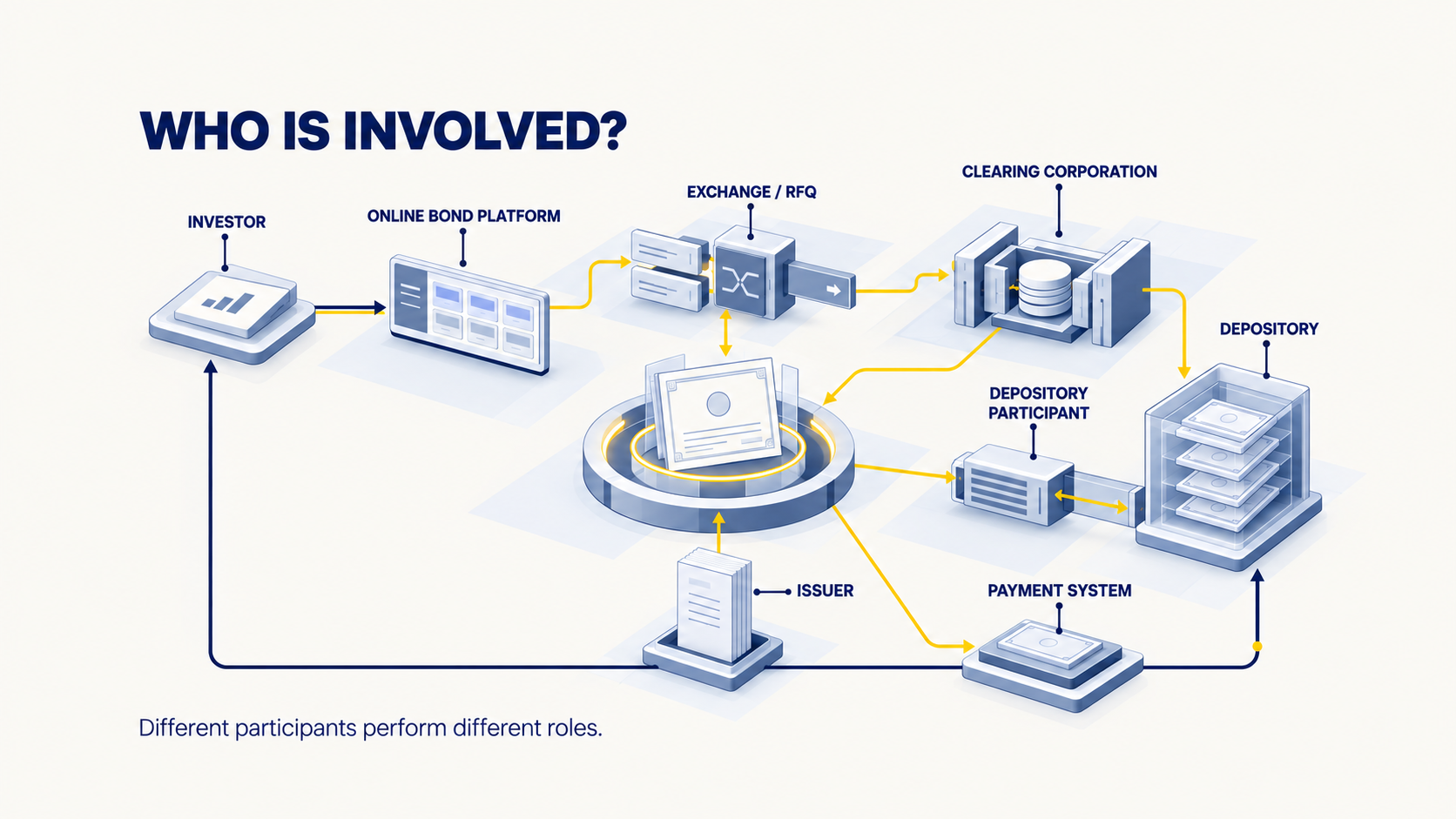
A listed bond transaction may involve several regulated or market-infrastructure entities.
| Participant | Primary Role |
|---|---|
| Issuer | The company or entity that has borrowed through the bond. |
| Online Bond Platform Provider | Provides the digital interface and facilitates access to eligible transactions. |
| Stock exchange or RFQ platform | Supports order execution or quote-based transactions, where applicable. |
| Clearing corporation | Facilitates clearing and settlement for applicable exchange transactions. |
| Depository | NSDL or CDSL maintains securities in electronic form. |
| Depository Participant | Provides and services the investor’s Demat account. |
| Registrar or RTA | Supports issuer records, allotment and corporate-action processes, where applicable. |
| Debenture trustee | Performs responsibilities specified under the bond documents and applicable regulations. |
| Bank or payment service | Processes the investor’s payment through the supported channel. |
Not every transaction involves each entity in the same way.
Step 1: Review the Order Summary
Before clicking the final payment or confirmation button, check the complete order details. These may include:
- Issuer name
- Bond description
- ISIN
- Credit rating
- Quantity
- Face value
- Market or issue price
- Accrued interest, where applicable
- Total amount payable
- Coupon rate
- Yield to Maturity
- Maturity date
- Settlement date
- Security status
- Call or put provisions
Why the ISIN Matters
Every eligible security is identified by an International Securities Identification Number, or ISIN.
The ISIN helps distinguish one bond from another. The same issuer may have several bonds with different coupons, maturity dates, security structures, ratings, payment frequencies and seniority levels.
Confirm that the ISIN shown in the order summary matches the bond you intended to purchase.
Step 2: Authorise Payment
The payment method depends on the type of transaction and the applicable market process.
For an eligible exchange or RFQ-based purchase, payment and settlement may be processed through the designated market-infrastructure mechanism. For a primary issue, funds may be blocked or collected through the payment route described in the offer and application documents.
Before Authorising Payment
Check:
- The beneficiary or payment destination displayed
- The total amount payable
- Whether accrued interest is included
- The payment deadline
- The applicable refund or fund-unblocking terms
- Whether payment must come from your registered bank account
Do not transfer money using bank details received through an unsolicited email, message or phone call. Use only the payment flow provided through Equirize’s official website or application.
Step 3: Order Placement and Validation
Once payment is authorised, the order is submitted through the applicable transaction route. Depending on the transaction, the system may validate:
- Investor details
- PAN and KYC status
- Demat-account information
- Registered bank details
- Available bond quantity
- Applicable price or quote
- Payment confirmation
- Investor eligibility
An order being submitted does not always mean it has been executed or allotted. Check whether the status displayed is:
- Payment pending
- Order placed
- Awaiting confirmation
- Executed
- Allotted
- Settled
- Rejected
- Cancelled
If the order fails, the refund or unblocking timeline will depend on the payment method, market mechanism and reason for failure. Do not assume that every failed order will be refunded within a fixed 24-hour period.
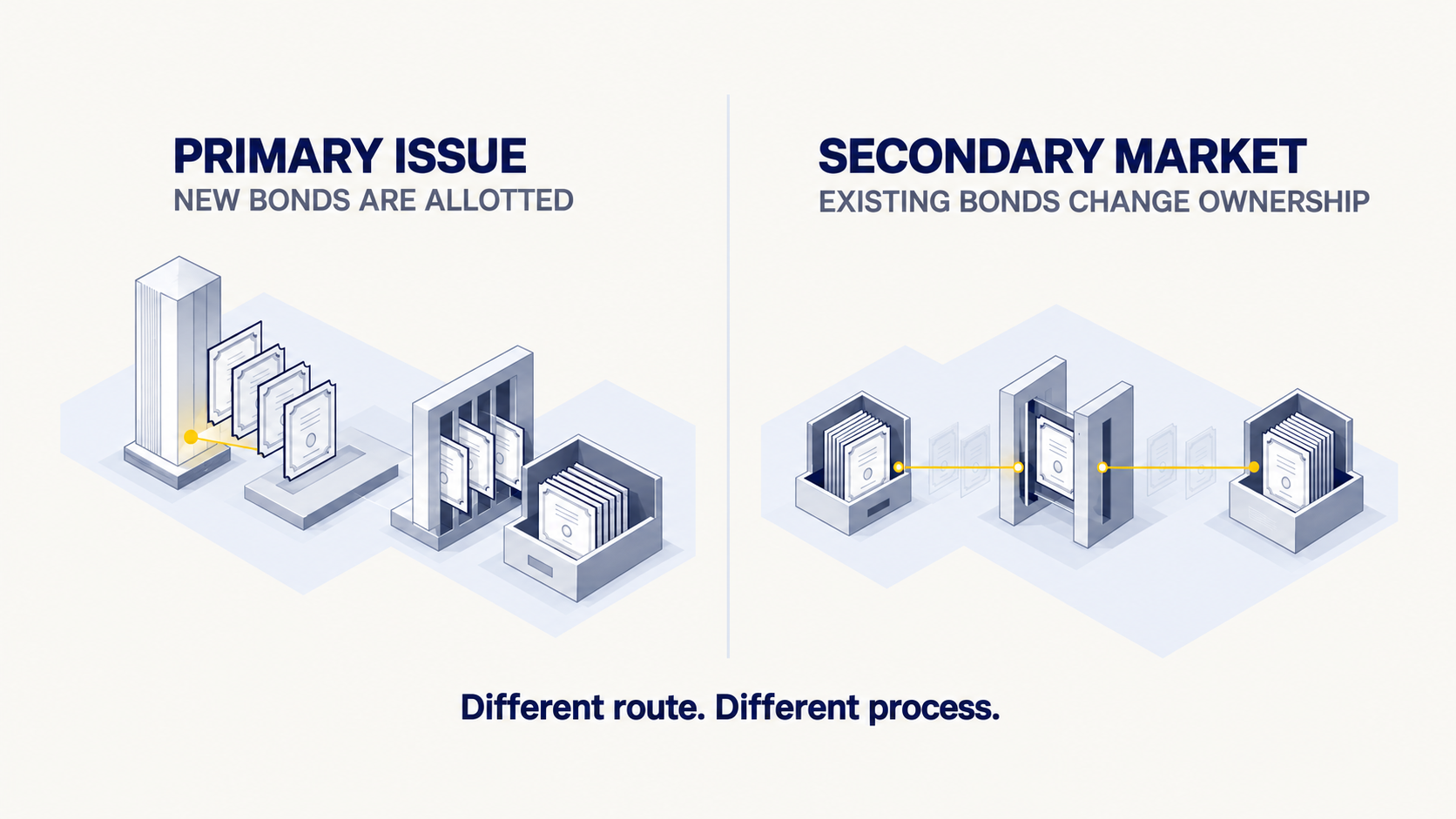
Step 4A: What Happens in a Primary Issue?
In a primary-market subscription, you are applying for bonds being offered by the issuer. The general sequence may include:
- Submission of the application
- Payment or blocking of funds
- Closure of the issue or application window
- Validation of eligible applications
- Basis of allotment, where applicable
- Allotment by the issuer
- Credit of allotted bonds to the Demat account
- Refund or release of excess or unsuccessful application funds
The issuer and its appointed intermediaries—including the registrar, where applicable—support the allotment and record-maintenance process.
The number of bonds allotted may be lower than the number requested if the application is not fully accepted or the issue is oversubscribed. Refer to the offer document for the applicable allotment, listing and refund timelines.
Step 4B: What Happens in a Secondary-Market Purchase?
In a secondary-market purchase, the bond already exists and is being transferred from a seller to the buyer.
The transaction may be executed through an exchange or Request for Quote mechanism, depending on the platform and security. After execution:
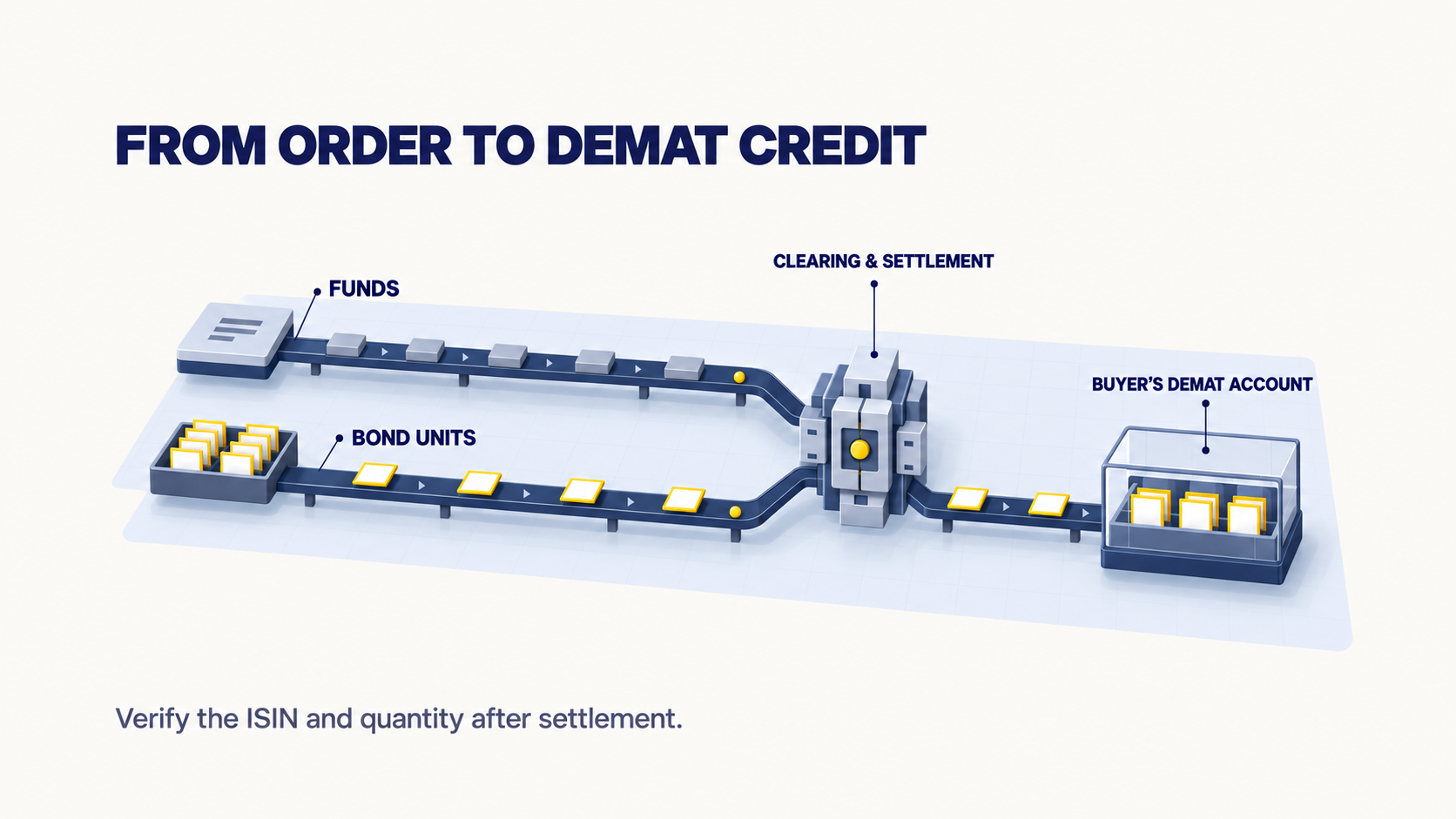
- The transaction moves to clearing and settlement
- Funds are settled through the applicable mechanism
- Bond units are transferred from the seller’s Demat account
- The units are credited to the buyer’s Demat account
An RTA does not “allot” fresh bonds in an ordinary secondary-market trade. Ownership changes through the depository and settlement infrastructure.
Step 5: Clearing and Settlement
Clearing determines the obligations of the buyer and seller. Settlement completes the exchange of funds and securities.
For many exchange debt-segment transactions, settlement may occur on a rolling T+1 basis:
- T: Trade date
- T+1: Next applicable settlement day
However, the exact timeline can vary according to the transaction route, exchange or platform, security, payment method, trading calendar, bank or market holiday, and failed or delayed obligations.
Always use the settlement date shown in your order confirmation or contract note instead of assuming that every transaction will follow the same timeline.
Step 6: Demat Credit
After successful settlement or allotment, the bond units are credited to the Demat account linked to your transaction.
Depending on your communication settings, you may receive confirmation from:
- Equirize
- Your broker
- Your Depository Participant
- NSDL or CDSL
- The relevant market-infrastructure entity
What to Verify After Settlement
- Issuer or security name
- ISIN
- Quantity credited
- Settlement date
- Demat account
- Transaction price
- Total amount paid
You can verify the holding through your Depository Participant’s statement or the facility provided by NSDL or CDSL.
If the units do not appear after the stated settlement timeline, contact Equirize or your Depository Participant through an official support channel.
Step 7: Contract Note and Transaction Records
Where applicable, retain the documents generated for the transaction. These may include:
- Order confirmation
- Payment receipt
- Contract note
- Allotment advice
- Depository confirmation
- Account statement
- Offer document
- Term sheet
- Credit-rating rationale
These records can help you verify the transaction, calculate taxes and raise a service or grievance request if required.
Step 8: Coupon Payments
After the bond is credited, coupon payments are governed by the bond’s terms. Depending on the instrument, interest may be scheduled:
- Monthly
- Quarterly
- Half-yearly
- Annually
- At maturity
The issuer or its appointed agents generally use depository records as of the applicable record date to identify eligible holders. The scheduled payment is then processed to the bank account registered through the relevant records.
Important Checks
Confirm that:
- Your bank details are current
- Your Demat account is active
- Your name and PAN details are consistent
- You understand the record date
- You know the scheduled coupon dates
A scheduled coupon is a contractual obligation—not a guaranteed payment. Payment remains subject to the issuer meeting its obligations.
Step 9: What Happens at Maturity?
At maturity, the issuer is required to repay the principal according to the bond’s terms. The process generally involves:
- Identification of eligible holders using depository records
- Processing of principal and any final interest payment
- Credit of the applicable amount to the registered bank account
- Extinguishment or debit of the matured bond units from the Demat account
The actual payment remains dependent on the issuer fulfilling its obligations. If the issuer delays or defaults on payment, the bond’s default provisions, debenture-trustee process and applicable legal remedies may become relevant.
What If the Equirize Platform Stops Operating?
Your Demat holdings are not the same as your account interface on an online bond platform.
Once successfully credited, bond units are generally reflected in the investor’s Demat account maintained through the depository system. The issuer’s coupon and principal obligations arise from the bond terms, not from the continued operation of the interface through which the investment was originally purchased.
However, this does not mean that a platform shutdown would have no effect at all. It could affect:
- Access to the platform’s dashboard
- Customer support
- Transaction history available through the platform
- Ability to initiate a sale through the same interface
- Platform-provided reminders or tracking features
Investors should retain their records and know how to access holdings through their Depository Participant, NSDL or CDSL.
They should also keep details of:
- The issuer
- ISIN
- Debenture trustee
- Depository Participant
- Stock exchange
- Grievance-redressal channels
A platform ceasing operations does not remove issuer credit risk or guarantee that all future payments will be made.
Platform Risk and Issuer Risk Are Different
It is useful to separate three different risks:
| Risk | What It Relates To |
|---|---|
| Platform or service-continuity risk | Continued availability of the online interface and support. |
| Custody and settlement risk | Maintenance and transfer of securities through market infrastructure. |
| Issuer credit risk | The issuer’s ability to pay interest and principal. |
A regulated transaction structure can reduce certain operational concerns, but it cannot eliminate investment risk.
Before You Subscribe: Final Checklist
Confirm that you have reviewed:
- Issuer name and ISIN
- Credit rating and rating rationale
- Coupon and Yield to Maturity
- Total amount payable
- Accrued interest, if applicable
- Maturity date
- Settlement date
- Security status
- Liquidity and early-exit risks
- Call or put options
- Offer document and term sheet
- Official payment route
- Demat and bank details
Do not proceed solely because the payment journey appears simple. A convenient transaction process does not make the underlying bond low-risk or suitable for every investor.
Key Takeaway
After you click “Subscribe” or “Buy,” your transaction moves through the applicable payment, execution, clearing, settlement and depository processes.
The precise journey depends on whether you are applying to a primary issue, buying an already-listed bond, or transacting through an exchange or RFQ mechanism.
Review the order status and settlement details shown for the specific transaction. After completion, verify the bond’s ISIN and quantity in your Demat account.
Explore Listed Bonds on Equirize
Review available listed bonds using details such as:
- Issuer information
- Credit rating
- Yield
- Maturity
- Coupon frequency
- Security status
- Minimum investment amount
Read the term sheet, offer document, rating rationale and risk factors before making an investment decision.
Explore Listed BondsRisk Disclosure
Investments in listed corporate bonds and other debt securities are subject to market risks, including credit risk, interest-rate risk and liquidity risk.
Bond prices may fluctuate, and investors may not be able to sell an investment before maturity at the original purchase price. Listing on a stock exchange does not guarantee liquidity.
Scheduled coupon and principal payments remain subject to the issuer meeting its obligations. Returns and repayment are not guaranteed.
Credit ratings are opinions regarding credit risk and are not recommendations to buy, sell or hold any security. Past performance does not indicate or guarantee future results.
Please read the offer document, term sheet, credit-rating rationale and applicable risk factors carefully before investing.
SEBI Non-Endorsement Disclosure
Registration with SEBI or a stock exchange does not constitute approval, endorsement or guarantee of Equirize, any security displayed on the platform or any investment outcome.
Educational Disclaimer
This content is provided solely for informational and educational purposes. The transaction, payment, allotment, refund and settlement process may vary according to the security, transaction route and applicable market mechanism.
This content does not constitute investment advice, an offer or a solicitation to invest.
EquiRize Securities Private Limited
SEBI Registration Number: INZ000323730
BSE Debt Segment Member No.: 6914
NSE Debt Segment Member No.: 90472