How to Get the Highest Bond Yield in India: Guide


If you want the highest bond yield in India, do not start by chasing the highest coupon. Start by checking the price you are actually paying. The same listed bond can be available at different prices across platforms, brokers, and order books. Since bond yield moves in the opposite direction of price, a small price difference can quietly change your final return.
This is especially important for investors buying listed corporate bonds, NCDs, government securities, or other fixed-income securities through SEBI-registered Online Bond Platform Providers (OBPPs). Regulation improves the transaction framework, but it does not make every displayed quote equally efficient.
For example, if the same ISIN is quoted at Rs. 985 on one platform and Rs. 1,005 on another, both investors may receive the same coupon, but the investor who paid Rs. 985 starts with a better yield. This guide explains how to use ISIN lookups, Last Traded Price checks, market depth, and platform comparison before investing.
Why the Same Bond Can Give You a Different Yield on Different Platforms
Many investors assume that a bond has one fixed price at any given time, like an FD interest rate printed by a bank. Listed bonds do not work that way. A bond has a face value, coupon rate, maturity date, credit rating, and ISIN, but its secondary-market price can vary by demand, supply, trade size, liquidity, and platform access.
This is why two investors can buy the same bond on the same day and still lock in different yields. The instrument is identical, but the entry price is not.
Yield to maturity, or YTM, is price-sensitive. If you buy a bond below its face value, the discount can improve your annualised return, assuming scheduled coupon and principal payments happen on time. If you buy above face value, the premium can reduce your annualised return. That is why understanding bond YTM vs coupon rate is essential before comparing offers.
How Bond Prices Move with Supply and Demand
Bond prices move because buyers and sellers keep changing their expectations. When demand is strong for a specific issuer, rating, maturity, or coupon, buyers may accept a higher price. A higher price pushes yield down. When sellers are more active or buyers demand a wider return, the price can fall. A lower price pushes yield up.
This price-yield relationship is the foundation of bond investing. The coupon tells you the interest rate on face value. The price tells you what you are paying today. The yield connects both.
How Broker Markups and Platform Spreads Silently Reduce Your Yield
The second reason prices vary is the cost layer between market price and investor price. A platform may show an offer price that includes a markup, spread, brokerage, or other charge. Even when the charge looks small, it can reduce your effective yield because you are paying more for the same future cashflows.
This is the hidden cost of not comparing bond prices in India. The bond may be good, the issuer may be acceptable, and the tenure may suit you, but an inefficient entry price can still reduce your return.
A Worked Example: Same ISIN, Two Prices, Two Yields
Assume a listed bond has a face value of Rs. 1,000, a coupon of 9%, and three years left to maturity. Investor A buys the same ISIN at Rs. 985. Investor B buys it at Rs. 1,005. Both receive the same coupon if the issuer pays on schedule, and both are due the same maturity value. Investor A earns more because the entry price is lower. Investor B earns less because the entry price is higher.
| Same bond, different entry price | Investor A | Investor B |
|---|---|---|
| ISIN | Same | Same |
| Coupon | Same | Same |
| Entry price | Rs. 985 | Rs. 1,005 |
| Price impact on yield | Positive | Negative |
| Investor lesson | Better entry price improves yield | HIgher entry price reduces yield |
The numbers are illustrative, but the principle is practical: the highest yield on the same bond usually comes from better price discovery, not extra credit risk.
Step 1 - Use the ISIN to Identify the Exact Bond Across All Platforms
The first step in any bond price check is to identify the exact security. Do not rely only on the issuer name or product card title. Many issuers have multiple bonds outstanding, and each one can have a different coupon, maturity, rating, seniority, security structure, call option, payment frequency, and liquidity profile.
The International Securities Identification Number, or ISIN, solves this problem. It is the unique identifier for a specific security. When you search using the ISIN, you are comparing the same bond across platforms rather than accidentally comparing two similar-looking securities.
For investors exploring listed bonds on EquiRize, the ISIN should be part of the pre-investment checklist. It helps you compare quotes, check market data, review traded prices, and reduce the chance of buying a bond based on an incomplete name match.
What is an ISIN and why it is the only reliable bond identifier
An ISIN is like a passport number for a security. The issuer name tells you who borrowed the money. The ISIN tells you which exact bond you are looking at. This matters because one issuer can have dozens of listed debt securities with different terms.
For example, a company may have one bond maturing in 2027, another in 2029, and another with a call option before maturity. Searching only by issuer name can create confusion. Searching by ISIN keeps the comparison clean.
Where to look up an ISIN in India
Investors can cross-check bond information through exchange and depository-linked sources. Useful references include NSE bond market data, BSE debt segment pages, and NSDL India Bond Info or ISIN search tools. These sources help validate the instrument identity, issuer details, and market activity before you rely on a platform quote.
If an offer does not clearly show the ISIN, treat that as a reason to pause. A serious bond comparison should begin with the exact security identifier.
Step 2 - Benchmark the Quoted Price Against the Last Traded Price (LTP)
Once you have the ISIN, the next step is to compare the quoted price with the Last Traded Price, commonly called LTP. The LTP tells you the price at which a real trade last happened for that security. It is not a guarantee that you can buy the bond at the same price, but it is one of the best available reference points for market reality.
Without LTP benchmarking, you are looking at a platform quote in isolation. With LTP benchmarking, you can ask a sharper question: is this quote close to where the market has actually traded, or am I paying a meaningful premium?
This is the difference between casual browsing and professional pre-investment diligence.
What Last Traded Price tells you that the quoted price does not
The quoted price is what a platform, broker, or seller is currently showing you. The Last Traded Price is evidence of a completed transaction. That distinction matters. A quote can be aspirational, marked up, stale, or available only for a limited quantity. LTP shows where buyers and sellers previously agreed.
If the quoted price is materially higher than the recent LTP, your yield may be lower than the market-clearing level suggests. If the quoted price is below recent LTP, check whether the quantity is actually available and whether anything has changed in issuer risk.
How far from LTP is too far? A practical rule of thumb
There is no universal perfect spread because bonds differ in liquidity, tenure, rating, and market demand. As a practical discipline, treat any meaningful gap from recent LTP as a prompt for investigation. Ask why the quote is different. Is liquidity thin? Is the bond rarely traded? Is the trade size small? Is there a broker markup? Has the issuer's credit perception changed?
For liquid bonds, large unexplained deviations deserve caution. For illiquid bonds, LTP may itself be old, so you should combine it with market depth, recent trade history, and bid-ask quotes.
If you are still learning how price affects returns, read the EquiRize guide on how to invest in corporate bonds before placing large allocations.
Step 3 - Check Market Depth Before Committing Your Allocation
Market depth shows the available buy and sell interest at different price levels. For bond investors, it answers a practical question that LTP alone cannot answer: how much quantity is available at the price you want?
This matters because a good-looking price on a small quantity may not be useful for a larger order. You might get partial allocation at the attractive price and then have to pay more for the rest. Or the displayed price may disappear before your order is filled.
Market depth is also a liquidity signal. A bond with multiple bid and offer levels may be easier to enter or exit than a bond where only one small order is visible. Liquidity does not remove credit risk, but it affects execution quality and exit flexibility.
What market depth means for bond investors
For retail and HNI investors, market depth is the difference between "this price exists" and "this price is realistically available to me." A single quote may not represent the true cost of building your desired position.
Suppose you want to invest Rs. 10 lakh. If only Rs. 1 lakh worth of bonds is available at the attractive price, your blended purchase price may be higher once the remaining allocation is filled. Your actual yield will then be lower than the headline quote.
How to avoid the "great price, no allocation" problem
Before committing, check whether the available quantity matches your intended allocation. If the attractive price is available only for a small quantity, calculate the blended price across the full order. Also check whether the bond has enough trading activity to support exit needs before maturity.
Investors comparing high-yield bonds should be especially careful here. A higher yield may reflect genuine opportunity, but it may also reflect lower liquidity, weaker demand, or higher perceived credit risk.
Step 4 - Compare Across Platforms Before Placing Your Order
Most people compare flights, hotels, insurance premiums, and electronics before buying. Bonds deserve the same discipline. The difference is that in bonds, comparison is not just about saving money. It directly affects yield.
To compare properly, use the same ISIN, the same intended investment amount, and the same settlement assumptions. Then compare the quoted price, yield to maturity, available quantity, brokerage, platform charges, and recent LTP. If one platform shows a meaningfully lower price for the same ISIN, ask whether the quantity is available and whether the quote is executable.
EquiRize's ISIN-based price check workflow is useful as a neutral diligence step before investing. It helps investors compare the bond as a market security rather than relying only on one visible platform quote.
This is not about choosing the flashiest platform. It is about using a repeatable process before every bond order.
How Much Yield Difference Can a Price Check Actually Make?
A price check can matter more than investors expect. The exact impact depends on coupon, maturity, purchase price, and payment frequency, but even a small difference in entry price can change the annualised yield.
Here is a simple illustrative example. Assume you invest Rs. 10 lakh in a bond with three years left to maturity. If one platform's effective price is 0.50% higher than another for the same bond, you may be paying Rs. 5,000 more at entry. Spread over three years, that difference can reduce your annualised return by roughly 15-20 basis points before considering compounding and exact cashflow timing.
| Investment amount | Price difference | Extra amount paid | Investor impact |
|---|---|---|---|
| Rs. 5 lakh | 0.50% | Rs. 2,500 | Lower effective yield |
| Rs. 10 lakh | 0.50% | Rs. 5,000 | Lower effective yield |
| Rs. 25 lakh | 0.50% | Rs. 12,500 | Larger return leakage |
This is why price discipline is not a small operational detail. It can be the difference between an efficient bond purchase and a return that was reduced before the investment even began.
Important risk note: fixed-income investments are subject to credit risk, market risk, liquidity risk, reinvestment risk, and default risk. A better entry price can improve yield on the same bond, but it does not remove issuer risk. Read all offer documents, disclosures, rating rationales, and risk factors carefully.
How Do I Check Market Depth for a Bond in India?
Market depth can be checked through exchange-linked market data, broker terminals, OBPP workflows, or platform support teams that can show available quantities at different price levels. Look beyond the best displayed price and check whether enough quantity is available for your intended allocation.
Run a price check before your next bond investment
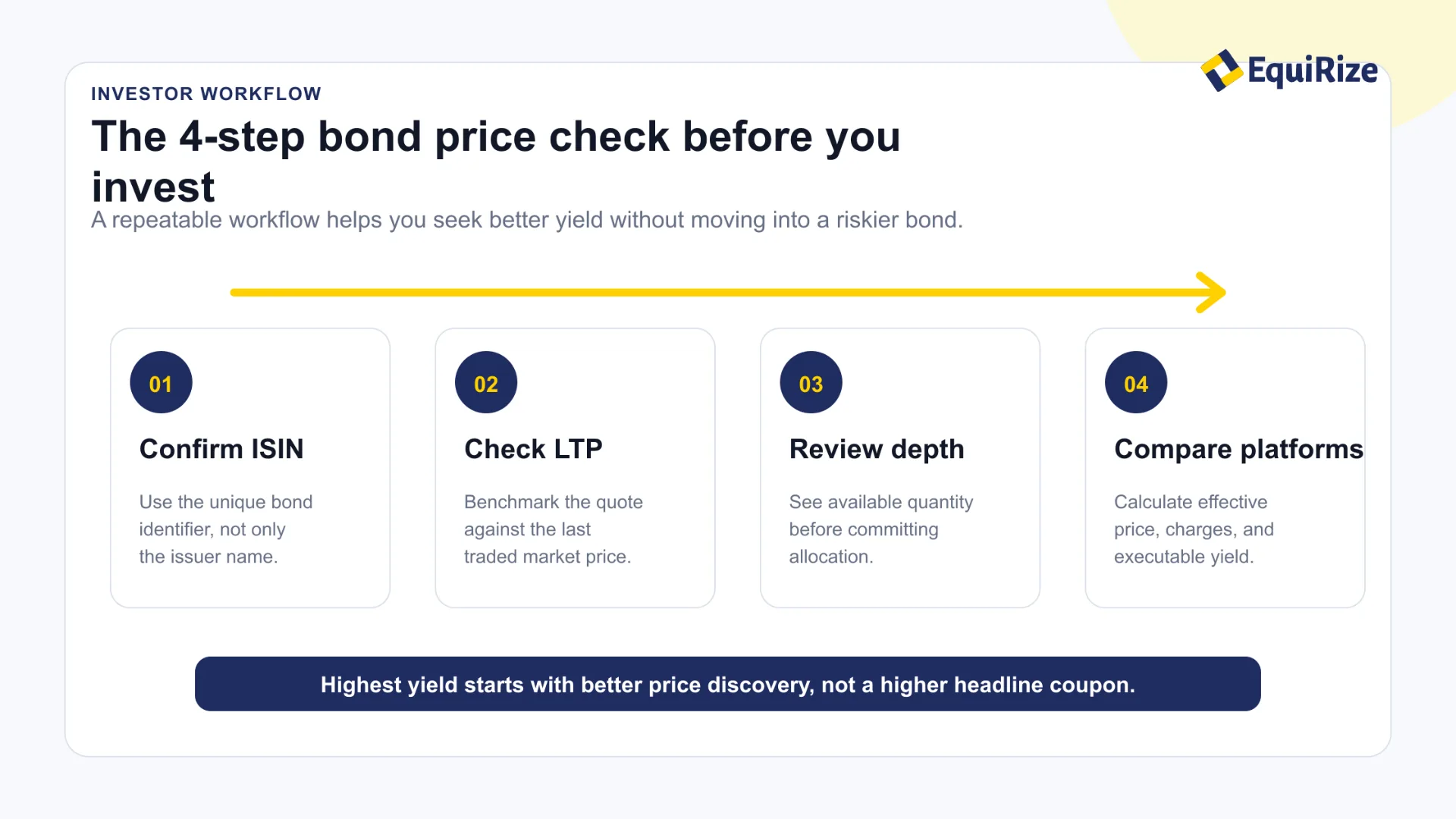
Before your next bond order, run a simple four-step check: confirm the ISIN, benchmark the quote against LTP, review market depth, and compare across platforms. This can help you pursue the highest bond yield in India on the same security without taking additional credit risk.