Form 121 for Bond Investors: TDS, Interest Income and What to Check


Understanding non-deduction declarations without confusing TDS treatment with final tax liability.
When interest is credited without tax deducted at source, investors sometimes assume that the income is exempt. That conclusion is unsafe.
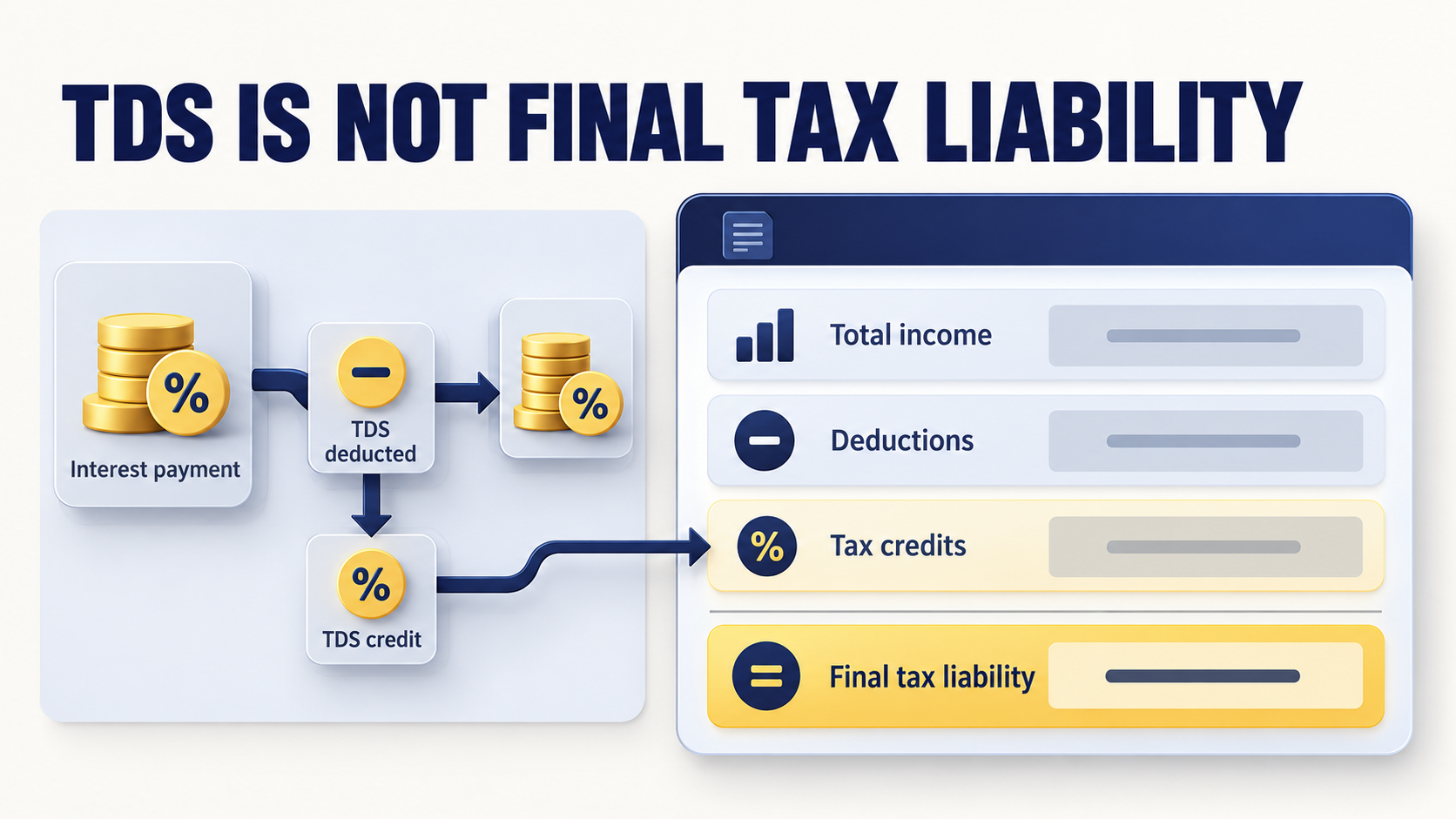
TDS is a tax-collection mechanism. Final tax liability is determined separately under the law that applies to the investor, the income and the relevant tax year. A valid non-deduction declaration may change what is deducted when income is paid; it does not automatically change whether the income is taxable.
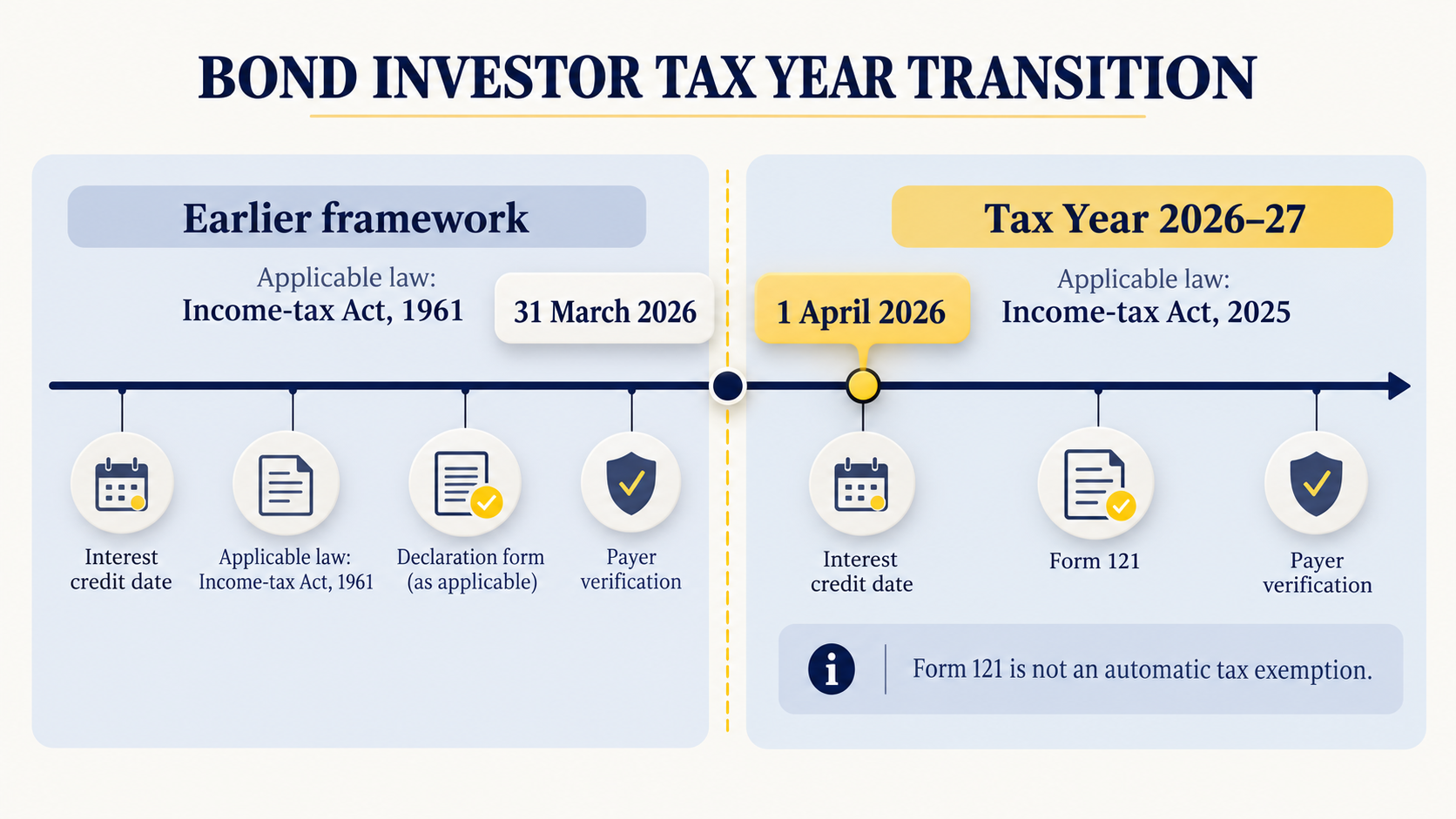
From the tax year beginning on or after 1 April 2026, the Income Tax Department’s forms framework under the Income-tax Act, 2025 includes Form 121 for applicable declarations relating to deduction at source. Eligibility and filing conditions must be checked under the current rules before use.
TDS and Final Tax Are Different Questions
TDS asks: should tax be deducted when the payment is made or credited?
Final tax asks: after considering the investor’s total income, deductions, rates, reliefs and credits, what tax is actually payable?
An investor may have no TDS deducted but still owe tax. Another investor may have tax deducted and later claim credit or a refund, depending on the return computation.
What Form 121 Is Intended to Do
Form 121 sits within the new forms framework for the Income-tax Act, 2025. It is not a certificate that converts taxable bond interest into exempt income.
Where the form is legally available and the declarant satisfies the applicable conditions, it may be used to request non-deduction or the treatment provided under the relevant provisions. The exact eligibility can depend on factors such as taxpayer category, estimated total income, tax liability and the nature of the payment.
Important: Do not submit the form merely because an online portal displays it. Read the declaration, confirm that the statements are true for the relevant tax year and obtain professional advice where necessary.
Which Tax Year and Law Apply?
Tax transitions require care. A form or provision applicable to a tax year beginning on or after 1 April 2026 should not automatically be used for an earlier period.
Before filing, confirm:
- The date on which interest is credited or paid
- The tax year to which the income belongs
- The law and form applicable to that period
- The investor category and eligibility conditions
- Whether the payer supports the relevant declaration process
How Bond Interest May Appear in Your Tax Records
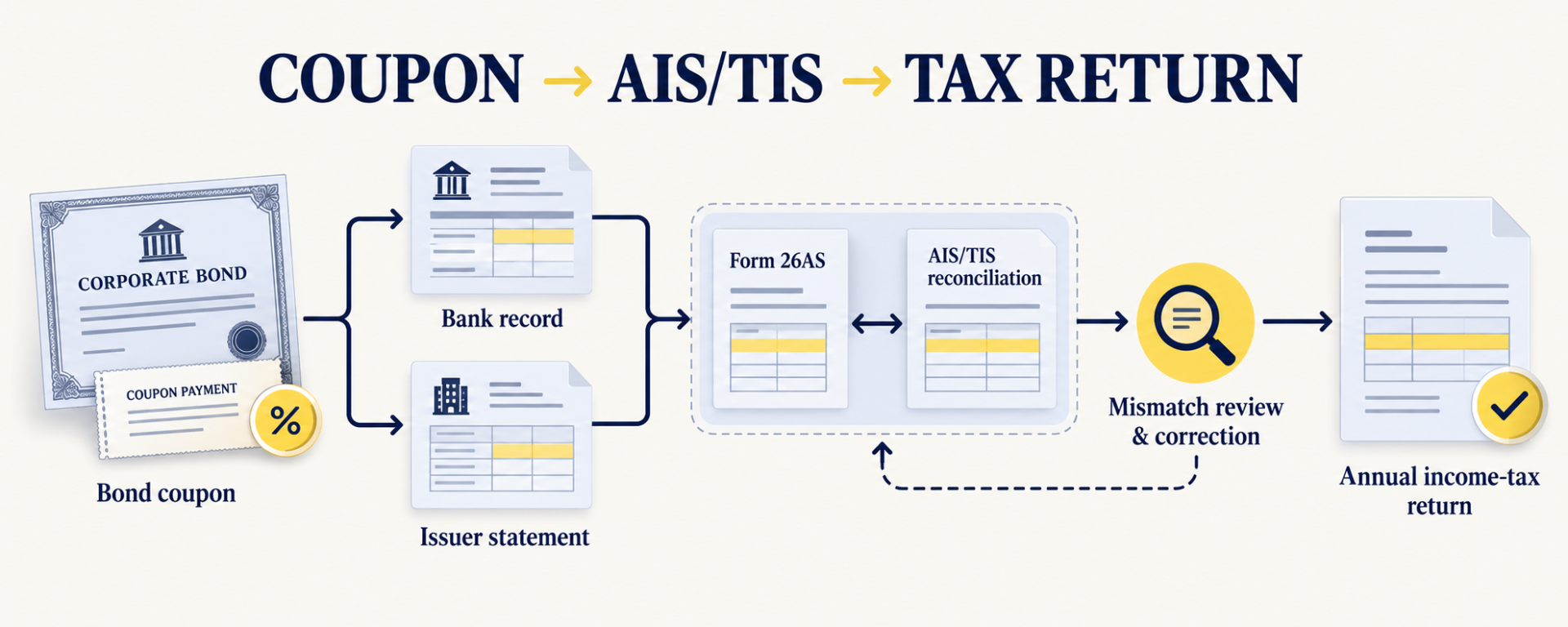
Bond interest can appear through coupon credits, bank entries, payer statements, TDS certificates where applicable and information reflected in Form 26AS or AIS/TIS.
Keep a simple reconciliation for every holding:
| Record | What to verify |
|---|---|
| Bank statement | Amount and date of coupon received |
| Demat statement | ISIN and quantity held around the record date |
| Issuer or platform statement | Coupon schedule and payment details |
| Form 26AS | TDS deposited, where applicable |
| AIS/TIS | Interest information reported against PAN |
| Tax return working | Income offered and credit claimed |
A mismatch does not necessarily mean tax evasion or issuer error. Timing, accrued interest, joint ownership, duplicate reporting or an incorrect PAN mapping can create differences. Investigate and correct the underlying record.
No TDS Can Still Create an Advance-Tax Obligation
If tax is not deducted and the investor has taxable income, the final liability may need to be managed through advance tax or self-assessment tax, subject to the applicable rules.
This is particularly relevant when interest income is meaningful or when the investor has income from several issuers and platforms. Review the expected annual income rather than treating every coupon in isolation.
What the Payer and Investor Each Need to Do
The payer applies the deduction rules and processes a valid declaration under the applicable system. The investor remains responsible for the accuracy of the declaration and the final tax return.
The investor should provide consistent PAN, name and contact details; retain the filed form or acknowledgement; track the gross interest credited; and verify whether any tax was deducted and deposited. If a declaration is rejected or cannot be processed, do not assume that the payer has accepted it merely because it was uploaded.
Where interest is received from more than one issuer, maintain an issuer-wise schedule. This reduces the risk of overlooking income that appears separately in AIS/TIS or of exceeding an eligibility condition that was evaluated using only one holding.
What to Do When the Records Do Not Match
If the bank credit, issuer statement, Form 26AS or AIS/TIS does not match your records:
- Confirm the ISIN, payment date and gross coupon amount.
- Check whether the entry relates to another financial year or tax year.
- Review whether accrued interest or a joint holding affects the figure.
- Contact the issuer, registrar or payer through official channels.
- Use the applicable AIS feedback or correction process where appropriate.
- Keep supporting statements with the tax working.
Do not simply delete or ignore an entry because it appears incorrect. A documented reconciliation is safer than an unsupported adjustment.
Common Mistakes to Avoid
- Treating “no TDS” as “tax-free.”
- Using a declaration without checking eligibility.
- Using an old form for a new tax year or a new form for an earlier year.
- Ignoring AIS/TIS and Form 26AS.
- Reporting only the net amount received instead of reconciling gross income and tax credit.
- Assuming Demat ownership automatically removes TDS.
- Waiting until return filing to calculate a possible advance-tax shortfall.
Before Submitting Form 121
Confirm the current official form and instructions on the Income Tax Department portal. Review the declaration carefully and retain the acknowledgement, issuer communication and income working.
If your facts involve substantial interest income, multiple forms, joint holdings, non-resident status, trusts, businesses or uncertainty about eligibility, consult a qualified tax adviser.
Key Takeaway
Form 121 concerns deduction at source under the applicable framework. It should not be marketed or understood as a “tax-free interest form.” The correct process is to verify eligibility, reconcile reported interest and calculate final tax separately.
Review Current Tax Documents and Explore Listed Bonds
Review the applicable tax documents and evaluate listed bonds using issuer, rating, yield, maturity and instrument details.
Explore Listed BondsTax and Educational Disclaimer
Tax rules, forms, thresholds and interpretations can change. Their application depends on the investor’s facts and the relevant tax year. This article is general education and does not constitute tax, legal or investment advice. Consult a qualified tax adviser and use only the current forms and instructions published by the Income Tax Department.