Floating Rate Bonds in India: How They Work in a Rising-Rate Cycle


Floating Rate Bonds in India: How They Work in a Rising-Rate Cycle
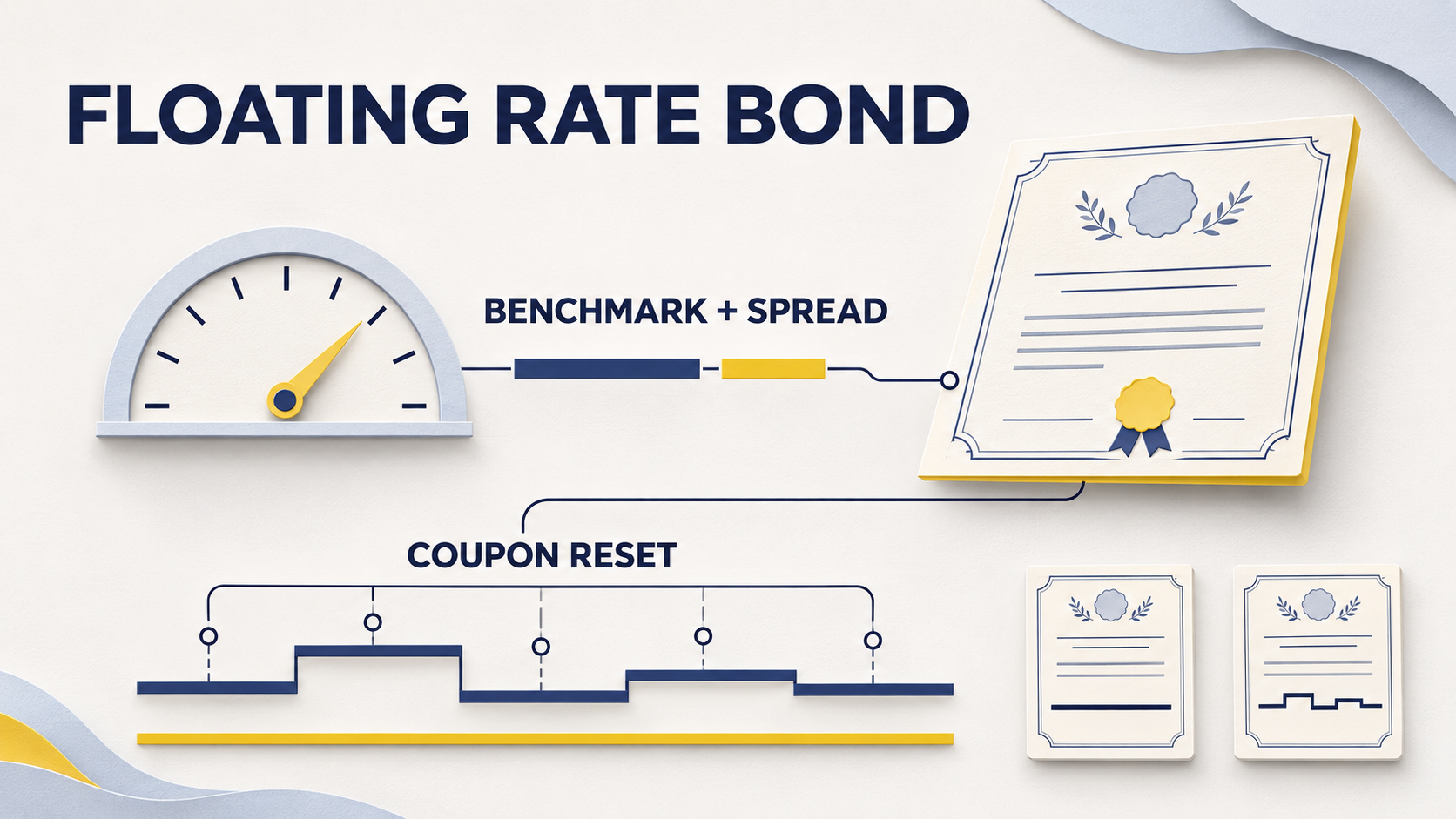
The coupon resets to a benchmark at set intervals. It can move up or down, and the bond still carries risk.
A floating rate bond is not a bond that protects you from interest rates. It is a bond whose coupon is re-priced to a benchmark at fixed intervals, so the interest you receive moves with that benchmark, up or down.
On 7 October 2026, the Reserve Bank of India’s Monetary Policy Committee raised the policy repo rate from 5.25% to 5.50% and described its stance as “calibrated tightening”. When rates have recently gone up, floating rate bonds in India tend to come up in conversation, often with the suggestion that they solve the problem of rising rates. They change the problem. They do not remove it.
Four questions decide whether a floater behaves the way you expect:
- What is the coupon linked to?
- How often does it reset?
- What can still move its price?
- What happens to your income if rates fall?
Floating Rate Bonds in India: The Quick View
| Feature | Fixed-Coupon Bond | Floating Rate Bond |
|---|---|---|
| Coupon | Set at issue for the full tenure | Benchmark plus spread, reset on fixed dates |
| Income if rates rise | Generally unchanged | May rise at the next reset, with a lag |
| Income if rates fall | Generally unchanged | May fall at the next reset |
| Benchmark-rate sensitivity | Usually higher | Typically lower until the next reset |
| Credit risk | Applies to non-sovereign issuers | Applies to non-sovereign issuers |
How Floating Rate Bonds Work: Benchmark Plus Spread
Every floating rate bond has two moving parts written into its terms.
The benchmark is an external reference rate that the issuer does not control. The term sheet names the rate, publisher and observation date.
The spread is a fixed margin added to the benchmark. It is usually set when the bond is issued and may remain unchanged for the life of the bond.
The coupon is paid until the next reset date. At that point, the benchmark is observed again and the coupon is recalculated.
- Fixing date: The benchmark may be observed before the coupon period begins.
- Reset frequency: Quarterly, half-yearly or annual resets may apply.
- Payment frequency: The payment schedule may differ from the reset schedule.
Benchmark Types Used in India
Treasury Bill Yields
Government of India Floating Rate Bonds may be linked to 182-day Treasury bill yields plus a fixed spread. Some corporate floaters may use 91-day, 182-day or 364-day T-bill yields.
T-bill yields respond to the policy rate, liquidity conditions and government borrowing. They may move in the same broad direction as the repo rate, but not necessarily by the same amount or on the same day.
Repo-Linked Benchmarks
Some instruments link their coupon directly to the RBI policy repo rate plus a spread. These coupons change when the repo rate changes on policy dates.
MIBOR-Type Benchmarks
MIBOR and related money-market benchmarks are used in some corporate floating-rate debt and interest-rate products. These benchmarks may reflect short-term interbank funding conditions.
NSC-Linked RBI Floating Rate Savings Bonds
RBI Floating Rate Savings Bonds, 2020, are linked to the National Savings Certificate rate plus 0.35%, with the rate reset every six months.
These bonds are different from listed floaters because they are not traded on exchanges and early exit is subject to scheme conditions.
Corporate Floating Rate Bonds
Companies, banks, NBFCs and public-sector entities may issue floating-rate bonds or NCDs linked to different benchmarks. Each issue carries the credit risk of the issuer, regardless of the benchmark.
An Illustrative Coupon Path: Rates Up, Flat and Down
The following figures are illustrative and hypothetical.
Assumptions: Face value ₹1,00,000, benchmark starts at 5.60%, spread is 1.50%, coupon resets and is paid every six months, no cap or floor, and the issuer pays on time.
| Period | Rising coupon | Rising payout | Flat payout | Falling coupon | Falling payout |
|---|---|---|---|---|---|
| 1 | 7.10% | ₹3,550 | ₹3,550 | 7.10% | ₹3,550 |
| 2 | 7.35% | ₹3,675 | ₹3,550 | 6.85% | ₹3,425 |
| 3 | 7.60% | ₹3,800 | ₹3,550 | 6.60% | ₹3,300 |
| 4 | 7.60% | ₹3,800 | ₹3,550 | 6.60% | ₹3,300 |
| Two-year total | ₹14,825 | ₹14,825 | ₹14,200 | ₹13,575 | ₹13,575 |
- If the benchmark rises, the floater’s income rises from the next reset.
- If the benchmark stays flat, payments remain unchanged.
- If the benchmark falls, the floater’s income falls.
How Floating Rate Bond Prices Behave
For a fixed-coupon bond, when market yields rise, the price generally falls. The longer the duration, the larger the movement.
A floating-rate bond is typically less sensitive to benchmark-rate changes because its coupon resets towards the new rate. However, the fixed spread can still become unattractive if the market demands more compensation for the issuer’s risk.
Illustrative Price Comparison
| Situation | Approximate change |
|---|---|
| Fixed-coupon bond, yield rises from 7.10% to 7.60% | About −2.05% |
| Floater, next reset four months away | About −0.16% |
| Floater, spread widens from 1.50% to 2.00% | About −2.05% |
The first two rows show why floaters are often described as having lower benchmark-rate sensitivity. The third row shows why that description is incomplete.
What Can Still Move a Floating Rate Bond’s Price?
1. Credit Spread Changes
A fixed spread may become inadequate if the market’s view of the issuer worsens. The bond price may adjust downward.
2. Reset Lag
Between reset dates, the coupon remains fixed. If rates rise immediately after a reset, the bond may pay below-market interest until the next reset.
3. Benchmark Mismatch
The benchmark may move differently from the rates that matter to buyers. T-bill yields may not move exactly with corporate borrowing costs.
4. Caps and Floors
A cap limits how high the coupon can rise. A floor sets a minimum coupon level.
5. Liquidity
Secondary-market trading in many Indian corporate bonds is limited. A floater that is difficult to sell may trade at a discount, and the bid-ask spread may be wide.
Risks to Weigh Before Evaluating Floating Rate Bonds
Credit Risk
The benchmark determines the coupon formula. It does not determine whether the issuer can pay. Corporate floating-rate bonds carry the issuer’s credit risk.
Spread Risk
A fixed spread can become inadequate if the market’s view of the issuer changes.
Reset Lag Risk
Your coupon can trail the benchmark by up to one reset period.
Falling-Income Risk
If rates fall, the coupon may fall. This matters for investors who depend on bond income for regular expenses.
Liquidity Risk
Listing does not mean frequent trading. Check the actual trading activity of the specific ISIN.
Call and Structural Risk
Some floaters include call options, step-up clauses, step-down clauses or unusual fixing rules.
Tax
Interest from floating-rate bonds is generally added to your income and taxed at your applicable income-tax slab rate. Tax treatment depends on individual circumstances and may change. Please consult a qualified tax advisor.
How to Read a Floating Rate Bond Term Sheet
| Term Sheet Item | What to Check |
|---|---|
| Benchmark | Exact name, publisher and tenor |
| Fixing date | Observation date, average method and look-back period |
| Spread | Fixed margin and any step-up or step-down clause |
| Reset frequency | Quarterly, half-yearly or annual reset dates |
| Payment schedule | Coupon dates, record dates and payment frequency |
| Cap and floor | Whether either feature exists and the applicable levels |
| Fallback benchmark | What happens if the benchmark is discontinued |
| Call or put option | Early redemption rights and conditions |
| Credit rating | Rating, agency, date, outlook and watch status |
| Security and seniority | Ranking and collateral, if any |
| Listing and ISIN | Listing status and exact security identifier |
If any of these terms is unclear, pause until you understand it. A term you do not understand is a term you cannot properly evaluate.
Where Floating Rate Bonds May Fit
A floater may suit an investor who is more concerned about price movements during the holding period than variation in income, and who understands that coupons can fall as well as rise.
A fixed-coupon bond may suit an investor who values a known payout schedule and plans to hold to maturity, while accepting that the market price may move before maturity.
The benchmark, spread, reset terms, issuer quality and liquidity are the parts you can review before investing.
Key Takeaways
- A floating-rate bond’s coupon is benchmark plus a fixed spread.
- Indian floaters may use T-bill yields, the repo rate, MIBOR-type rates or the NSC rate.
- Floaters are typically less sensitive to benchmark-rate moves than fixed-coupon bonds.
- Their prices can still move because of credit spreads, reset lag, caps, floors and liquidity.
- If rates fall, floater income may fall.
- The floating structure does not remove credit risk.
- Interest is generally taxed at the applicable income-tax slab rate.
Explore Equirize
Review listed bonds, issuer details, ratings, yields, maturities and risk disclosures before investing.
Explore Listed BondsRisk Disclosure: Investments in listed corporate bonds and other debt securities are subject to market risks, including credit risk, interest-rate risk, liquidity risk, market risk and default risk. Returns are not guaranteed. Please read the offer document, term sheet, credit-rating rationale and risk factors carefully before investing.
Registration with SEBI as an Online Bond Platform Provider does not constitute SEBI’s approval, endorsement or guarantee of any specific security listed on the platform. Equirize does not provide investment advice.