Fixed Income vs Fixed Deposit: Not the Same Thing
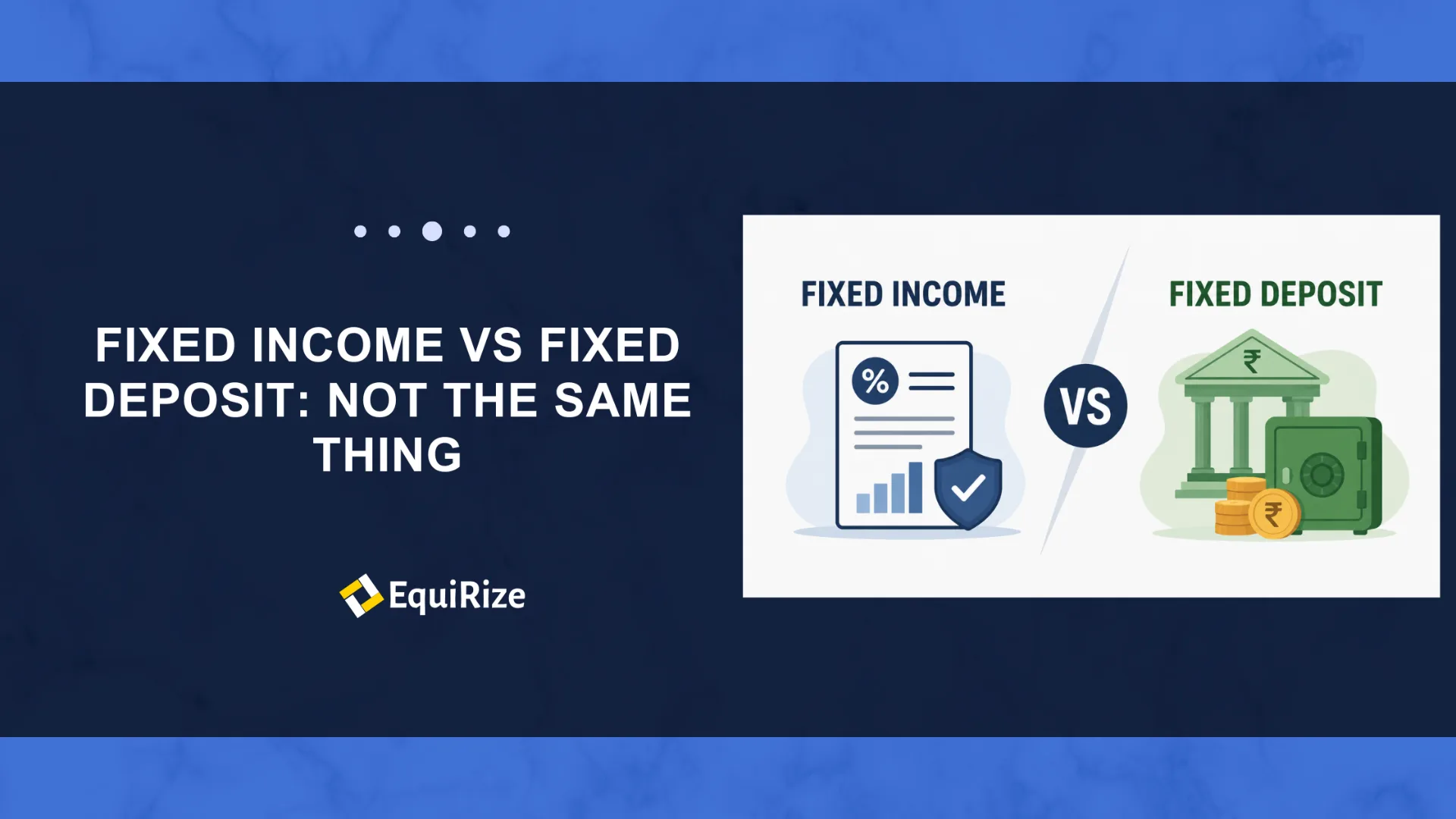


Every year, millions of Indian investors park surplus capital in bank FDs — not because it is the best option, but because it is the most familiar one. The result: returns that barely keep pace with inflation, and significant opportunity cost for high-income earners in the 30% tax bracket.
Fixed income investing is a broader, more powerful category — and an FD is just one narrow slice of it. This article breaks down exactly what separates the two, where each sits on the risk-return spectrum, and why SEBI-regulated bond investing has become a serious FD alternative for sophisticated investors in India.
What Does 'Fixed Income' Actually Mean?
The term fixed income describes any investment that generates regular, predetermined cash flows over a defined period. This includes government securities (G-Secs), treasury bills, corporate bonds, non-convertible debentures (NCDs), market-linked debentures, and yes — fixed deposits too.
What ties them together is the contractual obligation to pay: the issuer agrees to return your principal and a stated coupon on a schedule. Beyond that, the asset classes diverge significantly on yield, liquidity, tax treatment, and risk profile.
The confusion arises because most retail investors have only ever accessed fixed income through one door — the bank FD counter. That door is convenient. It is rarely the most rewarding.
Fixed Deposits: What You're Actually Getting
Bank fixed deposits are issued by scheduled commercial banks regulated by the RBI. Up to ₹5 lakh per depositor per bank is covered under the DICGC insurance scheme, which makes them one of the few genuinely capital-protected instruments available to retail investors in India.
FDs are simple to open, available from ₹1,000 upwards, and offer predictable maturity. For conservative investors with short time horizons and low risk appetite, they serve a clear purpose.
The Real Cost of FD Comfort
The trade-off is yield. As of mid-2025, the best 1–3-year bank FD rates from top private banks sit in the range of 7.0–7.5% per annum for retail depositors. For senior citizens, some banks offer a 25–50 bps premium.
Now apply the tax filter. For an investor in the 30% bracket, a 7.25% FD yields an effective post-tax return of roughly 5.1% per annum. At that rate, real returns after 6% CPI inflation are functionally close to zero — or negative.
This is the FD trap: it feels safe, it feels stable, but the after-tax, after-inflation outcome often destroys wealth over a 5–10 year horizon.
Fixed Income Investing Beyond the FD: The Broader Universe
Once you step outside the FD box, the fixed income universe in India is considerably larger and higher-yielding:
| Bank FD | 6.5 – 7.5% p.a. | 7 days - 10 years | Moderate (premature penalty) | RBI / DICGC |
|---|---|---|---|---|
| Corporate Bonds (Investment-grade) |
8.5 – 10.5% p.a. |
1 - 7 years | Secondary market | SEBI |
| NCDs (AA-rated) | 9.0 – 11.0% p.a. | 2 - 5 years | Listed on NSE/BSE | SEBI |
| Government Securities (G-Secs) | 6.8 – 7.5% p.a. | 1 - 40 years | High (RBI Retail Direct) | RBI |
| Market-Linked Debentures | 10 – 14% p.a. (indicative) | 1 - 3 years | Low (hold to maturity) | SEBI |
Corporate Bonds vs FD: A Direct Comparison for HNI Investors
For high-net-worth investors evaluating fixed income investment options in India, the corporate bond vs FD comparison is particularly relevant. Here is how they stack up on the parameters that matter most:
Yield Differential
A well-curated portfolio of investment-grade corporate bonds rated AA or above can offer 200–350 basis points more than a comparable bank FD. On a ₹50 lakh investment, that spread translates to ₹1–1.75 lakh in additional annual income — before tax optimisation.
Tax Treatment
Both FD interest and bond coupon income are taxed as 'Income from Other Sources' at the investor's applicable slab rate — so no structural tax advantage for either in regular coupon bonds. However, zero-coupon bonds and certain market-linked debentures offer capital gains treatment, which can be more efficient for investors in higher brackets.
Liquidity
FDs carry premature withdrawal penalties — typically 0.5–1% reduction in rate. Listed bonds and NCDs trade on NSE/BSE secondary markets, offering an exit route without penalty, though liquidity depth varies by issuance and credit profile. For investors with a defined hold period, this matters less than it appears.
Credit Risk
This is where the honest answer matters. FDs up to ₹5 lakh carry DICGC insurance — corporate bonds do not. Investors moving up the yield curve must accept that credit risk is real. The way to manage it: stick to rated instruments (AA and above for core allocations), diversify across issuers, and use a SEBI-registered platform that shows credit ratings and disclosures alongside yield
Why SEBI Regulation Matters When Investing in Bonds
One of the most important distinctions for retail and HNI investors entering the bond market is counterparty risk at the platform level. When you invest in bonds through a SEBI-registered entity, your investments are governed by Securities Contract (Regulation) Act (SCRA) norms, SEBI's debenture trustee framework, and mandatory disclosures under the LODR regulations.
This means your bond holdings are typically held in your own Demat account — not on the platform's balance sheet. The platform is a facilitator, not a custodian. This is structurally different from, say, an unregulated aggregator pooling investor money into opaque instruments.
Always verify: Is the platform SEBI-registered? Are the bonds listed? Is there a debenture trustee in place? These are not bureaucratic checkboxes — they are the mechanisms that protect you if an issuer defaults.
Building a Fixed Income Portfolio as a Salaried Professional or NRI
The framing of 'bonds vs FDs' as an either/or choice is a false binary. For most salaried professionals with investable surpluses of ₹10 lakh and above, a tiered approach makes more sense:
Tier 1 - Liquidity reserve (FDs / Liquid Funds)
3–6 months of expenses in a combination of high-yield savings accounts and short-duration FDs. This is your emergency buffer. Yield optimisation is secondary to instant accessibility.
Tier 2 - Core fixed income (Bonds / NCDs)
The bulk of your fixed income allocation — 60–70% — should target investment-grade bonds and NCDs with a 2–5 year horizon, aiming for 9–11% target yields. This is where the real work of building non-equity, stable-return wealth happens.
Tier 3 - Satellite / Higher-yield instruments
A 15–20% allocation to higher-yield structured products or market-linked debentures for investors who understand the mechanics and can hold to maturity. Not mandatory — but worth exploring once the core is in place.
NRI investors should note that bond investments through SEBI-regulated platforms are generally permissible through NRO or NRE accounts, subject to FEMA compliance. Consult your tax advisor for repatriation implications.
Key Questions Investors Ask
Is fixed income safer than a fixed deposit?
Not categorically — it depends on the instrument. Bank FDs up to ₹5 lakh carry DICGC insurance, making them one of the few capital-protected products in India. Fixed income instruments like corporate bonds and NCDs carry credit risk and are not insured. However, investment-grade bonds from AA-rated and above issuers, held through a SEBI-registered platform with debenture trustee oversight, offer a strong risk-management structure. 'Safer' should be evaluated in context of your specific instrument, issuer, and allocation size.
Can I earn higher returns than an FD through fixed income investing?
Yes — in most market conditions, investment-grade corporate bonds and listed NCDs offer 200–350 basis points more than comparable bank FDs. A well-structured bond portfolio targeting 9–11% per annum indicative yield can meaningfully outperform a 7–7.5% FD on a pre-tax basis. The key caveat: higher yield comes with credit risk. Diversification across issuers and sticking to rated instruments helps manage this.
What is the minimum amount needed to invest in bonds in India?
Historically, the institutional bond market required minimum ticket sizes of ₹10 lakh or more, putting it out of reach for most retail investors. Today, SEBI's regulatory changes and platforms like EquiRize have brought that threshold down significantly — select bonds and NCDs are accessible at ₹1,000 per unit (face value), though deal minimums vary by issuance. It is now realistic for salaried investors with ₹5–10 lakh surplus to build a diversified bond portfolio.
How is interest from bonds taxed compared to FD interest in India?
Both bond coupon income and FD interest are typically taxed as 'Income from Other Sources' at your applicable income tax slab rate. For investors in the 30% bracket, both are taxed similarly on regular coupon payments. However, certain bond structures — zero-coupon bonds, deep-discount bonds, and some market-linked debentures — may attract capital gains treatment at maturity, which can be more efficient. Always verify the specific tax treatment of any instrument with your CA before investing.
Are bonds listed on NSE/BSE liquid enough to sell before maturity?
It varies. Government securities and large AAA/AA-rated corporate bond issuances tend to have reasonable secondary market liquidity on NSE/BSE. Smaller issuances or lower-rated instruments may be thinly traded, making exit at fair value difficult. For most retail and HNI investors, the better mental model is to plan to hold bonds to maturity. If liquidity is a priority, choose shorter-tenure bonds — 1–2 years — so you are not locked in for long.
The Takeaway: It is Time to Think Beyond the FD
Fixed deposits are not bad products — they are the wrong tool for the wrong job when used as a wealth-building strategy for high-income earners. If you are earning 7.25% gross on an FD and paying 30% tax on it, you are accepting a 5.1% post-tax return in an environment where well-structured bonds are targeting 9–11%.
Fixed income investment in India has evolved dramatically. SEBI-regulated platforms now give sophisticated investors access to curated bond deals — with debenture trustee oversight, secondary market listings, and transparent credit disclosures — that were previously available only to institutional desks.
The shift from FD-only thinking to a diversified fixed income strategy is not about chasing yield at any cost. It is about being precise — knowing your instruments, understanding the credit, and allocating intelligently across the risk-return spectrum.
Ready to explore curated bond and NCD opportunities? Browse current fixed income deals on EquiRize, or join the Deal Alert waitlist to receive high-quality opportunities directly. If you prefer to discuss your allocation strategy first, connect with a fixed-income specialist on the platform.