Credit Ratings 101: How to Read a CRISIL or ICRA Bond Rating


Credit Ratings 101: How to Read a CRISIL or ICRA Bond Rating
When reviewing a listed corporate bond, you may see symbols such as AAA, AA− or BBB+ displayed alongside the instrument.
These ratings may be assigned by SEBI-registered credit-rating agencies such as CRISIL Ratings, ICRA, CARE Ratings or India Ratings and Research.
For a first-time investor, the letters can feel difficult to interpret:
- What does a credit rating measure?
- Is AAA completely safe?
- What is the difference between AA+ and AA−?
- What does a Negative outlook indicate?
- Where can you find the latest rating rationale?
- What risks does the rating not cover?
A rating can provide useful information about credit risk, but it should never be the only reason for subscribing to a bond.
1. What Does a Credit Rating Measure?
A credit rating represents a rating agency’s opinion on the likelihood that a rated debt obligation will be repaid in full and on time.
In simple terms, the agency evaluates the issuer’s capacity to meet the bond’s scheduled:
- Interest payments
- Principal repayments
- Other rated financial obligations
A rating is generally assigned to a particular instrument or borrowing programme—not automatically to every bond issued by the company.
The same issuer may have different ratings for different instruments because their:
- Security structures
- Maturities
- Seniority
- Guarantees
- Credit enhancements
- Repayment terms
may be different.
2. What Does a Credit Rating Not Tell You?
A credit rating is not:
- A recommendation to buy, hold or sell
- A guarantee of repayment
- A measure of expected investment return
- A guarantee of secondary-market liquidity
- An indication that the bond price cannot fall
- A complete assessment of suitability
- An endorsement by SEBI or the rating agency
SEBI explains that credit ratings generally do not measure several other risks relevant to fixed-income investors, including:
- Liquidity risk
- Interest-rate risk
- Prepayment risk
- Secondary-market loss
- Exchange-rate risk, where applicable
A highly rated bond can still be unsuitable if its maturity, liquidity or cash-flow structure does not match your requirements.
3. How Rating Agencies Assess Credit Risk
Each credit-rating agency has its own methodology and may assign different weights to individual factors.
The assessment may include:
Business Profile
- Nature of the business
- Competitive position
- Revenue concentration
- Sector outlook
- Regulatory environment
Financial Profile
- Revenue and profitability
- Cash-flow generation
- Debt levels
- Leverage
- Interest coverage
- Repayment obligations
Management and Governance
- Management experience
- Financial policies
- Track record of debt servicing
- Governance practices
- Related-party exposure
External Factors
- Economic conditions
- Industry cycles
- Regulatory changes
- Access to funding
- Dependence on banks or capital markets
A rating is based on information available and expectations formed at a particular point in time. If the information or circumstances change, the rating may also change.
4. Understanding the Long-Term Rating Scale
For long-term debt securities—generally instruments with an original maturity exceeding one year—SEBI has standardised the broad rating symbols and definitions.
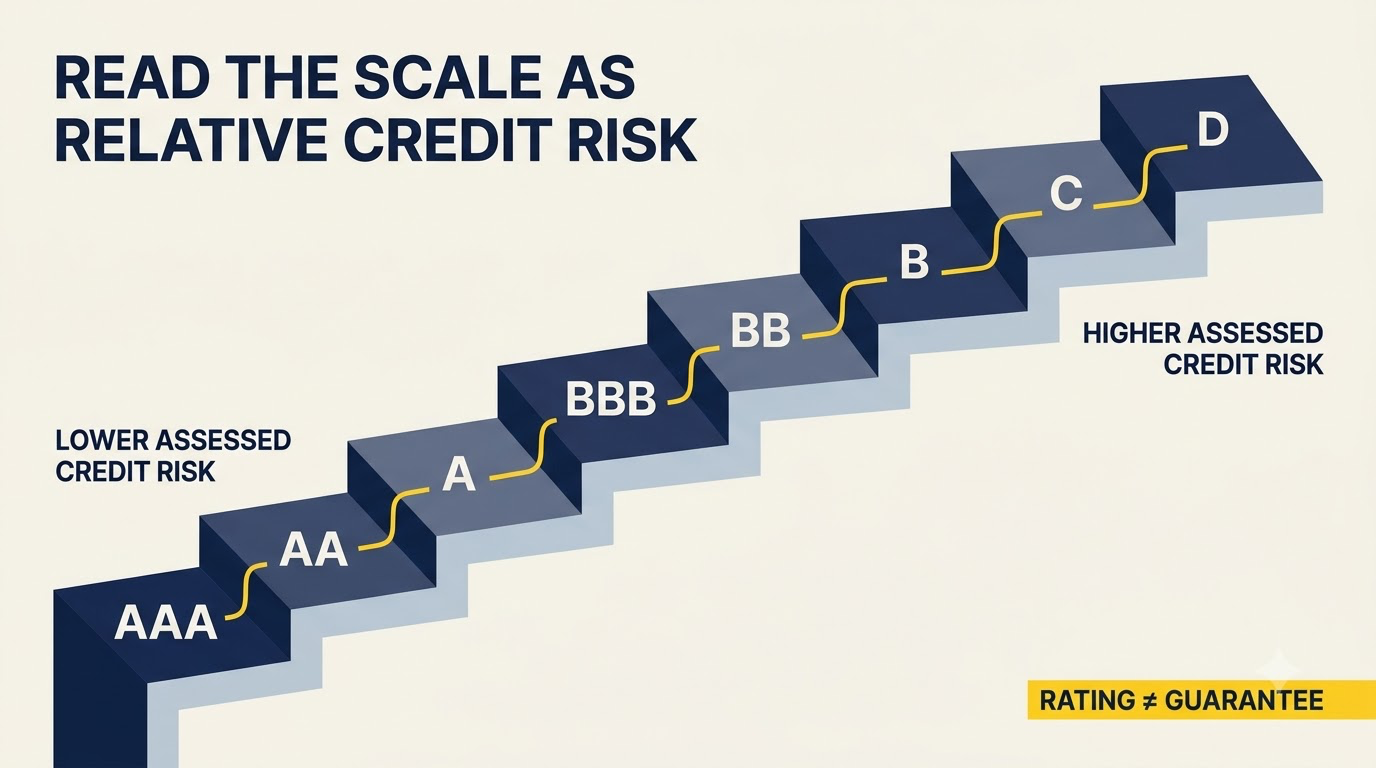
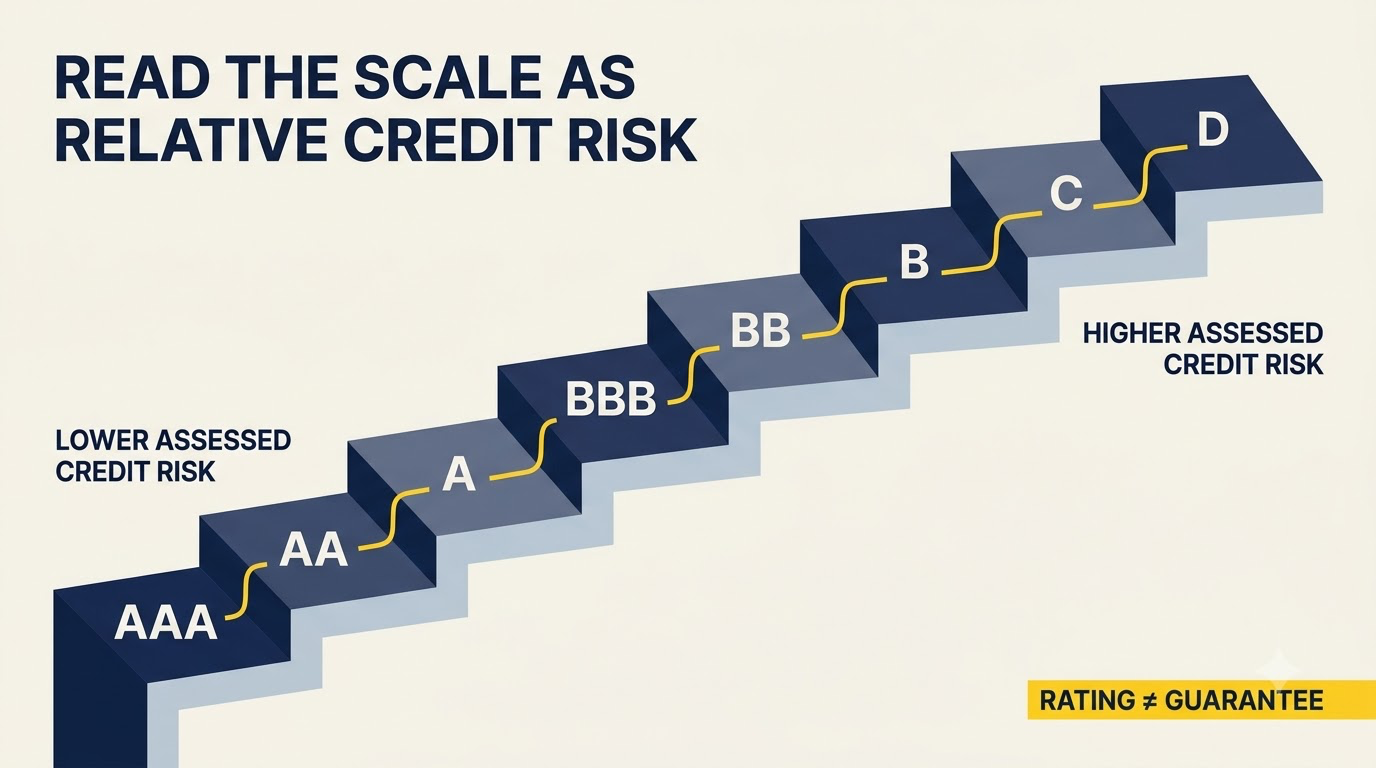
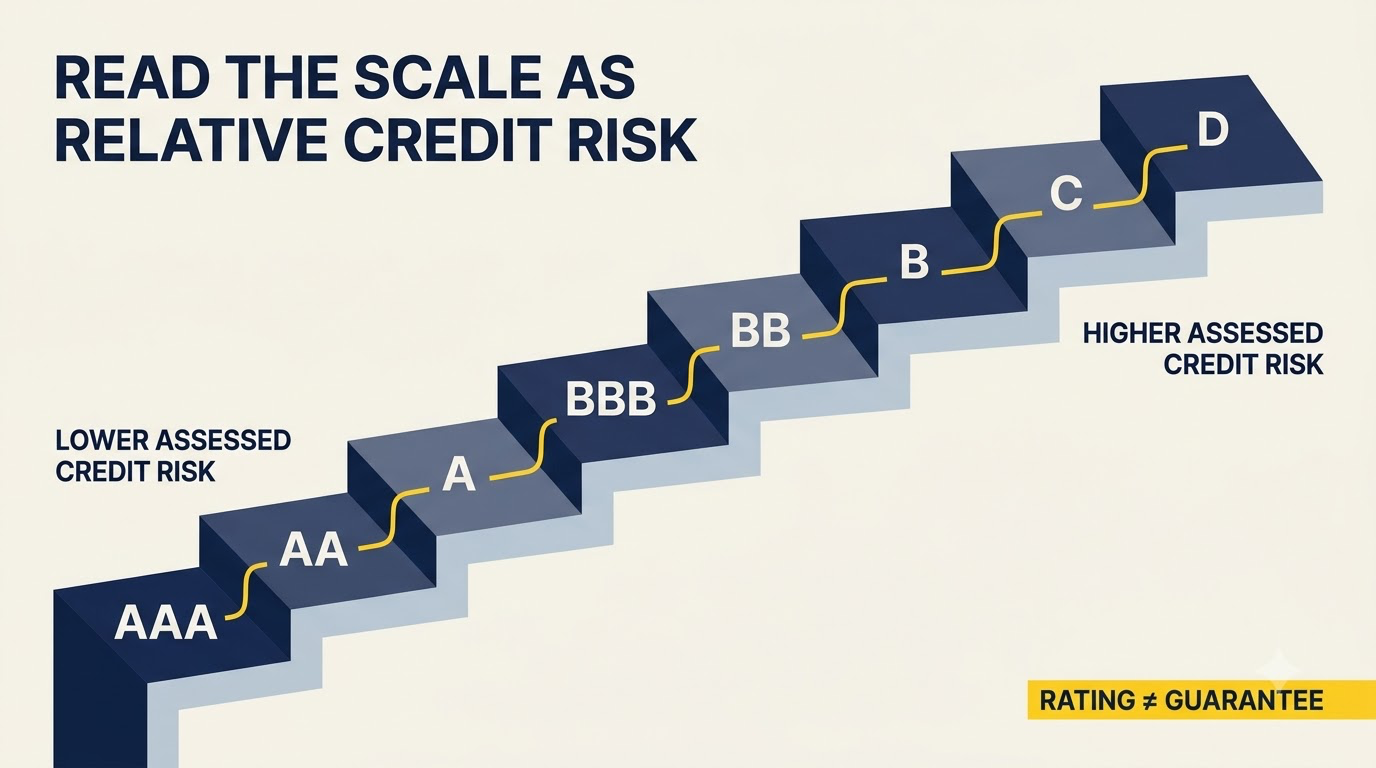
| Rating | SEBI-Standardised Interpretation |
|---|---|
| AAA | Highest degree of safety regarding timely servicing of financial obligations; lowest credit risk |
| AA | High degree of safety regarding timely servicing of financial obligations; very low credit risk |
| A | Adequate degree of safety regarding timely servicing of financial obligations; low credit risk |
| BBB | Moderate degree of safety regarding timely servicing of financial obligations; moderate credit risk |
| BB | Moderate risk of default regarding timely servicing of financial obligations |
| B | High risk of default regarding timely servicing of financial obligations |
| C | Very high risk of default regarding timely servicing of financial obligations |
| D | In default or expected to be in default soon |
These definitions describe relative credit risk. They should not be interpreted as a guarantee that a payment will or will not occur.
Investment-Grade Classification
Ratings of BBB− and above are generally regarded as investment grade. Ratings below this level indicate progressively higher default risk.
“Investment grade” does not mean risk-free or suitable for every investor.
5. What Do Plus and Minus Symbols Mean?
Rating agencies may use “+” and “−” modifiers for rating categories from AA to C.
These modifiers show relative standing within the same category.
For example:
AA+ → AA → AA− → A+
An AA+ rating is one notch above AA, while AA− is one notch below AA.
However, AA− remains in a higher rating category than A+.
The minus sign does not automatically mean that a downgrade has occurred. It identifies the instrument’s position within its rating category.
6. Check the Rating-Agency Prefix
A published rating should identify the agency assigning it.
For example:
- CRISIL Ratings AAA
- [ICRA]AA+
- CARE AA−
- IND A+
The prefix matters because ratings from different agencies should not be treated as though they came from one combined rating system.
Always confirm:
- Which agency issued the rating
- The date of the latest rating action
- The specific instrument covered
- Whether another agency has assigned a different rating
7. Rating, Outlook and Rating Watch Are Different
A rating symbol may be accompanied by an outlook or a Rating Watch designation.
Rating Outlook
An outlook indicates the agency’s view of the possible direction of the rating over its stated assessment period.
Common outlooks include:
- Stable: A rating change is considered less likely over the relevant period
- Positive: The rating may move upward
- Negative: The rating may move downward
A Positive or Negative outlook does not guarantee that an upgrade or downgrade will occur.
The meaning and time horizon may vary by agency. For example, ICRA describes its outlook horizon as the near to medium term, typically six months to two years.
Rating Watch
A rating may be placed on watch when a specific event creates uncertainty about its credit impact.
Possible triggers include:
- Acquisition or merger
- Change in ownership
- Proposed refinancing
- Regulatory development
- Significant business disruption
- Material deviation from expected performance
A Rating Watch may have:
- Positive implications
- Negative implications
- Developing implications
Rating Watch and rating outlook are not interchangeable. Review the agency’s report to understand the reason for the designation.
8. The Rating Rationale: Where the Details Live
The rating symbol provides a summary. The rating rationale or press release explains the analysis behind it.
Before investing, locate the latest rating rationale on the credit-rating agency’s official website.
Do not rely solely on:
- A platform summary
- An old marketing presentation
- A screenshot
- The issuer’s name
- A rating without its date
The latest report may be longer or shorter depending on the agency, issuer and rating action.
9. What to Read in a Rating Rationale
A. Rating Action and Date
First, identify whether the rating was:
- Assigned
- Reaffirmed
- Upgraded
- Downgraded
- Placed on watch
- Withdrawn
Check the date carefully. An older rating report may no longer reflect the current position.
B. Instrument Details
Confirm that the report covers the exact bond or borrowing programme you are evaluating.
Match:
- ISIN, where provided
- Instrument type
- Rated amount
- Maturity
- Security or guarantee structure
A rating assigned to one instrument should not automatically be applied to another obligation of the same issuer.
C. Key Rating Strengths
This section may discuss factors supporting the rating, such as:
- Established market position
- Stable cash flows
- Strong capitalisation
- Diversified funding
- Experienced management
- Adequate liquidity
Treat these as the rating agency’s assessment—not as guaranteed outcomes.
D. Key Credit Challenges
Look for risks such as:
- High leverage
- Weak profitability
- Asset-quality pressure
- Customer concentration
- Refinancing dependence
- Regulatory exposure
- Maturity mismatches
- Volatile cash flows
Do not read only the rating strengths. The credit challenges often explain why the instrument is not rated higher.
E. Liquidity Profile
The liquidity section may discuss:
- Available cash
- Expected cash flows
- Unused bank facilities
- Upcoming repayments
- Dependence on refinancing
- Asset-liability maturity profile
Phrases such as “adequate liquidity” or “strong liquidity” are agency assessments based on the information and assumptions described in the report.
They do not guarantee that cash will remain available throughout your holding period.
F. Rating Sensitivities
Rating sensitivities describe developments that could support an upgrade or lead to a downgrade.
They may include:
- Changes in leverage
- Profitability trends
- Asset-quality deterioration
- Reduction in liquidity
- Increase in funding costs
- Failure to raise planned capital
- Changes in regulatory conditions
Some reports provide numerical thresholds. Others use qualitative conditions. Do not assume that every report will provide exact trigger levels.
G. Security and Credit Enhancement
If the rating includes a suffix such as (CE), it may reflect an explicit credit enhancement.
This could involve:
- Corporate guarantee
- Partial guarantee
- Debt-service reserve
- Letter of credit
- Escrow or payment mechanism
A credit-enhanced rating should not automatically be treated as the issuer’s standalone rating.
Review:
- The standalone credit profile
- Identity of the support provider
- Nature of the enhancement
- Enforceability
- Conditions for accessing the support
- Whether the support covers all obligations
10. Watch for “Issuer Not Cooperating”
A rating publication may carry the designation Issuer Not Cooperating, sometimes shown as INC.
This can mean that the rating agency did not receive sufficient information or cooperation from the issuer for its review and relied on the best information available.
Investors should read the related disclosure carefully and understand:
- Why the designation was applied
- When the last full review occurred
- What information was unavailable
- Whether the rating remains under surveillance
Do not treat an INC rating as equivalent to a rating supported by complete and current information.
11. Ratings Can Change
Credit ratings are monitored during the life of the rated security and may be reviewed periodically.
A rating may change because of:
- Weaker financial performance
- Higher leverage
- Liquidity pressure
- Delayed payments
- Sector disruption
- Regulatory change
- Merger or acquisition
- Improved cash flows
- Capital infusion
- Reduction in debt
A downgrade indicates that the agency’s assessment of default risk has worsened relative to its earlier view.
Investors should continue monitoring the rating after purchasing a bond rather than checking it only at the time of subscription.
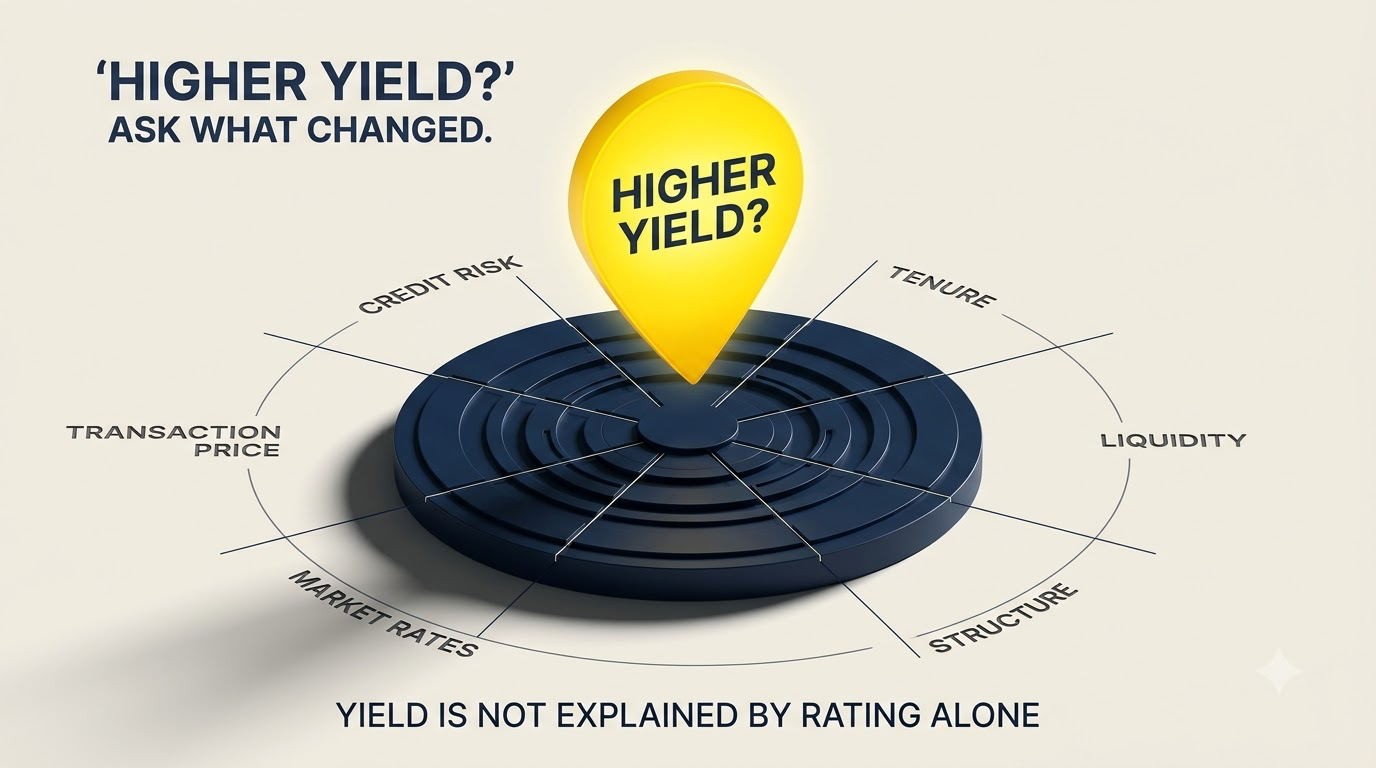
12. Why Do Lower-Rated Bonds Often Offer Higher Yields?
A lower-rated bond may offer a higher yield to compensate investors for accepting greater assessed credit risk.
However, rating is not the only factor affecting yield.
Yield may also reflect:
- Market interest rates
- Remaining tenure
- Secondary-market liquidity
- Security structure
- Call or put options
- Supply and demand
- Issuer-specific developments
- Transaction price
A higher yield should prompt the question:
What additional risk or constraint am I being asked to accept?
It should not automatically be interpreted as a better investment opportunity.
A Practical Credit-Rating Checklist
Before subscribing to a listed corporate bond, ask:
- Which agency assigned the rating?
- Does the rating apply to this exact instrument?
- When was the rating last reviewed?
- Was it reaffirmed, upgraded or downgraded?
- What outlook or Rating Watch is attached?
- What are the key credit strengths and challenges?
- What does the liquidity analysis say?
- Which factors could trigger a downgrade?
- Is the issuer cooperating with the rating agency?
- Are there ratings from other agencies?
- Does the instrument rely on a guarantee or credit enhancement?
- What important risks are not covered by the rating?