How to Read a Bond Term Sheet Before Investing
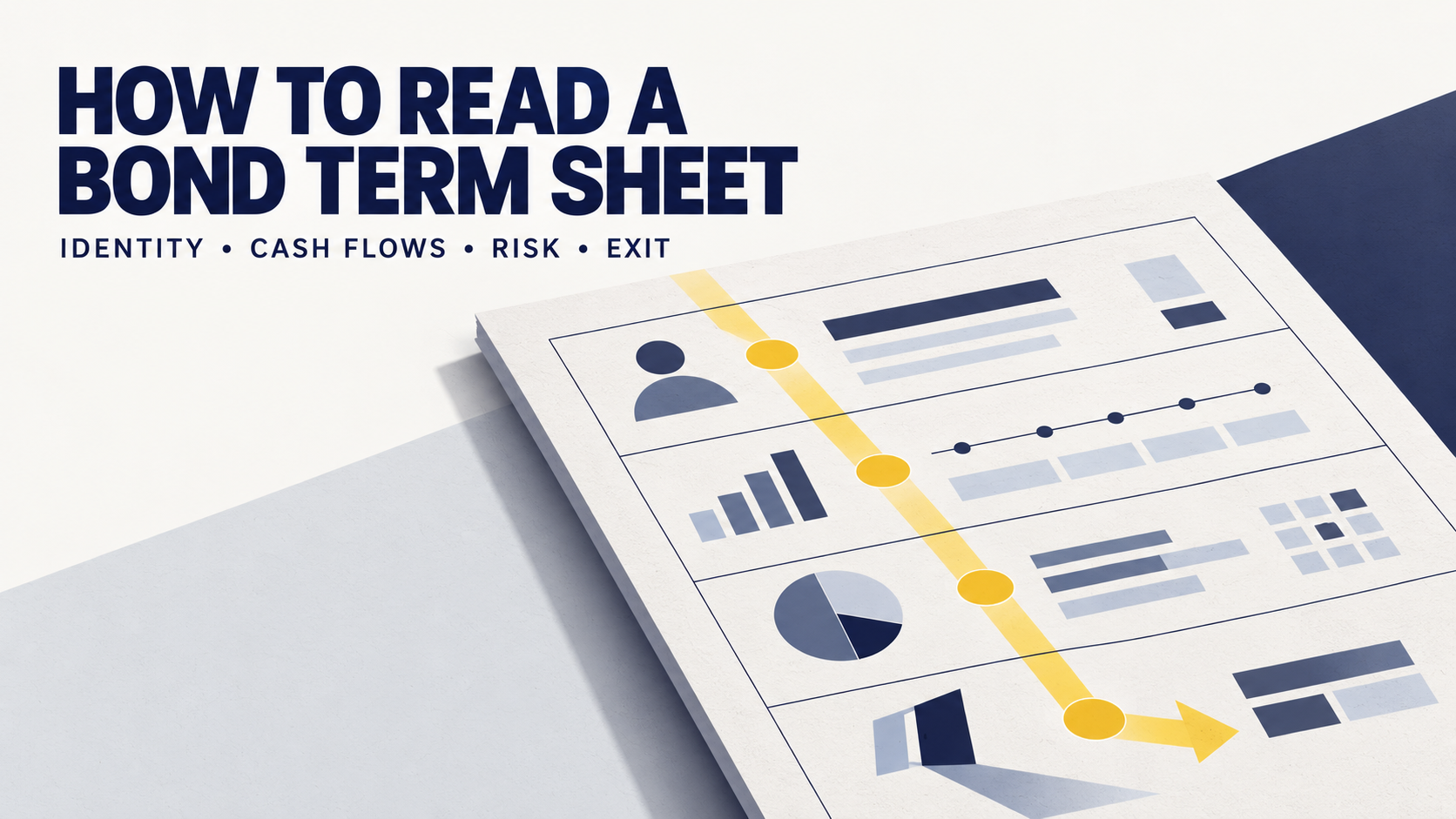


A first-time investor’s guide to the eight details that shape a bond’s cash flows, risks and exit conditions.
When investors evaluate a stock, they may study earnings, valuation and price movement. When they evaluate a listed corporate bond, the starting documents are different.
The term sheet, Key Information Document, General Information Document, placement memorandum, offer document and related disclosures describe the instrument’s commercial and legal terms.
A term sheet is useful because it summarises important details such as the issuer, coupon, maturity, security and redemption structure. However, it should not automatically be treated as the only governing document or as a substitute for the complete issue documents.
For a first-time investor, these documents can look like a wall of legal and financial language.
This guide explains eight areas to review before placing an order.
1. Confirm the Issuer and the Exact Instrument
Start by identifying who is borrowing the money and which security you are reviewing.
Legal issuer name
Check the issuer’s complete legal name. A familiar group or brand name may not be the entity legally responsible for making the bond’s payments.
Review the issuer’s business, financial position, existing debt, use of proceeds and material risk factors.
ISIN
An International Securities Identification Number, or ISIN, uniquely identifies a security.
The same issuer may have multiple bonds with different:
- Coupon rates
- Maturity dates
- Credit ratings
- Security structures
- Seniority
- Payment schedules
- Call or put provisions
Match the ISIN shown on the platform with the ISIN in the relevant issue document and transaction summary.
Instrument type
Confirm whether the instrument is a non-convertible debenture, bond, subordinated debt instrument or another form of listed debt security.
Different structures can carry different rights, payment terms and risks.
2. Distinguish Face Value, Price and Minimum Investment
These figures are related but do not necessarily mean the same thing.
| Term | What it means |
|---|---|
| Face value | The nominal denomination of one bond unit |
| Issue price | The price at which the bond is initially offered |
| Market price | The price at which an already-listed bond may be available |
| Minimum investment | The amount required to complete the available transaction |
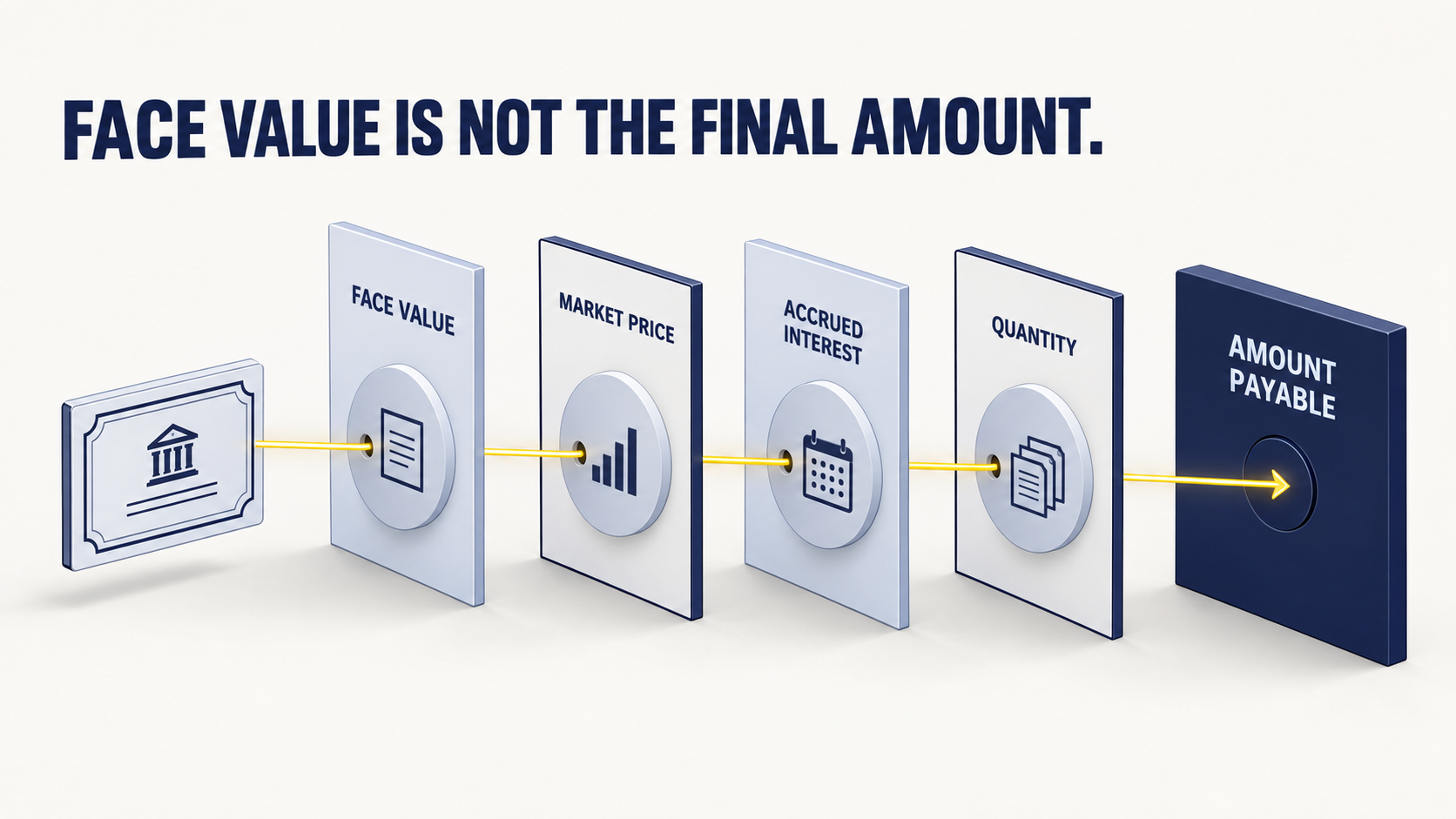
The total amount payable may also be affected by the trading lot, quantity, accrued interest and applicable transaction components.
Do not assume that a bond with a face value of ₹10,000 will always require exactly ₹10,000 to purchase.
For a coupon-paying bond, the contractual coupon amount is generally calculated with reference to face value—not necessarily the price paid in the secondary market.
3. Compare Coupon Rate and Yield to Maturity
Coupon and Yield to Maturity answer different questions.
Coupon rate
The coupon rate determines the scheduled interest payment with reference to the bond’s face value.
For illustration, a 9% annual coupon on a ₹10,000 face value would correspond to ₹900 of scheduled annual coupon before applicable tax, subject to the instrument terms and the issuer meeting its obligations.
Yield to Maturity
Yield to Maturity, or YTM, is an estimated annualised return based on factors including:
- Purchase price
- Remaining coupon payments
- Redemption amount
- Time remaining to maturity
- Assumption that scheduled payments occur
- Assumption that the investor holds the bond until maturity
If the purchase price is above or below face value, YTM may differ from the coupon rate.
Important: YTM is not a guaranteed return. The amount ultimately realised can be affected by issuer payments, holding period, transaction price, taxes, costs and applicable call or put provisions.
Check whether the displayed yield is indicative, pre-tax or calculated using accrued interest.
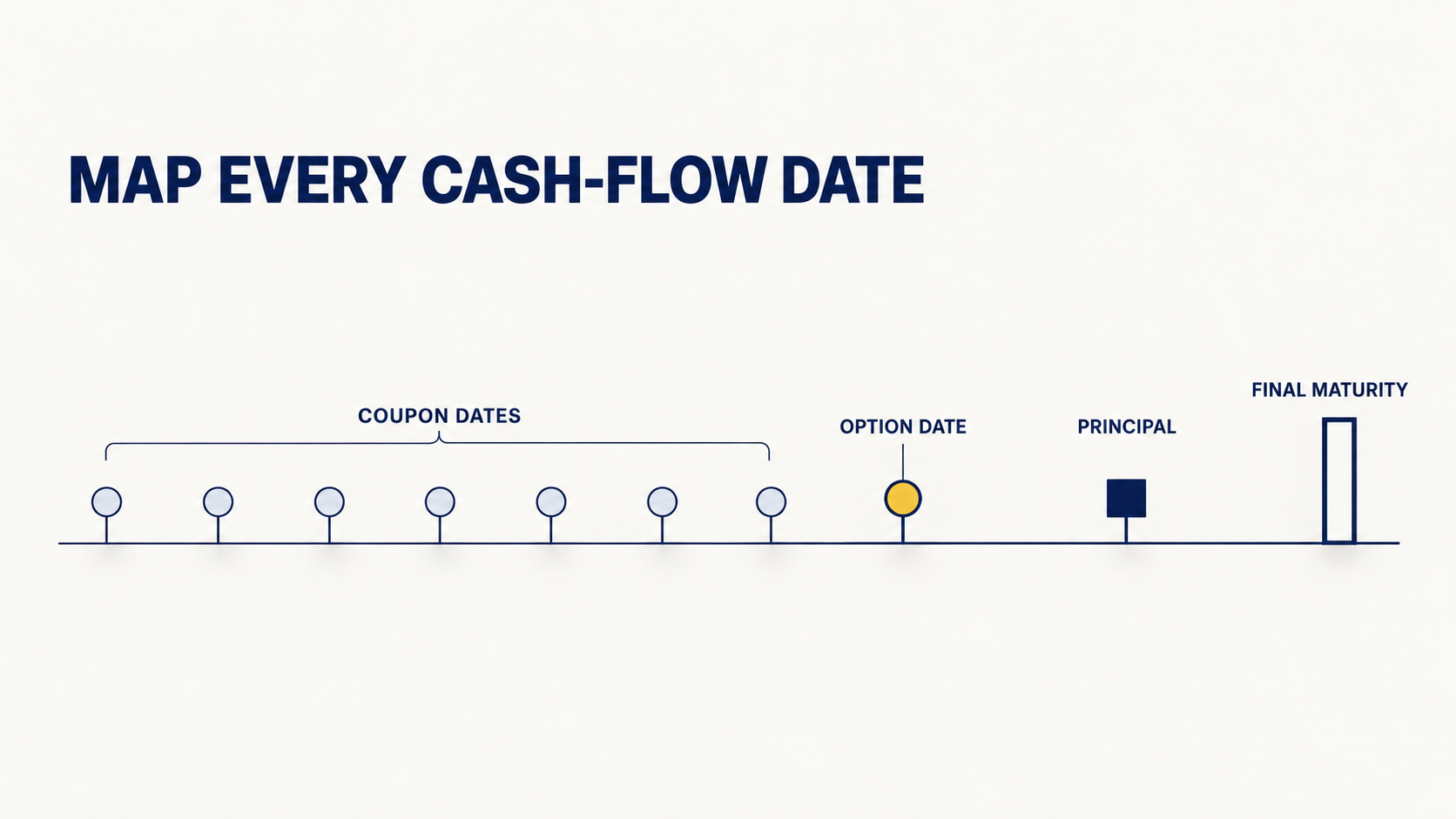
4. Map the Complete Cash-Flow Schedule
The maturity date is important, but it is not the only date that matters.
Review:
- Coupon payment dates
- Coupon frequency
- Record dates
- Principal-repayment schedule
- Final maturity date
- Call dates
- Put dates
- Early-redemption provisions
Coupon payments may be scheduled monthly, quarterly, half-yearly, annually or according to another specified structure.
Some bonds repay the full principal at maturity. Others may amortise the principal in instalments.
Match these cash flows with your own requirement date. Avoid assuming that you will always be able to sell the bond before maturity at the original purchase price.
5. Read the Credit Rating and Latest Rationale
A credit rating is a rating agency’s opinion regarding the credit risk of the rated obligation.
It is a starting point—not a guarantee or recommendation.
Check:
- Rating agency
- Exact instrument covered
- Latest rating and outlook
- Date of the rating action
- Rating history
- Key rating strengths
- Key credit challenges
- Liquidity assessment
- Upgrade and downgrade sensitivities
- Issuer-cooperation status
Do not apply one instrument’s rating automatically to every debt obligation of the same issuer.
There is no universal rule that a specific rating category is suitable for every investor. Suitability depends on the investor’s objectives, financial position, time horizon, risk tolerance and the complete structure of the instrument.
Read the latest rating rationale on the rating agency’s official website rather than relying only on a platform summary or an undated screenshot.
6. Understand Seniority, Security and Security Cover
Seniority
Seniority describes the instrument’s position in the repayment hierarchy relative to other obligations of the issuer.
Review whether the bond is senior, subordinated or carries another priority status under its terms.
Secured bonds
A secured bond is backed by specified security under the instrument documents.
Review:
- Nature of the charged assets
- Charge ranking
- Whether the charge is exclusive, pari passu or subordinate
- Security-cover requirement
- Valuation methodology
- Monitoring frequency
- Existing or prior claims
- Enforcement provisions
A reported security cover of 1.25 times generally indicates that the reported value of the specified security is intended to equal ₹1.25 for each ₹1 of covered debt.
Security cover should not be interpreted as a guaranteed recovery value. Asset values may change, enforcement can take time and realised proceeds may be lower than the reported cover.
Unsecured bonds
An unsecured bond does not have a claim over specified collateral in the same manner.
Do not assume that every unsecured bond offers a higher coupon or that every secured bond is lower-risk. Credit quality, tenure, liquidity, structure, market conditions and other factors also influence pricing.
7. Check Call, Put and Early-Redemption Provisions
A final maturity date may not represent the only possible end date.
Call option
A call option may allow the issuer to redeem the bond before final maturity, subject to the instrument terms.
This can create reinvestment risk if the investor receives the money earlier than expected when prevailing yields are lower.
Put option
A put option may permit the investor to seek early redemption on a specified date and under stated conditions.
Review:
- Call or put date
- Notice period
- Redemption price
- Eligibility conditions
- Whether exercise is automatic or optional
- Effect on the displayed yield
- Impact on expected cash flows
If the bond contains an embedded option, confirm whether the platform displays YTM, Yield to Call, Yield to Put or another yield measure.
8. Identify the Debenture Trustee and Read the Governing Documents
The issue documents should identify the appointed debenture trustee where applicable.
The trustee performs responsibilities prescribed under the instrument documents and applicable regulations. Depending on the structure, these may include due diligence relating to creation of security, monitoring specified covenants or security cover, communicating with debenture holders and taking steps provided under the documents and law when a breach or default occurs.
The presence of a debenture trustee does not guarantee that the issuer will make payments or that recovery will be immediate or complete.
Record the trustee’s:
- Legal name
- Contact details
- Grievance channel
- Relevant notices and reports
Also review the complete set of available documents, which may include:
- General Information Document
- Key Information Document
- Placement memorandum
- Offer document
- Term sheet
- Debenture trust deed
- Credit-rating rationale
- Financial disclosures
- Security documents or summaries
- Risk factors
The short term sheet is a navigation tool. The complete issue documents provide the wider legal and risk context.
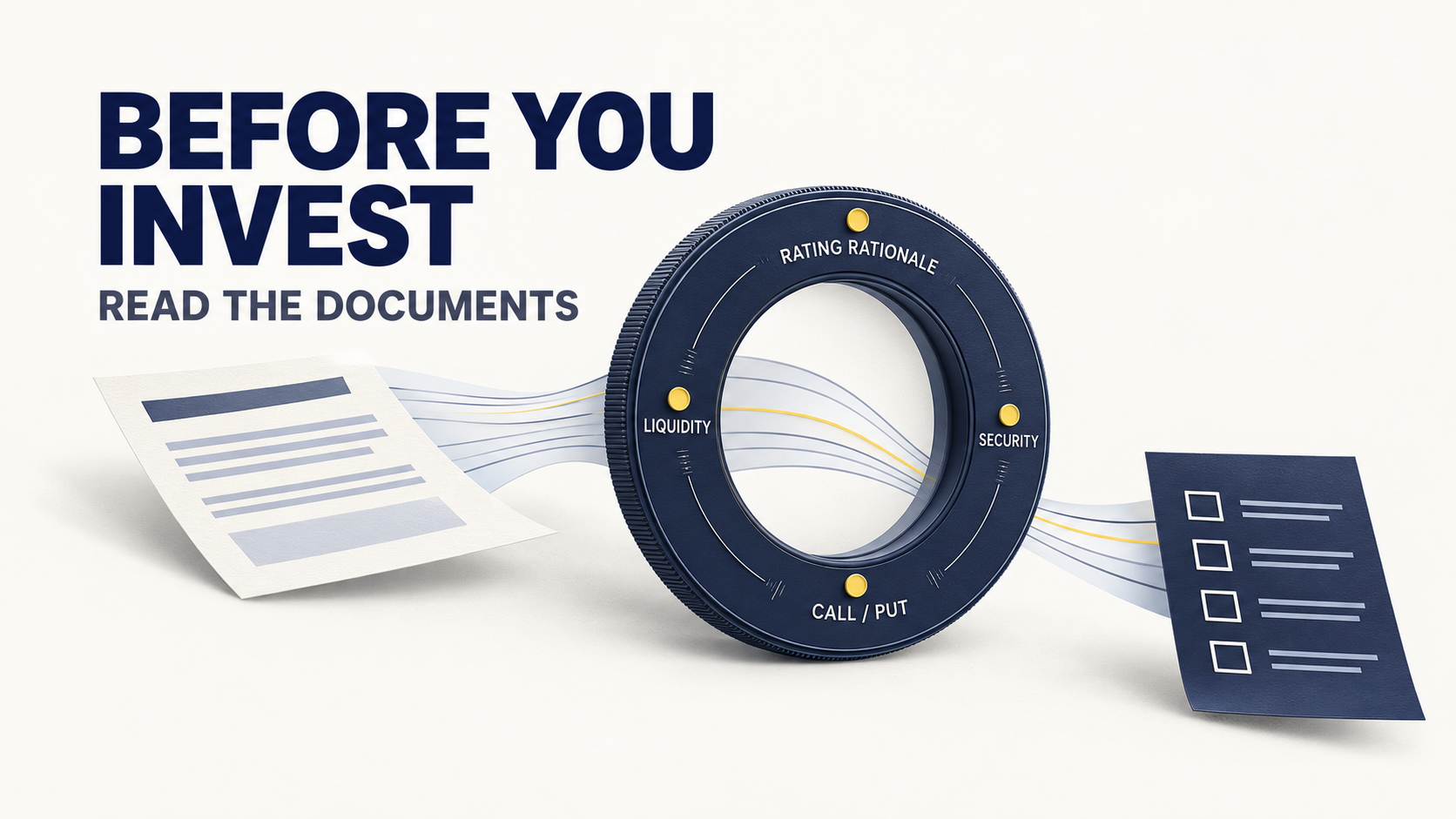
Do Not Ignore Liquidity and Settlement
A bond being listed on a stock exchange does not guarantee that it can be sold immediately.
Before investing, consider:
- Whether the bond has traded recently
- Whether observable bids and asks are available
- Quantity available
- Potential price difference on exit
- Settlement timeline
- Transaction route and applicable costs
If the money may be needed before maturity, an uncertain exit can create a mismatch even when the displayed yield appears attractive.
A Practical Term-Sheet Checklist
- What is the issuer’s exact legal name?
- Does the ISIN match the security you intend to purchase?
- What are the face value, transaction price and total amount payable?
- How do the coupon rate and displayed yield differ?
- What are the coupon, principal and maturity dates?
- Does the maturity align with your financial goal?
- What does the latest rating rationale say?
- What is the instrument’s seniority?
- Is it secured or unsecured?
- If secured, what assets and charge ranking support it?
- Does it contain call, put or early-redemption provisions?
- Who is the debenture trustee?
- What happens after a covenant breach or payment default?
- What liquidity and settlement constraints apply?
- Have you read the complete issue documents and risk factors?
Key Takeaway
A term sheet is not a return advertisement.
It is a structured map of the bond’s identity, price, cash flows, maturity, credit features, security, options and investor protections.
Reading it carefully helps you ask better questions. It does not remove credit, liquidity, interest-rate or market risk.
The goal is to understand how the complete instrument works—and whether its dates, risks and cash flows match your requirements.
Explore Listed Bonds on Equirize
Compare available listed bonds using information such as issuer, credit rating, yield, maturity, coupon frequency, security status and minimum investment amount.
Read the term sheet, offer document, latest rating rationale and applicable risk factors before making an investment decision.
Risk Disclosure
Investments in listed corporate bonds and other debt securities are subject to market risks, including credit risk, interest-rate risk and liquidity risk.
Bond prices may fluctuate, and investors may not be able to sell an investment before maturity at the original purchase price. Listing on a stock exchange does not guarantee liquidity.
Scheduled coupon and principal payments remain subject to the issuer meeting its obligations. Returns and repayment are not guaranteed.
Credit ratings are opinions regarding credit risk and are not recommendations to buy, sell or hold any security. Past performance does not indicate or guarantee future results.
Please read the offer document, placement memorandum, term sheet, latest credit-rating rationale and applicable risk factors carefully before investing.
SEBI Non-Endorsement Disclosure
Registration with SEBI or a stock exchange does not constitute approval, endorsement or guarantee of Equirize, any security displayed on the platform or any investment outcome.
Educational Disclaimer
This content is provided solely for informational and educational purposes. It does not constitute investment, legal or tax advice, an offer or a solicitation to invest.
EquiRize Securities Private Limited
SEBI Registration Number: INZ000323730
BSE Debt Segment Member No.: 6914
NSE Debt Segment Member No.: 90472