Bond Duration vs Maturity: Why a Rate Hike Moves Some Bond Prices More Than Others


Bond Duration vs Maturity: Why a Rate Hike Moves Some Bond Prices More Than Others
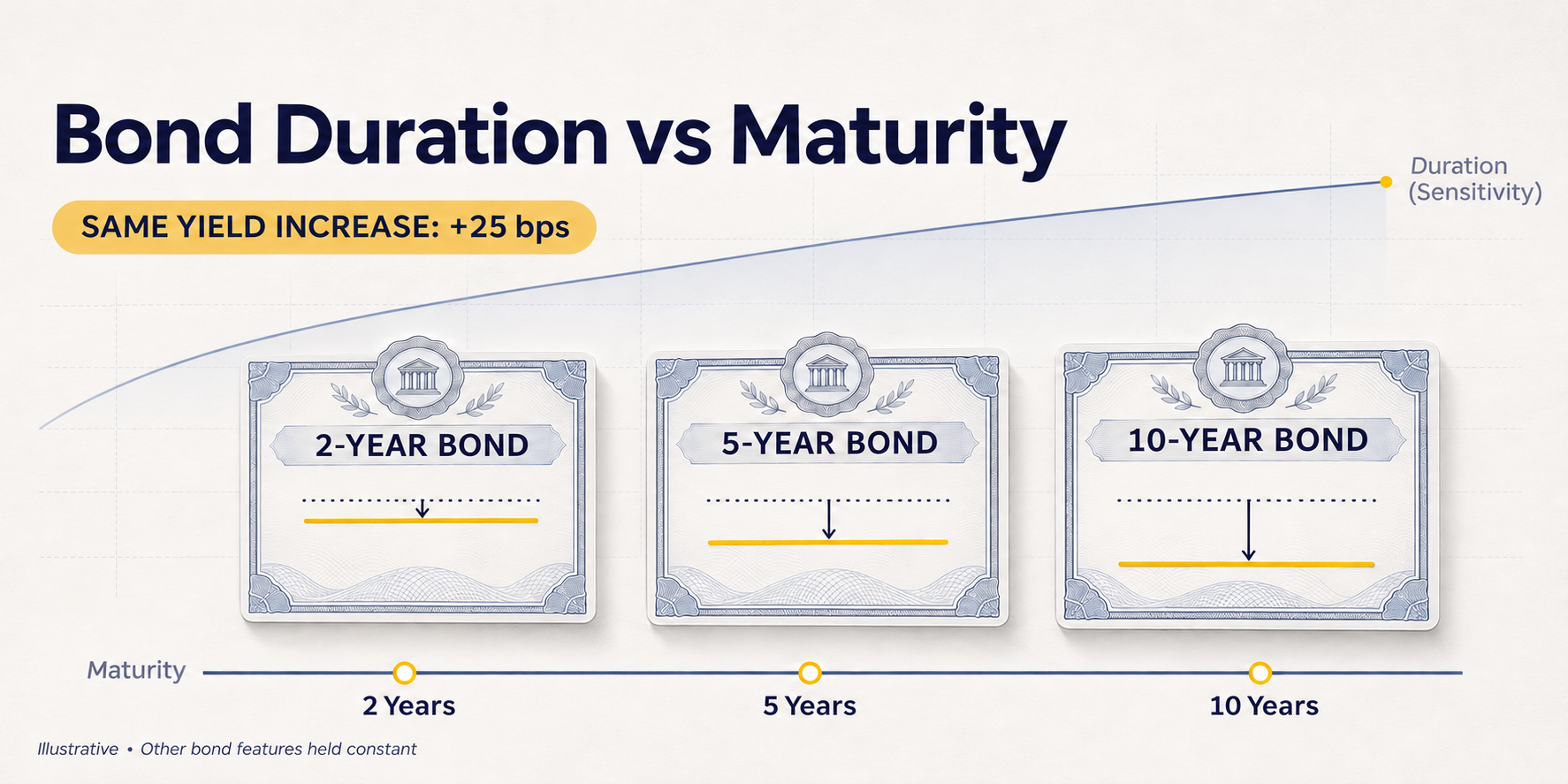
Two bonds can have the same maturity but very different price sensitivity. Duration helps explain why.
On 7 October 2026, the Reserve Bank of India’s Monetary Policy Committee raised the repo rate by 25 basis points, from 5.25% to 5.50%, and described its stance as “calibrated tightening”. If you hold listed bonds, you may have noticed that the same news did not move every bond’s price by the same amount.
Two bonds can carry the same credit rating, sit in the same demat account and react to the same policy announcement, yet one barely moves while the other drops noticeably. The usual explanation is bond duration versus maturity.
Maturity tells you when the issuer is scheduled to repay your principal. Duration tells you how sensitive the bond’s price is to a change in yield.
Maturity: The Calendar Answer
Maturity is the date on which the bond contract ends and the issuer is scheduled to repay the face value. Remaining maturity is the time left between today and that date.
Maturity answers a planning question: When will this money come back to me, assuming the issuer pays as scheduled?
Two bonds maturing on the same date can have very different cash-flow patterns. One may pay a coupon every year, while another may pay nothing until maturity. Same maturity does not mean the same exposure to yield changes.
Macaulay Duration: The Weighted-Average Time
Macaulay duration is the weighted-average time, in years, until you receive the bond’s cash flows. Each coupon and the final principal repayment is weighted by its present value.
- A coupon-paying bond usually has a Macaulay duration shorter than its maturity.
- For a zero-coupon bond, Macaulay duration equals its maturity.
- Macaulay duration measures time, not percentage price change.
The familiar rule about price moving approximately 1% for every year of duration belongs to modified duration, not Macaulay duration.
Modified Duration: The Price-Sensitivity Number
Here, y is the yield to maturity and k is the number of coupon payments per year.
A bond with modified duration of 4 may fall by approximately 4% if its yield rises by 1 percentage point, or approximately 1% if its yield rises by 25 bps.
Illustrative Duration Comparison
| Coupon frequency | Macaulay duration | Modified duration |
|---|---|---|
| Annual | 4.31 years | 3.99 |
| Semi-annual | 4.22 years | 4.06 |
A Worked Example: Three Bonds, One 25 bps Move
These figures are illustrative and hypothetical. All three bonds experience a yield increase from 8.00% to 8.25%.
| Metric | Bond A | Bond B | Bond C |
|---|---|---|---|
| Annual coupon | 9.00% | 8.00% | 7.50% |
| Remaining maturity | 2 years | 5 years | 10 years |
| Macaulay duration | 1.92 years | 4.31 years | 7.33 years |
| Modified duration | 1.78 | 3.99 | 6.79 |
| Exact price change | −0.443% | −0.992% | −1.678% |
| Market-value change per ₹1,00,000 | −₹450 | −₹992 | −₹1,621 |
What the table shows: Duration, not maturity alone, sets the size of the price movement. Bond C has the longest duration and shows the largest price decline.
What Drives Duration?
1. Maturity
Longer maturity usually means higher duration because more cash flows arrive further in the future.
2. Coupon
A higher coupon returns more money earlier, so it usually reduces duration and price sensitivity.
3. Yield
A higher yield discounts distant cash flows more heavily, which can slightly reduce duration.
Callable, puttable, amortising and floating-rate bonds can behave differently because their cash-flow schedules are different. For these instruments, effective duration may be more appropriate.
The Zero-Coupon Case
A zero-coupon bond pays no periodic interest and repays its face value at maturity. Because there is only one cash flow, Macaulay duration equals remaining maturity.
| Metric | Zero-coupon bond | 5-year coupon bond |
|---|---|---|
| Macaulay duration | 5.00 years | 4.31 years |
| Modified duration | 4.63 | 3.99 |
| Price change for 25 bps rise | −1.149% | −0.992% |
Why Duration Matters Mainly If You Sell Before Maturity
If you hold a bond to maturity and the issuer makes every payment as scheduled, interim price movements do not change the contractual coupons and principal.
If you sell before maturity, you receive the market price on the day of sale. A higher-duration bond may show a larger price change for the same yield movement.
Liquidity also matters. There may not be a buyer at the price you want when you need to sell. Duration is one input in evaluating a bond, not a verdict on suitability or credit quality.
Where to Find or Calculate Duration
- Check whether the platform or exchange displays Macaulay or modified duration.
- Review debt mutual-fund factsheets for portfolio-level duration.
- Read the bond’s term sheet or offer document.
- List future cash flows and their payment dates.
- Discount the cash flows at the yield to calculate present values.
- Calculate Macaulay duration and then modified duration.
Spreadsheet software may include DURATION and MDURATION functions for standard fixed-coupon bonds. These functions may not capture calls, puts, amortisation or step-up structures.
Key Takeaways
- Maturity is when principal is scheduled to be repaid.
- Duration measures price sensitivity to yield changes.
- Macaulay duration measures weighted-average time.
- Modified duration estimates percentage price sensitivity.
- Longer maturity, lower coupon and lower yield generally push duration higher.
- Duration-driven price changes matter most when selling before maturity.
- Holding to maturity does not remove issuer credit risk.
Explore Equirize Resources
Explore more explainers on bond pricing, yields, duration and interest-rate risk.
Explore Bond ResourcesRisk Disclosure: Investments in listed corporate bonds and other debt securities are subject to market risks, including credit risk and interest-rate risk. Returns are not guaranteed. Past performance does not predict future results. Please read the offer document and risk factors carefully before subscribing. Equirize is a SEBI-registered Online Bond Platform Provider (OBPP) and does not provide investment advice.
Registration with SEBI as an Online Bond Platform Provider does not constitute SEBI’s approval, endorsement or guarantee of any specific security listed on the platform. Investments are subject to market risks. Please read the offer document and risk factors carefully before subscribing.