Advance Tax Is Due September 15: Where Should Your Fixed-Income Surplus Go?
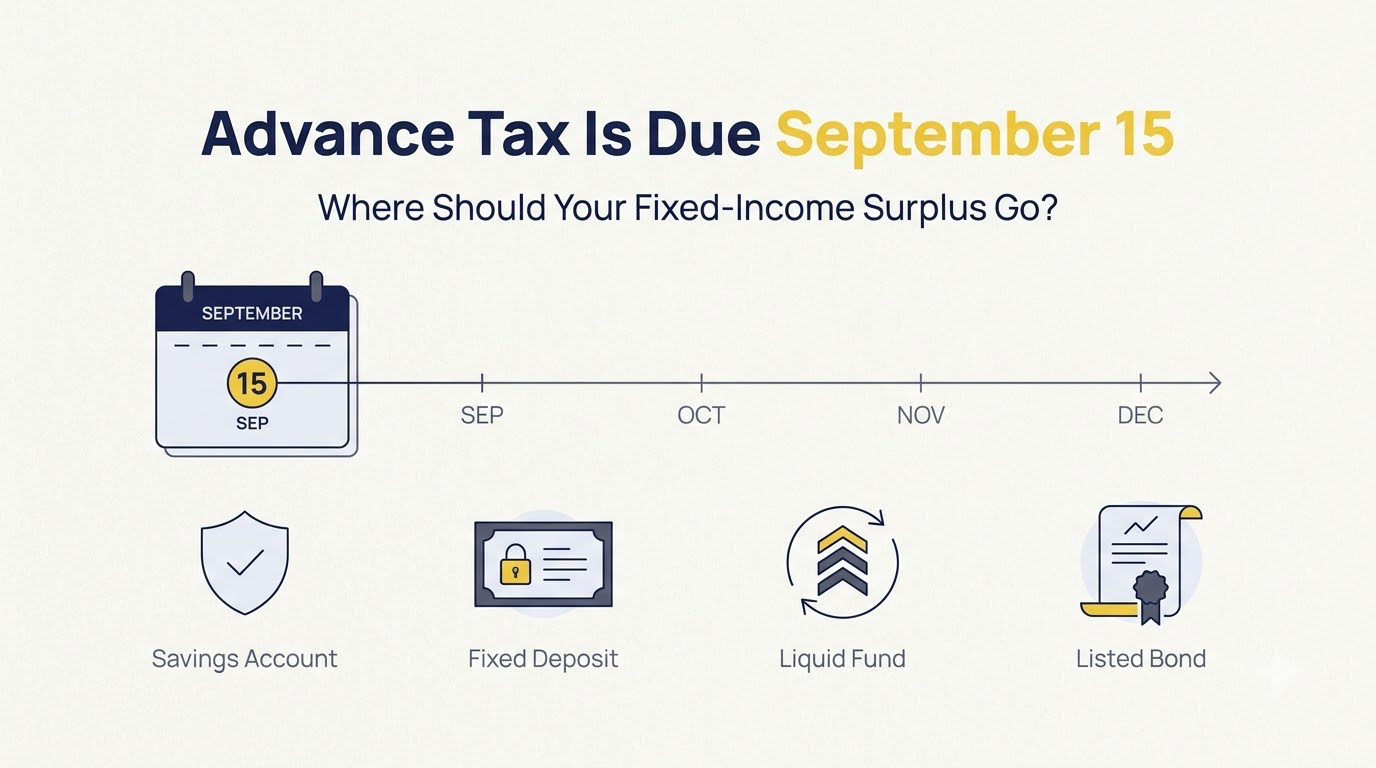


The second advance-tax instalment is due on September 15. For most taxpayers covered by the regular instalment schedule, the total advance tax paid by this date must reach at least 45% of the estimated annual advance-tax liability.
This is a cumulative target. Any advance tax paid by June 15 is counted towards the 45% requirement.
For individuals and businesses paying from an operating or savings account, the tax payment itself may be routine. The more easily overlooked question is what to do with the cash around it: money set aside early to ensure that the payment clears smoothly, and any balance left after the instalment is paid.
That surplus may not be required again until the next advance-tax instalment on December 15. This creates a horizon of approximately three months—short enough to prioritise capital preservation and access, but long enough to make the default parking choice worth reviewing.
Before moving the money, keep its purpose clear: this is money reserved for a near-term obligation, not long-term investment capital. The maturity or exit timeline of any selected product should therefore remain aligned with the date on which the cash may be needed.
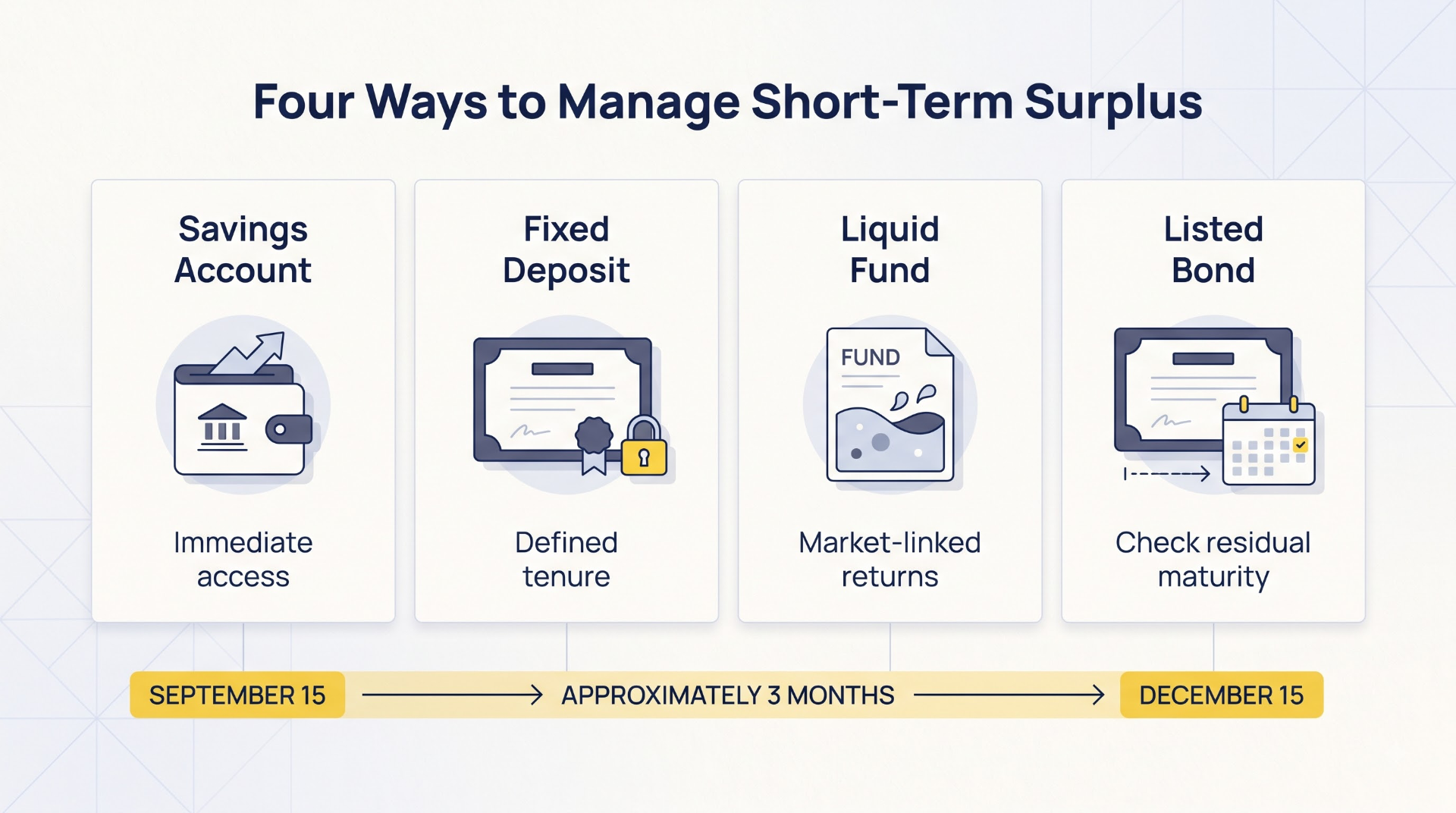
Where Short-Term Surplus Usually Goes
1. Savings Account
A savings account is often the first choice because access is immediate and there is no maturity commitment. That convenience can be valuable when the final payment amount or date may change.
The trade-off is that the interest rate may be lower than other short-term alternatives. If only part of the balance needs to remain instantly available, keeping the entire surplus in the same account may involve an opportunity cost.
2. Fixed Deposit
Fixed deposits are familiar, straightforward and offer a stated interest rate for a selected tenure. Eligible bank deposits are insured by the Deposit Insurance and Credit Guarantee Corporation, subject to the applicable limit and conditions.
The main consideration for a three-month requirement is premature withdrawal. If the cash is needed before maturity, the bank may apply a lower interest rate, a premature-closure penalty or both, according to its terms.
Compare the estimated post-tax return after accounting for premature-withdrawal conditions—not only the advertised interest rate.
3. Liquid or Ultra-Short-Duration Mutual Fund
Liquid and ultra-short-duration mutual funds are commonly considered for short-term cash management. They generally provide redemption access on business days, subject to the scheme’s cut-off times, settlement cycle, exit load and other applicable terms.
Their returns are market-linked and not fixed. Portfolio quality, maturity profile, interest-rate movements and credit events can affect performance.
Before investing, review the scheme’s riskometer, portfolio disclosures, expense ratio, settlement timeline and exit-load structure.
Listed Bonds as Another Option
A listed bond can also be evaluated for short-term surplus through a SEBI-registered Online Bond Platform Provider.
Such platforms may offer listed debt securities and facilitate transactions under the applicable stock exchange, clearing corporation and depository framework.
For money that may be required in December, the relevant comparison is generally not a newly issued long-tenure bond. It is a listed bond with a residual maturity close to the date on which the money will be needed.
Matching the residual tenure with the cash requirement can reduce dependence on finding a buyer in the secondary market before maturity.
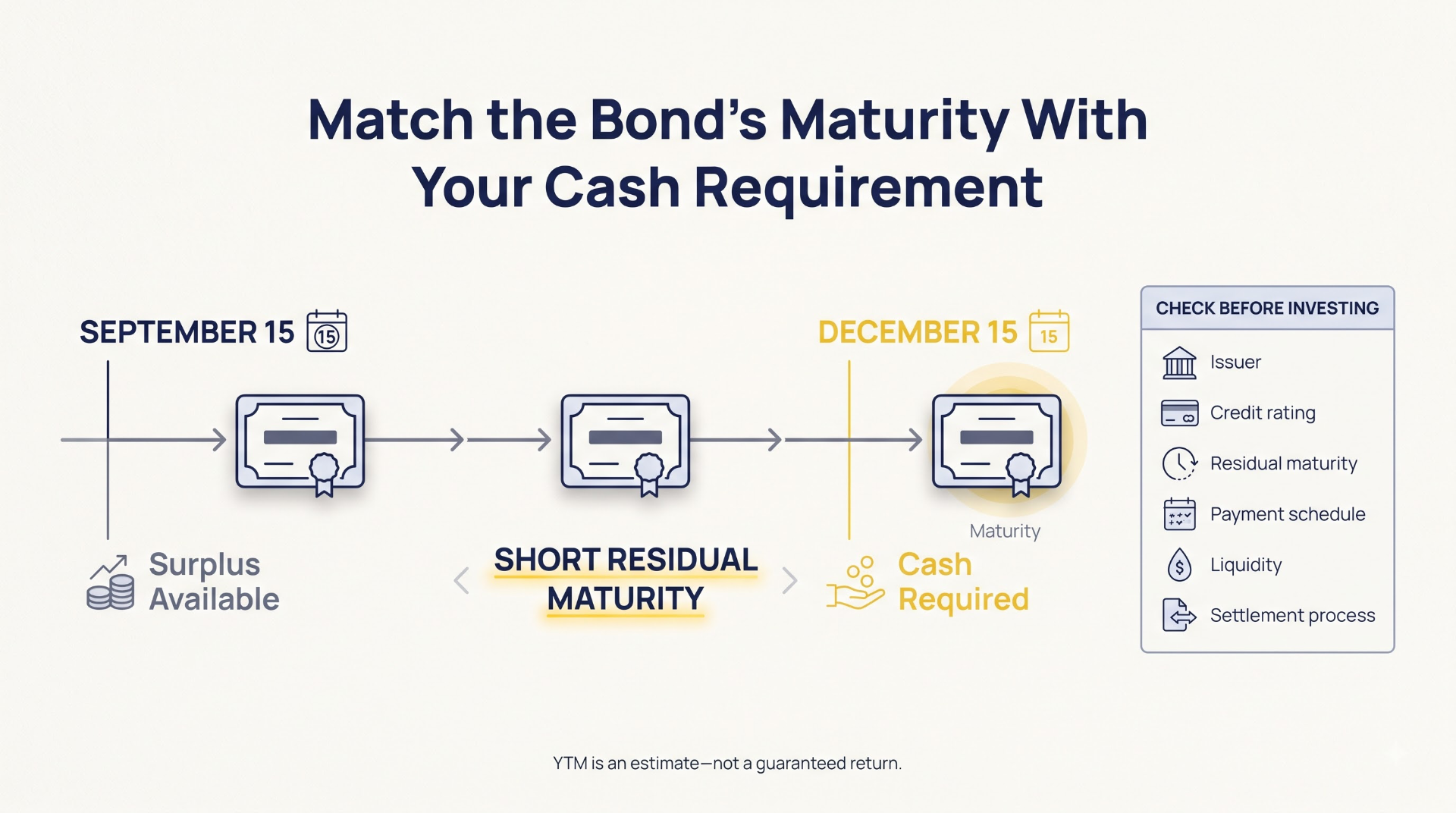
Listed bonds can offer visibility into the issuer, credit rating, coupon, maturity date, current market price and yield to maturity.
Important: Yield to maturity is an estimate based on the purchase price and promised cash flows. It is not a guaranteed return. The return ultimately realised depends on factors including timely payment by the issuer, the investor’s holding period, transaction price, applicable taxes and costs.
How Listed Bonds Differ From Fixed Deposits
Listed bonds differ from bank fixed deposits in several important ways:
- Listed bonds are not covered by deposit insurance.
- Their market price can change with interest rates, market liquidity and the issuer’s perceived creditworthiness.
- A quoted market price does not guarantee that a transaction will execute immediately at that price.
- Credit ratings represent an opinion on credit risk and do not guarantee repayment.
- Selling a bond before maturity may result in a capital gain or loss.
These risks do not automatically exclude listed bonds from consideration. They mean that the issuer, credit rating and rating rationale, residual maturity, payment schedule, security structure, liquidity, settlement process and product documents should be examined carefully before investing.
Compare Every Option on the Same Basis
For a short and clearly defined horizon, comparing only the displayed return can be misleading. Evaluate each option using the same decision filters.
- Required Date
Will the money become available before the next tax payment is due? - Capital Risk
Can the value decline, or can repayment be delayed? - Liquidity
How quickly can the investment be exited? Is the exit dependent on the availability of a buyer? - Early-Exit Cost
Does the product carry a premature-withdrawal penalty, exit load or possibility of a price loss? - Post-Tax Outcome
What is the estimated return after applicable tax and costs? - Operational Fit
What are the cut-off time, settlement cycle and fund-transfer process? - Documentation
Are the offer documents, rating rationale, portfolio details and risk disclosures available for review?
A Practical Way to Structure the Surplus
The entire balance does not have to be placed in one product.
A cash buffer for payment revisions, operating expenses or unexpected requirements can remain immediately accessible. Only the amount that is genuinely surplus should be evaluated for an alternative short-duration product.
The final decision may favour a savings account, fixed deposit, liquid fund or a short-residual-maturity listed bond.
The more important shift is to treat tax-season surplus as purpose-bound money with a known requirement date—not as idle cash, and not as capital available for unnecessary risk.
Key takeaway: With only approximately three months between the September and December instalments, liquidity and capital protection should lead the decision. Any possibility of earning an additional return should be evaluated only after these requirements have been satisfied.
Disclaimer: Equirize Securities Private Limited (ESPL) is a SEBI-registered Online Bond Platform Provider. Transactions in listed debt securities are undertaken under the applicable exchange, clearing corporation and depository framework.
This article is intended solely for general information and investor education. It does not constitute investment, tax or legal advice, or a recommendation or solicitation to buy or sell any security. Tax rules and their applicability may vary. Please consult a qualified tax adviser regarding your circumstances.
Fixed-income instruments, including listed bonds, are subject to credit risk, interest-rate risk, liquidity risk and market risk. Yield to maturity is based on the current market price and assumed cash flows and is not a guaranteed return. Credit ratings are opinions and not guarantees. Please read all issuer, rating and platform-related documents carefully before investing.